Goosebumps

Director: Rob Letterman (2016)

Magical mayhem materialises when book bound monsters come to life in this entertaining horror comedy.

It runs away at a decent pace, has fine performances from an attractive cast, isn’t short of laughs and tries hard to make you jump out of your seat.

The spooky fun is based on the massively popular Goosebumps books by R.L. Stine.

And as Stine says, it’s full of twists, turns, insights and some personal growth for the hero.

He appears as a character in the film and is played by Jack Black in one of his stronger performances.

Black abandons his frequently smug demeanour for a more acerbic and angry persona, and he’s all the more entertaining for it.

In a quiet suburb the reclusive Stine home-schools his teenage daughter Hannah, claiming it’s for her own protection.

A tentative romance begins when handsome high school student Zach Cooper moves in next door. Dylan Minnette and Odeya Rush share a sweet chemistry as they sneak out at night to an abandoned fair ground.

But Zach inadvertently unlocks one of Stine’s books, releasing an evil ventriloquist’s dummy, called Slappy, also voiced by Black.

The marvellously malevolent Slappy frees a multitude of fantastical fiends from Stine’s shelf of manuscripts and burns the volumes, preventing the creatures from being caged again.

The leaves the town at the mercy of aliens, zombies, killer clowns and in a spirited homage to the sci-fi monster movies of the 1950’s, a giant praying mantis.

Steven McQueen’s drive-in classic The Blob (1958) is also a key reference.

The film’s best scene is the emergence of the garden gnomes. It combines the comic violence of the job interview from The Full Monty (1997) and the creeping horror of the doll attack from Barbarella (1968).

Amanda Lund briefly steals the film as an overly enthusiastic police trainee and I wish we’d seen more of her.

The suitably scary score by Danny Elfman works hard to gloss over the less than groundbreaking special effects, which themselves are used to pad out at least a couple of scenes.

It’s probably too scary for very young kids. But everyone else, even big kids like me, are guaranteed the goosebumps of a good time.

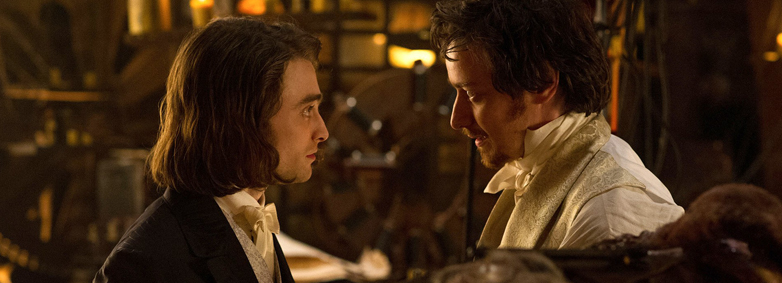
Victor Frankenstein

Director: Paul McGuigan (2015)

There’s magnetism a foot as the electric talent of James McAvoy and Daniel Radcliffe jolt Mary Shelley‘s gothic horror back into life.

This romping reinvention relocates the story to London and is told in flashback by Radcliffe’s hunchback Igor.

Lurching from action set piece to another, it has someone’s tongue stitched firmly in it’s cheek.

McAvoy gives a gleefully twitching turn as the mad scientist who wants to prove death is temporary by recycling dead bodies and applying shock treatment.

Recreated as a Victorian gentleman adventurer, he’s a monster mash-up of Robert Downey Jnr’s Sherlock Holmes (2009) and Hugh Jackman’s Van Helsing (2004).

Recognised as talented pair of hands, Igor is rescued from life as a brutalised circus clown by McAvoy’s mad medical student Frankenstein.

He’s the brains of the partnership with the choice cuts of dialogue, while Igor is the heart, feeding off the rump scraps of the script.

Soon the pair are in the laboratory and up to the elbows in blood and gore.

While Victor is working the graveyard shift cutting up cadavers to complete a creature, Igor and a trapeze artist called Lorelei practise making life the old fashioned way.

Better known as Lady Sybil from TV’s Downton Abbey, Jessica Brown Findlay role is only really required to add a pretty face to the bones of the action.

Unsurprisingly the finale involves a castle, a reconstructed cadaver and a lightning storm.

If it’s not quite the exquisite show of depraved lunacy a bystander claims he hopes to see, Victor Frankenstein does manage to be energetic and knowingly silly.

Crimson Peak

Director: Guillermo del Toro (2015)

This lavishly stylised and violent fairytale splashes around buckets of blood but is sadly anaemic.

Inspired by the Hammer House of Horror films, the period sets and costumes are fantastic though the story is predictable and lacks bite.

It begins as a sumptuous and intriguing gothic romance bubbling with ideas, filtered through the director’s usual motifs of steampunk contraptions and ladies of letters.

But once the story leads to bleak estate in the north of England where red clay oozes from the mansion’s every pore, proceedings become bogged down in sticky CGI.

There’s a workshop in the tower, many doors are locked and Edith is warned not to go down to the cellar.

it all sadly ends with all the suspense of a steroid-filled episode of Scooby Doo. But without any of the fun.

Talented Mia Wasikowska is at her insipid worst as young heiress Edith Cushing who follows her new husband Sir Thomas Sharpe to his crumbling gothic pile.

The baronet is pallid, impoverished and played in impeccable black by the devilishly charming Tom Hiddleston.

The pair played vampiric siblings in the superior Only Lovers Left Alive (2013) in which they vividly essayed far more interesting characters.

Here Jessica Chastain plays Hiddleston’s screen sister who keeps her brother’s best interests close to her heart. With barking intense piano playing and a choice wardrobe, she dominates her every scene.

An anonymous Charlie Hunnam plays a lovelorn ophthalmologist left looking for clues, probably as to where any sense of mystery or danger is.

The Messenger

Director: David Blair (2015)

 Scruffy, sarcastic, and self-medicating with alcohol, Jack is not always welcome at the funerals he gatecrashers.

At the behest of the bothersome ghosts he conveys messages from the deceased to the bereaved.

We see his troubled life in flashback as the scripts toys with whether his powers are really the manifestation of mental illness.

In a dubious subplot featuring no surprises, a dead journalist is badgering Jack to visit his TV presenter girlfriend.

Robert Sheehan is nicely abrasive as he manfully holds the film together.

Former model Lily Cole offers sympathy as Jack’s sister and Joely Richardson appears as a psychiatrist.

There’s nice location work but the script is uncertain and the ghost of Bruce Willis in The Sixth Sense haunts throughout.

The Visit

Director: M. Night Shyamalan (2015)

You’d best pretend to be out when this confused comedy horror calls round for tea.

It’s an inconsistent, dull and exploitative example of the over-used found footage format.

When a single mother Kathryn Hahn heads off on a weeks holiday cruise with her boyfriend, she packs her kids off to their grandparents whom they’ve never met.

Played with by Olivia De Jonge and Ed Oxenbould the young pair are as un-endearing a pair of teenagers as you could possibly hope to avoid.

Rebecca is a fifteen year old budding documentary maker. Her high minded if half hearted attempts to deconstruct cinematic technique has no bearing on proceedings.

The germaphobic Tyler raps on demand.

Pop-pop and Nanna live in a creaking farmhouse miles from everywhere. The kids are banned from the cellar.

Despite the vomiting, nudity and scratching at the walls, They’re never too scared to pick up their cameras.

Most frightening is the Frankensteins’ monster of a script, stitched together to form an incoherent whole, lurching in tone from scene to scene.

The Visit is broadly sympathetic to dementia sufferers but happy to mock the criminally insane; a contradictory position which it never attempts to reconcile or even seems to be aware of.

It seems as if Shyamalan wrote a script based on the idea the effects of mental illness may appear to others as disturbing and horrific.

Then the producers Blumhouse wandered in and said we’ll give you the cash to make the movie but only if you give us a cheap, tawdry and predictable third act.

The Human Centipede 3 (Final Sequence)

Director: Tom Six (2015)

This prison-based satirical surgical horror sequel is far too disgusting to swallow or stomach.

With it’s gleefully graphic and provocative portrayal of rape, castration and torture, it’s twisted, disgusting and obscenely offensive in every scene.

Despite his brutal methods of discipline, demented prison warden Bill Boss (Dieter Laser) struggles to control the inmates.

Due to impending election, State Governor Hughes (Eric Roberts) demands a drop in the violent incidents.

Instigating medieval torture is rejected as not effective – or cost efficient or possibly too lenient.

Inspired by the DVD copies of the first two movies -The Human Centipede (First Sequence) (2009), The Human Centipede 2 (Full Sequence) (2011) – his assistant Dwight Butler (Laurence R. Harvey) suggests the prisoners are stitched together mouth to anus to form a giant human centipede.

Offering a manic commitment to his role, Laser delivers an eye-popping and vein-bulging performance.

Former porn star Bree Olson appears as abused secretary Daisy and the Dutch director Tom Six appears as himself.

Both Laser and Harvey have starred in previous entries as the main antagonists, Dr. Josef Heiter and Martin respectively.

The half-hearted attempts at satirising the US penal system are swamped by the filmmaker’s desire to shock and sicken.

Bill Boss is described as sadistic and vile – a knowingly apt description for the film.

Spring

Director: Justin Benson and Aaron Moorhead (2015)

A young American suffers the holiday romance from hell in this seductive supernatural shocker.

Having lost his mother and his job and finding himself wanted by the police, Californian cook Evan (Lou Taylor Pucci) high-tails to Italy to sort his head out.

Having hooked up with foul-mouthed Brits Tom and Sam (Nick Nevern, Jonathan Silvestri) Evan accompanies them on a road trip to the beautiful port of Bari.

Once there Evan is picked up in a bar by a raven-haired beauty in a startling red dress. She says she’s called Louise (Nadia Hilker).

She’s a forthright and well-travelled genealogy student who has a secret skin-care regime and may be lying about her age. Louise is also averse to having her photograph taken and says she tries to be vegetarian.

Evan is smitten and as his Brit friends disappear to Amsterdam, he takes a labouring job on a farm in order to stay close to the enigmatic Louise.

His boss is taciturn widower Angelo (Francesco Carnelutti) whose melancholic devotion to his crops adds depth to the slowly gestating romantic tone.

Evan tries to woo Louise with dinner dates, boat trips and museum visits. Together they’re charming and funny and we want them break through the emotional barriers keeping them apart.

Unknown to Evan, Louise suffers a condition and it’s getting worse. Macabre tones twist up through the romance as maggots, insects and snakes begin to intrude.

For reasons which become horribly clear, Louise enjoys unprotected sex and there are discarded needles on her bathroom floor.

We appreciate the danger Evan is in long before he does and the fate of their relationship is dependent on the arrival of the imminent spring equinox.

Inventive, intriguing and gently hallucinogenic, Spring benefits from deliciously visceral physical effects, a confident and precisely constructed script and two likeable leads who share an engaging chemistry.

Their deadpan banter is cut from a similar vein to the horror classic An American Werewolf In London (1981) – but also sweet and tart like the fruit of Angelo’s grove.

Co-director Benson wrote the script and his partner Moorhead acted as cinematographer. Both are in healthy command of their respective disciplines and combine to create a film substantially more than the sum of its low budget parts.

Moorhead’s camerawork is fluid and controls the rhythms of the story, contributing to the sly and slightly trippy tone. He makes the old town quarter of Bari look fabulous, as much a character as Vienna was in Don’t Look Now (1973).

The romantic touchstones would be Richard Linklater’s Before Sunrise (1995) and of course F.W. Murnau’s masterpiece Sunrise: A Song Of Two Humans (1927).

With it’s expertly mixed combination of horror, comedy and romance, Spring is a smart, enjoyable and accomplished addition to the cinema of 2015.

What We Do In The Shadows

Director: Taika Waititi & Jemaine Clement (2015)

This dead-pan mockumentary about flat-sharing vampires lacks sufficient bite to be funny.

Offering low-key, bone-dry humour, this undead oddity struggles to come to life and struggles with weak plotting and indulgent pacing.

It feels more like a series of thin sketches strung together than a fully realised feature film and it’s no surprise to learn it was based on a short film made by the same team.

Four vampires of varying age share a house. Viago (Taika Waititi) is a 317 year old Georgian dandy who organises the house. Vladislav (Jemaine Clement) is 862 and a medieval vampire in the Turk-skewering tradition. Petyr (Ben Fransham) is an 8,000 year old Nosfertu type who lurks rat-like and unspeaking in the cellar. Deacon (Jonathan Brugh) is a former travelling salesman who was turned by Petyr and a relatively youthful 183.

Viago’s faithful familiar (servant) Jackie (Jackie Van Beek) is increasingly disillusioned at her prospects of ever being turned into a vampire and is incensed when her dinner guest Nick (Cori Gonzalez-Macue) jumps the queue. He slowly learns life as a bloodsucker isn’t as much fun as he first imagined.

Zombies and werewolves all appear at the Unholy Masquerade, an undead ball where Vladislav confronts his nemesis he refers to as The Beast.

Strip aside the vampires stylings and what’s left are some humdrum observations about four mundane middle-aged blokes sharing a house in genteel poverty and struggling to adjust to a changing world. Their vampire problems don’t inform their contemporary concerns or vice versa.

Jokes rely on mastering the internet and name-checking movies The Lost Boys, the Twilight franchise and Blade. They seek far too much comedy mileage out of unresolved domestic squabbles such as whose turn is it to do the washing up.

The strongest aspect of the production is the design by Ra Vincent whose shabby drawing room chic is complemented by deeply textured interior lighting by cinematographers Richard Bluck and D.J. Stipsen.

The use of shaky cam is unavoidable, the flying stunts are nicely realised and old-school blood splurts are enjoyably silly.

Writer-directors-actors Taika Waititi and Jemaine Clement are both connected to The Flight of the Conchords. Completists of their work may be keen to see this but everyone else may decide to opt for a wooden stake through the heart instead.

It Follows

Director:  David Robert Mitchell (2015)

The sex life of a young girl returns to haunt her in this teen queen scream horror show.

Employing intelligence, tremendous technique and a great central performance, this is an original, nerve-rippingly tense and supremely scary shocker.

Jay (Maika Monroe) is attacked by kind-of-boyfriend Hugh (Jake Weary) after sex in the car. She wakes to find herself strapped into a chair in an abandoned carpark.

As a naked woman slowly walks towards them, Hugh explains he has passed a curse onto Jay.

Unless she can pass the curse on through sex to someone else, she will be stalked forever by the monster – the It – until she’s caught and killed. When she’s dead the monster will move back down the line to Hugh and kill him and so on.

The relentless, slow moving It always takes on the form of a loved one and is disturbingly effective as it lumbers after Jay

Armed only with a conscience Jay shies away from what she sees as nuclear option of making others a victim to save herself. Her sister Kelly (Lili Sepe) and friends Paul, Yara and Greg (Keir Gilchrist, Olivia Luccardi and Daniel Zovatto) rally to help.

Everything is played at face value and is more involving for it. There’s no comedic meta banter about how teenagers behave in horror films.

Up to the point when Jay’s willpower breaks there’s intrigue in guessing who her choice will fall on. The film is canny enough to suggest she pays an emotional price for her behaviour.

Cinematographer Mike Gioulakis carefully controlled camera is often stationary but will occasionally turn in hypnotic loops. The editing by Julio Perez IV is equally seductive.

Set in Detroit, the decaying city is a major character, suggestive of an Eden destroyed. After a few days hiding, their shared bedroom begins to resemble a drug-ridden squat.

The first house we see is number 1492, linking the history of America with sex, violence and death.

Although set in contemporary USA, the production design is rooted in the past with cathode ray TV’s, clamshell phones and classic films playing at the cinema. There is too much stonewashed denim.

Sparse dialogue is punctuated by a thunderous industrial synth soundtrack that belongs in the 1980’s, strengthening the It as an AIDS metaphor. But there’s no heavy-handed message to interrupt the assured and creepy storytelling.