The Danish Girl

Director: Tom Hooper (2016)

Oscar winner Eddie Redmayne aims for more Academy gold as a transgender artist in this period drama.

As in The Theory Of Everything (2015) where he played scientist Stephen Hawking, the British actor gives a committed performance as Einar Wegener.

However he is outshone by Swedish co-star Alicia Vikander as his on-screen wife Gerda who offers strong marital support.

She acts with her eyes and he with his mouth. Some of his alarming lip quivering reminds us of his space camp turn in the terrible Jupiter Ascending (2015).

Gorgeous costumes, polished interiors and fresh exterior locations give Copenhagen of 1926 a living, picturesque appeal.

But it’s suffocatingly sincere and suffers from banal dialogue and a lack of conflict.

Plus director Tom Hooper inflicts on us the same close ups and curious framing which marred his films The King’s Speech (2011) and Les Miserable (2013).

Gerda producers portraits and wears the trousers while Einar paints landscapes and discovers he enjoys wearing frocks.

As he discovers himself more comfortable in women’s clothes than men’s, Einar adopts the alter ego of ‘Lili’.

Gradually she becomes his dominant personality and seeks to make a permanent transformation to womanhood.

Redmayne is a pretty boy in real life but no great beauty as a woman, especially when stood between to his gorgeous on-screen wife and her ballerina best mate Oola, played by Amber Heard.

Lili’s selfish behaviour fails to garner much sympathy and nor does she meet much resistant to her life choices. Society is indifferent to Lili’s plight. So was I.


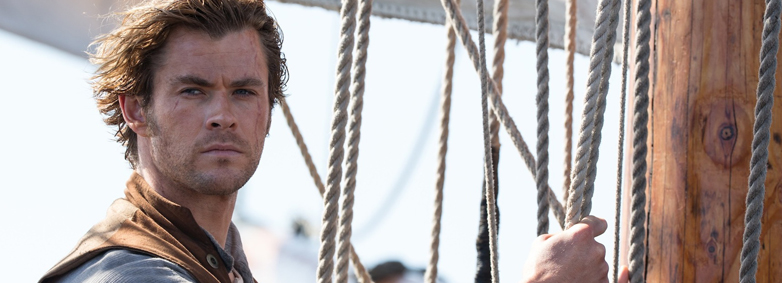
In The Heart Of The Sea

Director: Ron Howard (2015)

It’s all hands on deck for an epic old fashioned adventure on the high seas.

Based on the events which inspired Herman Melville‘s classic novel Moby Dick, it’s a shipshape and manly yarn full of arrogance, greed and danger.

The story is anchored by the reliable talents of Ben Whishaw and Brendan Gleeson as novelist Melville and drunken old sea-dog Thomas Nickerson.

One dark night in 1850, Melville pays Nickerson to tell the truth behind the voyage of the whaling ship The Essex, on which he served on as a cabin boy thirty years earlier.

Whaling is a dangerous and potentially lucrative industry, harvesting the seas for oil to serve America’s fast growing population.

Back then Nickerson was in the charge of Owen Chase, an experienced first mate, played with manly gusto by Chris Hemsworth.

The star of Marvel’s Thor always gives good smoulder and here he glowers with resentment.

Impoverished and eager to provide for his pregnant wife, Chase’s ambitions to captain his own ship are thwarted by the shipping company directors.

They make him serve under Benjamin Walker’s novice Captain Pollard, the privileged son of an important investor.

Lashed together in mutual antipathy and greed, they sail from Nantucket round Cape Horn to the Pacific ocean.

The scenes where the crew row out in tiny boats to manually harpoon their enormous prey are terrific.

But the increasingly desperate hunt for whales goes awry with the crew facing fires, storms, mutiny and of course a very angry white whale.

The heart of the sea becomes a very dark place indeed as despair and madness grip the sailors.

Following Rush (2013) the biopic of motor racing star James Hunt, this is the second film Ron Howard has made with Hemsworth.

Exciting, intelligent and respectful to it’s source In The Heart Of The Sea is the sort of film Hollywood is now accused of not making any more.

Well now they have so you really should go and see it.


The Hateful Eight

Director: Quentin Tarantino (2016)

Quentin Tarantino’s new western is a slow burning fistful of cinematic dynamite which explodes all over the screen.

In a set up surprisingly reminiscent of Agatha Christie, eight hateful desperadoes are brought together one night by a Wyoming blizzard.

The discovery of loose connections leads to the opportunity to settle old scores and much bloodshed.

It’s a major work from an important director and a minor masterpiece of the genre.

Building on the strengths of Django Unchained (2013), Tarantino’s burgeoning maturity after a mid career slump of Kill Bill 2 (2004) and Death Proof (2007) suggests the mouthwatering prospect his best work is yet to come.

The Hateful Eight (2016) is proclaimed as Tarantino’s 8th film. With one eye on his legacy the 52 year old director recently speculated he would only make 10 movies, adding he felt he would never dominate the Academy Awards with multiple wins for a single film.

His current upward trajectory suggests his tenth and possibly final film could easily sweep the Oscars board.

In any circumstances I very much doubt Tarantino will go quietly into the cinematic night of his own accord.

With two consecutive westerns under his gun belt, Tarantino seems to have found his meter in the genre, itself the great American art form.

His previous best work was Jackie Brown (1997) based on the novel Rum Punch (pub. 1992) by Elmore Leonard.

The inestimable crime writer produced a raft of novels, many of which ended up on screen. Notable examples are Hombre (1967) Get Shorty (1995) and Out of Sight (1998).

However he began his career as a prodigious writer of pulp westerns. Three-Ten To Yuma (pub. 1953) was filmed in 1957 as 3:10 To Yuma starring Glenn Ford and Van Heflin, and filmed again in 2007 with Christian Bale and Russell Crowe.

Should Tarantino feel the need for inspiration he could do worse than tackle another of Leonard’s many works.

Until then we have The Hateful Eight which as rich in character and performance as any movie Tarantino has made thus far.

The former enfant terrible of Indie cinema takes a more mature and traditional approach.

He throws out the pop cultural references in favour of discussions on justice and the morality of the civil war.

Also out are the eclectic rock soundtrack and in comes a score by the maestro of spaghetti westerns, Ennio Morricone.

As good as it is, it’s no disservice to suggest it’s not the greatest work from the composer of the score for The Good, The Bad and the Ugly, among many others.

And it’s worth the entrance fee to be able to savour it on a cinema sound system.

A majestic opening shot features a vast snow-filled plain with a stagecoach driving past a frozen crucifix.

This elegant, eloquent statement of intent gives an icy indication of the grand guignol the passengers are heading towards.

This is cinematographer Robert Richardson’s 5th Tarantino movie after Django Unchained (2013), Inglourious Basterds (2009) Kill Bill 2 (2004) and Kill Bill (2003).

His ridiculously impressive CV includes 6 Scorsese films, 9 by Oliver Stone and works by Robert Redford, Barry Levinson and Robert Reiner.

Plus he’s one of only two living persons to win 3 Oscars for his craft. There’s another 5 nominations in there as well.

Colorado stands in for Wyoming and camera movement is kept to practical minimum while capturing the magnificent icy vistas.

Once inside in the relative warmth, Richardson’s camera glides about the confined space to skilfully illuminate the dialogue.

Even with 2 screenplay winning Oscars from 3 nominations, his sharp wordcraft is among the best Tarantino has written, it’s no wonder actors return to work for him time and again.

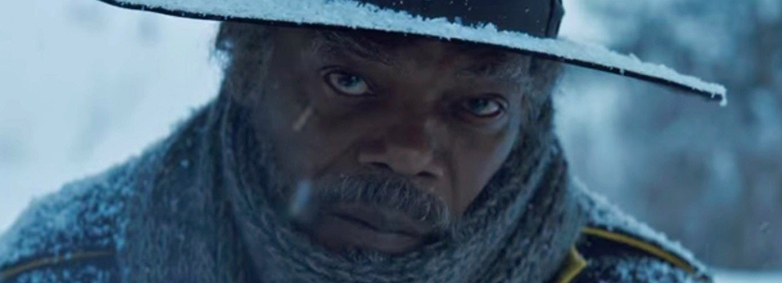
Heading what is now practically of troupe of Tarantino regulars, Samuel L. Jackson plays Major Warren, a former Union soldier turned bounty hunter.

Our first encounter him reprises the entrance of John Wayne in John Ford’s Stagecoach (1939).

Other visual influences are Sam Peckinpah’s The Wild Bunch (1969) and Robert Altman’s McCabe And Mrs Miller (1971).

With his frozen bounty in tow Warren hitches a ride on a private stage hired Kurt Russell’s bounty hunter, known as The Hangman.

It’s always great to see Russell in anything  and seeing him in wrapped up in a blizzard raises pleasant memories of John Carpenter’s sci-fi chiller The Thing (1982).

The Hangman is transporting outlaw Daisy Domergue to the town of Red Rock to be hung. Jennifer Jason Leigh brings a fierce humour to her demented portrayal.

Her heavily bruised eye resembles the stylised look of Alex from Kubrick’s A Clockwork Orange (1971), and suggests some impending ultra violence.

Vying with Leigh as the most valuable player in the uniformly excellent cast is Walton Goggins. He plays a racist former confederate soldier called Chris Mannix.

Other returning Tarantino regulars include Michael Madsen, Zoe Bell and Tim Roth channelling Terry-Thomas.

Caught up in a blinding snowstorm the travellers reluctantly take refuge together in an isolated holding post where other guests are warming themselves.

This fraught atmosphere demonstrates Tarantino’s ability to and it frequently wrong foots us in our expectations of where the story is going.

All the characters have nicknames referring to their status, The Prisoner, The Sheriff and so on.

When doubt is shed on their self-declared personal narratives, this remove from their professed identities adds layers to the slowly building snow drifts of lies, fear and mistrust.

As we’ve come to expect from Tarantino, there is a non-linear narrative. This gives a greater opportunity for character development than a more straightforward approach to structure would allow.

There’s a crude and confrontational tale Major Warren tells Bruce Dern’s aged General and some may feel this scene is evidence the director hasn’t yet shaken off his juvenile sense of humour.

However it serves a narrative purpose and there’s a sense Tarantino can’t resist baiting his film with poisoned morsels for unwary detractors.

Domergue suffers repeated physical abuse. It’s not the violence itself which worries, that can be justified by the milieu and far worse treatment is meted out to women in the westerns of Leone and Eastwood.

What’s problematic about this violence is its use as a literal punchline. The abuse of a captive woman, the only female character of note, is intentionally used to draw laughs from the audience.

The defence could reasonably claim more and greater violence is trespassed against other characters and done in an equally intentionally comic and more grisly manner.

Plus her tolerance for pain and patience for revenge tells us a great deal about her character.

Production of The Hateful Eight ran parallel to the Leonardo DiCaprio vehicle The Revenant (2016).

Although superficially similar in their brutal nature and western setting, the two frozen features are very different beasts except in the extremes of their ambition.

With The Hateful Eight distributor Harvey Weinstein stealing a commercial march by opening in the UK a week earlier, it’s doubtful a mass UK audience could stomach two similar seeming films in quick succession.

With this in mind I expect The Hateful Eight to win at the box office but The Revenant to win bigger at the Oscars.


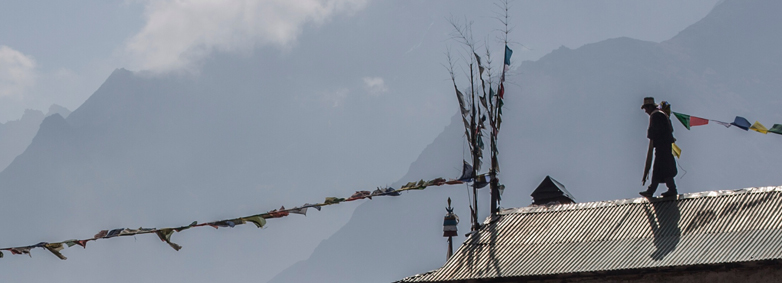
Sherpa

Director: Jennifer Peedom (2015)

Money, militancy and mountaineering on Mount Everest cause an avalanche of unrest in this refreshing documentary.

Told with an icy clarity and crystal clear cinematography, it’s a Sherpa’s eye view of an ill fated expedition in 2014.

Sherpas are used by wealthy Western tourists as pack horses to transport the necessary equipment from successive camps up the mountain.

What is a monumental ego trip for wealthy foreigners is an economic imperative for the local population. It’s also a major revenue stream for the Nepalese government.

An exploration of how the mountaineering industry has long marginalising the Sherpa’s achievements in favour of Western climbers provides a foothold for the thrust of the story.

The brief two month season when a summit is achievable sees TV and film crews jostle for space in human traffic jams on the mountainside.

When major fatalities occur, the Sherpas refuse to continue to facilitate the climb, putting the entire lucrative summit season at risk.

Everest is a place of holy significance to the Nepalese and they have no wish to dishonour the dead by climbing over the frozen bodies or further put their lives in danger.

Bullying, lies and misinformation swirl around the camp as a government delegation fly in to pacify the angry workers, frustrated tour operators and petulant climbers.

Sherpa would make an interesting double bill with the excellent You’ve Been Trumped (2011). It’s a fascinating account of how the Scots government allowed the US billionaire Donald Trump to bulldoze areas of outstanding natural beauty to build golf courses.

They share stories of bullish foreign money and a compliant government marginalising its own citizens to exploit precious natural resources.

While holding union meetings on the vertiginous heights, the Sherpas achieve a greater perspective on life than their over-privileged and arrogant employers.


The Revenant

Director: Alejandro G. Inarritu (2016)

Gripping, grisly and grizzly, this epic revenge western is the first must see film of 2016.

Leonardo DiCaprio goes hunting for the best actor Oscar in this thrilling and icily apocalyptic adventure.

Despite his best efforts, notably his portrayal of a ravenous financier in The Wolf of Wall Street (2014), the Academy award has so far eluded him.

But on this form as fur trapper and explorer Hugh Glass, there’s every chance he’ll bag it.

While on an expedition in the uncharted Northern frontier, Glass is brutally mauled by a bear.

I could barely endure the ferocious scene as the angry beast tears away at Glass with it’s hot breath steaming the camera lens.

He just about survives only to see his son murdered and find himself abandoned.

Driven by his pain and suffering Glass begins a 200 mile odyssey across the wild, wild west, intent on killing the man who betrayed him.

On the lonesome trail Glass endures being washed away, buried alive, burned and stabbed.

There’s visceral violence and dialogue as sparse and unforgiving as the environment.

For those who aren’t convinced by DiCaprio’s acting ability, they should see how much he conveys here while speaking very little.

Meanwhile as an old native American leads a war party in search of his missing daughter, a party of French hunters are wreaking destruction across the landscape and complicating Glass’ progress.

A huddle of orphaned children, murdered sons, forgotten wives and rich fathers are offered as a limited backstory for various characters, tying them together in a litany of loss.

With long stretches of screen time dialogue free, character is conveyed though action. The principals are aware of the conflicts in the damnable choices they face.

A trio of British actors offer brilliant support to DiCaprio.

With Mad Max: Fury Road (2015), Legend (2015) and Locke (2014) Tom Hardy is enjoying a great run of projects.

He plays the pipe smoking trapper Fitzgerald, a vicious pragmatist rather than evil incarnate.

Even more blessed with an uncanny knack of choosing great projects is the likeable, versatile and always interesting Domhnall Gleeson.

He comes of age as Captain Henry, the leader of the hunting expedition who is out of his depth.

Will Poulter is Jim Bridger, the youngest of the troop and arguably the closest it carries to a conscience.

Editor Stephen Mirrione previously worked on Birdman (2015) and won an Oscar for Steven Soderbergh’s Traffic (2000).

His signature long edits create an intensive immediacy and putting us uncomfortably in the centre of the action.

Cinematography Emmanuel Lubezki won consecutive Oscars for Gravity (2014) and Birdman (2015) and may well earn a third here.

Director Inarritu won best film, director and screenplay Oscars for Birdman (2015) and it would it not be undeserved if he repeated the trick in 2016, though in the adapted screenplay not original screenplay category as in Birdman (2015).

As in Birdman (2015) Lubezki’s ceaselessly circling camera work puts us in the middle of the action whether on horseback, on boats or underwater.

We witness an avalanche, rape, castration, shoot outs, knife fights, a hanging, a massacre and the aftermath of several more.

The landscape is alive with moose, wolves, horses, fish, buffalo and ants, demonstrating how ill geared humanity is to surviving in this fierce winter wonderland.

Set in Wyoming the production went snow chasing through Canada, the United States and Argentina to achieve the frostbitten extremes of the American frontier.

Grounded in fire, rock and ice, the elemental force of the film is captured in blues,whites and greys, with explosive moments of orange punctuating the palette.

Visual reference points are Robert Altman’s McCabe And Mrs Miller (1971) and Werner Herzog’s Aguirre: Wrath of God (1972).

Thematically the story draws on Ridley Scott’s Gladiator (2000) and John Ford’s The Searchers (1956). It is based on Michael Punke’s 2002 novel of the same name inspired by the exploits of the real Hugh Glass.

Ideas of commerce and colonisation swirl around the contemporary issues of the ownership of natural resources, the conflict between races and the role of the military in a civil society.

The Revenant means ‘the returned’ and refers to a person who comes back from the dead.

It sounds like a combination of ‘revenge’ and ‘covenant’, god’s code of behaviour issued to Moses in the Old Testament.

These two ideas compete within Glass for supremacy as he battles towards his prey.

Glimpses of Glass’ late wife through fragments of memories remind us of his spirituality even as he symbolically swathes himself in bearskin.

Eating its flesh shows his growing connection with the environment but also suggests a departure from the rational to an animal state.

In fables there is always a limit to how long one can adopt the shape of another creature before losing one’s humanity for ever.

Glass’ quest for revenge becomes a battle for his soul from which he may never recover.

A chilling final frame questions the audience as to how they would behave in Glass’ circumstances. It’s an electrifying end to a remarkably realised endeavour.

@ChrisHunneysett

Hector

Director: Jake Gavin (2015)

A homeless pensioner begins a long road to self forgiveness and redemption in this touching British drama.

The always watchable Peter Mullan is once again excellent in the title role.

Hector has been gentleman of the road for fifteen years and though in poor health and history of mental illness, he lacks self pity and  retains a welcome Scots wit.

A chance meeting in Glasgow sets Hector off to Newcastle and London in search of his estranged family.

Britain is a bleak landscape of rain lashed service stations and shuttered shopfronts.

He is mugged and accused of theft but also receives small unexpected kindnesses. Each makes a mockery of the tatty commercialisation of Christmas littering the country.

In a test of faith loaded with potential for disaster, Hector frequently asks strangers to mind his suitcase.

This sense of trust in his fellow man makes us warm to him.

Though with his portly frame, white beard and orange hi vis coat, Hector’s the spirit of Christmas present no one wants a visit from.

When we discover his reason for his homelessness, this suitcase he drags around takes on a meaning worthy of Dickens’ A Christmas Carol (pub. 1843).

There’s strong support from Gina McKee and Ewan Stewart as his siblings who retain issues with each other while Stephen Tompkinson swears enjoyably as a cash conscious car dealer.

Without preaching the script gently reminds us of the need for compassion and charity, filling Hector with an abundance of festive spirit and warmth.

Merry Christmas.

By The Sea

Director: Angelina Jolie Pitt (2015)

With bickering, boozing and bust ups, life’s far from a beach in this exasperating period drama.

Written and directed by Jolie Pitt, it’s a moody, beautiful and sincere exploration of grief and love.

It’s also seriously dull and a far cry in tone and scale from her last directorial effort, the entertaining second world war action epic Unbroken (2014).

Jolie Pitt’s ambition to stretch her range is admirable and she’s crafted a well acted movie with a consistent tone.

She co-stars with real life hubby Brad Pitt as an unhappily married couple holidaying in the south of France.

But Jolie’s writing strands them both with unappealing characters and some awful dialogue.

Vanessa is a pathetic, self-pitying and pill popping former dancer.

Roland’s a hard drinking chain smoking novelist who seems to model himself on Ernest Hemingway.

They’re nursing an unspoken grief the eventual revelation of which is predictable and a very long time coming.

Their strained relationship changes when passionate young newlyweds check into the hotel suite next door.

They’re played by the beautiful and frequently naked pair of Melvil Poupaud and Melanie Laurent.

What  follows is sunbathing and shopping as well a lot of voyeurism and a little violence.

There’s a vague sense of By The Sea being a thriller without a crime or a heist without a con.

It could be set in any time or place and still achieve the lavish levels of dramatic inertia.

Malta stands in for Cote D’Azur and is suitably ravishing while the1973 setting allows for extremely glamorous clothes and cars.

Brad sports some fabulous looking flannel which is exactly what this film amounts to.

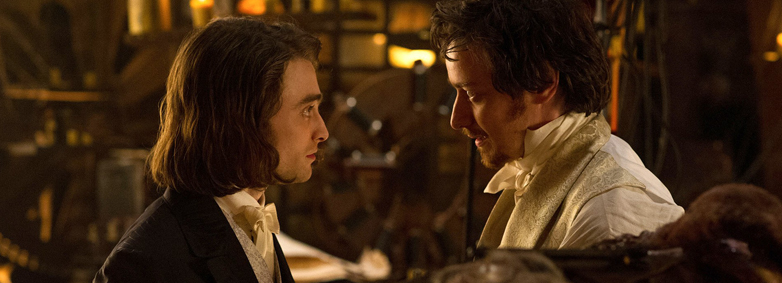
Victor Frankenstein

Director: Paul McGuigan (2015)

There’s magnetism a foot as the electric talent of James McAvoy and Daniel Radcliffe jolt Mary Shelley‘s gothic horror back into life.

This romping reinvention relocates the story to London and is told in flashback by Radcliffe’s hunchback Igor.

Lurching from action set piece to another, it has someone’s tongue stitched firmly in it’s cheek.

McAvoy gives a gleefully twitching turn as the mad scientist who wants to prove death is temporary by recycling dead bodies and applying shock treatment.

Recreated as a Victorian gentleman adventurer, he’s a monster mash-up of Robert Downey Jnr’s Sherlock Holmes (2009) and Hugh Jackman’s Van Helsing (2004).

Recognised as talented pair of hands, Igor is rescued from life as a brutalised circus clown by McAvoy’s mad medical student Frankenstein.

He’s the brains of the partnership with the choice cuts of dialogue, while Igor is the heart, feeding off the rump scraps of the script.

Soon the pair are in the laboratory and up to the elbows in blood and gore.

While Victor is working the graveyard shift cutting up cadavers to complete a creature, Igor and a trapeze artist called Lorelei practise making life the old fashioned way.

Better known as Lady Sybil from TV’s Downton Abbey, Jessica Brown Findlay role is only really required to add a pretty face to the bones of the action.

Unsurprisingly the finale involves a castle, a reconstructed cadaver and a lightning storm.

If it’s not quite the exquisite show of depraved lunacy a bystander claims he hopes to see, Victor Frankenstein does manage to be energetic and knowingly silly.

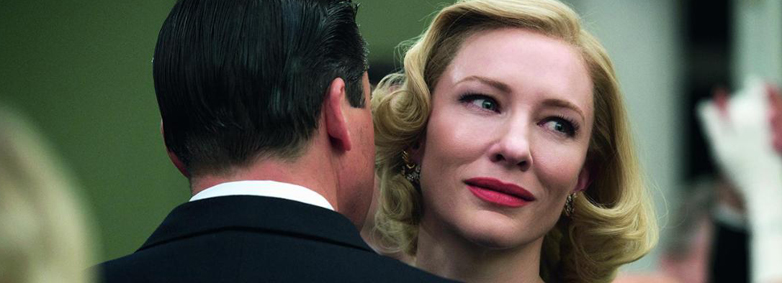
Carol

Director. Todd Haynes (2015)

There’s tremendous quality to admire in this intelligent, assured and elegant period piece.

A shame it lacks the drama the tremendous acting, design and writing promise but don’t deliver.

It’s based on a novel by Patricia Highsmith who also wrote The Talented Mr Ripley (1999).

Cate Blanchett was award nominated for that film and certainly will be again her immaculate performance here.

In the title role she’s a moneyed, married mother who begins an affair with shop girl Therese.

Rooney Mara’s quiet reserve essays a delicate flowering of awareness.

It’s her finest performance to date and hopefully it will be recognised as such by the Academy.

They take a road trip with a camera in one suitcase and a gun in another.

This leads to a showdown with Carol’s seemingly decent husband, played by the dependable Kyle Chandler.

The presence of the gun acknowledges the problem with a script which doesn’t have a lot going on once the couple consummate their relationship.

So the gun is clumsily thrown in to add a frisson of drama where none exists.

As the romance develops and what obstacles exist seem to melt away, we realise we’re witnessing a beautifully played and sumptuous soap opera.

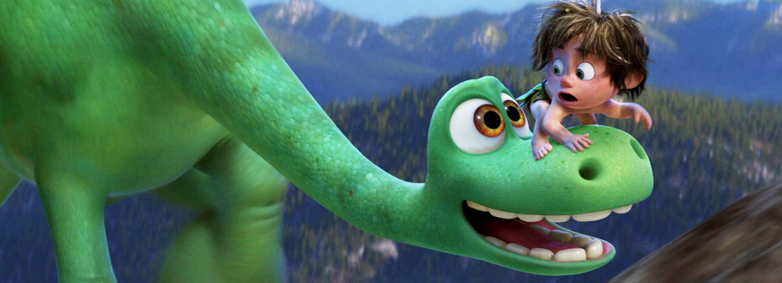
The Good Dinosaur

Director: Peter Sohn (2015)

As plodding as the hero of the title, this prehistoric animated adventure is occasionally exciting, funny and sad, but never in any great measure.

Made by Pixar and released by Disney, it’s a middling effort which has made it to the screen after a difficult production.

History was changed 65 million years when an asteroid didn’t hit the earth and wipe out the dinosaurs.

They’ve evolved to speak, build houses and grow crops.

Arlo is a cowardly and dim Apatosaurus who after some reckless parenting, is lost in the wilderness.

He’s befriended by a brave caveboy nicknamed Spot and together they set off on the long trek home.

Raymond Ochoa whines and whimpers as Arlo and Jack Bright grunts and howls as Spot.

Episodic adventures follow one another and we’re invited to admire the magnificent vistas on the way. They are epic in scale, beauty and frequency.

Credited as ‘Volumetric Cloud Supervisor’, Matthew Webb does a stand up job styling the weather.

Meanwhile the sweeping herds of prehistoric wildebeests are sufficient to placate even the most intemperate guests of Torquay hoteliers.

There’s an unfortunate contrast between the stunning photo-realistic backgrounds and the cartoon cast of rubbery skinned, glass eyed dinosaurs of uncertain charm.

It’s distracting, as if Mickey Mouse popped up in a David Attenborough documentary.

The first director was sacked halfway through, the script was re-written and the cast almost completely replaced.

One character says ‘we must gather our crops before the first winter storm’ immediately after a winter storm. Just one example of a failure to iron out all the issues.

Minor characters are churned through the script before being forgotten.

With all this in mind it’s a marvel the film is as competent as it is.

Kids will love the game of whack-a-mole and adults will grin at the magic mushrooms reminiscent of Dumbo (1941).

Parenting orders are hammered home in heavy handed homilies by Jeffrey Wright‘s daddy dinosaur.

Obey your parents. Do your chores. Don’t play in the river. Do kill your enemies. Not very Disney that last one.

I felt lectured and wanted to rebel. And I’m a parent. Lord knows how children will respond to this.

There’s a strong Western vibe as the boy and his dog, sorry, dinosaur and his boy trek home to their farmstead.

As they meet cowboys along the trail, Sam Elliot adds his magnificent Texas drawl to a tall-tale telling Tyrannosaurus Rex.

He’s called Butch, a sly reference to the actor’s cameo in the classic Butch Cassidy and the Sundance Kid (1969).

The Good Dinosaur is neither brilliant or awful. Good is the operative word.