

A frothy and glossy escapist musical romantic comedy of 1956, High Society is a terrific example of the ability of filmmakers from Hollywood’s golden age to draw on existing material and fashion a sparkling fresh and brilliant entertainment.
It can also be understood as a great example of producer power, was a commercial and critical hit, and was nominated for two Oscars in the musical categories.
Employing irresistible star wattage of Bing Crosby, Frank Sinatra, Grace Kelly and Louis Armstrong, the timeless tunes of Cole Porter and fabulous costume design of Helen Rose, it’s unmistakably the product of MGM, the studio which made the best musicals of the era, including 1951’s An American In Paris, and 1952’s Singin’ In The Rain.
Using a well established dramatic structure, and drawing on elements of American literature, it was produced as the post-war US consensus was being supplanted by the dawn of the teenager as a social phenomenon, and the film’s struggle to wrestle with the real world are all too evident. High Society is politically reactionary and has no sense of itself as herald to the end of the jazz age in which its stars and genre were mired, and sadly for lovers of the studio’s defining genre, High Society is the last great hurrah of the MGM musical.
I absolutely love it.

Based on 1944’s Oscar winning comedy The Philadelphia Story, itself an adaptation of a Broadway play, High Society glides through its 111 minute running time in bubbles of glamour, charm and wit, as we watch a pair of tabloid journalists covering the upcoming high society wedding of a spoilt socialite who’s being courted by three different men.
Bringing four leads together all of whom were previous Oscar winners, Bing Crosby, Grace Kelly, Frank Sinatra and Celeste Holm engage in song, dance, and repartee as they resolve various romantic entanglements over the course of one night and two days in a mansion in the wealthy enclave of Newport, Rhode Island, the high society of the title.
Crosby heads the romantic leads as C. K. Dexter Haven, a wealthy composer who lives next door to his ex, Tracy Samantha Lord, played by Grace Kelly. Meanwhile Frank Sinatra and Celeste Holme are the down at heel muckraking journalists, Mike Connor and Liz Imbrie, who arrive to cover the wedding for their magazine.
When Crosby isn’t singing, he strolls about in cardigans or black tie, and though it’s not a performance of great range or energy, he delivers his popular brand of avuncular charm, is given a veneer of cool by his association with musicians of the calibre of Armstrong, and is offered some reflected glamour by the glittering star power of Kelly, best known at this point for her work with Alfred Hitchcock.

Kelly is perfectly cast in her last Hollywood appearance before abandoning Los Angeles for life in Monaco. Whether in slacks or a ball gown, the luminous Kelly sweeps all before her in a series of gorgeous costumes, including a far from revealing but indecently sexy swim suit.
Plus she delivers a terrifically accomplished performance in the mould of screwball-era Katharine Hepburn, and whether being deliberately over the top, drunk, angry or playful, Kelly can wordlessly make us aware of what she’s thinking, in the manner of another Hitchcock blonde, Ingrid Bergman.
Presumably the casting call asked for an actress less attractive than Kelly to play the second female lead. On this showing that would be every other woman in the world at the time. Which is hugely unfortunate for the wonderfully droll Celeste Holm, who’s teamed up with Sinatra in my favourite big screen performance of his.
Sinatra plays well with Holm, and he’s either smart enough to allow her space to shine, or possibly barely able to keep up with her, and Holme brings a level of dignity and self-awareness lacking in other characters. But Holm was repeatedly ill-served by Hollywood, and after High Society she didn’t make another film for five years.
Elsewhere Lydia Reed is winningly confident and sparky alongside Kelly as her young sister Caroline Lord, and John Lund plays George Kittredge, the culturally barren, nouveau rich cattle baron who’s Tracy’s intended beau.
Playing himself, Louis Armstrong is an invitee performer at a jazz festival Crosby’s character is holding on his estate, a plot device which allows Armstrong to pal about with Crosby and duet together on the number ‘Now You Have Jazz‘, which is supposedly – but clearly isn’t – filmed in front of a wealthy white festival crowd.
Jazz musician Louis Armstrong is granted not inconsiderable screen time, performs three songs and is granted the first and last words. This is fitting for his screen ‘character’ is a Greek chorus to the comedy, a dramatic device used by later musicals such as 1972’s Cabaret, 1975’s The Rocky Horror Picture Show, and 1978’s Grease.
I could write an entire post about radio broadcasters in movies acting as a Greek chorus by starting with 1979’s The Warriors and taking it from there.
Acting as a Greek chorus to the story, introducing the setting and then commenting on events as they unfold, as well as being a character in the story, Armstrong is mostly at one remove from the narrative and he could be excised from the film entirely without his absence changing the story.
In contrast to the previous year’s drama, Blackboard Jungle, the film which made a star of future Oscar winner Sidney Poitier, High Society’s principal black star is clearly at times not on same set at the same time to white actors and has to be edited into scenes in which he is ostensibly a part.
Check out the final scene (from 2.27mins) where although nominally in the same scene, he never shares screen time with Grace Kelly. Armstrong is included but never incorporated.
A generous reading of Armstrong’s separation from the main narrative would be to suggest his performing and recording scheduling conflicts prevented a deeper integration in the narrative. A less charitable reading would be the studio were wary if not frightened of too much interaction of a black character with white ones, and Armstrong’s certainly not allowed to interact with the white female cast members in any way. And good luck spotting a black female actor.
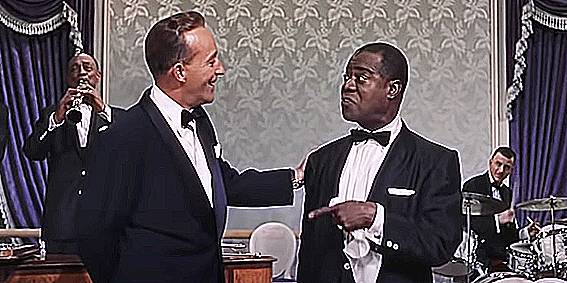
It’s important to recognise High Society was released in 1956, and although the segregation of public schools had been declared unconstitutional by the U.S. Supreme Court in 1954, it was many years before this decision was universally implemented. Other laws of segregation weren’t overruled until the Civil Rights Act of 1964 and the Voting Rights Act of 1965.
With race being the defining political fault line of the US, High Society wants to exploit Armstrong’s cache as a long established and popular crossover artiste by contributing his jazz bona fides to the soundtrack and bringing his own fanbase to the films audience, but his role suggests a nervousness on behalf of the filmmakers who had to sell the film in a US market place.
MGM had at the time previous form with being vary of the controversial subject of race. The studio’s 1951 version of Show Boat notably tones down any ‘controversial’ racial elements compared to previous cinematic adaptions of the stage show on which it’s based.
However in theme and plot the film enforces existing racial boundaries. As one might expect of a mainstream entertainment which recognises social division in its title, maintenance of the status quo is a key theme of the film.
The script was written by a playwright John Patrick who’d previously written the NBC radio series Streamlined Shakespeare, and there’s a strong influence of Shakespeare scattered through the script – more of which later – so Armstrong’s narrator role may well have been included in the earliest draft. If so then casting Armstrong as the Chorus could be read as a deliberate act of segregation rather than a creative solution to a scheduling issue.
Patrick doesn’t steer away from the plot of the original film adaptation or the stage play which preceded it, but adding the Chorus – which Shakespeare used in Henry V for example – the audience to be guided into the heightened and otherworldly setting of High Society, as if leading us into a magical forest of one of Shakespeare’s arboreal comedies, one populated by the fairy Kings and Queens such as found in A Midsummer Night’s Dream, perhaps.
The Chorus is a visitor to this world of wealth and definitely not of or from it, a point underlined by Armstrong’s casting, and the musician’s persona can also be read as ‘blue collar’ and so acts as surrogate for all those in the audience not born to wealth. The film wants us to be amused by the superficiality of the Lord’s family behaviour and regard them with a mocking if warm detachment, and having the Chorus played by Armstrong helps to underline the idea the wealthy do things differently to the rest of us, they are apart, they are ‘other’.
This is story is about maintaining society’s status quo, keeping the high safe and separate in their gilded mansions and the rest of us, well, anywhere else. There is to be no storming of the barricades here, no tearing down of social division, but a determined raising of the drawbridge. This is a piece of high end comfort cinema, lavishly dressed with great tunes. If you want social conflict and a conscience, check out the Poitier flick instead.
Fitting the Shakespearean comic pattern there are two central couples, and all four must gain insight into themselves to find happiness with the correct person, and ‘correct’ is defined as with one whom not only shares a social standing, but also the person who reinforces the rigidly defined social divisions. The rich and the poor have their place, and are happier when the rigid social hierarchy is maintained.
We’re safe in assuming the family name at the top of this society is ‘Lord‘ is deliberately in keeping with Shakespeare’s habit of nominative determinism.
Taking place in a gilded world of enormous drawing rooms, private pools and a butler who offer visitors the south parlour as a waiting room, the film can feel as distinct from reality and as gloriously make-believe as a fairytale, a feeling underlined the magical appearance of a secret mechanical private bar from a book-lined wall.
Gatecrashing this magical realm are two journalists – rude mechanicals in Shakespeare terms – who cast a wry and cynical eye over the fabulous wealth the residents seem to treat with barely a second thought. And though they are drawn to it, they realise they are and cannot ever be part of it. Mike Connor’s brief fling with Tracy is comparable with the encounter between Bottom and Titania the Queen of the Fairies in A Midsummer Night’s Dream. That Sinatra is playing Mike, comparable with the idiot turned donkey, Bottom, is surely am unacknowledged joke at the actor’s expense by the film’s producer. More of him, later.
This is a fantasy which asks us to engage and sympathise with a wealthy white upper class family as they negotiate concurrent romantic entanglements. And the softening of the cynical stance of a pair of muckraking journalistic interlopers encourage us to find sympathy in ourselves for this madly wealthy household rather than maintaining or hardening of our critical stance.
The head of the Lord household has placed his ‘kingdom in a state of chaos due to his latest extra-marital affair, a scandalous fling with a ballerina, and in doing so has become estranged from his daughter, Tracy.
Peace and order will only be brought to the kingdom when father and daughter are reconciled, which will only happen when she choses the correct romantic partner and comes to understand her parent’s worldview, making her fit to succeed her father in due course.
Father knows best, especially where his daughters love life is concerned, is a thoroughly 1950’s attitude.
This is also a coming of age tale, and if Sidney Blackmer as patriarch Seth Lord isn’t given a huge amount of screen time as the stern but loving father who uses his own discretions to teach his daughter about the adult world, it’s their reconciliation which signals the end of the movie. And the curtain comes down with a pleasing and impressive speed which some modern day filmmakers could learn from.
Like Ayesha, the white queen of H. Rider Haggard’s 1887 adventure novel, ‘She’, Tracy’s power seems only to exist as long as she remains in her own world, and the suggestion is if John Lund’s character, the cattle baron George Kittredge, is successful in his courtship of Tracy and takes her away, then she will become ordinary, a mortal being almost. Much is made of George’s wanting to put Tracy on a pedestal and adore her.
One thing the wealthy do differently to the rest of us is put on a music festival in their home. Crosby plays a composer whose house is full of musicians. And the life of Tracy Lord is full of the arts. She and her sister dance, sing, and play piano. They have no regard, interest or knowledge in the ordinary or everyday.
In part George Kittredge is a poor fit not because he’s self-made – Crosby’s character is only second generation wealthy – but because he values commerce above art.
Cole Porter’s fabulous songs have endured even more successfully than the film itself and have achieved a life of their own beyond the confines of cinema. ‘True Love‘ was Oscar nominated for best song but lost out to ‘Que Sera, Sera’ from Hitchcock’s The Man Who Knew Too Much. Some of them have been successfully re-recorded by later generations, such as ‘Well, Did You Evah!‘, the film’s best song, which was originally written for 1939’s DuBarry Was a Lady, and latterly recorded by Debbie Harry and Iggy Pop as part of a HIV/AIDS benefit project.
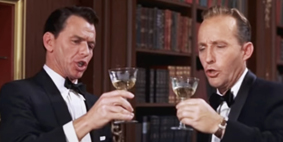
Being the greatest lyricist of his generation, Porter was capable of writing lyrics reflecting the film’s sense of magic and otherworldliness. He drops in classical references such as ‘Circe‘ the Greek goddess in ‘Little One‘, while also referencing more contemporary concerns, such as uranium, in ‘Who Wants to Be A Millionaire?‘ And yes, the song did inspire the name of the popular TV quiz show. And ‘she got pinched in the Astor Bar‘ from ‘Well, Did You Evah!‘ is as sly and funny now as it was then, especially with Sinatra’s astutely comic phrasing.
Not all the songs have aged as well, ‘Now You Has Jazz‘ is a decent example of the form, but the lyric ‘Jazz is the king, jazz is the thing that folks love the most.‘ seems unduly optimistic as jazz was about to be swept off the pinnacle of popular culture by rock ‘n’ roll.
However that’s aged nowhere near as badly as the icky staging of the torch sing Crosby sings to Kelly’s screen sister, which summons up the spectre of child sexploitation rife at the time in the Studios, and should be shocking to a modern audience in the era of #MeToo. And were High Society be remade today it’s the song that wouldn’t make the cut. As highly problematic as it is, it sadly it fits in with other songs of the era, notably ‘Little Girls‘, from MGM’s 1958 musical, Gigi.
Director Charles Walters was a choreographer turned director who as as well as directing films for Ginger Rogers and Esther Williams, made 1948’s Easter Parade with Fred Astaire and Judy Garland, received a Best Director Oscar nomination for 1953’s Lili, and directed the Frank Sinatra and Debbie Reynolds 1955 comedy, The Tender Trap.
There’s no signature artistry, just the absence of ego of a professional going about his business. When your star is also your producer, there’s rarely opportunity to do anything other than what you’re told. Certainly there’s none of the daring brush with 3D technology of 1953’s Kiss Me, Kate, or Gene Kelly’s experimental dance and design found in 1951’s An American In Paris.
Cinematography Paul Vogel as an Oscar-wining studio veteran journeyman who went on to shoot George Pal’s 1960 sci-fi adaptation, The Time Machine. His shots are always well balanced and composed so the audience know who’s the most important person in the room. Characters are usually fairly static within the frame, making it all the more startling when Kelly or or her screen sister flurry across a room.
The best we can say of his camerawork is it’s efficient and economical, with occasional daring pans from left to right, and though the camera becomes more agile in the musical numbers, it’s movement generally reflects Crosby’s laid back performance style.
There are no big theatrical set pieces and even the big ballroom scene at Tracy’s hen party, a great excuse for a swirl of costumes if ever there was one, hints rather than shows a crowd. And the big song and dance during the hen party is set in a drawing room where Crosby and Sinatra hide away.
In fairness the number is the storming duet ‘Well, Did You Evah! and remains not only only my favourite song in the film, but also one of my favourites in the Hollywood musical canon. Even the one crowd scene at the festival during the number ‘Now You Has Jazz‘ seems an out-take from a different picture.
Ralph E. Winters editing style allows the performances to breathe and to hold the audience in the moment. This is in contrast to the more excitable contemporary and haphazard style seen, for example, in 2019’s musical monstrosity Cats.
High Society’s production budget was an unadjusted-for-inflation $2.7 million, and US box office was a healthy and profitable $8.2 million. This compares favourably with 1952’s Singin’ In The Rain which scored for $7.2 million on a budget of $2.5 million.

Distributed by MGM, High Society sits high in their pantheon of great musicals, but was a joint production between two production houses, Sol C. Siegel Productions, and Bing Crosby Productions. Presumably the first provided the finance and the latter the talent, with the whole concept intended as a vehicle for Crosby.
Appearing in cinemas two years after Seven Brides For Seven Brothers, and Brigadoon, High Society is notable for what its not doing that those prior films did. Due to Crosby’s limited dancing ability there’s no outrageously macho and colourful ballet such as the barn building dance in Seven Brides, or the muscular staging of a Gene Kelly number. In fact none of the leads or support are famed for dance skills, though Sinatra could hoof his way through a scene if required.
Although never upstaged Crosby is canny enough to let others have their time in the spotlight. However
there’s an unmissable line concerning how handsome he used to be, and by implication still is to a degree.
This doesn’t soften the achingly clear and embarrassing age and glamour gap between romantic leads Crosby and Kelly.
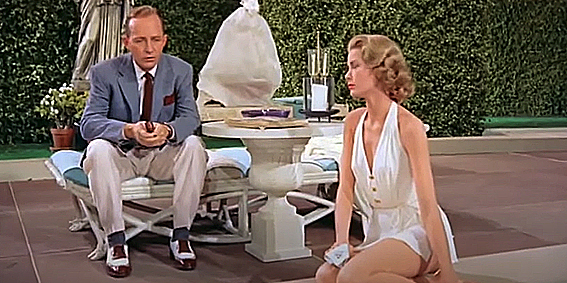
Having an older male starring a younger female seems to remain every Hollywood producer’s dream pairing. And Crosby certainly isn’t immune to the fantasy. Crosby was 53 years old at the time, Kelly was 27.
Helen Rose’s costumes achieve their aim of making Kelly look divine.
Though the use of studio sets, projected backdrops and second unit location work with extras driving cars pretending to be the leads now look decidedly false, they were common practice and would have been accepted by audiences at the time.
Lacks the scale of non-MGM musicals which shortly followed, such as 1961’s West Side Story, or 1965’s The Sound of Music, which addressed the themes of social conflict and Nazism head on. Compared to those behemoths High Society is a frothy endeavour, with even Julie Andrews’ movie featuring a singing nun-turned-nanny who marries her rich boss, seem hard hitting.
The golden age of MGM musicals kicked off with Fred Astaire and Judy Garland in 1948’s Easter Parade, includes 1949’s On The Town, and you can argue amongst yourselves whether 1954’s An American in Paris is ‘better’ than 1952’s Singin’ In The Rain. I love both but always favour the latter for a rewatch as its joyous frivolity makes for the easiest of watches.
High Society saw the MGM studio declining as a creative force. It’s principal stars were ageing – by Hollywood standards – and cinema was threatened by the usual suspects such as the growth of TV, changing demographics and tastes, and the social creation of the teenage generation. But for a run of flamboyant escapist entertainment, the MGM golden age is hard to match.
MGM released ten musicals in 1948, then nine in 1951, and ten more in 1953. It released eight musicals in 1955, before High Society became one of four films released in 1956. There were five the following year, only one in 1960, none in 1961, and only five in total in the 1960s. There was one original musical in the 1970, and the anthology That’s Entertainment!, a showcase of MGM’s greatest hits and a great introduction to their musicals. Two more anthologies followed, though they were seen primarily a way of generating cash in the pre-home video era for MGM’s new owners.
Of two hundred MGM musicals listed on IMDB.com, High Society is number 177 by release date. The only ones of note which follow it are 1957’s Silk Stockings featuring Cyd Charisse, and 1958’s wildly problematical Gigi.
From the sense of other worldliness, images of ruined houses and the backdrop of fin de siècle, the ghosts of F. Scott Fitzgerald’s 1925 Jazz-age novel The Great Gatsby, are inescapable. The book was enjoying a renewed interest and re-evaluation and its influence is clear. It can be seen in Crosby’s character throwing not only an extravagant party in his house but an entire festival, one clearly designed to attract the attention of his beautiful soon-to-be-married-to-someone else next door neighbour. And he pointedly describes himself as inheriting the wealth of his bootlegger father, the same means by which Gatsby acquired his fortune.
Tracy holds her hen party in one of the many emptied decaying mansions which line the coast, a situation described in the novel, and it’s possible to imagine long after the credits roll, that the characters and otherworldly kingdom the movie conjures up continue to exist in their own magical bubble of reality quite separate from our mundane reality.
High Society celebrates its 75 years anniversary this year, and as I’ve yet to watch it on the big screen, maybe I’ll get lucky and it will find itself released back into cinemas to celebrate. What a swell party that would be.

 chrishunneysett.uk
You must be logged in to post a comment.