La La Land

Director: Damien Chazelle (2017) BBFC cert: 12A

Be swept off your feet by this swooning romantic musical.

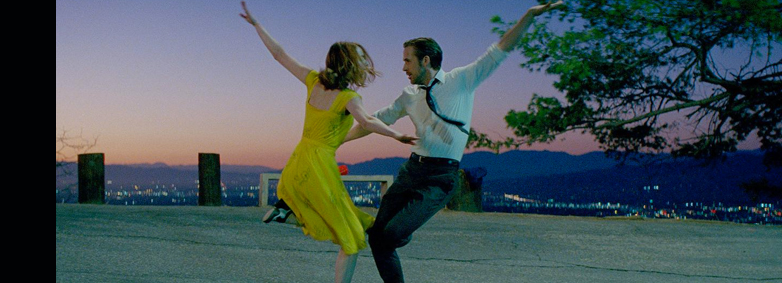
Unashamedly nostalgic for the music, movies, stars and Los Angeles of yesteryear, this fabulous fantasy is a sumptuous love letter to Hollywood’s golden age classics such as Singin’ In The Rain (1952) and An American In Paris (1951).

The ridiculously attractive Emma Stone and Ryan Gosling star in their third film together, and their irresistible chemistry continues to burn through the screen. While neither are great singers or dancers, the film doesn’t pretend they are, adding to the honesty and charm of their performances.

Their characters meet in a gridlocked highway, a metaphor for their lives going nowhere. As the traffic jam becomes a joyful dance number, it’s tempered with the sting of frustration, and the tone scene is set for the story to come.

Gosling plays Sebastian, a struggling jazz pianist with dreams of opening a jazz club. His life takes a left turn when he meets the aspiring actress, Mia. Between auditions she works as a coffee shop waitress at the Warner Brothers studio.

Matching her dance partner step for step but having the more difficult part of doing it backwards and in high heels, Stone offers astonishing levels of heartbreaking vulnerability.

Though Gosling’s talent means he’s far from just window dressing, Stone owns the film. As the pair follow their dreams, they discover compromises must be made when balancing art and commerce.

La La Land‘s deserved record breaking sweep of seven Golden Globe awards has seen bookies make it the favourite for this years top Oscars and its easy to see why.

This is a dreamy, delirious and delightful concoction of high stepping choreography and toe tapping compositions. It’s bursting with sexy energy, eye popping colour and soaring ambition.

Go ga ga for La La Land and shower yourself with tinsel town stardust.

@ChrisHunneysett


The Light Between Oceans

Director: Derek Cianfrance (2016) BBFC cert: 12A

Wade into a sea of grief, madness and death with this mournful melodrama. Solid performances and breathtaking locations bring the best selling book by M. L. Stedman to windswept life.

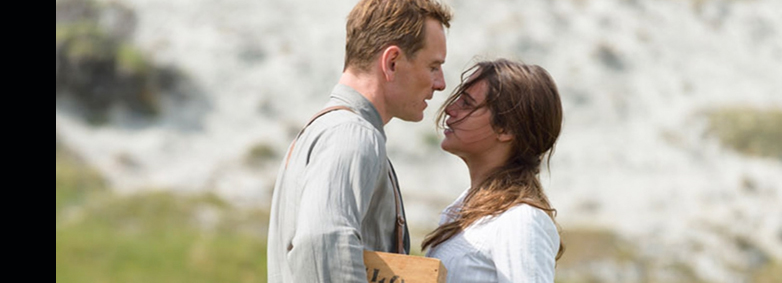
Michael Fassbender and Alicia Vikander star as Tom and Isabel Sherbourne. He is a black clad and brooding veteran of the First World War’s western front, she is a vivacious local girl in angelic white.

The happiness of Australia’s most photogenic lighthouse keepers hits the rocks due to a repeated failure to have a child.  Demented by grief, Isabel persuades Tom to abandon the ship of common sense when a baby girl is washed ashore. They pass the child off as their own, with the only clue to her identity an expensive silver rattle.

As a period romance this is more gothic tragedy than uplifting celebration of love. Imagine Emily Bronte’s Cathy and Heathcliff escaping Wuthering Heights to spend a day out at the seaside.

There are tales of suicide, ghostly images, wild walks on stormy nights, wailing widows and mourning mothers. There are letters from beyond the grave. In flashback we see the dead, living. Beneath breathy voice overs, the script shovels on unlikely occurrences and coincidences.

The lighthouse island is named after Janus, two headed god who looks to the future and the past. Tom looks one way, Isabel the other. When Isabel shaves off Tom’s moustache, she is defenestrating his stiff upper lip and removing his emotional barrier to the world. Not only does this indicate he prepared to reveal his emotions, but it places him in her power. It is redolent of Samson having his locks shorn and is the harbinger of their doom.

As the drama sinks under the weight of this heavy handed symbolism, eventually the over-wrought storytelling cops out and dissolves into sentimentality. A lack of social smoking undermines the carefully constructed period detail.

Filmed in Tasmania and off the New Zealand coast, the coastline is a character and the crashing waves are a soundtrack. Rachel Weisz offers strong support as Hannah, the daughter of local businessman. It’s always great to see Bryan Brown on screen, even when playing Septimus Potts, as unpleasant a man as his name suggests.

Fassbender and Vikander became a couple while on set and the early scenes have an earthy crackle of electricity. I hope they achieve more happiness than their characters do.

@ChrisHunneysett


Bridget Jones’ Baby

Director: Sharon Maguire (2016) BBFC cert: 15

Fans of the UK’s favourite singleton will cheer at this amiably entertaining and almost touching third entry in the romcom franchise.

Renee Zellweger returns as an older, wiser and sadder but still loveable Bridget. The Texan’s talent and charm give the uneven and scattershot script a depth it doesn’t deserve. Her assured underplaying is especially welcome in a restaurant scene of excruciating embarrassment.

Helen Fielding based her original Bridget Jones Diary newspaper column on Jane Austen’s Pride and Prejudice (pub. 1813). Books and films followed with great commercial success.

Having Fielding, Dan Mazar and Emma Thompson contributing conflicting styles of humour to the script causes unresolved tensions between scenes. Plus there is again a grating change of politics between those found in the source material and some of the broader gags.

It’s not one should expect Austen levels of wit from this generally light-hearted romp, but there is a huge departure from the author’s social concerns in order to land a few punchlines. Austen was highly critical of a society where the second class status of women made them financially reliant on men and forced them to seek a ‘good’ marriage. In Bridget’s world finding a rich man is one what does for sport, not necessity.

Fielding astutely includes her comic standbys of a Bridget film. There is a breathy voice over, an obsession with sex and alcohol, a grand resignation, swearing kids and eccentric OAPs. The famous diary has been replaced by a laptop. It’s all as cosy as one of Bridget’s famous Christmas jumpers, which also make an appearance.

Thompson won an Academy Award for Best Adapted Screenplay for her adaption of Austen’s Sense and Sensibility (1995. Novel pub. 1811). Presumably she wrote her scene stealing role as Bridget’s maternity doctor, the only consistently Austen-like female character on show.

The brief moment when the tone threatens to take a dark almost Dickensian turn also suggests Thompson’s fingers in charge of the keyboard. This plays far better than Fielding’s indulgent, ill conceived and seemingly Richard Curtis inspired cameos, Italian stereotypes and pratfalls. Having said that, Thompson isn’t afraid to lift a joke popstar Robbie Williams used on Graham Norton’s chat show, during an edition on which she also appeared.

Thompson’s deftly drawn and waspish character is hugely at odds with the presumably Mazar scripted sequence featuring a distressed and suddenly helpless Bridget. Our heroine relies for rescue on a pair of men for transport, only to find their way blocked by a parade of breast baring radical feminists.

At this point all pretence of Bridget as a modern, independent woman is abandoned for cheap gags and a Cinderella subtext. This moment also sees the flowering of another subtext as Bridget’s vagina is reduced to a conduit for a closeted bromance.

In the film’s defence there is a strong if ham-fisted appeal for inclusivity. There is also a decent Margaret Thatcher joke, though not at the Iron Lady’s expense.

Having been nominated for an Oscar for Best Adapted Screenplay for co-writing Baron Cohen’s Borat: Cultural Learnings of America for Make Benefit Glorious Nation of Kazakhstan (2006), it’s easy to speculate which elements Mazar contributed. More recently he wrote the Zac Efron/Robert DeNiro gross out comedy Dirty Grandpa (2016).

The film opens in a reassuringly familiar fashion and will immediately win old fans over. Although now a successful if accident prone TV news producer, Bridget celebrates her 43rd birthday alone, drinking chardonnay and listening to her signature tune ‘All By Myself’,  by Eric Carmen.

After a couple of one night stands, the occasional wanton sex goddess finds herself pregnant and unsure whom the father is. One possible parent is Jack Qwant, a billionaire mathematician and internet dating guru at a music festival. American TV star Patrick Dempsey is vanilla at best.

The other is her former lover, the now married but still uptight human rights lawyer, Mark Darcy. Bridget and he bump into each other at a memorial service for his erstwhile and wonderfully louche love rival, Daniel Cleaver.

The absence of Hugh Grant’s Cleaver is keenly felt. Colin Firth’s grumpy and lacklustre performance as Darcy suggests he is pining for Grant’s light comic touch to rub up against.

Jim Broadbent and Gemma Jones offer game support as Bridget’s parents alongside franchise favourites Celia Imrie, Shirley Henderson, James Callis and Sally Phillips.

It all ends in champagne as our heroine becomes the sort of person she once purported to despise. A late and predictable plot twist suggests a fourth film is not out of the question.

@ChrisHunneysett


Maggie’s Plan

Director: Rebecca Miller (2016) BBFC cert. 15

The best laid plans of Greta Gerwig go awry in this New York comedy of manners.

As Maggie she is forever interfering in the lives of others and must learn restraint in order to find her own happiness.

She’s a sensible shoe wearing singleton who is ready to have a kid but lacks a boyfriend. Her scheme to inseminate herself via a sperm donor is interrupted by the appearance of John, a hunky academic.

This doesn’t endear Maggie to his wife Georgette and their kids. Ethan Hawke and Julianne Moore enjoy themselves as the feckless, self pitying, dishonest man child and his ferociously poised Danish wife.

The script gives John the anthropologist a forensic examination and finds the behaviour of this modern man severely wanting. But it also has the heart to allow the him at least a small measure of self respect.

Bill Hader and Maya Rudolph offer Maggie an alternative view of life as home truth dispensing best friends and Travis Fimmel is sweet as a lyrical pickle entrepreneur.

As a director Miller is in love with the city and it’s full of therapy, hipster beards, wooly hats, street entertainers, health food, ice skating and outdoor markets, but keeps its quirky mannerisms to a thankful minimum.

And her script obeys the rules of a romcom while functioning as a commentary on our atomised society, one which is indifferent to reducing conception to a mechanical process involving a syringe and a smart phone app.

Maggie’s Plan plays as an updated version of Jane Austen’s Emma filtered through Woody Allen, and is an honest, sharp and very funny look at modern life.

@ChrisHunneysett


Colonia

Director: Florian Gallenberger (2016)

This handsome historical prison drama is shackled by weak dialogue, a pedestrian pace and an unconvincing central relationship.

Emma Watson and Daniel Bruhl play Lena and Daniel, a fictional couple caught up in General Pinochet’s military coup of Chile in 1973.

The force of history rests heavy on Watson’s slender shoulders, weighing down a performance which is far from her strongest.

When political activist Daniel is arrested and sent to a remote charitable mission ran by a cult, flight attendant Lena infiltrates the camp ‘Colonia Dignidad’ to rescue him.

It’s the personal fiefdom of a messianic and abusive leader who uses physical and psychological torture to keep his followers in line.

Although staged on an impressive scale it, the finale descends into silliness as door slamming trolly dollies defy the mass ranks of the Chilean army.

@ChrisHunneysett


Mother’s Day

Director: Garry Marshall (2016)

I haven’t quite recovered my will to live after suffering this irredeemably awful comedy drama.

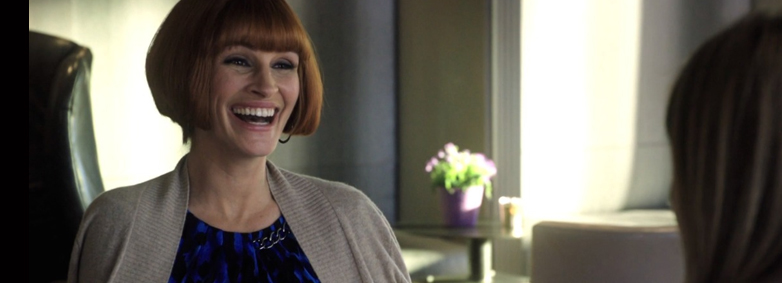
Along with Valentine’s Day (2010) and New Year’s Eve (2011), it’s the third in a trilogy of wasted talent. Julia Roberts and Jennifer Aniston are the notable victims this time round.

None of the films are related except in being based around a particular date and involving an absence of entertainment for the audience.

Similarly this features a pitiful parade of self obsessed souls vaguely connected by unlikely coincidences.

Mother’s Day is approaching and Aniston’s divorcee is arguing with her newly remarried ex about custody of their kids on the big day. Intimidated by their hot young step mum, Sandy has joined a gym.

It’s ran by a widower who is struggling to raise his kids. Jason Sudeikis is wildly miscast as the former marine master sergeant.

In an astonishingly misjudged attempt at inclusiveness, Kate Hudson’s racist redneck parents are unaware of her mixed race marriage and their other daughter is gay.

Unfunny British stand up comic Jack Whitehall is suitably cast as an unfunny British stand up comic. His girlfriend with whom he has a baby is reluctant to marry him. Clever girl.

It’s directed for want of a better description, by Garry Marshall, the person who helped propel Roberts to stardom in the superior in every way Pretty Woman (1990).

This feels like a big screen adaption of a much loathed TV show mistakenly released in to cinemas instead of being buried at midnight in an unmarked show business grave.

With nothing but contempt for its audience, this cheap looking collection of mawkish  platitudes is shabbily conceived, woefully written and shoddily edited.

Plus it features the worst game of ‘soccer’ ever committed to celluloid.

Mother’s Day is rare for being a female dominated movie headlined by two performers nearing 50 years old and supported by a third approaching 40.

This is exactly the sort of highly visible roles for older actresses which the industry, audiences and critics bemoan the lack of. The tragedy is in being an appallingly poor piece of work in which to showcase their talents.

Aniston and Roberts deliver typically professional performances of charm and warmth and no blame for this disaster can be landed at their feet. Their agents may need to carefully consider their futures.

While Roberts can look to her Oscar win for Erin Brockovich (2000) for consolation, Aniston’s search for a film role worthy of her talent continues.

Roberts was reportedly paid $3 million for four days work for her role as television shopping channel host. I should have been paid at least as much for watching.

Easily the worst film of 2016.

@ChrisHunneysett


Me Before You

Director: Thea Sharrock (2016)

Get your hankies at the ready for this modern day old fashioned romantic weepie.

Based on the best selling novel by Jojo Moyes, it’s derivative, sentimental and impervious to the charms of subtlety. But it is effective.

Two fabulously attractive young people are brought together by tragedy. Once they’ve fallen in love those same circumstances threaten to tear them apart.

Sporty banker William loses the use of his legs and arms while lowly waitress Louisa loses her job. Their fates collide when she takes a job as his carer.

Emilia Clarke and Sam Claflin have a hugely engaging chemistry and the film succeeds on the strength of their charm and talent.

The puppyish enthusiasm of Clarke and her incredibly expressive eyebrows contrast nicely with Claflin’s remarkably still sneer.

William teaches Louisa culture and she helps him lighten up. But his strong views on his condition threatens to cast a permanent shadow on their potential happiness.

It’s best imagined as a British version of Pretty Woman (1990) where Richard Gere is in a wheelchair and Julia Robert’s hooker is now an obliging nurse played by the ditzy younger sister of Bridget Jones (2001).

A snow clad castle dominates the chocolate box scenery as they visit the races and a concert of classical music.

It would be too easy to mock the One Nation Tory politics underpinning this twist on the Cinderella story.

It’s a fairytale world where the landed gentry casually bestow jobs on the feckless and bitter unemployed working classes. Plus there’s a singular avoidance of the practical hardships of being quadriplegic.

However Me Before You doesn’t pretend or aspire to be a movie with a social conscience.

There isn’t any ambition beyond making you smile through a bucket of tears and on that score it’s an undoubted success.

Charles Dance and Janet McTeer provide gravitas as William’s parents and Dr Who’s Jenna Coleman appears as Louisa’s single parent sister. Joanna Lumley breezes through as a fragrant wedding guest.

Clarke is famed for her frequent nudity on TV’s Game of Thrones but here keeps her curves under wraps.

This tearjerker won’t be the last performance which has Clarke’s fans reaching for the tissues.

@ChrisHunneysett

Spring

Director: Justin Benson and Aaron Moorhead (2015)

A young American suffers the holiday romance from hell in this seductive supernatural shocker.

Having lost his mother and his job and finding himself wanted by the police, Californian cook Evan (Lou Taylor Pucci) high-tails to Italy to sort his head out.

Having hooked up with foul-mouthed Brits Tom and Sam (Nick Nevern, Jonathan Silvestri) Evan accompanies them on a road trip to the beautiful port of Bari.

Once there Evan is picked up in a bar by a raven-haired beauty in a startling red dress. She says she’s called Louise (Nadia Hilker).

She’s a forthright and well-travelled genealogy student who has a secret skin-care regime and may be lying about her age. Louise is also averse to having her photograph taken and says she tries to be vegetarian.

Evan is smitten and as his Brit friends disappear to Amsterdam, he takes a labouring job on a farm in order to stay close to the enigmatic Louise.

His boss is taciturn widower Angelo (Francesco Carnelutti) whose melancholic devotion to his crops adds depth to the slowly gestating romantic tone.

Evan tries to woo Louise with dinner dates, boat trips and museum visits. Together they’re charming and funny and we want them break through the emotional barriers keeping them apart.

Unknown to Evan, Louise suffers a condition and it’s getting worse. Macabre tones twist up through the romance as maggots, insects and snakes begin to intrude.

For reasons which become horribly clear, Louise enjoys unprotected sex and there are discarded needles on her bathroom floor.

We appreciate the danger Evan is in long before he does and the fate of their relationship is dependent on the arrival of the imminent spring equinox.

Inventive, intriguing and gently hallucinogenic, Spring benefits from deliciously visceral physical effects, a confident and precisely constructed script and two likeable leads who share an engaging chemistry.

Their deadpan banter is cut from a similar vein to the horror classic An American Werewolf In London (1981) – but also sweet and tart like the fruit of Angelo’s grove.

Co-director Benson wrote the script and his partner Moorhead acted as cinematographer. Both are in healthy command of their respective disciplines and combine to create a film substantially more than the sum of its low budget parts.

Moorhead’s camerawork is fluid and controls the rhythms of the story, contributing to the sly and slightly trippy tone. He makes the old town quarter of Bari look fabulous, as much a character as Vienna was in Don’t Look Now (1973).

The romantic touchstones would be Richard Linklater’s Before Sunrise (1995) and of course F.W. Murnau’s masterpiece Sunrise: A Song Of Two Humans (1927).

With it’s expertly mixed combination of horror, comedy and romance, Spring is a smart, enjoyable and accomplished addition to the cinema of 2015.

The Age Of Adaline

Director: Lee Toland Krieger (2015)

A woman who never grows old falls for a much younger man in this weird fantasy romance.

Adaline Bowman (Blake Lively) lives alone, is kind to her dog, speaks in a breathy register and laughs at her own jokes.

Although really 107 years old, a mysterious event when she was 29 has prevented her from ageing.

Ever since the FBI tried to arrest her for being a suspected threat to the US, she’s been dodging the authorities and running away from love and commitment.

She changes addresses and identities every ten years, allowing the Costume and Make-up deptartments (Angus Strathie, Monica Huppert) to make Lively look lovely in all the major fashions of the twentieth century.

Plus it usefully acts as a visual shorthand for whatever decade we find ourselves in during one of the many flashbacks.

Her only friend is piano player Regan (Lynda Boyd) which suggests Adaline has been seeking out blind people to hang with as they don’t recognise her lack of ageing.

At a New Year’s Eve party she meets the hunky, needy, pushy yet altruistic internet millionaire Ellis (Michiel Huisman).

He’s not as endearing as the film imagines him to be and Adaline tries to reject his advances due to their secret age difference.

There are several dates, shooting stars, snow storms, two car accidents and a drive-in movie.

Despite Adaline’s reservations she agrees to visit Ellis’s parents where someone kindly explains the rules of Trivial Pursuit for those watching who haven’t played it.

It leads to a big surprise for his dad Bill (Harrison Ford) on the eve of his fortieth wedding anniversary to Kathy (Kathy Baker).

Ford seems energised for the first time in years and is allowed a door-smashing moment. Perhaps being back home on the Falcon is therapeutic.

However it’s at this point the heavy air of sentimental nostalgia curdles and becomes creepily uncomfortable.

A gravelly voice over by Hugh Ross offers the only grit available as well as the illusion of a patina of science.

San Francisco looks fabulous and the true romance on show is between the city and cinematographer David Lanzenberg.

Scriptwriters J. Mills Goodloe and Salvador Paskowitz are also enamoured of the city, highlighting it’s history as a leader of technological innovation.

Somebody ought to point out to the writers gifting first editions of famous novels only counts as romantic if there is a financial, emotional or other cost to the donor.

A millionaire dishing out rare works to relative strangers they wish to bed smacks not of romance but thoughtless opportunism.

The Age Of Adaline suggests grey hair and wrinkles are the gateway to true love; a sly commentary on women who can’t accept growing old and resort to going under the knife.

But if you want to send this sort of message then it’s important to create an effective and engaging delivery system first.

Suite Francaise

Director: Saul Dibb (2015)

This World War II drama about star-crossed music lovers is handsomely orchestrated but suffers tone deaf storytelling,

When a married French woman falls for a German officer, she has to decide between the love of her life and the love of her country.

There’s some decent acting and a lovely period feel but it’s ruined by the unconvincing romance, unsympathetic characters, a pointless voice over and simplistic dialogue.

It is based on the novel written in secret during the war by Irène Némirovsky. Though she perished in Auschwitz the manuscript was recovered by her daughter and eventually published in 2004.

Filmed on location in Marville, the picturesque town is complemented by the richly authentic production design of Michael Carlin and captured by the graceful cinematography of Eduard Grau. Editor Chris Dickens brings welcome injections of energy.

Lucille (Michelle Williams) is an insipid soul who’s peeved at her sour-faced mother-in-law Madame Angellier (Kristin Scott Thomas) for locking shut her precious piano.

With Lucille’s husband Gaston missing in action, the women share a large house and occupy themselves collecting rent from tenant farmers.

Their privileged if unhappy rural existence is transformed when the German Wehrmacht roll into town.

They’re mostly a benign presence, lacking the SS Nazi zeal for shootings, beatings, floggings or rapes.

When not standing around the square flirting, the squaddies consign themselves to skinny dipping and getting drunk in a nearby chateau.

Meanwhile the locals are busy posting anonymous hate-mail about each other to the Germans in order to curry favour. The officer charged with investigating their contents is good Lieutenant Bruno von Falk (Matthias Schoenaerts).

Billeted with Lucille and Madame Angellier, not only is he a strapping young man but he plays piano beautifully. He even composes his own music. Swoon.

Bad Lieutenant Bonnet (Tom Schilling) fancies Lucille’s friend Madeleine (Ruth Wilson) and insults her husband Benoit (Sam Riley).

Bonnet quotes Nietzsche to underscore how nasty he is. It’s amazing he’s not goose-stepping to Wagner while he does it.

As soon as we see impoverished farmer’s daughter Celine (Margot Robbie) sporting silk stockings, we know how her storyline will unfold. Even before the German’s invade.

The rest of the French give cheese-eating surrender monkeys a bad name. They’re solicitous, duplicitous, hypocritical liars and collaborators; seeing the war as an opportunity to betray, cheat and exploit one another.

I was reminded of Walter Sobchak (John Goodman) in The Big Lebowski when he remarks: ‘say what you want about the tenets of National Socialism, Dude, at least it’s an ethos.’ The French portrayed here have barely a scruple between them.

Handing over an arsenal of weapons without a murmur, resistance amounts to throwing uniforms up a tree. It’s a wonder the Germans need to deploy quite so many troops.

As soon as Bruno unlocks the piano and tinkles the ivories, Lucille is all a quiver with barely concealed passion.

But other than being the nearest port in a storm it’s a wonder what he sees in her. She’s prettily vacant and is miffed by having calloused hands when forced to carry her own shopping. Doesn’t she know there’s a war on?

By the time Lucille and Bruno come to acknowledge their passion, half the town’s women have been at it with the invaders – so it doesn’t seem much of a transgression.

Plus Lucille absolves herself of guilt when an anonymous letter accuses her husband of infidelity; an accusation she’s astonishingly blase about accepting.

When they end up hiding in the hydrangeas from Madame Angellier, its too much effort not to snigger.

As townsfolk seek to exploit her blossoming relationship with the Lieutenant, half of them congratulate her for bravery, the other half condemn her as a collaborator.

Well one person does. We’re simply told by the persistent and annoying voice over what everyone thinks.

When Benoit is betrayed and goes on the run, Lucille has to decide where her loyalties lie.

Eventually the Germans start shooting but they’re so ineffectual it’s amazing they managed to blunder into Paris at all. Executing a door-to-door search they scare some nuns and frighten a few chickens.

While this is going on Bruno finds time to apologise to Lucille for breaking off their date. It’s Bridget Jones: The War Years – but without the laughs.

☆☆☆