Ratchet And Clank

Director: Kevin Munroe (2016)

From Super Mario Bros. (1993) to Street Fighter (1995), Hollywood has a low scoring rate when trying to turn video games into cinema hits.

Never threatening the high score of soon to be remade Lara Croft: Tomb Raider (2001) or Resident Evil (2002), Ratchet And Clank features a defective robot and an alien mechanic teaming up to save the universe.

Based on the game of the same name, this is a poorly assembled and malfunctioning sci-fi animated adventure.

More a sugar fuelled distraction than a coherent movie, it’s written for and possibly by attention deficit kids wide eyed on popcorn and fizzy drinks.

David Kaye voices Crank, a defective War-bot. Unlike his monstrously armoured production line robot siblings, he’s petite, prissy and pacifist.

Clank is scheduled for demolition by Paul Giamatti’s Chairman Drek. He’s employed Armin Shimerman’s evil scientist Doctor Nefarious to build an army of robot assassins to annihilate the Galactic Rangers.

The Rangers are a dim and trigger happy team of celebrity loving law enforcers, lead by the square jawed and muscle bound buffoon Captain Qwark, voiced by Jim Ward.

Crash landing on a distant world, Clank is rescued by Ratchet. Energetically voiced by James Arnold Taylor, he’s some sort of orange space fox.

A small mechanic with big dreams, Ratchet whisks his new friend away to warn the Rangers.

With the least possible attention to detail in the animation, character, plot or dialogue, it’s a manic, mirthless mash up of movie spare parts, many borrowed from the Star Wars films.

But sadly not just the good ones. There’s a planet destroying weapon and pod racing. Architecture is republican era Alderaan.

The script throws in jokes about selfies and hashtags in a futile bid to be relevant. At one point a robot henchmen chews up a smartphone as punishment.

For the intended audience it’s probably the most terrifying moment in the whole film.

The release date is presumably to capitalise on the UK Bank holiday, pitching itself at all the kids too young to see Captain America: Civil War (2016) or have already seen The Jungle Book (2016) and Zootropolis (2016).

Sylvester Stallone, Rosario Dawson and John Goodman offer recognisable names to tempt unwary parents with a mirage of quality.

It’s game over already for this wannabee franchise.

Friend Request

Director: Simon Verhoeven (2016)

This silly horror show about internet stalking opts for cheap slasher action and ignores the very real dangers of the virtual world.

Lurking at it’s dark heart is a cabal of well worn ideas such as secret sects and black magic.

Wasps buzz angrily and the scrabbly screechy soundtrack is laden with ominous echoes.

Alycia Debnam-Carey stars as student Laura who accepts a social media friend request from classmate Marina, played by pallid Liesl Ahlers.

When the lonely goth commits suicide on camera, Laura’s social media account takes on a life of its own, publishing the video and offensive messages.

As Laura’s friends suffer violent deaths, she must turn cyber sleuth to save herself and importantly, her diminishing online popularity.

It’s difficult to work out if the pair of cops investigating the case are a signifier of satirical intent. There are numerous unintentional laughs.

Presumably  in a bid to prevent legal problems, the specific social media site is never identified and the F word is never mentioned. But I could think of a few.

The Divide

Director: Katharine Round (2016)

There’s a serious lack of facts in this wooly minded documentary which wants to change the world.

It claims extreme levels of relative inequality within the UK and US are the main driver of social problems such as ill health, substance abuse and crime. Advertising is blamed for stimulating demand for unnecessary excessive consumption.

Archive news footage is mixed with testimony of historians and economists.

There’s a sloppy failure to define poverty or present a single chart or graph. Instead the narrative such as it is relies on emotive anecdotes and opinion to make its point.

Abandoning its starting point of 1928, it briefly raises the spectres of Thatcher and Reagan before landing in the present.

Seven people, including a rapping Scots alcoholic, a Wall Street psychologist and a Sunderland care worker, are used as examples of the unhappiness in both the rich and poor.

Apparently being wealthy does not make one happy, a theory I’d like to put to the test.

Described as a ‘a call to arms’ The Divide is propaganda for change but forgets to offer a solution to the ills it idnetifies.

Without which it amounts to little more than a cry of ‘it’s not fair’ – behaviour I don’t tolerate in my five year old.


The Absent One

Director: Mikkel Norgaard (2016)

This moody Danish thriller has homelessness, rape, mental illness and murder plus teen drugs and sex.

A shame then the dour tone is a drag on momentum and the plot twists itself into the silliness of a revenge slasher flick.

Nikolaj Kaas and Fares Fares star as obsessive cop Carl and his laid back partner Assad. They’re dismissed in the precinct as the drunk and the Arab.

A suicide lead to them re-examine an old unsoved case of murdered school children.

They find a connection between the boarding school and current corruption in high society.

The split narrative flips between then and now with the flashbacks showing us layers of deceit and abuse, with potentially fatal consequences for the future.

Black Mountain Poets

Director: Jamie Adams (2016)

This rambling comedy has the Welsh mountains echoing to the sound of offbeat poetry – but not much laughter.

Alice Lowe and Dolly Wells bicker sweetly  as neurotic sisters who go on the run after failing to steal a JCB. One is aggressively rampant and the other uptight and longing for children.

They steal the identities and car of a pair of poets and hide out at a remote retreat where oddball poets are gathering for a weekend of inspiration.

Tom Cullen’s hunky Richard proves dexterous with his tent pole, leading to some midnight tent hopping.

There’s a large cash prize for the best beat poem and to stand a chance of winning the girls must discover their muse before the police arrive.

It’s edited, photographed and performed with the same improvised rhythm of the freestyle poetry readings.

Nicely turned moments of reflection are overwhelmed by an over reliance on attempts at humorous embarrassment and oneupmanship.

The game cast perform outdoors where the freezing wet weather puts a dampener on the the scripts attempt at a lyrical finale.


Zootropolis

Director: Byron Howard, Rich Moore & Jared Bush (2016)

Spring an Easter surprise on your kids with this arresting animated tale of a crime busting bunny.

It’s a joyously bright eyed and bushy tailed adventure with a Disney heroine quite like no other.

Gone are the doll figured fairytale Princesss of old and replaced with a smart, sharp and agile doe who’s easily the equal to any buck. Or any other creature.

A small town rabbit with big time dreams, Judy Hopps goes against her cautious parents advice and enrols at Police academy before heading off to the soaring skyscrapers of Zootropolis.

It’s where animals of every stripe and hue live in mostly civilised harmony with none of that anti social eating of each other.

When Hopps’ reluctant chief gives her forty eight hours to crack the case of a missing Otter, it leads to the discovery of a plot to unleash the animal nature of every predator in the city.

She teams up with Nick Wilde, a streetwise Fox who opens her eyes to the challenges of living and working in the big city.

Far from being the dumb cute bunny she’s patronised as, Hopps is brave, hard working, and determined to be the best.

Ginnifer Goodwin and Jason Bateman are inspired casting and bring sparky humour, chemistry and the slightest hint of romance.

Idris Elba plays Chief Bogo, the buffalo chief of Police and offers a brilliantly concise and funny critique of Disney’s irritating mega smash Frozen.

J.K. Simmons plays the Lionheart the Mayor and singer Shakira is Gazelle, a famous beauty and singer of forgettable songs.

Being filled with charming invention make the laboured riffs on The Godfather and TV’s Breaking Bad all the more disappointing.

The script twists time and scale to comic effect and there’s a blue flower nod to the work of Philip K. Dick, which may well be a first for a mouse house movie.

Of course underpinning all the fun is a typical Disney message of universal tolerance and understanding, but don’t let that stop you having a thumper of a good time.

Batman Vs Superman

Director: Zack Snyder (2016)

Long, loud and laden with apocalyptic doom, this superhero scrap sees the two big beasts of DC comics collide for the first time on the silver screen.

Though the story is a timely nod to the galvanising effect a symbolic sacrifice can have on the behaviour of humanity, this is a suitably dour sequel to Snyder’s equally ponderous Man of Steel (2013).

More concerned with exploring humanity’s relationship with god than having fun fighting crime, it’s full of visions of hell, ghostly conversations and lashings of occasionally shoddy CGI mayhem.

Rare moments of weak humour seem included by studio diktat and every utterance is underlined by Hans Zimmer’s typically thunderous score.

Added to the huge amount of explosions and gunfire, it is for many stretches a numbing rather than uplifting or exciting experience.

At the beginning for those who may have forgotten already, there is a mercifully quick revision of Batman’s origin story. Then we plough right into the end of Man Of Steel where Superman’s titanic battle with General Zod is witnessed by an aghast Bruce Wayne.

Bulked up Brit Henry Cavill returns as Superman and a beefy Ben Affleck stars for the first time as Batman. Both are well cast though I suspect Cavill is operating at the top of his game while Affleck is operating well within his.

Affleck has himself appeared in the Superman costume in the role of ill-fated TV star George Reeves in the excellent Hollywoodland (2006). He was also Marvel comics Daredevil (2003) in a version every bit as poor as the Netflix TV series is excellent.

The super serious Man of Steel and The Caped Crusader are pitched against each other through the nefarious plans of Lex Luthor.

Jesse Eisenberg twitches and simpers as the skinny evil scientist. He sports a suit and trainers combo topped off with straggly shoulder length hair.

Contributing little, dressed to the nines and wandering around backstage like a lost contender for hottest businesswoman of the year, Gal Gadot is eventually unveiled as Wonder Woman to the accompaniment of a personal guitar riff. I’m sure I wasn’t supposed to be laughing, but it’s the only time I did.

Amy Adams is repeatedly rescued as Superman’s squeeze Lois Lane and Diane Lane returns as Martha Kent, Superman’s adoptive human mother.

 Sharing scant screen time with his employer, Jeremy Irons makes little impression as Alfred, butler and mechanic to Batman’s alter ego, the billionaire Bruce Wayne.

There is  a strong sense of design with chains and fire being recurring motifs, suitable for a film which mines the god-confronting myth of Prometheus for inspiration. The Bat-suit is nicely scarred and demonic and Wayne manor has a full complement of bat gadgets, bat memorabilia and of course a Batmobile.

Director Zac Snyder is also responsible for the ponderous and slavish adaption of the superhero satire Watchmen (2009).

Based on Alan Moore’s seminal work, it was one of two groundbreaking graphic novels of the ’80’s which contributed to making comic books acceptable cultural fodder for adults.

The other was Frank Miller’s Bat-tale The Dark Knight Returns, and Snyder lifts some ideas, images and dialogue directly from the page.

Those graphic novels use the presence of super powerful godlike beings on Earth to explore the media manipulation of disaster for political and military gain. This forms a central thrust to Batman Vs Superman.

Snyder has an impressive and sure footed visual sense but it’s superseded by self important one note storytelling. With even the smallest scene over wrought to the nth degree, emotional power seeps away from those scenes from where it’s most needed.

Outflanked by the billion dollar success of the Marvel Connected Universe featuring Captain America, Iron Man etc, Warner Bros. have taken what was conceived as a straight up Man of Steel (2013) sequel and quickly expanded it to include first Batman and then Wonder Woman.

The Dawn of Justice tagline refers to the forthcoming follow up The Justice League movie, the first part of which is slated for 2017. Characters are hinted at here and intended as competition to Marvel’s Avengers ensemble and Fox studio’s X-Men franchise.

Given the almost pointless inclusion of Wonder Woman here, there is little to whet the appetite for what will be an even more crowded super powered excursion.


Kung Fu Panda 3

Director: Jennifer Yuh Nelson & Alessandro Carloni (2016)

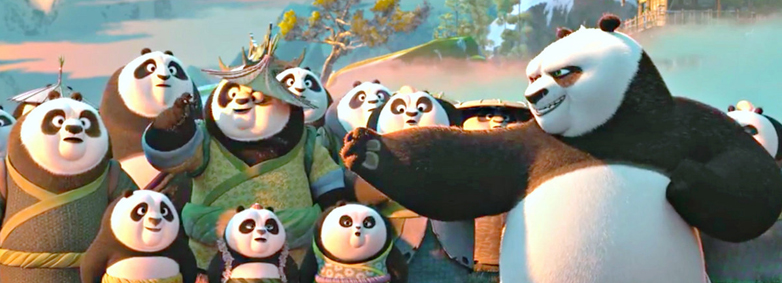
It’s re-enter the dragon warrior as martial arts most portly practitioner returns in his third animated action adventure.

Drawn on a spectacular epic canvas it combines a light hearted tone with a serious message about responsibility, family and achieving one’s potential.

There’s plenty of silly slapstick but no major laughs, relying heavily on the exuberance of Jack Black as Po, the reluctant hero panda of the title.

At home in the Valley of Peace, Po is reunited with Li Shan, his long lost biological dad, played by Bryan Cranston.

J.K. Simmons voices Kai, a giant ox like supreme warlord who’s returned from the spirit world and intent on stealing the everyone’s life force.

With his friends incapacitated, Po the former pupil must become a master and train up some wannabe karate kids to help defeat Kai.

If you enjoyed the first two then this will definitely err, panda to your taste.


A Bigger Splash

Director: Luca Guadagnino (2016)

Dive into the shallow end of the celebrity gene pool in this sun kissed erotic thriller.

Intelligently written and beautifully photographed, it features the normally ultra serious Ralph Fiennes on liberated form as a hyper active hedonist music producer called Harry.

He arrives unexpectedly at the Italian villa of his ex love Marianne, a recuperating rock star.

Tilda Swinton gives a rasping performance as the singer protecting her voice, a symbol of the film’s grand themes of the inability to communicate with honesty and freedom.

Matthias Schoenaerts is in typically morose mode as her new partner Paul, their shared idyll threatened by Harry and his lithe daughter Penelope, played by Fifty Shades star Dakota Johnson.

It’s almost an anthropological examination of human behaviour, a shame the subjects aren’t more deserving of our study.

At first entertaining, the preening narcissism of the characters is wearying during the slow build up to an act of violence. It couldn’t have happened to a more deserving person.


The Big Short

Director: Adam McKay (2016)

Take cover from an atomic bomb of fraud and stupidity in this knockabout drama based on the catastrophic financial crash of 2008.

Based on Michael Lewis’s account published as The Big Short: Inside the Doomsday Machine (pub. 2010) it’s been nominated for five Oscars including best film, best director and best actor for Christian Bale.

Ryan Gosling plays narrator Jared Vennett, an unrepentant bond salesman at Deutsche Bank.

Vennett meets the one-eyed Aspergers sufferer Michael Burry. Played by Bale in a bad haircut,  he’s a maverick hedge fund manager.

Burry’s discovered Wall Street has been selling mortgages to people with no jobs or income.

So he’s ‘shorting’ the housing market, i.e. betting it will crash and anticipates making billions of dollars by betting millions.

Vennett teams up with Steve Carell‘s permanently angry banker Mark Baum to get rich quick.

Yet no-one seems to have fun with the money they’re making or have any idea what to do with it, or even why they’re doing it.

The script wants us to like these guys, showing us their life traumas to garner sympathy.

They’re fictitious versions of real people and we’re encouraged to see them as heroic outsiders, uncovering the impending crisis.

But they willingly keep schtum and treat it as another investment opportunity.

Then the film’s millionaire movie producer Brad Pitt turns up looking like a retired geography teacher and flexing his social conscience, much like he did in his self-produced project 12 Years A Slave (2014).

Pitt plays another banker who makes a min out of the misery of millions..

Financial flicks Martin Scorsese’s The Wolf Of Wall Street (2014) and J.C. Chandor’s Margin Call (2013) have already covered much the same ground as The Big Short.

This hasn’t the blistering riotousness and moral vigour of the former in which Margot Robbie also appeared, and lacks the sober cynicism of the latter.

It’s all very Scorsese light with an up tempo pace and jokey tone created by pop tunes, freeze frames, frantic editing and characters regularly speaking directly to camera.

Plus it’s full of great performances, very energetic and niftily employs a game of jenga to explain what causes the banking meltdown.

But it’s misjudged in its sympathies and patronisingly employs Margot Robbie and Selena Gomez as themselves to explain the maths.

But The Big Short fails to condemn these hypocritical parasites – the bankers not the actresses – and instead dresses them as heroes.

They should be strung up from lamp posts with the rest of the bankers responsible.