Tale Of Tales

Director: Matteo Garrone (2016)

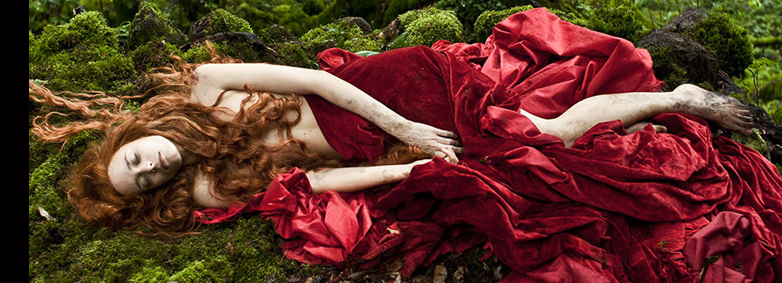
Full of deliciously dark deeds and black comic moments, this fabulously grotesque fairytale is definitely not one for the kids.

In the grand tradition of European folk stories it’s a moral foray through a murky forest of avarice, gluttony, madness, magic and death.

With a minimal of dialogue its entwining stories are expertly twisted together by a marvellous mix of strong performances, stunning costume design, incredible locations and beautiful cinematography.

The loosely connected stories of three medieval monarchs begin with Salma Hayek’s Queen who is longing for a child.

A cloaked figure guarantees her a child but warns of a potentially lethal price. The Queen’s husband must kill a sea monster and its heart must be cooked by a virgin and then eaten by the Queen.

Dishonesty causes repercussions which pass down the years.

Meanwhile Vincent Cassel’s debauched king courts a singing maiden without having seen her face. Toby Jones is a wonderfully distracted king who organises a tournament to find a prince to marry his daughter.

Ogres, giant fleas, leeches,  jugglers, fire eaters, dwarves and a fat lady add flavour to this witches brew of story telling. A circus troupe adds a layer of theatricality and make believe to the mythic environment.

Roccascalegna castle is one of several perfectly chosen examples of Italian architecture which anchor the extraordinary events in our imagination.

None of the royal plans ends in the way they or us expect as they discover lies and self interest have severe and deserved consequences.

The final shot is a breathtakingly beautiful comment on the frailty and difficulty of life, offering a degree of compassion to those who have suffered through their own weakness.

@ChrisHunneysett

Warcraft: The Beginning

Director: Duncan Jones (2016)

Feeling defeated after two hours of crushing cartoon violence, I beat a hasty retreat from this fantasy adventure.

Two worlds go to war in this combination of live action and state of the art animation.

Using motion capture technology, every sabre toothed hairy backed orc is lovingly rendered by photorealistic motion capture. They combat actors sporting lovingly detailed suits of armour.

It’s based on a hugely popular online video game and is set in a extraordinarily designed Tolkienesque world of humans, orcs, dwarves, elves and wizards.

But it’s a sadly underpowered drama of unfathomable mythology and unexplained geography.

Jim Henson’s The Dark Crystal (1982) seems to be a distant visual relative though Warcraft lacks its charm and clear narrative.

Although there’s no A list cast names, Warcraft possesses a recognised brand, a healthy budget and an up and coming director with a passion for the project.

But after this humdrum opener, it’s tricky to see how it will power the intended franchise to continued success.

There’s little sense of the early promise of Jones directorial career which kicked off with the smart and intimate sci fi thriller Moon (2009). It is an intelligent and intimate chamber piece. His follow up Source Code (2011) was less strong and now Warcraft completes a downward trajectory from which I hope he will recover.

A self confessed super fan of the game, Jones creates a world of extraordinary visual depth. With the excited air of a wayward puppy he rushes about to include as much of it as possible.

This is to the detriment of the dramatic tone which mostly occurs within a narrow bandwith, hovering at the level of Saturday morning kids TV.

A major contributing factor in the magnificence of Peter Jackson’s The Lord Of The Rings (2001-03) trilogy was having the good fortune to be based on the writings of an Oxford scholar and the canny casting of experienced Shakespearean actors to give his dialogue gravitas. An under reliance on computer imagery helped enormously to ground the fantastical elements.

There’s a noticeable lack of such rich cultural heritage here. This is a shame as buried deep down is a cracking old fashioned story of family, betrayal and star crossed lovers.

Daniel Wu glowers as Gul’dan, a powerful orc shaman whose world is dying. Human sacrifice powers his evil green magic which he uses to open a portal into the peaceful human kingdom of Azeroth.

He sends through his fearsome orc warriors to conquer it, crushing their enemies with a signature move of using huge hammers to slam them bloodlessly into the ground.

The orcs are awesome looking eight foot tall humanoids. Pneumatically muscled and sabre toothed, they dress in in the skulls and furs of defeated foes.

Defending their land against the horde are a collection of wizards and warriors. They’re led by a puzzled looking Dominic Cooper who plays King Llane.

I shared his confusion as the story whizzes from castle to battle to floating fortress in the sky.

Travis Fimmel’s knight and Paula Patton’s green skinned half orc captive are given the best of the scarce humour. The way these two characters are brought together and assume greater prominence is one of the film’s few strengths.

As orcs who question Gul’dan’s vicious regime, Toby Kebbell and Anna Galvin give the most effecting performances and share a personal chemistry notably lacking almost everywhere else.

On the eve of the final battle, the King gives us two words from Shakespeare’s Henry V Agincourt speech before rushing off for yet another fight. This suggests a lack of confidence in the attention span of the audience.

As everyone struggles with the functional dialogue, CGI armies slash, stab and slay. A lot of casualties are reduced to husks when their life force is sucked out of them.

It’s a risk unwary viewers will share.

@ChrisHunneysett


Alice Through The Looking Glass

Director: James Bobin (2016)

It’s six long years since the staggeringly successful but forgettable Alice In Wonderland (2010) from director Tim Burton.

And time drags in this muddled sequel which has even less connection to the fantastical novels of Lewis Carroll.

There’s no lyrical sense of wonder just hack handed sentiment, blunt slapstick and plodding special effects.

It jettisons familiar characters into two distinct and parallel plots of its own invention, respectively involving time travel and female empowerment. The resolution of family conflict joins the two strands loosely together.

Never forget Hollywood’s golden rule of scriptwriting; a film is always about family, regardless of how appropriate it is to the material.

Burton butchered Carroll’s whimsical masterpiece, replacing its playful intelligence, charm and wit with flamboyant gothic design and an excruciating mannered performance by Johnny Depp as the Mad Hatter.

Against the odds, Burton’s replacement James Bobin has made an even more unwieldy and incoherent film.

Previously Bobin directed The Muppets (2011) and Muppets Most Wanted (2014). He began in TV with The 11 O’Clock Show (1998) where he collaborated with Sacha Baron Cohen. The comic actor features heavily if sadly not hilariously in Looking Glass.

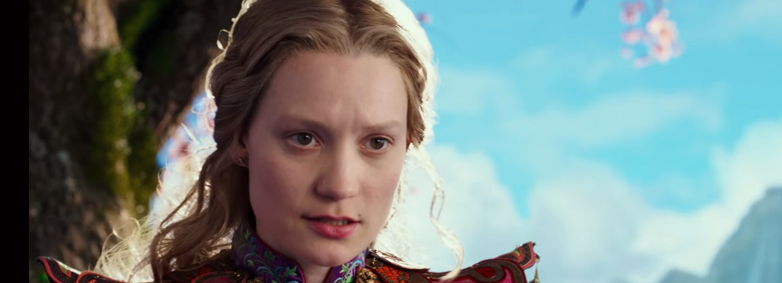
Despite Alice being reinvented as an action heroine, the pale Mia Wasikowska gives a pallid performance as Alice. Perhaps she’s miffed she’s billed a humble third after Depp and Anne Hathaway.

Alice steps through a mirror and falls into Wonderland, immediately signalling to us nothing in this world can hurt her. Which destroys any potential sense of danger in one dull thud.

She is told her friend the Mad Hatter has gone more mad but in a bad way, and is dying.

In white face paint, orange wig and tweeds, Depp’s Hatter resembles Ronald McDonald’s eccentric great uncle after confinement to a suitable attic.

To cure him Alice must do the impossible task of stealing a device called the chronosphere and go back in time to rescue his long lost family.

Removing the time travelling machine risks destroying Wonderland and everyone in it. But this threat is quickly forgotten about as the film is more interested in whizzing Alice about. There’s a surprise incursion to an insane asylum.

Alice is chased by Time who wants his contraption back. The film can’t decide if the black clad and German accented Sacha Baron Cohen is the baddie.

Also vying to be the baddie but failing in villainy are Helena Bonham Carter and Hathaway. They make a squabbling return as respectively the large headed and rude Red Queen and the elegant and duplicitous White Queen.

The presence of Bonham Carter, his now ex-wife, may explain Burton’s exclusion from the director’s chair.

The sepulchral tones of the late Alan Rickman offers a fleeting moment of gravity. While in her brief appearances as Alice’s mother, theatrical Scots stalwart Lindsay Duncan makes more of an impression than Wasikowska achieves.

Lending their voices to the advertising poster in some un-necessarily expensive casting choices are Stephen Fry, Michael Sheen, Timothy Spall, John Sessions, Barbara Windsor, Paul Whitehouse and Toby Jones.

Usually my heart despairs whenever Matt Lucas appears so it says a great deal about the film I found his presence curiously bearable.

Alice won Oscars for Best Art Direction and Best Costume Design, as well as being nominated for Best Visual Effects.

No doubt Looking Glass will follow the first film in being in the running for similar awards. It’s rich and detailed production design gives us plenty to look at while everyone busily runs around.

The chronosphere is a golden mechanical marvel Alice sits in to blast back in time, a design nod to George Pal’s teen culture embracing adaption of HG Well’s The Time Machine (1960).

Alice visits vast gothic halls and traverses a tumultuous ocean of time. The world is populated by  mechanical assistants, vegetable guardsmen, giant chess pieces, a fire breathing Jabberwocky, walking frogs, talking dogs and of course the disappearing Cheshire Cat.

Bookending the film is a framing device featuring Alice’s adventures at sea pursued by pirates. Because the world needs another big budget CGI fest involving Johnny Depp and pirates.

The story stresses the importance of not wasting ones time. Which is strange as I wasted two hours of my life watching this joyless merry go round of a movie.

Mind you, it felt much longer.

@ChrisHunneysett


Victor Frankenstein

Director: Paul McGuigan (2015)

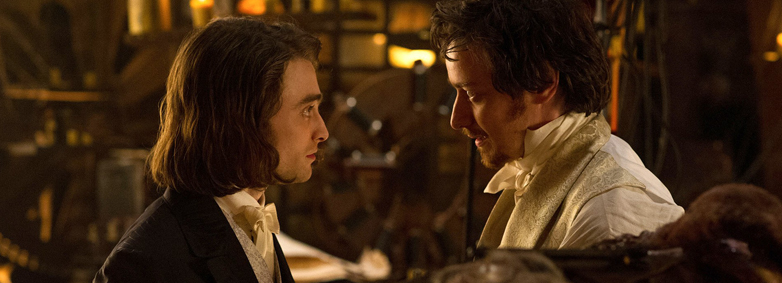
There’s magnetism a foot as the electric talent of James McAvoy and Daniel Radcliffe jolt Mary Shelley‘s gothic horror back into life.

This romping reinvention relocates the story to London and is told in flashback by Radcliffe’s hunchback Igor.

Lurching from action set piece to another, it has someone’s tongue stitched firmly in it’s cheek.

McAvoy gives a gleefully twitching turn as the mad scientist who wants to prove death is temporary by recycling dead bodies and applying shock treatment.

Recreated as a Victorian gentleman adventurer, he’s a monster mash-up of Robert Downey Jnr’s Sherlock Holmes (2009) and Hugh Jackman’s Van Helsing (2004).

Recognised as talented pair of hands, Igor is rescued from life as a brutalised circus clown by McAvoy’s mad medical student Frankenstein.

He’s the brains of the partnership with the choice cuts of dialogue, while Igor is the heart, feeding off the rump scraps of the script.

Soon the pair are in the laboratory and up to the elbows in blood and gore.

While Victor is working the graveyard shift cutting up cadavers to complete a creature, Igor and a trapeze artist called Lorelei practise making life the old fashioned way.

Better known as Lady Sybil from TV’s Downton Abbey, Jessica Brown Findlay role is only really required to add a pretty face to the bones of the action.

Unsurprisingly the finale involves a castle, a reconstructed cadaver and a lightning storm.

If it’s not quite the exquisite show of depraved lunacy a bystander claims he hopes to see, Victor Frankenstein does manage to be energetic and knowingly silly.

The Hunger Games. Mockingjay Part 2

Director: Francis Lawrence

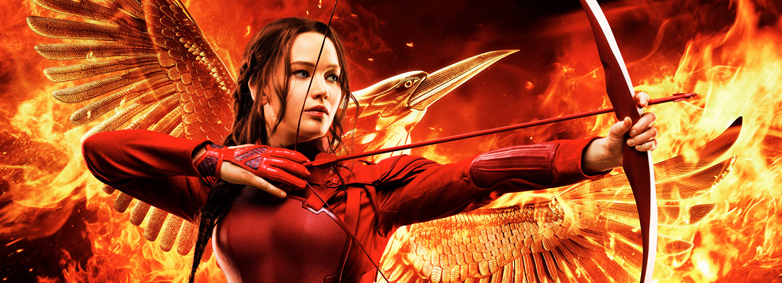
Jennifer Lawrence takes arms against the world for the fourth time as in this concluding chapter of the dystopian sci-fi series.

As freedom loving fighter Katniss Everdeen, Hollywood’s highest paid actress offers a typically excellent performance of weary intensity.

She is given far less opportunity to display her fighting skills in this sombre episode.

It’s handsome, well acted and thoughtful, yet the dialogue is often uninspiring and it’s a long march to the action.

By adding scenes with human shields and a trail of refugees the script plunders contemporary concerns but doesn’t offer comment.

Initially we’re forced to put in a few hard yards ourselves as we’re re-introduced to the motivations of the characters and it’s almost a relief when war starts whittling away their numbers.

As her comrades die in the cause of freedom, Katniss longs to fight.

But Julianne Moore’s scheming rebel commander Coin considers Katniss a useful propaganda tool and refuses to let her.

When the unified rebel army marches on the Capitol, Katniss is embedded in a media platoon which contains both points of her love triangle.

But there isn’t much tension between hunky warrior Liam Hemsworth Gale and Josh Hutcherson‘s brainwashed former turncoat Peeta.

Both are fairly dull characters but with Sam Claflin’s maverick warrior Finnick married off, she hasn’t much to choose from.

When her squad commander is killed, Katniss takes charge and leads her team on a suicide mission.

Her target is to assassinate Donald Sutherland’s evil despot President Snow who is holed up in an opulent and heavily guarded mansion.

As Katniss navigates the rubble strewn streets, she’s lumbered with a device which suspiciously resembles a game console.

It’s designed to detect Snow’s extraordinarily elaborate booby-traps.

The troops combat floods, flame, friendly fire and ferocious underground ghouls.

Friends and family are killed or captured as they trek through the terrain of the fallen city and Katniss has a suicide pill should her plan fail.

Though the foreboding tone is sensibly free of laughs, the regular supporting cast bring smiles of recognition.

Elizabeth Banks and Stanley Tucci don their fabulous costumes one last time and a shambling Woody Harrelson adds some welcome warmth.

The late Philip Seymour Hoffman has a surprisingly large amount of screen time in a final hurrah for his great talent.

Four years ago Lawrence was a little known actress.

Now due in no small part to The Hunger Games’ billion dollar success, she’s firmly and deservedly part of the A list.

By tackling the themes of war, freedom, suffering and sacrifice in a measured and occasionally spectacular fashion, this franchise has raised the bar for the Young Adult genre.

But as solid and satisfying as the Hunger Games are, I’ve had my fill and I couldn’t stomach another one.

Crimson Peak

Director: Guillermo del Toro (2015)

This lavishly stylised and violent fairytale splashes around buckets of blood but is sadly anaemic.

Inspired by the Hammer House of Horror films, the period sets and costumes are fantastic though the story is predictable and lacks bite.

It begins as a sumptuous and intriguing gothic romance bubbling with ideas, filtered through the director’s usual motifs of steampunk contraptions and ladies of letters.

But once the story leads to bleak estate in the north of England where red clay oozes from the mansion’s every pore, proceedings become bogged down in sticky CGI.

There’s a workshop in the tower, many doors are locked and Edith is warned not to go down to the cellar.

it all sadly ends with all the suspense of a steroid-filled episode of Scooby Doo. But without any of the fun.

Talented Mia Wasikowska is at her insipid worst as young heiress Edith Cushing who follows her new husband Sir Thomas Sharpe to his crumbling gothic pile.

The baronet is pallid, impoverished and played in impeccable black by the devilishly charming Tom Hiddleston.

The pair played vampiric siblings in the superior Only Lovers Left Alive (2013) in which they vividly essayed far more interesting characters.

Here Jessica Chastain plays Hiddleston’s screen sister who keeps her brother’s best interests close to her heart. With barking intense piano playing and a choice wardrobe, she dominates her every scene.

An anonymous Charlie Hunnam plays a lovelorn ophthalmologist left looking for clues, probably as to where any sense of mystery or danger is.

Pan

Director: Joe Wright (2015)

Set sail to the stars with the boy who never grew up in this magical family fantasy.

Based on the tales of J.M.Barrie, it’s the action packed story of how the young orphan Peer first encounters the fantastical world of Neverland and discovers his destiny.

Die-hard fans of the book may be aghast at the liberties taken with the characters.

But there are compensations in this old fashioned adventure which is bolstered by some lovely design and beautiful animation.

Levi Miller is tremendously confident and engaging as the orphan Peter who is kidnapped from London by a flying pirate ship and whisked off to Neverland.

It’s a riotous place of broad humour, acrobatic fights, circus colours and rock songs, populated by Never-birds, crocodiles and fairies.

He’s set to work in a huge mine where he has to dig for Pixum, the powerful pixie dust.

It’s craved by the villainous pirate chief Blackbeard, performed in a lively pantomime by Hugh Jackman.

Peter escapes with the future Captain Hook, a two-handed rascal in the mould of Han Solo from Star Wars (1977).

Garrett Hedlund strives manfully in an unenviable role which requires a physical performance full of charm, humour and an edge of mystery and danger.

It’s too bad he’s not a young Harrison Ford but then again, who is?

He flirts unconvincingly with the kick ass princess Tiger Lily who’s from a multi-racial tribe of natives.

The character is described as a ‘redskin’ by Barrie and by allowing itself to be accused of whitewashing the role, the film scored a soft publicity own goal.

I’m far more concerned with Rooney Mara’s forgettable performance in a disappointingly thinly written female lead.

Her and Hedlund seem cast by committee.

Kathy Burke has fun as a devious nun and Cara Delevingne is alluring as a pod of mermaids.

Tiger Lily is mostly there to explain to Peter his part in a prophecy.

In order to fulfil it he must learn to believe in himself if he wants fulfil his destiny.

Director Joe Wright has form with making very theatrical film versions of classic books, such as in his Anna Karenina (2012).

He brings out the spectacle of the source material which was of course originally written for the stage.

Go on this awfully big adventure and you will believe in fairies.

★★★☆☆

The Age Of Adaline

Director: Lee Toland Krieger (2015)

A woman who never grows old falls for a much younger man in this weird fantasy romance.

Adaline Bowman (Blake Lively) lives alone, is kind to her dog, speaks in a breathy register and laughs at her own jokes.

Although really 107 years old, a mysterious event when she was 29 has prevented her from ageing.

Ever since the FBI tried to arrest her for being a suspected threat to the US, she’s been dodging the authorities and running away from love and commitment.

She changes addresses and identities every ten years, allowing the Costume and Make-up deptartments (Angus Strathie, Monica Huppert) to make Lively look lovely in all the major fashions of the twentieth century.

Plus it usefully acts as a visual shorthand for whatever decade we find ourselves in during one of the many flashbacks.

Her only friend is piano player Regan (Lynda Boyd) which suggests Adaline has been seeking out blind people to hang with as they don’t recognise her lack of ageing.

At a New Year’s Eve party she meets the hunky, needy, pushy yet altruistic internet millionaire Ellis (Michiel Huisman).

He’s not as endearing as the film imagines him to be and Adaline tries to reject his advances due to their secret age difference.

There are several dates, shooting stars, snow storms, two car accidents and a drive-in movie.

Despite Adaline’s reservations she agrees to visit Ellis’s parents where someone kindly explains the rules of Trivial Pursuit for those watching who haven’t played it.

It leads to a big surprise for his dad Bill (Harrison Ford) on the eve of his fortieth wedding anniversary to Kathy (Kathy Baker).

Ford seems energised for the first time in years and is allowed a door-smashing moment. Perhaps being back home on the Falcon is therapeutic.

However it’s at this point the heavy air of sentimental nostalgia curdles and becomes creepily uncomfortable.

A gravelly voice over by Hugh Ross offers the only grit available as well as the illusion of a patina of science.

San Francisco looks fabulous and the true romance on show is between the city and cinematographer David Lanzenberg.

Scriptwriters J. Mills Goodloe and Salvador Paskowitz are also enamoured of the city, highlighting it’s history as a leader of technological innovation.

Somebody ought to point out to the writers gifting first editions of famous novels only counts as romantic if there is a financial, emotional or other cost to the donor.

A millionaire dishing out rare works to relative strangers they wish to bed smacks not of romance but thoughtless opportunism.

The Age Of Adaline suggests grey hair and wrinkles are the gateway to true love; a sly commentary on women who can’t accept growing old and resort to going under the knife.

But if you want to send this sort of message then it’s important to create an effective and engaging delivery system first.

Lost River

Director: Ryan Gosling (2015)

A mother struggles to keep her family safe in this challenging and contemporary nightmarish fairytale.

Director Gosling can’t be faulted for a lack of ambition in his directorial debut, it’s the Hollywoods heart-throb’s execution of his underdeveloped story that let’s him down.

Billy (Christina Hendricks) is three months behind on the mortgage and local bank manager Dave (Ben Mendelsohn) suggests she takes a job with Cat (Eva Mendes)

She runs a local cabaret, owned by Dave. It’s a strange, credit card-accepted-only place where the acts involve the dismemberment of beautiful women. The audience gleefully lap up this conflation of sex and violence as bloody entertainment.

However it’s downstairs in the secret chamber where the girls can make the real money but the fearful Billy is reluctant despite the pressure to do so.

Meanwhile her eldest son Bones (Iain De Caestecker) is friendly with Rat (Saoirse Ronan) who lives next door with her grandmother.

Their tentative relationship is threatened by the local hardman called Bully (Matt Smith). Bones has fallen foul of Bully for stealing copper pipes and the plier-wielding psychopath is out for revenge.

It is an apocalyptic setting, there’s no internet for a start. The bureaucracy still operates though.

The destruction of the man-made environment is ongoing; sledgehammers smash through walls, bulldozers rip down houses, buildings are burnt to the ground, there are burnt out cars and dinosaur statues. The elemental power of fire and water are recurring motifs.

Detroit and its astonishing urban decay are exploited to good effect; roads are swamped by a green and aggressive mother nature. Zoos are empty, neighbourhoods are abandoned.

Encounters with random people seem unscripted and there’s far too much improvisation to too little effect. Dialogue is sparse and there are no real conversations but lots of questions asked in an open-ended teenage way.

Insufficient menace and tension are generated by a languid pace.

In natural light Gosling throws in every shot he has heard of with no rythym or reason; dutch angles, tracking shots, overhead pans, shifting focus – and all in the first five minutes.

It does possess a strong sense of colour with many scenes saturated, giving Hendricks hair and complexion a startling vivacity.

There’s nothing wrong with the work of editors Nico Leunen and Valdis Oskarsdottir or of cinematographer Benoit Debie – just a lack of cohesive thought in preparing the shoot.

The soundtrack is a curious combination of industrial noises and old melodies; Mendelsohn gives an unexpected performance of Bob Nolan’s 1936 western song Cool Water.

As an actor Gosling has made some interesting work with director Nicholas Refn and is strongly influenced by his work. There’s also touches of David Lynch though this is not necessarily a compliment.

More random ideas bandied about include the character of Rat’s Grandmother who has been mute since her husband died building a reservoir. She watches the video of her wedding day on a loop, echoing Miss Havisham in Great Expectations.

All the actors commit themselves to the directors vision and some are familiar with him. Both Mendelsohn and Mendes worked with Gosling on The Place Beyond The Pines (2012) while Hendricks appeared in the Refn’s Drive (2011) with Gosling. Ronan appeared in the similarly fairytale inflected Hanna (2011).

Lost River feels like a film shot with the intention of finding itself in the edit. It may still be looking.