Point Break

Director: Ericson Core (2016)

This shallow remake of Kathryn Bigelow’s 1991 surfing cop classic arrives dead in the water, lacking any sense of danger or fun. Or any sense at all.

The wild thrill ride of Bigelow’s action movie has been refashioned as a stumblingly  hyperactive extreme sports eco thriller.

Luke Bracey’s dons Keanu Reeves’ old wetsuit as an extreme sports ‘poly-athlete’ turned trainee FBI agent Johnny Utah. But he lacks the charm, looks and talent of his predecessor.

Edgar Ramírez replaces Patrick Swayze as the enigmatic Bodhi, the nirvana chasing leader of the criminal gang Utah has to bring to justice.

Following the plot of the superior first film, Utah goes undercover to infiltrate Bodhi’s crew of bank robbing, wealth distributing whale huggers.

Showcasing their tatts and abs at every opportunity, they surf, climb and batglide their way around the globe.

It’s as if they haven’t considered a consequence of dropping bundles of banknotes in impoverished rural areas will cause localised hyperinflation and make the residents poorer.

Or put another way, I was so uninvolved with the story I found myself applying economic theory to their actions, rather than cheering an act of audaciously performed philanthropy.

Utah’s backstory relies on a stunt borrowed from Taxi (1998), the not much remembered, Luc Bresson produced, action comedy. One fears this does not bode well for what’s to follow, but sadly said boding is far from adequate.

Director Ericson Core began his career as a cinematographer and it shows. Wearing both hats here he conjures some wonderful images, especially down in the fresh surf and up on the snow.

But as a storyteller he’s woeful, offering ciphers instead of characters who spout appalling dialogue.

The aesthetic is teenage cool, lots of posing in front of burning cars and graffiti’d underground gang hangouts.

Utah carries a Zippo because it’s a cool thing to do. He doesn’t go so far as to carry any cigarettes. Because smoking isn’t cool. Unless you’re offered a toke on a joint, which is edgy and therefore cool and allows for a cool pose.

Ray Winstone growls and tries to make himself useful as overseas FBI agent Angelo Pappas, but he has nothing to contribute to the plot.

Teresa Palmer’s position as bikini clad babe Samsara Dietz is to be leered over by the camera and prove Utah’s heterosexuality. And cook dinner for the chaps.

As a replacement for Lori Petty’s fierce and sculptured surfer from the original, Palmer is hopelessly out of her depth.

Delroy Lindo is Utah’s FBI controller who’s passion is for extreme exposition.

Employing three different editors suggests a reason why the movie feels so piecemeal, it’s a collection of set pieces strung together not a coherent story.

Plus edited in the irritated manner of a music video sells the stunts short. Much longer edits would sell us a frisson of much needed veracity, creating a threat the guys may at some point be hurt.

But as the stunts become bigger and higher, the stakes become lower. We’re not invested in the story and the physics defying leaps possess the dramatic depth of a video game.

There’s an absence of humour and no sense of the film is aware of it’s own preposterous nature.

Flagged up twice is the film’s one interesting idea, that the FBI are acting as the security wing of multinational corporations, inverting the good guy/bad guy dynamic and making Utah the villain.

But it’s not explored in any way and brushed aside in favour of yet more lightweight action.

The stunt team and camera operators deserve plaudits but for everyone else it’s a wipeout.

In The Heart Of The Sea

Director: Ron Howard (2015)

It’s all hands on deck for an epic old fashioned adventure on the high seas.

Based on the events which inspired Herman Melville‘s classic novel Moby Dick, it’s a shipshape and manly yarn full of arrogance, greed and danger.

The story is anchored by the reliable talents of Ben Whishaw and Brendan Gleeson as novelist Melville and drunken old sea-dog Thomas Nickerson.

One dark night in 1850, Melville pays Nickerson to tell the truth behind the voyage of the whaling ship The Essex, on which he served on as a cabin boy thirty years earlier.

Whaling is a dangerous and potentially lucrative industry, harvesting the seas for oil to serve America’s fast growing population.

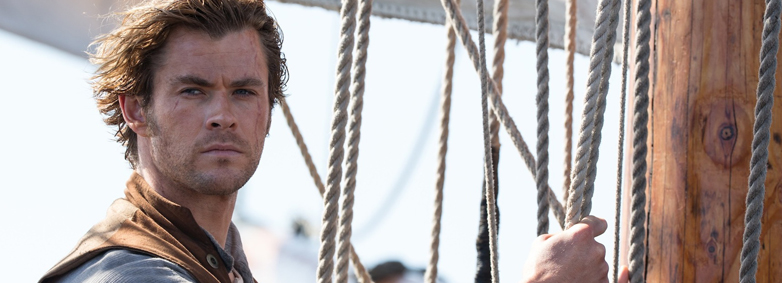
Back then Nickerson was in the charge of Owen Chase, an experienced first mate, played with manly gusto by Chris Hemsworth.

The star of Marvel’s Thor always gives good smoulder and here he glowers with resentment.

Impoverished and eager to provide for his pregnant wife, Chase’s ambitions to captain his own ship are thwarted by the shipping company directors.

They make him serve under Benjamin Walker’s novice Captain Pollard, the privileged son of an important investor.

Lashed together in mutual antipathy and greed, they sail from Nantucket round Cape Horn to the Pacific ocean.

The scenes where the crew row out in tiny boats to manually harpoon their enormous prey are terrific.

But the increasingly desperate hunt for whales goes awry with the crew facing fires, storms, mutiny and of course a very angry white whale.

The heart of the sea becomes a very dark place indeed as despair and madness grip the sailors.

Following Rush (2013) the biopic of motor racing star James Hunt, this is the second film Ron Howard has made with Hemsworth.

Exciting, intelligent and respectful to it’s source In The Heart Of The Sea is the sort of film Hollywood is now accused of not making any more.

Well now they have so you really should go and see it.


The Revenant

Director: Alejandro G. Inarritu (2016)

Gripping, grisly and grizzly, this epic revenge western is the first must see film of 2016.

Leonardo DiCaprio goes hunting for the best actor Oscar in this thrilling and icily apocalyptic adventure.

Despite his best efforts, notably his portrayal of a ravenous financier in The Wolf of Wall Street (2014), the Academy award has so far eluded him.

But on this form as fur trapper and explorer Hugh Glass, there’s every chance he’ll bag it.

While on an expedition in the uncharted Northern frontier, Glass is brutally mauled by a bear.

I could barely endure the ferocious scene as the angry beast tears away at Glass with it’s hot breath steaming the camera lens.

He just about survives only to see his son murdered and find himself abandoned.

Driven by his pain and suffering Glass begins a 200 mile odyssey across the wild, wild west, intent on killing the man who betrayed him.

On the lonesome trail Glass endures being washed away, buried alive, burned and stabbed.

There’s visceral violence and dialogue as sparse and unforgiving as the environment.

For those who aren’t convinced by DiCaprio’s acting ability, they should see how much he conveys here while speaking very little.

Meanwhile as an old native American leads a war party in search of his missing daughter, a party of French hunters are wreaking destruction across the landscape and complicating Glass’ progress.

A huddle of orphaned children, murdered sons, forgotten wives and rich fathers are offered as a limited backstory for various characters, tying them together in a litany of loss.

With long stretches of screen time dialogue free, character is conveyed though action. The principals are aware of the conflicts in the damnable choices they face.

A trio of British actors offer brilliant support to DiCaprio.

With Mad Max: Fury Road (2015), Legend (2015) and Locke (2014) Tom Hardy is enjoying a great run of projects.

He plays the pipe smoking trapper Fitzgerald, a vicious pragmatist rather than evil incarnate.

Even more blessed with an uncanny knack of choosing great projects is the likeable, versatile and always interesting Domhnall Gleeson.

He comes of age as Captain Henry, the leader of the hunting expedition who is out of his depth.

Will Poulter is Jim Bridger, the youngest of the troop and arguably the closest it carries to a conscience.

Editor Stephen Mirrione previously worked on Birdman (2015) and won an Oscar for Steven Soderbergh’s Traffic (2000).

His signature long edits create an intensive immediacy and putting us uncomfortably in the centre of the action.

Cinematography Emmanuel Lubezki won consecutive Oscars for Gravity (2014) and Birdman (2015) and may well earn a third here.

Director Inarritu won best film, director and screenplay Oscars for Birdman (2015) and it would it not be undeserved if he repeated the trick in 2016, though in the adapted screenplay not original screenplay category as in Birdman (2015).

As in Birdman (2015) Lubezki’s ceaselessly circling camera work puts us in the middle of the action whether on horseback, on boats or underwater.

We witness an avalanche, rape, castration, shoot outs, knife fights, a hanging, a massacre and the aftermath of several more.

The landscape is alive with moose, wolves, horses, fish, buffalo and ants, demonstrating how ill geared humanity is to surviving in this fierce winter wonderland.

Set in Wyoming the production went snow chasing through Canada, the United States and Argentina to achieve the frostbitten extremes of the American frontier.

Grounded in fire, rock and ice, the elemental force of the film is captured in blues,whites and greys, with explosive moments of orange punctuating the palette.

Visual reference points are Robert Altman’s McCabe And Mrs Miller (1971) and Werner Herzog’s Aguirre: Wrath of God (1972).

Thematically the story draws on Ridley Scott’s Gladiator (2000) and John Ford’s The Searchers (1956). It is based on Michael Punke’s 2002 novel of the same name inspired by the exploits of the real Hugh Glass.

Ideas of commerce and colonisation swirl around the contemporary issues of the ownership of natural resources, the conflict between races and the role of the military in a civil society.

The Revenant means ‘the returned’ and refers to a person who comes back from the dead.

It sounds like a combination of ‘revenge’ and ‘covenant’, god’s code of behaviour issued to Moses in the Old Testament.

These two ideas compete within Glass for supremacy as he battles towards his prey.

Glimpses of Glass’ late wife through fragments of memories remind us of his spirituality even as he symbolically swathes himself in bearskin.

Eating its flesh shows his growing connection with the environment but also suggests a departure from the rational to an animal state.

In fables there is always a limit to how long one can adopt the shape of another creature before losing one’s humanity for ever.

Glass’ quest for revenge becomes a battle for his soul from which he may never recover.

A chilling final frame questions the audience as to how they would behave in Glass’ circumstances. It’s an electrifying end to a remarkably realised endeavour.

@ChrisHunneysett

Victor Frankenstein

Director: Paul McGuigan (2015)

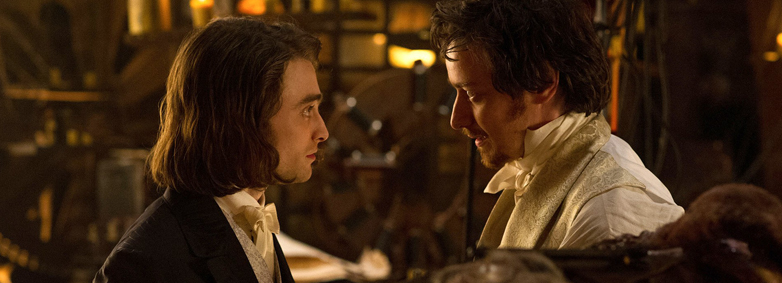
There’s magnetism a foot as the electric talent of James McAvoy and Daniel Radcliffe jolt Mary Shelley‘s gothic horror back into life.

This romping reinvention relocates the story to London and is told in flashback by Radcliffe’s hunchback Igor.

Lurching from action set piece to another, it has someone’s tongue stitched firmly in it’s cheek.

McAvoy gives a gleefully twitching turn as the mad scientist who wants to prove death is temporary by recycling dead bodies and applying shock treatment.

Recreated as a Victorian gentleman adventurer, he’s a monster mash-up of Robert Downey Jnr’s Sherlock Holmes (2009) and Hugh Jackman’s Van Helsing (2004).

Recognised as talented pair of hands, Igor is rescued from life as a brutalised circus clown by McAvoy’s mad medical student Frankenstein.

He’s the brains of the partnership with the choice cuts of dialogue, while Igor is the heart, feeding off the rump scraps of the script.

Soon the pair are in the laboratory and up to the elbows in blood and gore.

While Victor is working the graveyard shift cutting up cadavers to complete a creature, Igor and a trapeze artist called Lorelei practise making life the old fashioned way.

Better known as Lady Sybil from TV’s Downton Abbey, Jessica Brown Findlay role is only really required to add a pretty face to the bones of the action.

Unsurprisingly the finale involves a castle, a reconstructed cadaver and a lightning storm.

If it’s not quite the exquisite show of depraved lunacy a bystander claims he hopes to see, Victor Frankenstein does manage to be energetic and knowingly silly.

The Good Dinosaur

Director: Peter Sohn (2015)

As plodding as the hero of the title, this prehistoric animated adventure is occasionally exciting, funny and sad, but never in any great measure.

Made by Pixar and released by Disney, it’s a middling effort which has made it to the screen after a difficult production.

History was changed 65 million years when an asteroid didn’t hit the earth and wipe out the dinosaurs.

They’ve evolved to speak, build houses and grow crops.

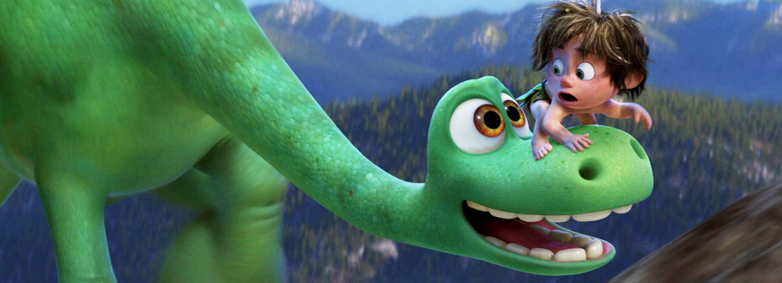
Arlo is a cowardly and dim Apatosaurus who after some reckless parenting, is lost in the wilderness.

He’s befriended by a brave caveboy nicknamed Spot and together they set off on the long trek home.

Raymond Ochoa whines and whimpers as Arlo and Jack Bright grunts and howls as Spot.

Episodic adventures follow one another and we’re invited to admire the magnificent vistas on the way. They are epic in scale, beauty and frequency.

Credited as ‘Volumetric Cloud Supervisor’, Matthew Webb does a stand up job styling the weather.

Meanwhile the sweeping herds of prehistoric wildebeests are sufficient to placate even the most intemperate guests of Torquay hoteliers.

There’s an unfortunate contrast between the stunning photo-realistic backgrounds and the cartoon cast of rubbery skinned, glass eyed dinosaurs of uncertain charm.

It’s distracting, as if Mickey Mouse popped up in a David Attenborough documentary.

The first director was sacked halfway through, the script was re-written and the cast almost completely replaced.

One character says ‘we must gather our crops before the first winter storm’ immediately after a winter storm. Just one example of a failure to iron out all the issues.

Minor characters are churned through the script before being forgotten.

With all this in mind it’s a marvel the film is as competent as it is.

Kids will love the game of whack-a-mole and adults will grin at the magic mushrooms reminiscent of Dumbo (1941).

Parenting orders are hammered home in heavy handed homilies by Jeffrey Wright‘s daddy dinosaur.

Obey your parents. Do your chores. Don’t play in the river. Do kill your enemies. Not very Disney that last one.

I felt lectured and wanted to rebel. And I’m a parent. Lord knows how children will respond to this.

There’s a strong Western vibe as the boy and his dog, sorry, dinosaur and his boy trek home to their farmstead.

As they meet cowboys along the trail, Sam Elliot adds his magnificent Texas drawl to a tall-tale telling Tyrannosaurus Rex.

He’s called Butch, a sly reference to the actor’s cameo in the classic Butch Cassidy and the Sundance Kid (1969).

The Good Dinosaur is neither brilliant or awful. Good is the operative word.

Scouts Guide To The Zombie Apocalypse

Director: Christopher B. Landon (2015)

There’s a bucketful of juvenile bad taste fun splashing about in this unsophisticated zomcom.

It’s a teenage boy fantasy of blood splattering adventure, available hot older babes, pneumatic policewomen and strippers.

After an incident featuring a janitor, a lab and a vending machine, the zombie apocalypse begins in a dull small town.

A trio of horny scouts find their outdoor skills come in unexpectedly useful.

Joey Morgan, Logan Miller and Tye Sheridan play the scouts and are respectively fat, loud and sensitive.

Loyalties are divided and the boys’ friendship is tested as they fight their way across town to gatecrash a secret rave.

David Koechner is their wig wearing Scout Leader whose Dolly Parton obsession extends to having her bust on his living room wall.

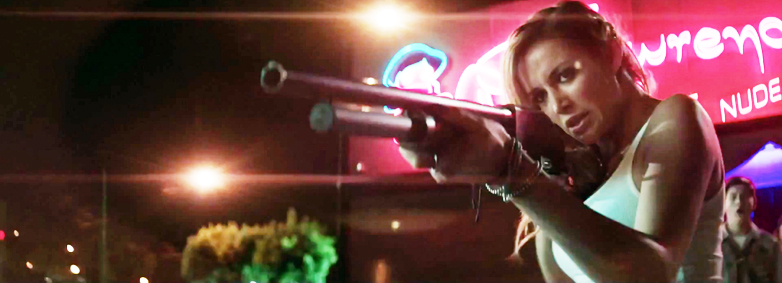
Sarah Dumont is a shot-gun wielding cocktail waitress in denim hot pants who offers leggy life lessons.

Cloris Leachman potters about as a secateur wielding senior citizen.

A vaguely mentioned viral outbreak is as much explanation as the script is interested in offering in explanation.

Instead the focus is on keeping the action brisk and the humour flowing.

It’s easy to imagine it as the spawn of the sci-fi biker sequence from John Hughes’ Weird Science (1985) stretched to a feature length.

Nor is it a million miles away from Life After Beth (2014) in tone, ambition or budget.

Teenage boys will love it but everyone else may want to avoid it like the zombie plague.

Pan

Director: Joe Wright (2015)

Set sail to the stars with the boy who never grew up in this magical family fantasy.

Based on the tales of J.M.Barrie, it’s the action packed story of how the young orphan Peer first encounters the fantastical world of Neverland and discovers his destiny.

Die-hard fans of the book may be aghast at the liberties taken with the characters.

But there are compensations in this old fashioned adventure which is bolstered by some lovely design and beautiful animation.

Levi Miller is tremendously confident and engaging as the orphan Peter who is kidnapped from London by a flying pirate ship and whisked off to Neverland.

It’s a riotous place of broad humour, acrobatic fights, circus colours and rock songs, populated by Never-birds, crocodiles and fairies.

He’s set to work in a huge mine where he has to dig for Pixum, the powerful pixie dust.

It’s craved by the villainous pirate chief Blackbeard, performed in a lively pantomime by Hugh Jackman.

Peter escapes with the future Captain Hook, a two-handed rascal in the mould of Han Solo from Star Wars (1977).

Garrett Hedlund strives manfully in an unenviable role which requires a physical performance full of charm, humour and an edge of mystery and danger.

It’s too bad he’s not a young Harrison Ford but then again, who is?

He flirts unconvincingly with the kick ass princess Tiger Lily who’s from a multi-racial tribe of natives.

The character is described as a ‘redskin’ by Barrie and by allowing itself to be accused of whitewashing the role, the film scored a soft publicity own goal.

I’m far more concerned with Rooney Mara’s forgettable performance in a disappointingly thinly written female lead.

Her and Hedlund seem cast by committee.

Kathy Burke has fun as a devious nun and Cara Delevingne is alluring as a pod of mermaids.

Tiger Lily is mostly there to explain to Peter his part in a prophecy.

In order to fulfil it he must learn to believe in himself if he wants fulfil his destiny.

Director Joe Wright has form with making very theatrical film versions of classic books, such as in his Anna Karenina (2012).

He brings out the spectacle of the source material which was of course originally written for the stage.

Go on this awfully big adventure and you will believe in fairies.

★★★☆☆

The Martian

Director: Ridley Scott (2015)

Blast off to the red planet in this breathless, big budget sci-fi adventure which rockets along to a disco beat.

Based on Andy Weir’s 2011 novel, director Ridley Scott has rarely had so much fun or provided so much clever, crowd pleasing entertainment.

Scott washes away his reputation as a dry visual perfectionist by splashing wild torrents of humour and humanity over his typically brilliant design and cinematography.

When a Nasa team is forced to abort their experiments on the surface of Mars, Mark Watney is assumed dead and left behind.

Intelligent and likeable, Matt Damon is terrifically cast as the marooned astronaut forced to improvise to survive.

His resourcefulness allows him to farm water, oxygen and food but is constantly beset by technical problems, not least having no communications with colleagues in space or on Earth.

The operation he performs on himself is not as graphic as the one Noomi Rapace endured in Scott’s flawed Prometheus (2012) but still not for the squeamish.

Meanwhile Jessica Chastain, Kate Mara and Michael Pena begin the long journey home in their spacecraft.

When a Nasa technician discovers Watney’s alive, his now not-dead presence presents a tricky PR problem, especially if they fail to keep him alive a second time.

It’s a race against time, budgets, office politics and technical limitations.

As harassed Nasa officials, the comic ability of Jeff Daniels and Kristen Wiig are used to good effect in straight roles.

British Oscar nominated star of misery memoir 12 Years A Slave (2013) Chiwetel Ejiofor brings charm and warmth.

Sean Bean is a gruff conscience who brings heart to the constant equation crunching and scores for a big laugh.

The huge success of Marvel’s Guardians of the Galaxy (2014) combination of humour, action, state of the art effects and pop tunes is clearly an influence. But this is more grounded and less smug.

With the exception of a strangely retro-titled ‘advanced supercomputer’, an excellent script offers plenty of plausible sounding sciency stuff.

Remember the killer scene in Apollo 13 (1995) when the Nasa techies have to improvise a new gizmo from old hairdryer parts and a vacuum cleaner? Most of The Martian is that scene – but bigger.

There are scenes in China which may well be extended when the film is released in that market. Unlike films such as Iron Man 3 (2013) the Chinese element feels a necessary part of the narrative.

Ideas and motifs touched upon in Silent Running (1972) Robinson Crusoe On Mars (1964) appear.

There’s little bitterness, fear or insanity but vast amounts of hope, hard work and optimism.

The Martian celebrates the courage, ingenuity and loyalty of humanity. It is a cry from the heart for the return of to an age of space exploration.

Cinematographer Dariusz Wolski worked on Scott’s flawed Exodus: Gods and Kings (2014). Scott often has him shoot from a low angle to include ceilings and skies in his shot, heightening the sense of Watney’s captivity and suffocating isolation.

Special effects by British SFX house Framestore bring the same bravura technical skills we saw employed to Oscar winning effect in Gravity (2013).

Having made two definitive pieces of sci-fi early in his career with Alien (1979) Blade Runner (1982), Scott has finally added a markedly different but triumphant third at the tail end of it.

Although much of the humour is as dry as the beautiful Martian landscapes, with music by Abba, Donna Summer and the O’Jays, there’s no shortage of atmosphere in this outer space epic.

The Man From U.N.C.L.E.

Director: Guy Ritchie (2015)

This big budget update of a much loved 1960’s spy series is sumptuous, smooth and stylish.

Although the loose vibe and fabulous locations are seductive, sadly the script and the chemistry aren’t.

4 series of the U.N.C.L.E. TV series ran from 1964 to 1968, plus there was the TV movie The Return of the Man from U.N.C.L.E. (1983).

Robert Vaughn starred as the American Napoleon Solo and British actor David McCallum as the Russian Illya Kuryakin.

Beyond the concept, period setting and character names not much remains of the show.

There’s not a radio pen in sight, no opening of Channel D, nor a hint of T.H.R.U.S.H. The U.N.C.L.E. (United Network Command for Law and Enforcement) organisation of the title receives a very belated introduction.

Director Guy Ritchie suffered a career slump with the inglorious mis-steps of Swept Away (2002) and Revolver (2005).

He painstakingly rebuilt his reputation as a safe pair of blockbuster hands with the excellent Sherlock Holmes franchise: Sherlock Holmes (2009) and Sherlock Holmes: Game of Shadows (2011).

Here he’s content to reject his customary zip and go against the grain of contemporary action movies. He is wilfully dismissive, almost contemptuous of his own plot.

Instead of constant wham bam action scenes he focuses on character and builds a mood of glamorous, languid indulgence which is rich in period detail.

It’s an admirable if potentially career-harming move by the writer/director/producer.

Having given Ritchie a name cast and a $75million budget, one can only imagine the horror of the studio’s executives on their first screening.

Certainly Ritchie can argue he included all the elements they wanted; cars, guns, girls, stunts, jokes – but the way he has editor James Herbert put it all together must have them tearing their hair out.

Even the sexually available and semi-naked hotel receptionist seems a studio imposition.

Elsewhere however there is a worrying confluence of violence and foreplay and a fair amount of dull macho posturing for which Ritchie can’t escape responsibility.

In 1963 the US and the USSR are threatening each other with nuclear annihilation.

Rogue nazi sympathiser Victoria Vinciguerra (Elizabeth Debicki) has stolen a computer disc. She’s a deliciously tall and cool glass of cyanide.

The disc contains data on how to super-enrich uranium to make nuclear bombs far more powerful than in existence, threatening the uneasy balance of the super-hot cold war. Whomever has the disc controls the world.

Top man at the CIA and art expert Napoleon Solo (Henry Cavill) is unwillingly teamed up with ferocious KGB agent Illya Kuryakin (Armie Hammer).

Both receive orders to recover the disc at any cost.

But the two leads are hamstrung by dull, innuendo-laden banter and a desire to project a faultless accent.

While the British Cavill plays an American, the American Hammer plays a Russian.

Hammer has less dialogue and is more able to cope but Cavill’s lumbered with laborious exposition. His careful enunciation slows scenes to a crawl.

Doing his best work when not required to speak, Cavill’s – and the film’s – best moment comes when Solo takes time to appreciate the finer aspects of life as the action goes on behind him.

It’s possible he would have been a brilliant silent movie star back in the day.

With his chiselled features and broad frame he’s the most classically movie star-looking movie star since James Garner. He steps through the film with the stately and exquisitely tailored grace of the ageing Cary Grant in To Catch A Thief (1955).

The two spies recruit an East German motor mechanic Gaby Teller (Swedish Alicia Vikander). Her rocket scientist father is held by Victoria and the boys intend to use Gabby’s connections to infiltrate Victoria’s outfit.

Sporting a chic collection of outfits but metaphorically trouser-wearing, Gabby refuses to yield superiority to the boys in any department.

A grey-haired Hugh Grant shuffles on for a couple of scenes to deliver a masterclass in light comedy.

With a storming pop operatic soundtrack throughout, Ritchie saves his visual dynamism for the finale when the screen erupts into a frenzy of split screens, fast cuts and twisted camerawork.

With beautiful production design by Oliver Scholl captured with glossy delight by cinematographer John Mathieson, it makes for a very easy on the eye experience. Berlin in 1963 is expertly rendered.

Ritchie should be applauded for making a film with a strong identity and has the courage to stand or fall on it’s own terms.

But for all it’s speedboats, helicopters and a terrifically synchronised car chase, it’s a pity it’s not more full throttle.