The Gunman

Director: Pierre Morel (2015)

Sean Penn is a brain-damaged assassin on the run in this dull and brutal action thriller.

It has a preposterous plot, makes heavy-handed political statements and has no sympathetic characters.

The frequent action sequences are powered by a fistful of heavyweight actors (Sean PennJavier BardemIdris ElbaRay Winstone and Mark Rylance). But they can’t distract you from how staggeringly implausible it all is.

Eight years ago, private security operative and part-time assassin Jim Terrier (Penn) abandoned his lovely girlfriend Annie (Jasmine Trinca) in the Democratic Republic of Congo.

He had to leave quickly after being the principal gunman responsible for the murder of the Minister of Mining, which threw the troubled country into renewed chaos.

Now Terrier has returned and is now working peacefully for an NGO but Annie is long gone. This gives Terrier plenty of time to go surfing and show off his impressive physique.

Penn’s body is by Charles Atlas, hair colour by Paul McCartney and skin tone by David Dickinson.

One day he’s attacked by shotgun and machete wielding thugs. After manfully protecting himself with a shovel, he’s jetting off to London to talk to former colleagues to discover why he’s been targeted.

In a swanky office overlooking St Paul’s Cathedral he meets Cox (Rylance). He now heads a multinational security firm and explains the other members of Terrier’s former hit-squad are dead.

So Terrier meets his friend and former SAS soldier Stanley (Winstone) in the pub. After winning a fight with a footie fan, Terrier is diagnosed with a brain condition which causes amnesia, nausea, headaches, dizziness and blurred vision.

It’s incurable but the doctor does provide headache pills and a sweet smile.

Terrier’s amnesia is so bad he forgets to suffer symptoms. Especially after being involved in explosive gunfights of the sort he’s specifically told to avoid, for fear of aggravating his condition.

London is grey so they fly to sunny Barca sunny which is full of bull-fighting. They contact a civilian who ran the Congo assassination, the drunkard Felix (Bardem).

He’s now married to Terrier’s former love Annie and lives in a palatial villa – but keeps his flash car in a nearby farmer’s barn.

Afters some handbags in a restaurant Annie finds Terrier at his secret Spanish Legion hideout. They’re soon making up for lost time before being separated – again.

Cinematographer Flavio Martinez Labiano aims for epic sweep with helicopter shots and tries to heighten our tension by closing the frame with lots of shallow focus.

The brutal violence but conspicuous lack of nudity and bloodshed suggests a more graphic product was imagined in the filming but the four – count them – four producers compromised the editing of Frédéric Thoraval to chase a lower certificate and a wider market.

The plot ricochets around with betrayals, explosions and a brief appearance by Idris Elba. There’s neck-snapping fist-fights, lots of gun play, more explosions and an angry bull.

There’s lots of bull here and if that weakly constructed metaphor is good enough to be used in the film – then it’s good enough for this review.

American Hustle

Director: David O. Russell (2014)

This brilliantly acted sleazy and greasy 1970s caper crackles with sexual tension like a cheap nylon suit.

The stellar cast consisting of three Oscar winners (Christian Bale, Jennifer Lawrence and Robert DeNiro) and three nominees (Bradley Cooper, Jeremy Renner and Amy Adams) is on excellent form in this slick, funny and dynamic crime comedy.

The fine performances combine with aggressive camera work, expert editing, a brilliant soundtrack and freaky 1970’s fashions to amp up an electric atmosphere ever higher.

Bale has rarely had so much fun with a role. He plays the balding, bearded, paunchy Irving Rosenfeld, a conman way out of his depth trapped between the mob and the FBI.

Rosenfeld and his mistress and partner in crime Sydney Prosser (Adams) are arrested by FBI Agent Richie DiMaso (Cooper) and compelled to assist him in cleaning up corruption in the new Atlantic City casino development.

The investigation expands to include expensive hotel suites, video surveillance, $2million in a suitcase and a Mexican who is posing as a fake sheikh.

The operation is threatened by Rosenfeld’s loose-lipped, loose-cannon of a wife Rosalyn – a dynamite performance by Lawrence.

They target passionate Carmine Polito (Renner), a corrupt mayor who is plagued by divided loyalties.

Russell even manages to squeeze a decent performance out of Robert DeNiro – something we haven’t seen for while.

Every character is forced to manipulate, lie, cheat and re-invent themselves as allegiances shift and con is built upon con but it’s not really interested in the plot as much as enjoying throwing the characters together and twisting the audience around it’s finger.

Deep down it’s also a critique of the film industry and of society’s cynical surrender to the power of capitalism – but don’t let that stop your enjoying the relentless ride as the toe-curling tension increases.

The scam continues to the very last line of the film.

Exodus: Gods and Kings

Director: Ridley Scott (2014)

Striding into cinemas on a mission from God, Exodus is a handsome and monumental retelling of the Moses bible story.

Ridley Scott combines typically impressive design with spectacular action and even makes a couple of successful stabs at humour.

But he fails to broaden our understanding of events . Remaining true to the spirit of the story he fails to put an interesting spin on it. There is, of course, the parting of the Red Sea and the carving of the Ten Commandments.

Surprisingly for the director who gave cinema Ellen Ripley, G.I. Jane and Thelma and Louise, Scott provides no memorable female characters.

Although Indira Varma as a High Priestess makes an impression, Sigourney Weaver appears briefly and to no great effect as as Ramses’ mother Tuya. Love interest Zipporah (Maria Valverde) is forgettable. Even Scott’s recent and deservedly maligned Prometheus gave us two entertaining female roles.

In a nothing role Aaron Paul continues to cash in on his Breaking Bad kudos – but the likeable actor needs to start banking decent roles soon.

Egyptian general Moses (Christian Bale) is troubled when told he is the son of a Hebrew slave. His foster brother King Ramses II (Joel Edgerton) sees him as a threat and casts him into the wilderness

God appears to Moses in the controversial guise of a haughty and petulant youth – a confident and spine-tingling performance by Isaac Andrews.

He tells Moses to return to Egypt and free the chosen people but the prince-turned-prophet takes his time about it. So in the movie’s stand-out sequence, God lets loose a terrifying series of plagues including crocodiles, frogs, boils, flies and locusts.

All the children of Egypt are killed, including Ramses’ own son, and he orders the Hebrews to flee. But he chases them and they end up trapped between the sea and his bloodthirsty army.

Bale, with his usual intensity, successfully turns from sceptical young warrior to devout old leader – though his wildly changing circumstances barely phase him.

He’s not even surprised when he is unexpectedly introduced to his adult brother Aaron (Andrew Tarbet) for the first time.

The Hobbit: The Battle of the Five Armies

Director: Peter jackson (2014)

Fighting on too many fronts is never a good idea and this epic fantasy trilogy comes to an underwhelming close.

Scale is epic and design is stunning and performances suitably large and loud but sadly the massive battles and computer effects are better than the storytelling of the human (elf, hobbit or dwarf) dramas.

This should be a straightforward tale of greed set against the backdrop of a brutal battle. But instead it becomes confused and stuck in a quagmire of subplots as too many minor characters fight for screen time.

Fili or possibly Kili aside, the company of dwarves are lost in the morass while cowardly Alfrid lickspittle (Ryan Gage) is crow-barred in to offer comic relief and clutter the over-stuffed cast list.

Hobbit Bilbo (Martin Freeman) is virtually a spectator and Gandalf (Ian McKellen) does little better. This is a shame as Freeman brings rare moments of contemplative quiet among what is otherwise a ferocious and overextended dust up.

Elf Legolas (Orlando Bloom) is levered in to silly effect and the dwarf/elf romance between Fili or possibly Kili and Tauriel (Evangeline Lilly) is developed and is even more unconvincing than it sounds.

Five Armies begins where the last film, The Desolation of Smaug, ended, with a brilliantly exciting attack by the dragon Smaug on Laketown.

He is stopped by heroic bowman Bard (Luke Evans) and with Smaug’s death, dwarf Thorin (Richard Armitage) becomes king of Erebor but his obsession with gold is turning him insane.

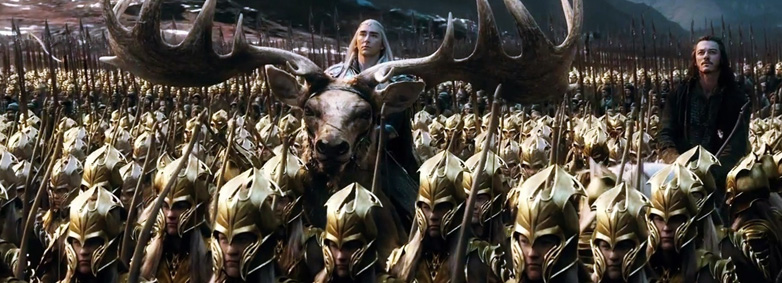
Elf lord Thranduil (Lee Pace), riding a giant moose and heading his golden army, joins up with Bard’s men to  challenge Thorin.

But they all unite when legions of orcs arrive and the skull-splitting slaughter begins. Arrows fly, swords crash and heads roll as armoured trolls, goats, pigs, eagles and a free-falling bear drop into the action.

The action and design are spectacular and the film dovetails nicely  into the first Lord of the Rings movie.

By trying to hit too many targets, the previously sure-sighted director Peter Jackson misses the mark.

☆☆

The Hobbit: The Desolation of Smaug

Director: Peter jackson (2013)

This second part of The Hobbit trilogy is a brilliant combination of solid gold action and spellbinding fun.

It looks glorious – from the magnificent and enormous mountain kingdom to the tiniest gold coin. The furnaces and forges are massive, built on a Herculean scale worthy of my native Teesside. The music is thunderously epic, scenery stunning and the action fantastic.

On top of all this there are dark and scary elements. Paranoia, corruption and madness are never far from the surface in the script.

There are big changes to Tolkien’s book in the confrontation between Bilbo and Smaug, plus there is an entirely new character called Tauriel (Evangeline Lilly).

She’s a kick-ass elven warrior who supplies some welcome female warmth among the bushy-browed band of brothers though her story arc may be an invention too far Jackson.

Underpinning this amazing adventure are the captivating characters of Gandalf the wizard, Bilbo the hobbit and dwarf chief Thorin, portrayed with charm and talent by Ian McKellen, Martin Freeman and Richard Armitage.

The horde of squabbling dwarves are played by the same actors as in the previous film and Orlando Bloom returns as the elvish prince Legolas.

Gandalf goes off to investigate the mysterious Necromancer, meanwhile Thorin continues to lead his dwarves on their quest to rightfully reclaim their Lonely Mountain kingdom from Smaug the dragon.

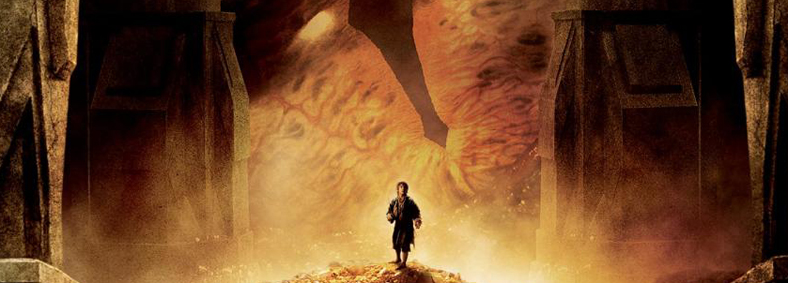
The superbly animated fire-breathing monster, who rests on a hill of gold, is voiced with chilling reptilian menace by Freeman’s Sherlock co-star Benedict Cumberbatch.

In one of 2013’s best action sequences the heroes shoot down a river in barrels while being chased by both elves and orcs.

Bilbo and the dozen dwarves are attacked by giant spiders, imprisoned by elves and captured by men yet the ferociously paced Hobbit is still packed with humour.

They use swords, arrows, knives and axes to fend off orcs, wolves and giant bears while lurking at the end of their quest, a ferocious fire-breathing dragon.

With much enthusiastic slaying, smiting and beheading, our heroes, ride, run and fight their way through streets, forest and caverns, from the diseased and dangerous Mirkwood forest to the ramshackle Laketown and into The Lonely Mountain itself where it ends in a flash – of gold and fire.

Pompeii

Director: Paul WS Anderson (2014)

There’s not an ounce of originality in this ridiculous Roman romp – but you can’t help being swept away on waves of lava-hot fun.

It shamelessly borrows scenes, images, fights and even jokes from Ridley Scott’s epic Gladiator despite not being fit to tie its sandals.

Pompeii is also poorly acted and badly written, with ramshackle dialogue and a plot that makes very little sense.

But Geordie director Anderson doesn’t waste time in getting to the main act – Mt Vesuvius blowing its top.

As choking-hot death rains down on Romans in an orgy of brilliant and gleeful destruction, I was grinning like a loon.

Plus it has Keifer Sutherland camping it up as a Roman Senator so resolutely evil that he has a English accent. (At least I think it’s supposed to be an English accent.)

The plot follows a Celtic – that is, British – child Milo who is captured after his family is butchered by Roman legionaries. lead by the evil Corvus (Sutherland).

Suddenly it’s 17 years later and he’s has grown up to become a feared gladiator known simply as ‘The Celt’ (Kit Harington) with the baddest rep, hardest abs and best hair.

Before you can say Maximus Decimus Meridius he is whisked off to Pompeii to fight in a computer-drawn city of unconvincing interior sets.

Milos falls in love with beautiful bland party-girl Cassia (Emily Browning). Her father Severus (Jared Harris) wants Corvus (now a Senator) to finance a new arena. But Corvus wants Cassia as part of the deal and plots to have Milo murdered.

Milos foils Corvus’s bid to kill him with the help of gladiator Atticus (Adewele Akinnouye-Agbaje). With the hero’s fate in the balance, the volcano erupts and everyone legs it for the docks to escape.

Except Milo, who must rescue Cassia, get revenge on Corvus and avoid being turned into ash with everyone else.

R.I.P.D.

Director: Robert Schwentke (2013)

This misfiring celestial cop caper should be locked up for a long time – for crimes against cinema.

Corrupt cop Nick Walker (Ryan Reynolds) is shot dead by a colleague over some ill-gotten gold.

Halfway to the afterlife he is offered redemption if he joins the RIPD (Rest In Peace Department) – a supernatural police force tasked with ridding Earth of “deados” – spirits hiding there hoping to evade judgment.

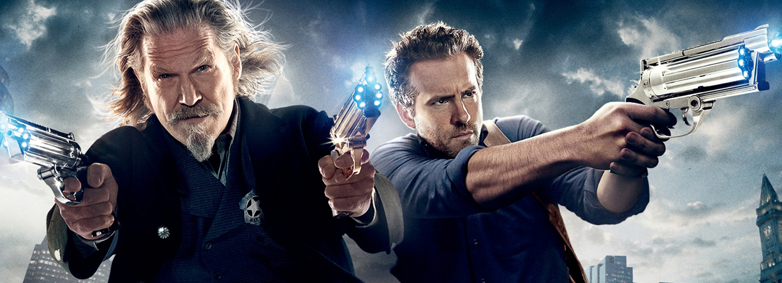
Walker is coerced into a partnership with Wild West sheriff Roy Pulsipher (Jeff Bridges), forming a demonically dull duo who share no tangible chemistry.

In many ways Reynolds is perfectly cast as a spook as it’s difficult to register his presence – while Bridges indulges himself and provides a pantomime performance.

Being dead and therefore indestructible adds lack of tension to the film’s extensive charge sheet – which includes ropey special effects, excessive use of formulaic scriptwriting and failing to provide wit, logic or excitement.

Action scenes are directed in a video-game style and the voice-over and flashbacks at the beginning smack of desperate editing to add some energy to the lacklustre and limp proceedings.

To disguise themselves from living loved ones (such as Walker’s wife) the pair appear to everyone as an elderly Chinese man and a glamorous blonde woman.

The script fails to do anything interesting with this idea and then forgets about it whenever it’s inconvenient.

Despite ascension imagery and allusions to paradise and the referencing of the staff of Jacob: God, the devil, heaven and hell are conspicuously not mentioned – presumably to avoid offending any religious types who may be watching. But there’s more chance of your sense of humour being offended by the paucity of fun on offer.

The pair pursue Walker’s killer and former partner Bobby Hayes (Kevin Bacon) and uncover a deado plot to take over the world.

Bacon seems to being enjoying himself and Mary-Louise Parker is nicely spikey presence. There’s occasionally some interesting imagery but even that looks purloined from A Life Less Ordinary or The Last Action Hero.

The detectives are suspended from the case after a deado escapes due to their incompetence.

With only 24 hours before hell literally breaks loose, the pair predictably go rogue and set about saving the world.

But they can’t also save this action comedy which is dead behind the eyes.

☆☆☆☆

Blade Runner: The Final Cut

Cert 15 117mins Stars 5

Blade Runner: The Final Cut (1982, 2007) 

Ridley Scott

Blade Runner: The Final Cut is the definitive version of director Ridley Scott‘s 1982’s sci-fi noir masterpiece.

Uniquely it stands on a pedestal with 1927’s Metropolis, and 1968’s 2001: A Space Odyssey, in the sci-fi canon, and alongside 1944’s Double Indemnity as a doom laden noir.

AndroidsDream

Based on the 1968 novel Do Androids Dream of Electric Sheep? by Philip K. Dick, Blade Runner is a combination of extraordinary visuals, superlative sound, Blade Runner’s superb cast includes Harrison Ford, Rutger Hauer, Sean Young, Edward James Olmos, M. Emmet Walsh and Daryl Hannah.

With various cuts of the film existing and offering very different endings, Scott trims The Final Cut to its noir roots and in doing so unequivocally resolves a long running debate concerning the nature of the central character, the ‘Blade Runner’, Rick Deckard.

Digitally remastered in 2007 for the 25th anniversary of the original 1982 release, Scott removed Deckard’s voice-over and a happy ending which the studio imposed on the original theatrical release, as well as reinserting a unicorn dream sequence.

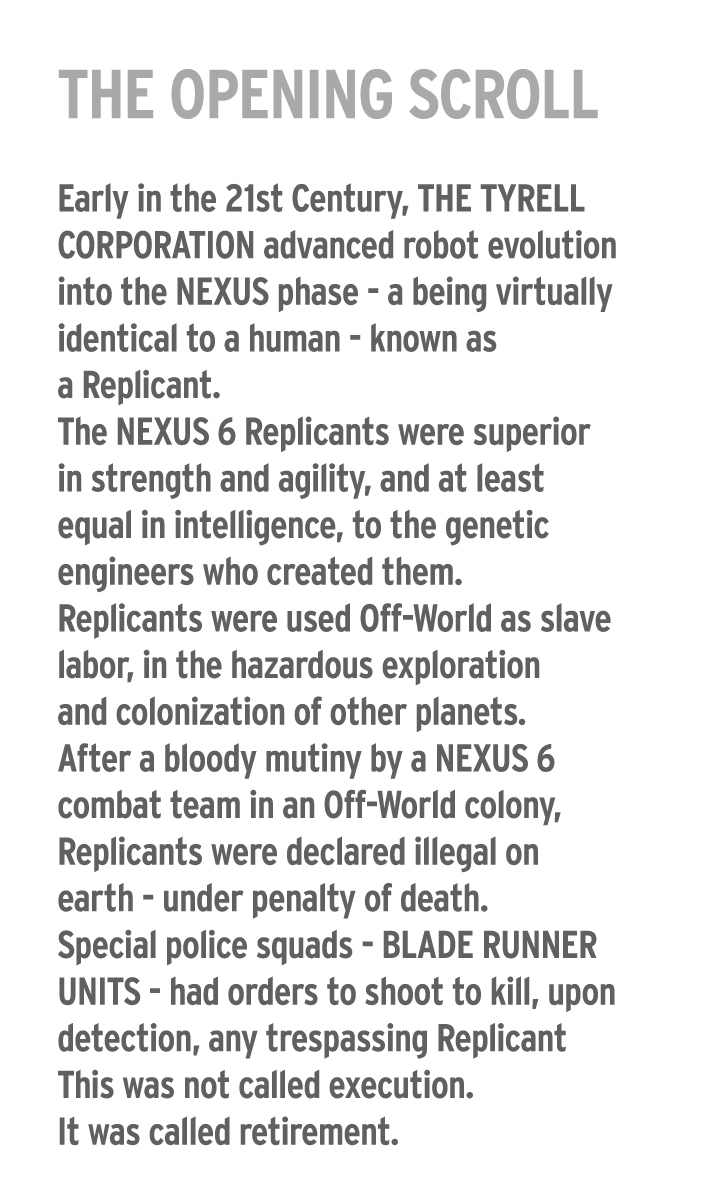
Blade Runner scroll

The film takes place in Los Angeles of the year 2019. Six genetically engineered humans called replicants have escaped from an off-world colony and made their way to Earth, where their presence is outlawed.

BR ford

In Los Angeles two replicants are killed after trying to break into the headquarters of the Tyrell Corporation. This prompts M. Emmet Walsh‘s seedy police captain to strong-arm Harrison Ford‘s reluctant former detective, Rick Deckard, back into harness.

Though insisting he is twice as quit as when he walked in, Deckard accepts the order to find the remaining four replicants and destroy them, and an origami-modelling cop called Gaff is assigned to monitor Deckard’s progress.

While on the case Deckard first interviews then starts an affair with Sean Young‘s Rachael. She’s the glamorous niece of the head of the Tyrell Corporation, Dr. Eldon Tyrell, the chess-playing creator of the replicants.

Deckard

The euphemistic use of the word ‘retire’, reminds us Dick’s paranoid fear of the inevitable decay of our mortal bodies, reinforced by Scott scattering his sets with mannequin parts.

The screenplay by Hampton Fancher and David Peoples is a loose adaption of the source novel but is faithful to Dick’s obsessions of decay, transformation, paranoia and identity, and in The Final Cut at least, is respectful of noir’s hard-boiled cynicism.

It can also be read as a twisted riff on John Milton’s epic poem, Paradise Lost, with the replicants representing fallen angels rejecting their godlike creator.

Incorporating tolling bells, the magnificent score by Greek composer Vangelis, announces key themes as the film opens and veers between the apocalyptic and the heavenly.

The Tyrell Corporation’s HQ is a pyramidal mausoleum, a suitable resting place for a god before an ascension to a higher level of existence. The replicants can be interpreted as angels or demons who have descended to Earth from the chaotic off-world to challenge the Earth’s divine order, and possibly raise humanity to a higher plane of existence.

Br sebastian

The subjugated and animal nature of Earthbound humanity is explored through the use of rats, those harbingers of disease, decay and death. Tyrell talks of deserting rats when discussing the altering of the replicant’s DNA. There are pet rats among J.F. Sebastian’s engineered toys. Deckard is herded like a lab rat through the decaying prison of a mansion block.

Filmed in the ironwork interior of LA’s Bradbury building, the dreamlike apartment of genetic engineer J.F. Sebastian is a repository of childhood toys which Deckard must escape before he can be enlightened as to his real identity.

Br Batty

The relationship between the replicants provides the emotional core of the film. Daryl Hannah wraps herself affectionately around Rutger Hauer, who plays her partner and the replicant’s leader, Roy Batty.

And though the a homicidal Batty is set up as the villain, Hauer’s poetic and physical performance aches with life, love and loss. His powerful closing monologue which always bring s me to tears is all the more astonishing for being self-penned.

BRrachael

For those who think Scott is a stylist indifferent to his actors labours, they should consider the performance he elicits from Sean Young, who is perfectly in tune with the demands of the role.

In a brilliantly tense conclusion we see Rachael asleep in her apartment and Deckard approaching her, gun in hand. We don’t know whether he will kill her or kiss her.

There’s a declaration of love and a big sigh of relief from the audience. But as Deckard and Rachael leave his apartment, they find an origami unicorn left by Gaff. This changes the entire thrust of the story and our understanding of it.

Unicorn

Gaff’s origami is evidence he knows Deckard’s dreams are memory implants, causing Deckard and the audience to belatedly realise he is also a replicant. His entire life is a lie and he has unwittingly killed his own replicant family members at the behest of the police, his enemies, who he realises he now has to escape from.

This bleak revelation is perfect film noir.

But the power of Blade Runner has been diluted by the studio edit prompting a discussion over Deckard’s replicant status. This drags our focus from a brilliant noir ending to a non-debate over the nature of Deckard’s humanity.

Instead of the audience being overwhelmed by the force of this drama, for nearly forty years everyone has chuntered over the ‘is he a replicant’ debate, a controversy this definitive version retires.

Harrison Ford was strategically picked to play Deckard in a casting masterstroke of cinematic deception. The audience is fooled by their own presumption the star is playing a hero.

A huge star from his swashbuckling roles in 1977’s Star Wars, and 1981’s Raiders of the Lost Ark, as Han Solo, and Indiana Jones, the audience expected more of the same. Ford’s status as heroic Hollywood leading man leads us to believe Deckard is the hero until we and Deckard realise he isn’t. We don’t expect a character played by Ford to be the fall guy.

The Big Sleep

As a hard drinking detective with a laconic delivery and ready attitude in the face of authority, Ford is presented as a futuristic Humphrey Bogart, rebooted, updated and teleported in from Hollywood’s Golden Age of noir.

Ford is happy to riff on Bogart’s goofy undercover book lover in  1946’s The Big Sleep to emphasise the connection. There’s even a reference to Sydney Greenstreet in Bogart’s classic wartime melodrama, Casablanca as Deckard interrogates a fez-wearing gangster, The Egyptian.

Plus the story is told through Deckard’s eyes. So Deckard’s the hero, right? He’s an updated and rebooted sci-fi Philip Marlowe, right? Wrong.

To watch The Final Cut is to realise, and this is despite what Bryant tells him, Deckard is not especially good at his job.

He’s beaten up in turn by each of the four replicants. While failing to dispatch either of the males, he shoots the unarmed females, and he only manages to kill one of them by shooting her in the back as she’s running away. And as Batty mockingly points out, Deckard is not very sporting. Ordered to retire Rachael, Deckard has sex with her instead.

indemnity

Far from being Bogart 2.0, Deckard is far more of an upgrade of Fred MacMurray’s hapless insurance salesman Walter Neff from 1944 noir masterpiece. Double Indemnity. In classic noir fashion, Deckard is too dim to realise he’s always behind the game. it’s not until the end he understands how little he knows. He’s a prize chump.

Blade Runner is rightly celebrated for its superlative sci-fi styling, but I love The Final Cut for revelling in the noir at the heart of this rain-soaked LA story.

@ChrisHunneysett

Nemo’s Fury is an exciting digital reinvention of Jules Verne’s classic steampunk adventure novel, 20,000 Leagues Under the Sea. 

Download for free to your smartphone or tablet, search your app store for ‘Nemo’s Fury’.

A mobile interactive fiction game employing a bespoke combat system and hundreds of original illustrations, Nemo’s Fury is inspired by the 1980’s role-playing gamebooks such as ‘The Warlock of Firetop Mountain’, of the Fighting Fantasy series which celebrated its fortieth anniversary last year.

Each player joins the legendary Captain Nemo on board his fabulous submarine, the Nautilus, on a wild voyage of adventure, intrigue, loyalty, and betrayal.

There’s mayhem, monsters, maelstroms and murder as Nemo takes you from the South Pacific to the Northern Atlantic via Antartica and the Red Sea. And if they survive long enough, the player will of course fight a giant squid.

Available on your smartphone or tablet, (but not yet your desktop), click on your app store below

Or go to Nemo’s Fury for more info

The Tale of the Princess Kaguya

Director: Isao Takahata (2015)

Magical and moving, this animated folktale is charming, moving and a beautifully crafted joy, bursting with humour and life.

When sent to the Earth as punishment, a young Moon spirit discovers that mortal life involves responsibility and pain as well as love.

Deservedly nominated for best animated feature at the Oscars, it’s a captivating combination of glorious pencil-work and delicate pastel colours.

Working in a secluded grove, an old Bamboo Cutter (James Caan) is startled when a bright light reveals a tiny female form inside a tree. The kindly man takes her home to his wise wife (Mary Steenburgen) where the sprite changes miraculously into a baby.

Being without children they resolve to look after the baby as if she were their own. She grows at a prodigious rate, sprouting from baby to toddler in a single crawl.

The Princess is named ‘Li’l Bamboo’ by the local children and joins the gang of Sutemaru (Darren Criss) with whom a strong emotional bond develops.

Loyal, clever, impetuous and mischievous, Li’l Bamboo accelerates through a joyous, gentle and comic childhood in a wonderful rural adventure land. It’s alive with gorgeously animated birds, frogs, spiders, pigs, snakes, squirrels, beavers, fish and deer.

Returning to the magic grove the Bamboo Cutter finds a tree filled with money, then another with swathes of fine cloth. He concludes Li’l Bamboo is a true princess and must be raised as one.

So he builds his daughter a palace in the Capital and when she turns 13 years old he moves the family there to live, away from her friends.

Stern Lady Sagami (Lucy Liu) is employed to teach Li’l Bamboo courtly social graces but the spirited girl rails against her tutoring and the subduing of her personality. She mocks the painful beauty procedures and rejects the subservient idea of womanhood.

At a three day banquet to mark her coming of age, she is given the name Princess Kaguya and to please her father tries to become an obedient, studious daughter. With her great beauty and social skills she attracts a multitude of suitors, including the greatest nobles in the land.

But the Princess isn’t impressed by their status and to her father’s consternation Kaguya issues them impossible tasks to prove their love.

However she’s aghast when one by one they return to make her keep her word and she makes a rash wish which changes her life.

It is more measured in pace and tone and lacks the delirious colours and engineered wackiness of contemporary megaplex crowd pleasers such as Disney’s excellent Big Hero 6. Plus with a running time of 137 minutes it is for older rather than younger children.

With it’s strong-willed country girl who learns of life in the city it’s similar to the story of Heidi which director Takahata adapted in 1974. It is a tale celebrating life but also reflective of grief, loss and suffering, heralding the virtues of honesty and friendship over wealth and looks, taking to task the way female identity is constructed for the benefit of men.

The animation is impressionistic in style with characters and backgrounds being drawn on the same page – unlike in traditional cel animation where characters are drawn separately and superimposed onto the background. It is a wonderfully immersive and suitably organic technique, emphasising the passion for the story in every exquisite and entertaining frame.

Suite Francaise

Director: Saul Dibb (2015)

This World War II drama about star-crossed music lovers is handsomely orchestrated but suffers tone deaf storytelling,

When a married French woman falls for a German officer, she has to decide between the love of her life and the love of her country.

There’s some decent acting and a lovely period feel but it’s ruined by the unconvincing romance, unsympathetic characters, a pointless voice over and simplistic dialogue.

It is based on the novel written in secret during the war by Irène Némirovsky. Though she perished in Auschwitz the manuscript was recovered by her daughter and eventually published in 2004.

Filmed on location in Marville, the picturesque town is complemented by the richly authentic production design of Michael Carlin and captured by the graceful cinematography of Eduard Grau. Editor Chris Dickens brings welcome injections of energy.

Lucille (Michelle Williams) is an insipid soul who’s peeved at her sour-faced mother-in-law Madame Angellier (Kristin Scott Thomas) for locking shut her precious piano.

With Lucille’s husband Gaston missing in action, the women share a large house and occupy themselves collecting rent from tenant farmers.

Their privileged if unhappy rural existence is transformed when the German Wehrmacht roll into town.

They’re mostly a benign presence, lacking the SS Nazi zeal for shootings, beatings, floggings or rapes.

When not standing around the square flirting, the squaddies consign themselves to skinny dipping and getting drunk in a nearby chateau.

Meanwhile the locals are busy posting anonymous hate-mail about each other to the Germans in order to curry favour. The officer charged with investigating their contents is good Lieutenant Bruno von Falk (Matthias Schoenaerts).

Billeted with Lucille and Madame Angellier, not only is he a strapping young man but he plays piano beautifully. He even composes his own music. Swoon.

Bad Lieutenant Bonnet (Tom Schilling) fancies Lucille’s friend Madeleine (Ruth Wilson) and insults her husband Benoit (Sam Riley).

Bonnet quotes Nietzsche to underscore how nasty he is. It’s amazing he’s not goose-stepping to Wagner while he does it.

As soon as we see impoverished farmer’s daughter Celine (Margot Robbie) sporting silk stockings, we know how her storyline will unfold. Even before the German’s invade.

The rest of the French give cheese-eating surrender monkeys a bad name. They’re solicitous, duplicitous, hypocritical liars and collaborators; seeing the war as an opportunity to betray, cheat and exploit one another.

I was reminded of Walter Sobchak (John Goodman) in The Big Lebowski when he remarks: ‘say what you want about the tenets of National Socialism, Dude, at least it’s an ethos.’ The French portrayed here have barely a scruple between them.

Handing over an arsenal of weapons without a murmur, resistance amounts to throwing uniforms up a tree. It’s a wonder the Germans need to deploy quite so many troops.

As soon as Bruno unlocks the piano and tinkles the ivories, Lucille is all a quiver with barely concealed passion.

But other than being the nearest port in a storm it’s a wonder what he sees in her. She’s prettily vacant and is miffed by having calloused hands when forced to carry her own shopping. Doesn’t she know there’s a war on?

By the time Lucille and Bruno come to acknowledge their passion, half the town’s women have been at it with the invaders – so it doesn’t seem much of a transgression.

Plus Lucille absolves herself of guilt when an anonymous letter accuses her husband of infidelity; an accusation she’s astonishingly blase about accepting.

When they end up hiding in the hydrangeas from Madame Angellier, its too much effort not to snigger.

As townsfolk seek to exploit her blossoming relationship with the Lieutenant, half of them congratulate her for bravery, the other half condemn her as a collaborator.

Well one person does. We’re simply told by the persistent and annoying voice over what everyone thinks.

When Benoit is betrayed and goes on the run, Lucille has to decide where her loyalties lie.

Eventually the Germans start shooting but they’re so ineffectual it’s amazing they managed to blunder into Paris at all. Executing a door-to-door search they scare some nuns and frighten a few chickens.

While this is going on Bruno finds time to apologise to Lucille for breaking off their date. It’s Bridget Jones: The War Years – but without the laughs.

☆☆☆