Lost River

Director: Ryan Gosling (2015)

A mother struggles to keep her family safe in this challenging and contemporary nightmarish fairytale.

Director Gosling can’t be faulted for a lack of ambition in his directorial debut, it’s the Hollywoods heart-throb’s execution of his underdeveloped story that let’s him down.

Billy (Christina Hendricks) is three months behind on the mortgage and local bank manager Dave (Ben Mendelsohn) suggests she takes a job with Cat (Eva Mendes)

She runs a local cabaret, owned by Dave. It’s a strange, credit card-accepted-only place where the acts involve the dismemberment of beautiful women. The audience gleefully lap up this conflation of sex and violence as bloody entertainment.

However it’s downstairs in the secret chamber where the girls can make the real money but the fearful Billy is reluctant despite the pressure to do so.

Meanwhile her eldest son Bones (Iain De Caestecker) is friendly with Rat (Saoirse Ronan) who lives next door with her grandmother.

Their tentative relationship is threatened by the local hardman called Bully (Matt Smith). Bones has fallen foul of Bully for stealing copper pipes and the plier-wielding psychopath is out for revenge.

It is an apocalyptic setting, there’s no internet for a start. The bureaucracy still operates though.

The destruction of the man-made environment is ongoing; sledgehammers smash through walls, bulldozers rip down houses, buildings are burnt to the ground, there are burnt out cars and dinosaur statues. The elemental power of fire and water are recurring motifs.

Detroit and its astonishing urban decay are exploited to good effect; roads are swamped by a green and aggressive mother nature. Zoos are empty, neighbourhoods are abandoned.

Encounters with random people seem unscripted and there’s far too much improvisation to too little effect. Dialogue is sparse and there are no real conversations but lots of questions asked in an open-ended teenage way.

Insufficient menace and tension are generated by a languid pace.

In natural light Gosling throws in every shot he has heard of with no rythym or reason; dutch angles, tracking shots, overhead pans, shifting focus – and all in the first five minutes.

It does possess a strong sense of colour with many scenes saturated, giving Hendricks hair and complexion a startling vivacity.

There’s nothing wrong with the work of editors Nico Leunen and Valdis Oskarsdottir or of cinematographer Benoit Debie – just a lack of cohesive thought in preparing the shoot.

The soundtrack is a curious combination of industrial noises and old melodies; Mendelsohn gives an unexpected performance of Bob Nolan’s 1936 western song Cool Water.

As an actor Gosling has made some interesting work with director Nicholas Refn and is strongly influenced by his work. There’s also touches of David Lynch though this is not necessarily a compliment.

More random ideas bandied about include the character of Rat’s Grandmother who has been mute since her husband died building a reservoir. She watches the video of her wedding day on a loop, echoing Miss Havisham in Great Expectations.

All the actors commit themselves to the directors vision and some are familiar with him. Both Mendelsohn and Mendes worked with Gosling on The Place Beyond The Pines (2012) while Hendricks appeared in the Refn’s Drive (2011) with Gosling. Ronan appeared in the similarly fairytale inflected Hanna (2011).

Lost River feels like a film shot with the intention of finding itself in the edit. It may still be looking.

Woman In Gold

Director: Simon Curtis (2015)

A young lawyer and elderly woman team up to haggle over the ownership of a valuable piece of art in this dull plod of a true story.

Half courtroom drama, half Second World War thriller and all unremarkable, an uninformative script fails to inspire two mismatched leads.

Widowed US citizen Maria (Helen Mirren) is Austrian by birth and bossy, rude and talkative by nature. She spends a lot of screen-time staring into space and listening to music. She has come into documents suggesting a valuable painting of her aunt Adele may in fact belong to her.

Painted by famous artist Gustav Klimt and known as the ‘Woman In Gold’, it’s of such great importance it’s colloquially referred to Austria’s Mona Lisa, though it’s real name is ‘Portrait of Adele Bloch-Bauer I‘. As her aunt’s will specified it’s hanging on public display in the famous Viennese Belvedere Gallery.

Maria hires the inexperienced lawyer Randol Schoenberg (Ryan Reynolds). The grandson of a famous Viennese composer, Randol takes the case to further his career but after visiting the Holocaust Memorial it becomes a personal mission to secure for Maria the painting.

Together they scuttle off to Vienna to demand the paintings return from the gallery. She tries to shame the authorities into gifting her a painting worth over a hundred million dollars. Even to my inexpert legal mind it’s not a strategy likely to succeed.

Eventually Randol discovers a legal loophole and takes Maria’s claim to the US Supreme Court for permission to sue the Austrian State for the painting’s return.

In one scene a Ferris wheel is featured prominently in the Viennese background, prompting the mind to drift to this famous moment from cinema.

Randol’s argument rests on the exploitation of a technicality not sympathetic to the intention or spirit of her aunt’s original will. Although Maria has an emotional claim to the painting of her aunt, the legal ends seem to have been resolved correctly if not by the right means.

Sepia-toned flashbacks to Maria’s privileged childhood in Vienna shows us a little of a somewhat cold relationship with her aunt Adele (Antje Traue). This undermines her argument her legal case is underpinned by her love for her family.

We see far more coverage of her life as a young married woman under Nazi house arrest for being a Jew, allowing for leather-slapping SS guards to inject some menace into the film. They steal the family silver as well as the Holbein from the wall, her father’s Stradivarius cello and of course, the painting at the heart of the story.

Young Maria abandons her parents to the war and as she flees to the airport, is chased on foot and fights off armed Nazis. What a gal. I didn’t believe for a moment this is how she left Austria.

There’s too much disconnect between eras and the desperate tone of the war years clash with the gentle banter between Mirren and Reynolds.

Scenes in the Supreme Court which are played for laughs. Legal arguments are easily defeated in an uninteresting way and long lapses of time of 9, 6 and 4 months interrupt what little dramatic tension there is in court.

Whenever anyone is offered opportunity to display generosity of spirit, self-interested petulance is chosen instead.

Both leads are miscast and lack chemistry. Reynolds is static wooden pole Mirren gamely gambols about him, flirting with a mannered Austrian accent.

it’s always pleasant to see Katie Holmes on the big screen but in an inconsistently written role she’s relegated to being Randol’s stay-at-home wife. Tatiana Maslany as young Maria makes a convincing young Helen Mirren.

Poor Daniel Bruhl plays journalist Bertus Czernin. He pops up to handily explain Austrian bureaucracy and their funny ways. Peculiarly for a journalist he takes no notes, writes no stories and takes no payment, Astonishingly he’s the one buying the drinks. Mostly he serves the function of providing Reynolds someone to talk to.

We lean nothing of Klimt, his life, art or why his art is so vital to Austrian culture, relegating him to the second most famous Austrian artist in this story.

Frozen

Director: Chris Buck & Jennifer Lee (2013)

Wrapped up in sisterly love, this snow-filled Disney animated adventure is exciting, funny and even moving – but sadly never in sufficient qualities to justify it’s being nearly two hours long.

Apparently ‘inspired’ Hans Christian Andersen’s The Snow Queen, it too often evades the dark icy heart of the fairytale.

Unapproachable Elsa (Idina Menzel) is the queen with the power to create snow and ice. She is a misunderstood and feared character who falls out with her sweet and ditzy sister Anna (Kristen Bell).

After Elsa accidentally uses her power, a summer instantly turns to permanent winter. She struggles to control her own magic so she is accused of being an evil sorceress and driven away into the mountains.

It is left to Anna to trek into the wilds, reconcile Elsa with her subjects and subdue the weather.

The animation is brilliant and the ice palace building sequence will send shivers down your spine. Lighthearted comic buffoonery balances the action which mostly involve being chased downhill by ice monsters and hungry wolves.

Along the way they make friends with comedy sidekicks including a mountain man called Kristoff (Jonathan Groff), his reindeer named Sven and Olaf (Josh Gad) a snowman. He’s the the most fun character on show but also the most inconsequential.

The annoying dialogue is, like, totally California teenspeak, except for Sven the reindeer, who is mute but a far from dumb animal.

The script has problems, not least the lack of a readily identifiable, hissable villain. Yes there’s a giant snow troll but the drama rests on Elsa changing her mind. A nicely dark opening chapter is followed by a long and middling middle section.

Plus Frozen has two feisty female characters but doesn’t make the most of them. We see too little of the more interesting Elsa and spend too much time with Anna contemplating her romantic interests.

 Elsa belts out the excellent song ‘Let It Go’ but two weak and unnecessary songs (yes I’m talking to you Olaf the snowman and you, tiny trolls) slow the pace and lengthen the running time.

Everything heats up for the finale and delivers the film’s heartwarming message that love is more powerful than fear. Awww.

Elements of Frozen suggests someone at Disney saw the record-breaking worldwide box office returns of the theatrical production of Wicked and decided they wanted a piece of the action.

Based on Gregory Maguire‘s novel  Wicked: The Life and Times of the Wicked Witch of the West in turn based on The Wizard of Oz by Frank L Baum. The success of Wicked the show was due to tapping into the under-exploited market serving young teenage girls. Frozen methodically sets out to exploit the same rich profit seam.

Her undoubted talent notwithstanding, it’s no coincidence Idina Menzel played the role of powerful but misunderstood witch Elpheba in Wicked before playing the powerful but misunderstood witch Elsa in Frozen. Nor is it a surprise Frozen’s signature tune Let It Go could easily be slipped into the Wicked songbook. In fact more than one song could be – as the Honest Trailer recognises.

Since this review was first penned Frozen has become a global phenomenon. A sequel is on the way and of course there’s the short film Frozen Fever being shown in cinemas before Disney’s Cinderella. Which I enjoyed more.

Godzilla

Director: Gareth Edwards (2013)

This handsome reboot of the Japanese sci-fi classic is monstrously poor, resurrecting the giant lizard with dazzling computer graphics but failing to create any excitement, tension or fun.

Characters are thin and lack humour, the dialogue is banal and the story needs focus. It lumbers from Japan to California creating plot-holes so deep they could hide a massive mutant reptile.

Nuclear physicist Joe Brody (Bryan Cranston) loses his wife in a mysterious explosion at a Japanese power plant. Fourteen years later and he has become a conspiracy theorist trying to establish what really happened.

When his estranged son, naval Lieutenant Ford (Aaron Taylor-Johnson), visits they are arrested investigating the quarantine zone where his wife died. Taylor-Johnson can be excellent but here he is a dead-eyed, muscle-bound charisma bypass.

They are taken to a secret base where scientists are keeping a huge radiation-eating insectoid called a Massive Unidentified Terrestrial Organism. It promptly buzzes off to the US to mate with another escaped Muto.

Scientist Dr Vivienne Graham (Sally Hawkins) has nothing to contribute except listen attentively to Dr Ichiro Serizawa (Ken Watanabe) bang on about the balance of nature. He displays a surprising amount of Godzilla background knowledge considering it’s the first time he or anyone else has ever encountered the beast.

Elizabeth Olsen plays Ford’s wife Elle who has very little to do. Director Edwards must shoulder the blame for his poorly written characters being absent-mindedly picked up, toyed with and forgotten about.

With no-one to empathise with we fail to care what’s happening on screen, regardless of the marvellous work of cinematographer Seamus McGarvey.

Meanwhile Godzilla appears and swims across the Pacific to fight the Mutos. The US navy manage to lose sight of him despite his size.

A dog is put in danger in a shameless attempt to generate tension. Then children are put in jeopardy in a school-bus on a bridge. I haven’t seen that happen since ooh, The Dark Knight Rises.

Military Intelligence decides to attack the radiation-eating monsters with a nuclear weapon. This is clearly stupid so Lieutenant Ford must parachute in to defuse the bomb, ending the film with a whimper not a bang.

The name Godzilla comes from the  Japanese word Gojira and is made of two words; Gorira, meaning gorilla and kujira meaning whale. So not so much a giant lizard. But it would probably have made for a more fun movie.

☆☆☆☆

What We Do In The Shadows

Director: Taika Waititi & Jemaine Clement (2015)

This dead-pan mockumentary about flat-sharing vampires lacks sufficient bite to be funny.

Offering low-key, bone-dry humour, this undead oddity struggles to come to life and struggles with weak plotting and indulgent pacing.

It feels more like a series of thin sketches strung together than a fully realised feature film and it’s no surprise to learn it was based on a short film made by the same team.

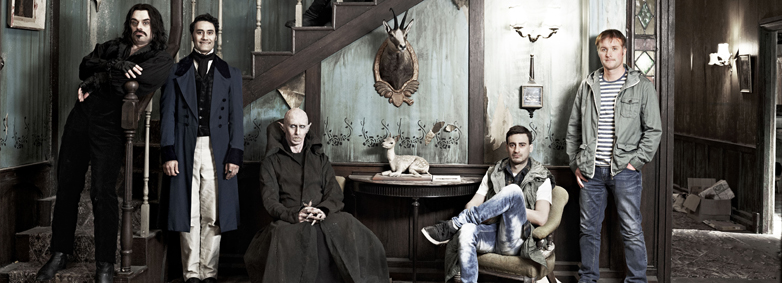
Four vampires of varying age share a house. Viago (Taika Waititi) is a 317 year old Georgian dandy who organises the house. Vladislav (Jemaine Clement) is 862 and a medieval vampire in the Turk-skewering tradition. Petyr (Ben Fransham) is an 8,000 year old Nosfertu type who lurks rat-like and unspeaking in the cellar. Deacon (Jonathan Brugh) is a former travelling salesman who was turned by Petyr and a relatively youthful 183.

Viago’s faithful familiar (servant) Jackie (Jackie Van Beek) is increasingly disillusioned at her prospects of ever being turned into a vampire and is incensed when her dinner guest Nick (Cori Gonzalez-Macue) jumps the queue. He slowly learns life as a bloodsucker isn’t as much fun as he first imagined.

Zombies and werewolves all appear at the Unholy Masquerade, an undead ball where Vladislav confronts his nemesis he refers to as The Beast.

Strip aside the vampires stylings and what’s left are some humdrum observations about four mundane middle-aged blokes sharing a house in genteel poverty and struggling to adjust to a changing world. Their vampire problems don’t inform their contemporary concerns or vice versa.

Jokes rely on mastering the internet and name-checking movies The Lost Boys, the Twilight franchise and Blade. They seek far too much comedy mileage out of unresolved domestic squabbles such as whose turn is it to do the washing up.

The strongest aspect of the production is the design by Ra Vincent whose shabby drawing room chic is complemented by deeply textured interior lighting by cinematographers Richard Bluck and D.J. Stipsen.

The use of shaky cam is unavoidable, the flying stunts are nicely realised and old-school blood splurts are enjoyably silly.

Writer-directors-actors Taika Waititi and Jemaine Clement are both connected to The Flight of the Conchords. Completists of their work may be keen to see this but everyone else may decide to opt for a wooden stake through the heart instead.

While We’re Young

Director: Noah Baumbach (2015)

A couple are re-energised when they hang with trendy new friends in this New York comedy drama.

Filled with topical commentary about social media, it’s well-paced with an engaging cast delivering strong performances.

But though it’s inspired by the New York films of Woody Allen it lacks his sharp one-liners. Plus there’s too much tired baby-orientated observational humour on the difficulties and disappointments of parenting and there’s some even weaker stuff about fading eyesight and creaky backs.

The relationship of forty-something childless couple Josh and Cornella (Ben Stiller and Naomi Watts) is thrown into relief by the newborn baby of contemporaries Marina and Fletcher (Maria Dizzia and Adam Horovitz).

Horovitz is better known as a former member of the once controversial hip hop group The Beastie Boys. It’s an achingly-knowing in-joke which threatens to stifle this world of middle-class comfort in a cloud of an intolerable smugness.

As an antidote to ageing, unfulfilled and angst-ridden Josh starts to hang out with twenty-something hipsters Jamie and Darby (Adam Driver and Amanda Seyfried) whose generosity of spirit gives a fillip to Josh’s career and home-life.

Josh is a documentary film-maker whose latest film is an attempt to explain America in all it’s complex economic, political and intellectual glory. Production has stalled, eight years into production.

Clearly Josh is a surrogate for writer-director Baumbach who is attempting to explore contemporary America but through the medium of comedy-drama instead. Maybe he’s not an interpretative dance sort of guy.

While We’re Young is an enquiry as to how the development of technology has changed society’s relationship itself.

This runs parallel with a critique of nepotistic Hollywood’s obsession with youth and it’s struggle to adapt or even understand the way young people interpret their online experience as part of their everyday life.

Then Baumbach throws in another baby joke to lighten the mood.

While Josh’s baby boomer father-in-law Leslie (Charles Grodin) once made documentaries with integrity, Josh is consumed by the process not the end product. Millennials such as Jamie and Darby are obsessed with the success of the end product – not the product itself. They’re happy to twist any truth to create an online buzz to achieve the success they crave.

Josh and Jamie begin a documentary project and as it proceeds Josh descends into paranoia and jealousy. There’s betrayal, infidelity, drugs, an all night gay bar, hallucinogenics and vomiting.

Cinematographer Sam Levy producers some great camerawork, tracing characters through the streets as they have conversations on the move. One lovely reverse tracking shot follows two characters cycling – the shot itself raises a smile even if the laboured humour doesn’t.

Writer Baumbach cleverly exploits the audience’s awareness of Hollywood script structure to deliver a couple of twists on a traditional finale. Plus he creates several frequently annoying but believable characters.

The exception is Jamie’s sexy flatmate Tipper (Dree Hemingway) who is woefully under-written. Played by the daughter of one-time Woody Allen muse Mariel, she’s reduced to a couple of ironically logo’d T shirts and demonstrates Baumbach hasn’t yet mastered Allen’s art of creating characters with a couple of deft brush-strokes.

It ends with another wry baby joke. As far as baby jokes go it’s not awful and is in tune with Baumbach’s themes but it’s predictable and not funny.

There’s no shortage of ambition or craft to admire in While We’re young, I just didn’t find the self-obsessed characters as interesting or amusing as the film itself does.

Blade Runner watch – the soundtrack is used during a purging ceremony.

The Decent One

Director: Vanessa Lapa (2015)

This tightly-focused documentary portrait of high-ranking Nazi Heinrich Himmler is all the more gripping for being told in his own mundane words.

It is based on documents belonging to Himmler, his wife Margarete, daughter Gudrun and mistress Hedwig. Their diaries and letters were controversially not handed over to the post-war military authorities but kept hidden for years.

Actors to bring a voice to their words while personal photographs and home-movies provide visual insight.

Tracing Himmler’s life from birth, we’re taken through Himmler’s comfortable middle-class upbringing to his high-ranking Nazi career and eventual capture and suicide at the end of the Second World War.

He was a sickly child and a ‘B’ grade school pupil. His casual anti-semitism and support for a militarised Germany were evident at an early age.

Between the wars at university in Munich, he joins an exclusive Apollo fraternity. They discuss degeneracy in society, the dangers posed by homosexuality and the ‘Jewish question’. He reads Oscar Wilde which puts him in a terrible mood.

An unprepossessing, balding man in round glasses, he is a natural, accomplished bureaucrat and quickly rises in the burgeoning Nazi party.

As Germany goes to war, he rises to the head of the SS and we’re provided with a contrast between the careerists comfortable life and the deadly consequences of his work.

He is supported and encouraged by Margarete and he describes her anti-semitism as charming. She takes great pride in his success and both enjoy the material benefits of his labour.

Beginning as flirtatious love-letters, the focus of their writing changes to the dull routines of his work and her domestic organisation. Their very ordinary concerns and casual bigotry puts the horror of his actions into sharp relief.

In the summer of 1942 he instigates the Final Solution, the systematic extermination of all Jews in German territory. As he father’s a child with his mistress Hedwig, he’s also exploring ways of sterilising all Jewish women.

The director (a granddaughter of Holocaust survivors) manipulates the material to create a well-paced and intelligent work with a strong narrative thread.

The film assumes an audience’s basic knowledge of twentieth century German history and politics. We see footage of the burning of the Reichstag in 1933 but we’re not told the significance of the event or even have described to us what we’re seeing.

Aeroplanes fly in swastika formation and there are book burning rallies. Hitler lurks mostly off-stage and is referred to as ‘the boss’.

As we hear Himmler’s thoughts on homosexuality, we treated to images of squads of healthy semi-naked german beefcakes exercising in the open air. It’s a small touch of humour and possibly the film’s last before it covers the war years. The tacit suggestion is perhaps Himmler protests too much.

There is horrific footage of the concentration camps with naked cadavers thrown into trucks by survivors. With no remorse from Margarete or Gudrun, the postscript is as eye-opening as anything else we witness.

The Water Diviner

Director: Russell Crowe (2015)

Oscar-winning actor Russell Crowe makes an ambitious directorial debut in this handsome and exciting period action adventure.

Set in Turkey in the aftermath of the First World War, it’s a sweeping and occasionally sentimental story filled with sacrifice, suffering, grief, duty, mysticism and romance.

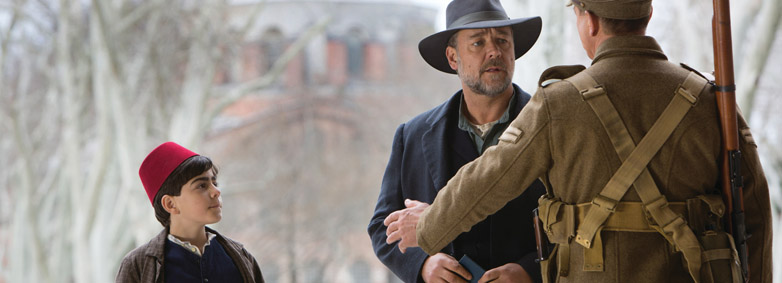
Crowe casts himself as Joshua Connor, a farmer and the titular water diviner. We first encounter him and his loyal dog in the digging in the red dusty earth for water. Crowe the director cheekily demonstrates his confidence by riffing on Daniel Day-Lewis in 2007’s There Will Be Blood.

After the tragic death of his wife he swears on her grave he will return with the bodies of their three sons. Four years earlier they were all lost in the battle of Gallipoli on the Turkish peninsular. The money-grabbing church offers no solace to Connor, he’s even smacked with a cross at one point.

He travels from the Outback to Istanbul where he struggles against pickpockets, the Turkish resistance, invading Greeks and the belligerent British army bureaucracy.

Connor’s helped along the way by Turkish soldiers Major Hasan and Sergeant Jemal (Yilmaz Erdogan and Cem Yilmaz). He also finds plenty of time to form a gentle bond with a beautiful hotel receptionist.

Turkish culture is treated with respect and in some detail. We see inside the fabulous Blue Mosque and witness several political protests. There are markets, religious ceremonies, brothels, cigarettes and raki. As a cultural exchange Connor teaches the Turks to play cricket.

The Water Diviner is built with the director’s virtues; it’s solid, honest, macho and hard-working, it’s easy on the eye and and offers unexpected moments of charm and humour.

Crowe underplays his own performance but still allows himself a lot of derring-do. There’s plenty of riding, fighting, drinking and even a rooftop escape to keep him busy.

As director he delivers some terrific action moments – especially an excellent sandstorm sequence – and there’s a harrowing depiction of trench warfare. We see the retreat form Gallipoli from the Turkish point of view, proving their soldiers are as brave and foolhardy as the ANZACS.

The film is less steady when Crowe approaches the delicate subject of the opposite sex, demonstrating he’s more comfortable with animals and children than he is with women. Connor even confesses he’s no good at courtship – it could be the director speaking.

There’s a decent stab at providing the character of Ayshe (Olga Kurylenko) with more to do than just being the love interest. She’s intelligent and proud yet realistic about life. As well as beating carpets and fetching wood, she runs the hotel and cares for her invalid father. She faces choices about her future which will affect her son Orhan (Dylan Georgiades).

Kurylenko seems uncertain in her early scenes though she improves as the film progresses – however the candlelit romantic subplot with Connor slows down the story when it should be gathering pace.

Faring far less well as a rounded character is her friend Natalia the prostitute (Isabel Lucas). She’s ever so jolly and lives upstairs in the hotel.

Crowe has thrown himself into the deep-end with this film but it’s no surprise he swims not sinks under the pressure.

Fast & Furious 7

Director: James Wan (2015)

Despite the mid-shoot death of star Paul Walker, the latest high-octane vehicle to roll off the Furious production line demonstrates there’s no end of the road in sight for this glossy franchise juggernaut.

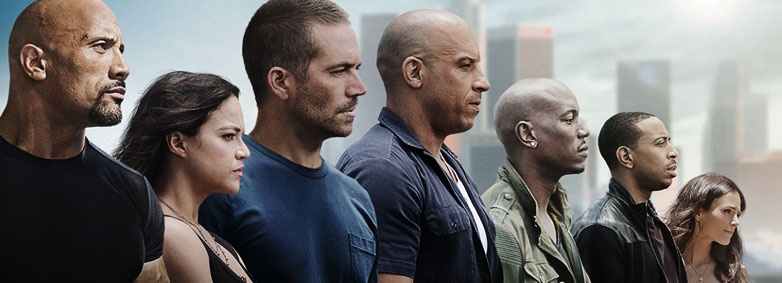
It’s a typical cacophony of tanked up car-nage powered by the winning performances of Walker and a billiard of bald action co-stars; Dwayne Johnson, Vin Diesel and Jason Statham.

Racing from London to Azerbaijan, Abu Dhabi and Los Angeles in a whirl of screaming tyres, knuckle-crunching fist-fights and shoot-outs, it picks up camels, military drones and helicopter gunships along the way.

What the series lacks is an easily identifiable theme for when the action kicks into gear, such as enjoyed by James Bond and the Mission Impossible films.

Following directly from the previous instalment, former British Special Forces Assassin Deckard Shaw (Statham) swears revenge for the injuries sustained by his brother.

Holding Dominic Toretto (Diesel) and his crew of drivers whom responsible, Shaw uses the office computer of Special Agent Luke Hobbs (Johnson) to discover their whereabouts – and then beats him up for good measure.

This allows Johnson to spend the greatest part of the film recuperating in bed. Despite being plastered prominently in the advertising posters, Johnson bookends the film rather than play a major part. His eventual reintroduction towards the end sees him striding about like Schwarzeneggar in Terminator 2.

When Toretto discovers his former comrade Kang has been murdered by Shaw, he sets out to find the assassin before Shaw can find him.

In walks supercool special operative Frank Petty (Kurt Russell) and puts Toretto’s team back together. Regular franchise watchers will recognise them as Brian, Letty, Roman and Tej (Paul Walker, Michelle Rodriguez, Tyrese Gibson and Chris Bridges).

It takes a while to adapt to seeing Russell – who earlier in his career played Snake PlisskenJack Burton and Elvis – as a government suit.

Petty works in an extremely busy yet surprisingly quiet car factory. He offers the team the use of the God’s Eye, a super-powerful computer program that will trace the whereabouts of Shaw.

But there’s a catch; the hacker who created it – Megan Ramsey (Nathalie Emmanuel) – has been kidnapped and Toretto’s team have to rescue her before they can access the God’s Eye.

This results in a brilliant mountainside chase is the movie’s best sequence and seems partly inspired by Michael Caine’s classic car caper The Italian Job (1969).

Another nod to a major a movie occurs in Los Angeles when a line of mannequins is destroyed immediately before a chase down the 2nd Street Tunnel. I doubt many of 2015’s mega-plex fillers will have the confidence to casually throw in a Blade Runner reference.

Fast Furious 7 works because no matter how preposterous the excellently executed action, all the actors play their roles with cast-iron conviction without once mugging or winking to the camera.

However the film does run away with itself. Except for the brief scene where Shaw is cornered in an old factory, the entire middle section set in Abu Dhabi could be jettisoned.

Although it provides for yet more bikini opportunities, a decent high-rise stunt and some cultural damage involving Chinese Terracotta soldiers, the film would be tightened up and considerably improved without it.

Due to Walker’s accidental death, various techniques were used to complete his scenes in a mostly seamless way.

His brothers Cody and Caleb stood in for him in certain shots and the director added footage of the actor from the earlier films. Some digital manipulation was also used to complete certain scenes.

This enable the producers to deliver a coherent movie which doubles as a fitting and touching tribute to the much-missed action star.

Robot Overlords

Director: Jon Wright (2015)

In this determinedly old school sci-fi adventure, a British teenager rallies the resistance against giant alien robots.

It has an energetic and engaging cast and some nifty design but with a story which might just squeeze as a last minute filler into the pages of 2000AD – still the galaxy’s greatest comic – it feels and looks too much like an extended episode of Dr Who.

For three years alien invaders have locked up the Earth’s population in their own homes. They claim they will leave when they have finished studying the human race.

Incineration is the penalty for breaking the nightly curfew, it’s enforced by heavily-armoured robots who patrol the streets and the skies.

Electronic implants are used to identify the population and track their whereabouts.

When an accident leads to the discovery of how to disconnect his tagging device, teenager Sean (Callan McAuliffe) goes looking for his Dad who went missing in action fighting the initial invasion.

He’s accompanied more or less willingly by friends Nathan and Alexandra (James Tarpey and Ella Hunt).

Meanwhile his mother Kate (Gillian Anderson) is left to fight off the attentions of collaborator Robin Smythe (Ben Kingsley).

The robots are nicely designed in a Robocop Ed-209 kind of way which is definitely this year’s most popular model.

Nor can there be enough sci-fi films using WWII Spitfires in an airborne attack.

Anderson and Kingsley add a touch of acting gloss and there’s an undoubted effort to entertain – but charm and enthusiasm can only engage or interest for so long.

A couple of characters are pointedly seen reading an old copy of 2000AD.

Shotgun toting, bullet-headed cockney hard-man Wayne (Tamer Hassan) seems based on Invasion!’s Bill Savage. He even looks a little like Stanley Baker on whom the character was originally modelled.

I’ve read 2000AD since Prog 64 and would love to see more films adaptions of its characters but It’s possible the complexity and scale of the writing defeats Hollywood’s finest.

2012’s excellent Dredd was a vast improvement on Sylvester Stallone’s maligned 1995 effort.

Paul Verhoeven’s 1987 Robocop which comes closest to capturing the comic’s manic satirical spirit and this year’s Ex Machina shows how intelligent and entertaining sci-fi can be done.

Robot Overlords is as straightforward as it’s title, I just wished I enjoyed it more than I did.