X-Men: Apocalypse

Director: Bryan Singer (2016)

Yawn your way to the end of the world in this inert episode of the increasingly under powered superhero franchise.

Bloated and boring, an exasperting multitude of characters are poorly served by laboured direction, haphazard editing and dialogue empty of any lyricism, humour or subtlety.

Lines of exposition are expanded to scene length and decorated with close ups of actors indifferent to the weightless CGI events occurring behind them. Presented with a lacklustre script, the top drawer cast offer up correspondent performances.

James McAvoy returns as Professor X, the wheelchair bound and telepathic leader of supergroup the X-Men who believes in peaceful co-existence with non-mutants. As his one time friend Magneto, Michael Fassbender wants the world to feel his pain.

Minor characters pose in heroic silence as the pair once again rehash their world views. In a film adverse to brevity, their relationship is underlined by the inclusion of footage of earlier films.

Oscar Isaac is barely recognisable and mostly immobile as the eponymous Apocalypse, a mutant from ancient Egypt who is resurrected by devout yet curiously security lax followers.

With the  ability to turn people to earth and metal, Apocalypse wants to build a better world from the ashes of the present one and starts recruiting mutants to serve him in his nefarious plan.

Jennifer Lawrence looks bored as the shapeshifting Mystique who seems to have mutated into a thin copy of her character Katnis Everdeen from The Hunger Games series (2012-15).

Now a reluctant global poster girl for mutants in hiding, Mystique needs convincing to take arms against Apocalypse.

Hugh Jackman cameos as Wolverine while Rose Byrne is beginning to rival Fassbender for being the best actor making the weakest career choices.

Evan Peters and Kodi Smit-McPhee as Quicksilver and Nightcrawler are the best of the B team. Olivia Munn, Ben Hardy, Alexandra Shipp and Sophie Turner are eager but forgettable.

The setting of 1983 allows for pop culture references to be scattered around but there’s a lack of the wit to exploit their comic potential.

Though the Cold War and the nuclear arms race are a major subplot, a nuclear launch occurs and is promptly forgotten about while our focus hurries away elsewhere.

Director Singer kickstarted with his career with the masterful The Usual Suspects (1995) and launched this series with the energetic X-Men (2000) but this is closer in muddled mediocrity to his Jack The Giant Slayer (2013).

The end of the world can’t come soon enough for this flatlining franchise.


Green Room

Director: Jeremy Saulnier (2016)

Plastered with gob, guts, groupies and guns, a punk band are torn apart by more than creative differences in this excoriating neo nazi thriller.

Suitably nihilist in attitude and stripped back in construction, it’s a visceral mosh pit of strip lighting, stanley knifes, and shotguns.

The Ain’t Rights are a penniless four piece band who have run out of money and luck. So they accept a gig in a nightclub in rural Portland where the clientele is described as boot and braces. The decor is confederate flags and swastikas.

When the band witness a crime they barricade themselves inside the Green Room backstage hospitality area, a grim concrete box with only one exit.

Pat is the band’s reluctant spokesman who’s played with nervous energy by Anton Yelchin, best known as Chekov from Star Trek (2009).

He attempts to negotiate with Darcy, the owner of the club while waiting for the police to arrive. Fellow Star Trek alumnus Patrick Stewart brings gravitas to his role and projects a majestic menace while whispering assurances from behind a locked door.

It’s noticeable how well he and another Brit Imogen Poots under play their lines to great effect. She plays Amber, a bystander caught up in events.

This is a welcome return to form for an engaging talent who has made some recent poor choices in Need For Speed (2014) and A Long Way Down (2014).

A smart script makes the characters endearing enough for us to root for them and peppers the dialogue with comic pop culture references.

Discussion about expenditure and fire hazards ground the events in the real world and hints at a critique of capitalism exploiting political foot soldiers for its own ends.

The band want out and Darcy wants them dead. The music and mayhem are turned up to 11.

Mustang

Director: Deniz Gamze Erguvan (2016)

This Turkish coming of age tale is a bitter sweet challenge to the conservation of prejudice and ignorance.

Powered by astonishingly natural performances, it’s engaging, intelligent, wonderfully fresh and surprisingly moving.

Five teenage sisters have been raised by their grandmother. They’re bright, lively and openly devoted to one another.

We watch through the eyes of the youngest. Lale makes jokes about boobs and giving birth while the older ones discuss sex and virginity. The tiny Gunes Sensoy is joyously defiant in the role as she carries our hopes and fears.

Nihal Koldas scolds and instructs as their grandmother, always doing what she believes to be right. She wails she has given them too much freedom when they’re falsely accused of impropriety with a group of local boys.

Ayberk Pekcan is pitifully macho as their aggressive uncle Erol who consequently imposes a strict new domestic regime.

The house is barred, computers and phones are removed and education is denied them. A dress code is enforced and they’re taught to cook and sew in preparation for future lives of domestic servitude.

The sisters’ different reactions to their new circumstance propels the drama to a range of destinations.

The Paris based Girlhood (2015) covers similar thematic ground to Mustang but this is the far more successful film. The Mustang girls are more rigorously denied freedoms. Plus they’re much more likeable characters than their bullying and work shy Parisian counterparts.

Oscar winning musical Fiddler On The Roof (1971) also featured the tribulations of five sisters. However it was told from the point of view of the father and with a considerably more sympathetic view of the dominant male.

The canny script suggests incarceration creates or exacerbates the girls’ desire to not conform. It is careful not to demonise men as a gender but as individuals. Erol is offered moments of dignity. The girls’ suitors are a mixed bag of fortune cookies.

Neither is this an attack on the culture of Turkey or Islam. Mustang is eager to stress the importance of education for women. It is the end of the school term and the leaving of a beloved teacher that signals the turning of the girls’ lives ‘to shit’. Istanbul is portrayed as an aspirational seat of culture and learning.

Nominated for this years Oscar for best film in a foreign language, wild horses shouldn’t stop you from seeing Mustang.


The Angry Birds Movie

Director: Clay Kaytis & Fergal Reilly (2016)

After a history of plundering plays, books, games and toys for inspiration, Hollywood has gone the whole hog and made a film based on a smartphone app.

And though The Lego Movie (2014) is a great example of how unpromising material can inspire awesome cinema, this animated effort featuring birds fighting pigs is a bird-brained bore.

It’s bright, colourful, busy and noisy but far less fun than the game ever was.

Scenes eke out their jokes with violent slapstick for the little ones and sneering sarcasm for the teens. Plus there’s snot, wee, a multitude of wriggling bums and a bizarre singing cowboy sequence.

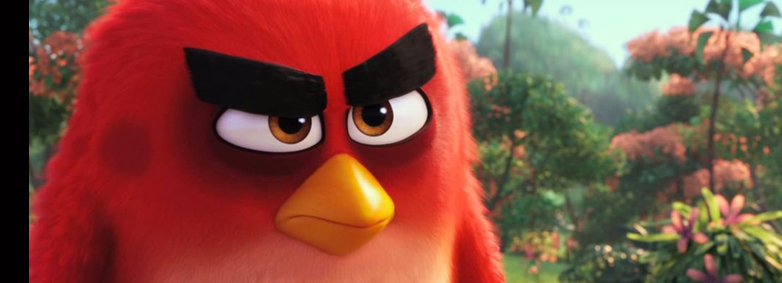
Jason Sudeikis voices the charmless Red, a lonely bird who gets angry when his feathers are ruffled.

He lives in a colony of cute flightless birds on a tropical island.

After a disastrous attempt at delivering a birthday cake, Red is sent to anger management class.

Because kids always find therapy jokes funny.

One day a steampunk pirate ship arrives with a crew of green pigs offering the trotter of friendship.

Red is given the bird by his compatriots when he questions the pigs motives.

He is proved right when the pigs kidnap the islander’s precious unhatched eggs. The swines.

So Red must come up with a plan and save the eggs’ bacon, without making a pigs ear of it and before their goose is cooked.

The soft boiled script relies heavily on crashing action and a scrambled mix of rap, rock and disco to capture the pointless freneticism of playing the game, but the tone is aggressive point scoring rather than giddy silliness.

And it all feels underdeveloped, presumably a consequence of trying to rush the movie into cinemas before everyone moves onto the next must-have gaming app. Oh dear.

Josh Gad and Danny McBride voice Chuck and Bomb. The former has super speed and the latter explodes.

Maya Rudolph irritates as Matilda the hippy psychologist and Sean Penn growls as a menacing over sized bird involved in a weird romantic subplot.

These pigging awful birds can flock off.

Bad Neighbours 2

Director: Nicholas Stoller (2016)

I strongly suspect this sequel to the successful 2014 frat boy comedy was only made so Zac Efron could be paid once again to oil his pecs and dance semi naked in front of a crowd of college girls.

Mind you, I’ve made worse career decisions myself.

However this proudly politically correct comedy is alarmingly enjoyable in its own undemanding bad taste way.

Efron returns as Teddy Sanders, now with a criminal record after event in the previous movie.

Wanting revenge on his former next door neighbours, Efron teams up with Chloe Grace Moretz who has rented his previous home to establish her own sorority.

Seth Rogen and Rose Byrne are again the family under siege while Selena Gomez, Lisa Kudrow and Kelsey Grammer cameo.


I Saw The Light

Director: Marc Abraham (2016)

This befuddled biopic sheds little light on the life of country music maestro Hank Williams.

It begins with a spine tingling rendition of his classic ‘Cold Cold Heart’, but it’s sadly all down hill from there.

Though the star of TV’s The Night Manager Tom Hiddleston sings his heart out, he chooses to hide his looks and charm under a cowboy hat. He does a decent of copy of Williams’ agitated crab stage gait.

By the time Williams died in 1953 at the tragically young age of 29, he had became one of the most influential singer songwriters of his time.

But you wouldn’t know that from the episodic and jumbled narrative given to us here.

We first meet Hank when he’s already enjoying a degree of success with his band and a regular slot on local radio. He has ambitions to appear on The Grand Ole Opry, the number one TV destination for country singers.

An impetuous, tempestuous, immoral, feckless,unreliable husband father and artist, the narrative is a familiar rock biography checklist of an alcohol fuelled career slide as he loses gigs, wives and friends.

But it’s presented full of leaps, detours and evasions, offering random snapshots of his life instead of a coherent story.

We’re spoon fed a brief resume of his success at the end, but it’s provided without context and leaves us with no greater understanding of his importance to country music or wider cultural impact or degree of success.

The classic songs Williams wrote such as ‘Your Cheatin’ Heart’ are short changed.

And so are the women. They’re presented as grasping and fertile while Hank takes no responsibility for his own behaviour.

Elizabeth Olsen is a determined presence as his wife Audrey, but is portrayed as a humourless self serving money grabber.

Except for Hiddleston the performers don’t seem to be enjoying themselves, and I didn’t either.

Florence Foster Jenkins

Director: Stephen Frears (2016)

Big screen diva Meryl Streep launches a ferocious assault on your ears in this biopic of the worlds worst opera singer.

As the title character, her ignorance of a lack of talent is a punishing off note joke.

But if you can endure Streep’s cacophony of comic caterwauling, there’s a lot of enjoyment in the tender chemistry created with her on screen husband St. Clair Bayfield, played by Hugh Grant.

It’s New York 1944 and heiress Florence is an overly generous patron of the arts whose entourage exploits her good nature for cash.

Determined to aid the war effort, she books herself a gig at Carnegie Hall and gives a thousand servicemen free tickets.

This threatens St. Clair’s luxurious life as neither he, tutors or muscians dare tell Florence the painful truth about her lack of ability, for fear of being put out on their arias.

Director Stephen Frears’ lack of visual ambition is compensated by adhering to the narrative and focusing on character.

He’s rewarded with two marvellous performances as the leads stretch their throats in extraordinary ways.

Grant has never better. With the fading of his still considerable leading man looks, his tremendous talent shines ever brighter. He gave a light comic masterclass in The Man From U.N.C.L.E. (2015) and here he dances like a young James Stewart.

Streep was last seen singing on screen as a bar room rocker in the weak Ricki And The Flash (2015) and here gives a performance of grand neurotic eccentricity.

The stars essay a complex relationship while the script saves its mockery for the sycophants who surround them.

Rebecca Ferguson is under served as St. Clair’s lover but Nina Arianda is show stopping as a ticking blonde bombshell, threatening blow up the whole charade whenever she speaks her mind.

This is the second telling of the story this year, after the French language version Marguerite (2016) which won 4 prestigious Cesar awards.

This version is undemanding with broad appeal, and you don’t have to appreciate opera to enjoy it.


These Final Hours

Director: Zak Hilditch (2016)

With the end of the world only twelve hours away, society has descended into an orgy of sex, suicide, booze, drugs and violence.

And that’s just the first five minutes of this scorchingly apocalyptic Australian road movie.

A meteorite has caused Europe, Africa and the Americas to be engulfed in an rolling inferno, and Perth is last on the list.

Nathan Phillips is well cast as buff surfer dude James, desperately racing to a party to be with his girlfriend.

With it’s vehicle hopping, dry humour and brutal violence, this is arguably an unofficial and worthy prequel to George Miller’s magnificent Mad Max: Fury Road (2015). It offers an explanation of how society reached there from here.

The smart script by the director Hilditch offers James choices whose actions flesh out his character. Further bonus points are gained by never compromising the central premise.

Cinematographer Bonnie Elliot exploits the local light in extraordinary ways by saturating the screen in blistering red, orange and yellow.

Plaudits also to the production designer Nigel Davenport for stretching the budget and providing vehicles in a suitably searing shades of ochre.

Similarly to Max, James is defined by the relationships he has with the women in his life.

Jessica De Gouw and Kathryn Beck offer bikini clad support as James’ girlfriends Zoe and Vicky. Lynette Curran steals a scene as his mother.

En route to see Vicky, James’ rescues a young school girl from a pair of paedophiles.

Angourie Rice gives a remarkable performance as the sweet and straight talking Rose, who insists on being taken to her waiting father.

These reluctant fellow travellers offer each other the possibility of redemption as they work out what is really important in the short time they have left.


Ratchet And Clank

Director: Kevin Munroe (2016)

From Super Mario Bros. (1993) to Street Fighter (1995), Hollywood has a low scoring rate when trying to turn video games into cinema hits.

Never threatening the high score of soon to be remade Lara Croft: Tomb Raider (2001) or Resident Evil (2002), Ratchet And Clank features a defective robot and an alien mechanic teaming up to save the universe.

Based on the game of the same name, this is a poorly assembled and malfunctioning sci-fi animated adventure.

More a sugar fuelled distraction than a coherent movie, it’s written for and possibly by attention deficit kids wide eyed on popcorn and fizzy drinks.

David Kaye voices Crank, a defective War-bot. Unlike his monstrously armoured production line robot siblings, he’s petite, prissy and pacifist.

Clank is scheduled for demolition by Paul Giamatti’s Chairman Drek. He’s employed Armin Shimerman’s evil scientist Doctor Nefarious to build an army of robot assassins to annihilate the Galactic Rangers.

The Rangers are a dim and trigger happy team of celebrity loving law enforcers, lead by the square jawed and muscle bound buffoon Captain Qwark, voiced by Jim Ward.

Crash landing on a distant world, Clank is rescued by Ratchet. Energetically voiced by James Arnold Taylor, he’s some sort of orange space fox.

A small mechanic with big dreams, Ratchet whisks his new friend away to warn the Rangers.

With the least possible attention to detail in the animation, character, plot or dialogue, it’s a manic, mirthless mash up of movie spare parts, many borrowed from the Star Wars films.

But sadly not just the good ones. There’s a planet destroying weapon and pod racing. Architecture is republican era Alderaan.

The script throws in jokes about selfies and hashtags in a futile bid to be relevant. At one point a robot henchmen chews up a smartphone as punishment.

For the intended audience it’s probably the most terrifying moment in the whole film.

The release date is presumably to capitalise on the UK Bank holiday, pitching itself at all the kids too young to see Captain America: Civil War (2016) or have already seen The Jungle Book (2016) and Zootropolis (2016).

Sylvester Stallone, Rosario Dawson and John Goodman offer recognisable names to tempt unwary parents with a mirage of quality.

It’s game over already for this wannabee franchise.

Golden Years

Director: John Miller (2016)

With grand designs on Hollywood, TV presenter and star of DIY SOS Nick Knowles has knocked out this very British comedy.

His workmanlike script is an off the shelf construction of stately homes, incompetent cops, cups of tea and bare arses.

As mild mannered retiree Arthur, Bernard Hill leads a solid cast that includes Una Stubbs, Alun Armstrong, Simon Callow and Virginia McKenna.

They give this gentle crime caper a dash of colour and a veneer of respectability.

Accidentally discovering an aptitude for bank robbery, Arthur plans to save the local bowling club from closure and sets about raising the funds in a Robin Hood stylee.

The story highlights the contemporary issue of OAP’s being fleeced of their pensions by robber banks, and makes a point of the invisibility of the elderly in society.

It bestows vitality on its characters and respect to its audience by wisely saving its mockery for the media attention seeking copper in charge of the robbery investigation.

Brad Moore as Detective Stringer channels his inner David Brent in a perma-tanned performance.

Although it offers mild entertainment and is difficult to object to, it all feels like the movie version of a never seen 1970s TV sitcom.

Breaking the golden rule of cinema finance, Knowles has used his own cash to fund the project.

There’s definitely a screw loose somewhere.