The Daughter

Director: Simon Stone (2016)

This gloomy family drama is a sombre reflection on class, wealth, infidelity and betrayal.

A respectful adaptation of Henrik Ibsen’s play The Wild Duck (pub. 1884 as Vildanden) it successfully migrates from 19th century Norway to modern day Australia.

A languid pace and sumptuous cinematography encourages us to wallow in the brooding atmosphere. Varied locations from stately home to derelict mill suggest the texture of history.

They anchor the poised performances from a top drawer cast which includes veteran Aussie actors Geoffrey Rush and Sam Neill. They play estranged former business partners Henry and Walter.

With an endearing and frank freshness, pink haired teenager Odessa Young plays Hedwig. She’s Walter’s grand-daughter and the daughter of the title. Bright and sensitive, she’s pursuing a romance with a school friend.

As Henry prepares to marry his young housekeeper Anna, his confrontational and alcoholic son Christian has returned from abroad.

Although never dull, we spend a long time waiting for a dark secret to power the violent finale where lives are shredded.

@ChrisHunneysett


Alice Through The Looking Glass

Director: James Bobin (2016)

It’s six long years since the staggeringly successful but forgettable Alice In Wonderland (2010) from director Tim Burton.

And time drags in this muddled sequel which has even less connection to the fantastical novels of Lewis Carroll.

There’s no lyrical sense of wonder just hack handed sentiment, blunt slapstick and plodding special effects.

It jettisons familiar characters into two distinct and parallel plots of its own invention, respectively involving time travel and female empowerment. The resolution of family conflict joins the two strands loosely together.

Never forget Hollywood’s golden rule of scriptwriting; a film is always about family, regardless of how appropriate it is to the material.

Burton butchered Carroll’s whimsical masterpiece, replacing its playful intelligence, charm and wit with flamboyant gothic design and an excruciating mannered performance by Johnny Depp as the Mad Hatter.

Against the odds, Burton’s replacement James Bobin has made an even more unwieldy and incoherent film.

Previously Bobin directed The Muppets (2011) and Muppets Most Wanted (2014). He began in TV with The 11 O’Clock Show (1998) where he collaborated with Sacha Baron Cohen. The comic actor features heavily if sadly not hilariously in Looking Glass.

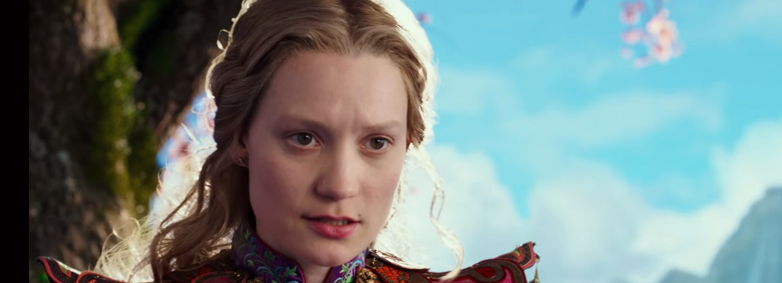
Despite Alice being reinvented as an action heroine, the pale Mia Wasikowska gives a pallid performance as Alice. Perhaps she’s miffed she’s billed a humble third after Depp and Anne Hathaway.

Alice steps through a mirror and falls into Wonderland, immediately signalling to us nothing in this world can hurt her. Which destroys any potential sense of danger in one dull thud.

She is told her friend the Mad Hatter has gone more mad but in a bad way, and is dying.

In white face paint, orange wig and tweeds, Depp’s Hatter resembles Ronald McDonald’s eccentric great uncle after confinement to a suitable attic.

To cure him Alice must do the impossible task of stealing a device called the chronosphere and go back in time to rescue his long lost family.

Removing the time travelling machine risks destroying Wonderland and everyone in it. But this threat is quickly forgotten about as the film is more interested in whizzing Alice about. There’s a surprise incursion to an insane asylum.

Alice is chased by Time who wants his contraption back. The film can’t decide if the black clad and German accented Sacha Baron Cohen is the baddie.

Also vying to be the baddie but failing in villainy are Helena Bonham Carter and Hathaway. They make a squabbling return as respectively the large headed and rude Red Queen and the elegant and duplicitous White Queen.

The presence of Bonham Carter, his now ex-wife, may explain Burton’s exclusion from the director’s chair.

The sepulchral tones of the late Alan Rickman offers a fleeting moment of gravity. While in her brief appearances as Alice’s mother, theatrical Scots stalwart Lindsay Duncan makes more of an impression than Wasikowska achieves.

Lending their voices to the advertising poster in some un-necessarily expensive casting choices are Stephen Fry, Michael Sheen, Timothy Spall, John Sessions, Barbara Windsor, Paul Whitehouse and Toby Jones.

Usually my heart despairs whenever Matt Lucas appears so it says a great deal about the film I found his presence curiously bearable.

Alice won Oscars for Best Art Direction and Best Costume Design, as well as being nominated for Best Visual Effects.

No doubt Looking Glass will follow the first film in being in the running for similar awards. It’s rich and detailed production design gives us plenty to look at while everyone busily runs around.

The chronosphere is a golden mechanical marvel Alice sits in to blast back in time, a design nod to George Pal’s teen culture embracing adaption of HG Well’s The Time Machine (1960).

Alice visits vast gothic halls and traverses a tumultuous ocean of time. The world is populated by  mechanical assistants, vegetable guardsmen, giant chess pieces, a fire breathing Jabberwocky, walking frogs, talking dogs and of course the disappearing Cheshire Cat.

Bookending the film is a framing device featuring Alice’s adventures at sea pursued by pirates. Because the world needs another big budget CGI fest involving Johnny Depp and pirates.

The story stresses the importance of not wasting ones time. Which is strange as I wasted two hours of my life watching this joyless merry go round of a movie.

Mind you, it felt much longer.

@ChrisHunneysett


The Call Up

Director: Charles Barker (2016)

I was tempted to go MIA while watching this misfiring sci fi action thriller.

Virtual reality gamers feeling the real pain of warfare is a strong premise. But the potential is carelessly squandered by the lack of polish in the script. This translates into a deficit of onscreen urgency, tension or humour.

Eight expert online gamers are invited to the top floor of a tower block.

Identified to each other only by their avartars, they’re squeezed into full immersion technology suits; an unforgiving combo of nylon jump suits and white armour.

Believing they’re playing a hi-tech version of paintball, they’re instructed to fight their way past ‘terrorists’ to the ground floor.

This is a similar scenario to the comic book adaptation Dredd (2012) and Indonesian martial arts movie The Raid: Redemption (2012). It worked brilliantly there but not so much here.

A strangely muted pace and the workaday action lacks the gleeful sadism of recent low similar budget flicks such as The Purge (2013).

The player with highest points will win £100,000 prize money. However the team quickly discover being shot involves pain, injury and even death. This is definitely not what they  signed up for.

Sadly the twist ending isn’t worth waiting for. Plus the characters are so thinly sketched we don’t care.

Morfydd Clark and Ali Cook are among the hard working actors struggling to inject life into a sterile environment.

There’s some sweet design in the costumes and technology but even assuming for the budget constraints, the location dressing is uninspired.

What should compensate is scorching action, great dialogue, the sense of a wider world, a critique of game playing or perhaps an examination of the correlation between on and off screen violence. And all of this is missing.

By setting itself low ambitions and barely achieving them, experiencing The Call Up was far too much a call of duty.

@ChrisHunneysett

Chicken

Director: Joe Stephenson (2016)

Intense performances, an assured tone and a textured landscape shot with an appreciative eye are the strengths of this earnest and occasionally raw drama.

But as the characters struggle with poverty and abandonment, the script fails to free itself of the burden of its theatrical roots, failing to ignite the painstakingly constructed emotional bonfire.

Morgan Watkins and Scott Chambers play brothers with learning difficulties who live in a derelict caravan on farmland.

Polly is older, aggressive and more capable than Richard, he earns beer money as a casual labourer.

During Polly’s daily absence, the sweet natured Richard strikes up an unlikely friendship with spoilt middle class teenager Annabelle, played brightly by Yasmin Paige.

The deterioration of the boys challenging circumstances accelerates the decline of their relationship, unearthing a life changing family secret.

@ChrisHunneysett


A Hologram For The King

Director: Tom Tykwer (2016)

The desert sun shines a soft light on a middle age crisis in this culture clash comedy drama.

Handsome, sentimental and undemanding, it relies heavily on the charm of a hangdog Tom Hanks to hold our attention.

He plays a salesman in a slump called Alan Clay, who jets off to Saudi Arabia to sell an innovative holographic conference call system to the King.

But he finds himself trapped in a Kafka-esque routine of cancelled appointments, stone-walling receptionists and elusive contacts.

This multiplies Alan’s many anxieties which manifest themselves as a cyst on his back and panic attacks.

Seeking treatment he’s befriended by glamorous doctor Zahra and his wild haired driver Yousef.

They’re played with graceful intelligence by Sarita Choudhury and a deceptive deapan delivery by Alexander Black. Ben Whishaw and Tom Skerritt appear briefly.

Hologram opens with an agitated Clay singing Talking Heads 1980’s ode to existential angst Once In A Lifetime.

This fabulous if too short sequence is the only time the film offers any daring. After which it settles into a comfortable rhythm, rolling along as gently as the desert dunes which stretch interminably along Clay’s horizon.

There’s a running joke involving Clay falling off his chair and watching Hanks tapping out flirtatious emails at his computer has echoes of Nora Ephron’s comedy You’ve Got Mail (1998).

Adapted from Dave Eggers novel of the same name, the script leaves politics and religion in the shade and offers a sunny outlook on the possibilities which exist in even the most unpromising terrain.


X-Men: Apocalypse

Director: Bryan Singer (2016)

Yawn your way to the end of the world in this inert episode of the increasingly under powered superhero franchise.

Bloated and boring, an exasperting multitude of characters are poorly served by laboured direction, haphazard editing and dialogue empty of any lyricism, humour or subtlety.

Lines of exposition are expanded to scene length and decorated with close ups of actors indifferent to the weightless CGI events occurring behind them. Presented with a lacklustre script, the top drawer cast offer up correspondent performances.

James McAvoy returns as Professor X, the wheelchair bound and telepathic leader of supergroup the X-Men who believes in peaceful co-existence with non-mutants. As his one time friend Magneto, Michael Fassbender wants the world to feel his pain.

Minor characters pose in heroic silence as the pair once again rehash their world views. In a film adverse to brevity, their relationship is underlined by the inclusion of footage of earlier films.

Oscar Isaac is barely recognisable and mostly immobile as the eponymous Apocalypse, a mutant from ancient Egypt who is resurrected by devout yet curiously security lax followers.

With the  ability to turn people to earth and metal, Apocalypse wants to build a better world from the ashes of the present one and starts recruiting mutants to serve him in his nefarious plan.

Jennifer Lawrence looks bored as the shapeshifting Mystique who seems to have mutated into a thin copy of her character Katnis Everdeen from The Hunger Games series (2012-15).

Now a reluctant global poster girl for mutants in hiding, Mystique needs convincing to take arms against Apocalypse.

Hugh Jackman cameos as Wolverine while Rose Byrne is beginning to rival Fassbender for being the best actor making the weakest career choices.

Evan Peters and Kodi Smit-McPhee as Quicksilver and Nightcrawler are the best of the B team. Olivia Munn, Ben Hardy, Alexandra Shipp and Sophie Turner are eager but forgettable.

The setting of 1983 allows for pop culture references to be scattered around but there’s a lack of the wit to exploit their comic potential.

Though the Cold War and the nuclear arms race are a major subplot, a nuclear launch occurs and is promptly forgotten about while our focus hurries away elsewhere.

Director Singer kickstarted with his career with the masterful The Usual Suspects (1995) and launched this series with the energetic X-Men (2000) but this is closer in muddled mediocrity to his Jack The Giant Slayer (2013).

The end of the world can’t come soon enough for this flatlining franchise.


Green Room

Director: Jeremy Saulnier (2016)

Plastered with gob, guts, groupies and guns, a punk band are torn apart by more than creative differences in this excoriating neo nazi thriller.

Suitably nihilist in attitude and stripped back in construction, it’s a visceral mosh pit of strip lighting, stanley knifes, and shotguns.

The Ain’t Rights are a penniless four piece band who have run out of money and luck. So they accept a gig in a nightclub in rural Portland where the clientele is described as boot and braces. The decor is confederate flags and swastikas.

When the band witness a crime they barricade themselves inside the Green Room backstage hospitality area, a grim concrete box with only one exit.

Pat is the band’s reluctant spokesman who’s played with nervous energy by Anton Yelchin, best known as Chekov from Star Trek (2009).

He attempts to negotiate with Darcy, the owner of the club while waiting for the police to arrive. Fellow Star Trek alumnus Patrick Stewart brings gravitas to his role and projects a majestic menace while whispering assurances from behind a locked door.

It’s noticeable how well he and another Brit Imogen Poots under play their lines to great effect. She plays Amber, a bystander caught up in events.

This is a welcome return to form for an engaging talent who has made some recent poor choices in Need For Speed (2014) and A Long Way Down (2014).

A smart script makes the characters endearing enough for us to root for them and peppers the dialogue with comic pop culture references.

Discussion about expenditure and fire hazards ground the events in the real world and hints at a critique of capitalism exploiting political foot soldiers for its own ends.

The band want out and Darcy wants them dead. The music and mayhem are turned up to 11.

Mustang

Director: Deniz Gamze Erguvan (2016)

This Turkish coming of age tale is a bitter sweet challenge to the conservation of prejudice and ignorance.

Powered by astonishingly natural performances, it’s engaging, intelligent, wonderfully fresh and surprisingly moving.

Five teenage sisters have been raised by their grandmother. They’re bright, lively and openly devoted to one another.

We watch through the eyes of the youngest. Lale makes jokes about boobs and giving birth while the older ones discuss sex and virginity. The tiny Gunes Sensoy is joyously defiant in the role as she carries our hopes and fears.

Nihal Koldas scolds and instructs as their grandmother, always doing what she believes to be right. She wails she has given them too much freedom when they’re falsely accused of impropriety with a group of local boys.

Ayberk Pekcan is pitifully macho as their aggressive uncle Erol who consequently imposes a strict new domestic regime.

The house is barred, computers and phones are removed and education is denied them. A dress code is enforced and they’re taught to cook and sew in preparation for future lives of domestic servitude.

The sisters’ different reactions to their new circumstance propels the drama to a range of destinations.

The Paris based Girlhood (2015) covers similar thematic ground to Mustang but this is the far more successful film. The Mustang girls are more rigorously denied freedoms. Plus they’re much more likeable characters than their bullying and work shy Parisian counterparts.

Oscar winning musical Fiddler On The Roof (1971) also featured the tribulations of five sisters. However it was told from the point of view of the father and with a considerably more sympathetic view of the dominant male.

The canny script suggests incarceration creates or exacerbates the girls’ desire to not conform. It is careful not to demonise men as a gender but as individuals. Erol is offered moments of dignity. The girls’ suitors are a mixed bag of fortune cookies.

Neither is this an attack on the culture of Turkey or Islam. Mustang is eager to stress the importance of education for women. It is the end of the school term and the leaving of a beloved teacher that signals the turning of the girls’ lives ‘to shit’. Istanbul is portrayed as an aspirational seat of culture and learning.

Nominated for this years Oscar for best film in a foreign language, wild horses shouldn’t stop you from seeing Mustang.


The Angry Birds Movie

Director: Clay Kaytis & Fergal Reilly (2016)

After a history of plundering plays, books, games and toys for inspiration, Hollywood has gone the whole hog and made a film based on a smartphone app.

And though The Lego Movie (2014) is a great example of how unpromising material can inspire awesome cinema, this animated effort featuring birds fighting pigs is a bird-brained bore.

It’s bright, colourful, busy and noisy but far less fun than the game ever was.

Scenes eke out their jokes with violent slapstick for the little ones and sneering sarcasm for the teens. Plus there’s snot, wee, a multitude of wriggling bums and a bizarre singing cowboy sequence.

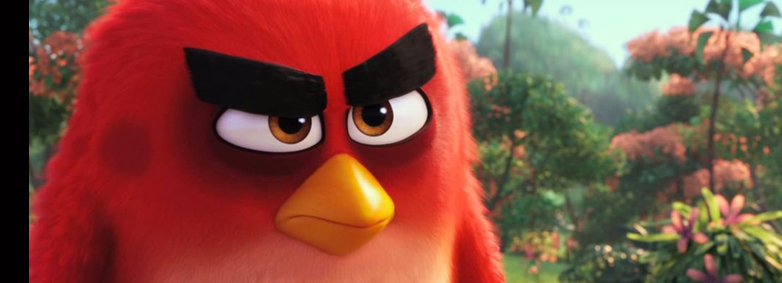
Jason Sudeikis voices the charmless Red, a lonely bird who gets angry when his feathers are ruffled.

He lives in a colony of cute flightless birds on a tropical island.

After a disastrous attempt at delivering a birthday cake, Red is sent to anger management class.

Because kids always find therapy jokes funny.

One day a steampunk pirate ship arrives with a crew of green pigs offering the trotter of friendship.

Red is given the bird by his compatriots when he questions the pigs motives.

He is proved right when the pigs kidnap the islander’s precious unhatched eggs. The swines.

So Red must come up with a plan and save the eggs’ bacon, without making a pigs ear of it and before their goose is cooked.

The soft boiled script relies heavily on crashing action and a scrambled mix of rap, rock and disco to capture the pointless freneticism of playing the game, but the tone is aggressive point scoring rather than giddy silliness.

And it all feels underdeveloped, presumably a consequence of trying to rush the movie into cinemas before everyone moves onto the next must-have gaming app. Oh dear.

Josh Gad and Danny McBride voice Chuck and Bomb. The former has super speed and the latter explodes.

Maya Rudolph irritates as Matilda the hippy psychologist and Sean Penn growls as a menacing over sized bird involved in a weird romantic subplot.

These pigging awful birds can flock off.

Bad Neighbours 2

Director: Nicholas Stoller (2016)

I strongly suspect this sequel to the successful 2014 frat boy comedy was only made so Zac Efron could be paid once again to oil his pecs and dance semi naked in front of a crowd of college girls.

Mind you, I’ve made worse career decisions myself.

However this proudly politically correct comedy is alarmingly enjoyable in its own undemanding bad taste way.

Efron returns as Teddy Sanders, now with a criminal record after event in the previous movie.

Wanting revenge on his former next door neighbours, Efron teams up with Chloe Grace Moretz who has rented his previous home to establish her own sorority.

Seth Rogen and Rose Byrne are again the family under siege while Selena Gomez, Lisa Kudrow and Kelsey Grammer cameo.