Vacation

Director: Jonathan Goldstein & John Francis Daley (2015)

This flat retread of Chevy Chase’s 1983 road trip comedy trundles from coast to coast in desperate search of of a decent joke.

Stupid and cheap, Vacation lifts characters, plot, jokes and theme song from the original and does nothing interesting with them.

At the height of his mystifying ’80’s popularity, National Lampoon’s Vacation (1983) starred Chase as Clark, the well-intentioned patriarch of the Griswold family.

A cameo here proves his laboured comic touch hasn’t deserted him. Beverly D’Angelo reprises her role as his wife Ellen.

This time out their grown up son Rusty takes centre stage and is played by Ed Helms, formerly of The Hangover franchise.

Rusty is following in his father’s footsteps and dragging his own squabbling family on a bonding trip across the US, heading once again for the Walley World amusement park.

En route the Griswold’s suffer white water rafting troubles, quad bikes accidents, quarrelling cops and dogging experiences.

Helms does an uncannily accurate impression of the young Chase, regardless of whether the world needs or asked for one.

Christina Applegate gives her all as his wife Debbie. Her talent was honed as the teenage daughter on TV’s Married With Children and she deserves far sharper material. As do we.

As an accomplished comic actress Applegate gives Jennifer Aniston a run for her money. They went head to head as screen sisters in Friends and it would be great to see them paired up in some future project.

Skyler Gisondo is their sensitive, singing teenage son James. He is bullied by his younger brother Kevin, a gleefully foul-mouthed Steele Stebbins.

Thor star Chris Hemsworth flexes his pecs as cow-wrangling brother-in-law with a suspiciously large gun in his pocket.

With craft in the writing all four family members have an identifiable arc which dovetails into the overall dynamic. Situations are set up and have a pay off.

But there’s a distinct lack of ambition as the script sets the comedy bar dispiritingly low and persistently fails to clear it. But at no point do any of the jokes raise a smile, just a rictus of disbelief.

The tone is set at the very beginning with a series of supposedly real holiday snaps which find hilarity in snot, urine, vomit, violence and inappropriate erections.

Vacation also riffs on Duel (1971), National Lampoon’s Animal House (1978) and Airplane! (1980) to barely discernible comic effect.

There is a meta moment where Rusty addresses the film’s nature as a sequel but it’s executed without the wit of Phil Lord and Chris Miller‘s Jump Street 22.

And of course there’s a special circle of hell reserved for films which features TV cook Gordon Ramsey in any capacity.

Technically it’s a fifth sequel to National Lampoon’s Vacation (1983). That was penned by John Hughes, directed by Harold Ramis.

Hughes was responsible for writing and directing the great teen movies of the period including Ferris Bueller’s Day Off (1986) The Breakfast Club (1985). Ramis went on to co-write Ghostbusters (1984) and Groundhog Day (1993) as well as directing the latter.

Despite this talent on board, it wasn’t very good.

Vacation 2015 was scripted by the directors Goldstein and Daley who were responsible for writing Horrible Bosses (2011) and The Incredible Burt Wonderstone (2013). It’s an altogether lesser pedigree, and it shows.

At one point a tour guide gives a primal scream of anguished rage, exactly mirroring my own feelings.

You’re better off at work than experiencing this vacation from hell.

Post script.

Chase and D’Angelo starred in National Lampoon’s Vacation (1983), National Lampoon’s European Vacation (1985), National Lampoon’s Christmas Vacation (1989) and Vegas Vacation (1997) plus the short Hotel Hell Vacation (2010) released online.

There was also National Lampoon’s Christmas Vacation 2 (2003) focused on the recurring character of cousin Eddie played by Randy Quaid.

Trainwreck

Director: Judd Apatow (2015)

This comedy about a young woman on the path to redemption feels like a series of sketches strung together by a threadbare plot.

Amy Schumer writes and stars and though she and co-star Bill Hader are engaging, their charm and talent can’t overcome the limitations of the script or the dead hand of director Apatow.

It is indulgent in length, grossly sentimental, fawning to celebrities, loosely improvisational and insufficient scenes to are brought to a strong close. Too often too many characters are allowed to waffle.

Drunk and promiscuous journalist Amy Townsend (Schumer) has a varied if unfulfilling sex life and is merrily chasing promotion at work at edgy magazine S’nuff.

Her colleagues are irritating idiots and her boss Dianna is played by an alarmingly accented Tilda Swinton. The hard-faced career woman is contrasted with Amy’s sister Kim (Brie Larson). She’s a warm, soft role model of stable maternity.

A happy homeless man offers a warning as to how Amy’s life may develop if she doesn’t change her wanton ways. She enables him in the worst possible way.

Dianna sends Amy off to interview Dr. Aaron Conners (Hader). He’s a knee surgeon famous for saving the careers of sportspeople I’ve mostly never heard of.

Before she realises it she’s falling in love, rejecting her former life of drugs and fun and embracing sobriety and monogamy.

Amy pulls a reverse Sandy (Olivia Newton-John) from Grease (1978). She migrates from independent woman to a person subservient to the needs of her un-inspirational boyfriend. But he’s a doctor, so that’s alright.

Even Grease’s Danny Zucco (John Travolta) recognises he has to compromise his behaviour to win the heart of Sandy. But Aaron is oblivious of the potential to change and so Amy must bend to meet his needs. The leader of the T’Birds is far more progressive than anyone on show here.

By the end Amy is publicly humiliating herself to prove her worth in a way that would have made her earlier, more attractive persona shudder.

Embracing family and domesticity is presented as the pinnacle of female endeavour. Her career success is dependent on the reflected glory of her beau.

The story is in thrall to the sexual politics of the ’50’s, the 1850’s. Even Charlotte Bronte (Jane Eyre pub. 1847) would blush to write a female so eager to be defined by a man for happiness and fulfilment.

There’s a funeral, a baby shower, an invasive medical procedure and several dates. It’s not the least embarrassed to lift from Woody Allen’s Manhattan (1979).

Featuring far too much basketball, someone called LeBron James features prominently as an emotional mentor to Aaron. Daniel Radcliffe, Marisa Tomei, Matthew Broderick and err, former Tennis champ Chris Evert all appear.

Amy gives a 16 year old – a legal minor – alcohol, assaults him and then attempts to have sex with him. Good luck switching the genders and getting away with that scene.

All of these failings could be overlooked if the film was rip-roaringly funny and entertaining – but it rarely musters a chuckle. The funniest scene is the first one – and Schumer isn’t in it.

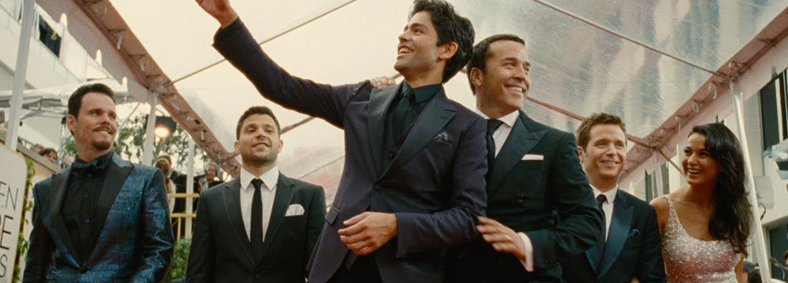
Entourage

Director: Doug Ellin (2015)

As well as being lazy, stupid and devoid of laughs, this spin-off of the US TV show is appallingly smug and horrifically misjudged.

Loosely based on the experiences of Marky Mark Wahlberg and his early years in Hollywood, it ran for eight series of which I never watched a second. Sadly I’ve now seen too much.

It was produced by the HBO channel which also responsible for the similarly glossy Sex And The City, a ground-breaking show which suffered two uninspired movie sequels.

Wahlberg produces and appears briefly in this big screen version which continues the careers and love-lives of talentless ‘A’ list actor Vincent Chase (Adrian Grenier) and his witless and charmless team of hangers-on.

Supposedly the central character, Vincent is anonymous in his own movie and even in his own gang.

It consists of his manager and best friend Eric, his brother Johnny and friend Turtle. (Kevin Connolly, Kevin Dillon and Jerry Ferrara).

We’re supposed to enjoy hanging out with the boys and find them amusingly out of their depth and adorably dim.

Jeremy Piven (UK TV’s Mr Selfridge) gives an energetic performance as Vincent’s stressed-out agent Ari Gold.

But when he’s not on screen the energy levels drop alarmingly along with quality and entertainment value.

Vince has left his wife after nine days of marriage and is undergoing a bout of soul-searching – while partying on an enormous babe-filled luxury yacht.

He decides to do something meaningful with his life and insists on directing his next movie

Maybe that’s a jokey reflection on Hollywood values but the self-satisfied tone makes it difficult to tell.

His movie is called Hyde, a trashy high concept sci-fi thriller which looks like a mash-up of The Matrix (1999) and Dredd (2012).

I’d much rather be watching that movie than this one.

Unfortunately Eric – the sensitive one with a pregnant ex-girlfriend – is as inadequate a producer as he is a manager.

When he allows the production to go over-budget, Ari has to go cap-in-hand to Texan billionaire Larsen McCredle (Billy Bob Thornton) for more money to finish the movie.

Larsen sends his son Travis (Haley Joel Osment) to Hollywood to oversee the film’s progress but he ends up causing more problems than he solves.

Among the relentless tedium of the boys rampant idiocy, there’s acting auditions, sex-tapes, dates, lunches, parties and meetings.

Employing a high nipple count, each scene seems to begin with a perfectly pert posterior parading past the camera.

Women exist only as targets to be ‘banged’ and a viagra-spiked pool party has a decidedly rapey feel.

The boys aren’t redeemed by going googoo over a newborn girl – especially in the light of a joke about an aged Lothario screwing his high-school daughter’s friends.

If that doesn’t make you laugh there’s plenty of homophobic abuse directed towards a gay Asian character called Lloyd Lee (Rex Lee).

As it’s all performed in inverted comma’s it’s presumably OK.

Liam Neeson and Kelsey Grammar appear in the stream of lacklustre acting cameos alongside a bunch of US sports stars I didn’t recognise.

When the former footballer Thierry Henry wanders through for absolutely no reason, it’s a snapshot of the Premier League levels of bantz and fawning indulgence towards anyone famous.

Entourage is for die-hard fans of the series only – even If such people exist – though judging by the weak box office ($26m at the time of writing) achieved on it’s home turf, perhaps it’s not even for them.

Hot Tub Time Machine 2

Director: Steve Pink (2015)

Anarchic and knowingly stupid, this gross-out comedy sequel goes back to the future with nobs on. And out.

Loud and lewd, it’s a booze, drugs, sex, vomit and gay-rape romp to the year 2025, a pop culture mash up of The Hangover and Back To The Future franchises.

Having exploited their time-travelling hot tub to become billionaires, Nick (Craig Robinson) and Lou (Rob Corddry) are having a party in Lou’s mega-mansion.

Nick is importing music and claiming it as his own while Lou has invented Lougle, the dominant internet search engine. Lou’s son Jacob (Clark Duke) is employed by his dad as a butler.

An unidentified man shoots Lou so Nick and Jacob throw him in the tub to travel back in time to stop the shooting. But they go forward in time by mistake and have to find a supply of secret formula chemical to take them back home.

They hook up with Adam (Adam Scott) the son of the character played by John Cusack in the original film. Cusack obvioulsy decided this is a Hot Tub trip too far. The very game cast who do return put their all into the film.

The story doesn’t bear any analysis with regards logic. It’s a shameless hook to hang on as many badly judged and executed jokes as possible, the more rude, offensive and stupid the better.

There’s a driverless smartcar with murder in mind, hallucinogenic trips, drasic dancing and Christian Slater as a game show host

Very aware that 2015 is the year in the future Back To The Future II travelled ahead to, there’s a hoverboard joke. References to other time travel movies include The Terminator, Looper and of course the Back To The Future films litter the script.

Joke cameos from Lisa Loeb, Jessica Williams and Bruce Buffer as themselves may have been funny if I didn’t have to Lougle them to discover who they are.

Disposable and daft, the most acute joke is 2025 is only ten years away.

What We Do In The Shadows

Director: Taika Waititi & Jemaine Clement (2015)

This dead-pan mockumentary about flat-sharing vampires lacks sufficient bite to be funny.

Offering low-key, bone-dry humour, this undead oddity struggles to come to life and struggles with weak plotting and indulgent pacing.

It feels more like a series of thin sketches strung together than a fully realised feature film and it’s no surprise to learn it was based on a short film made by the same team.

Four vampires of varying age share a house. Viago (Taika Waititi) is a 317 year old Georgian dandy who organises the house. Vladislav (Jemaine Clement) is 862 and a medieval vampire in the Turk-skewering tradition. Petyr (Ben Fransham) is an 8,000 year old Nosfertu type who lurks rat-like and unspeaking in the cellar. Deacon (Jonathan Brugh) is a former travelling salesman who was turned by Petyr and a relatively youthful 183.

Viago’s faithful familiar (servant) Jackie (Jackie Van Beek) is increasingly disillusioned at her prospects of ever being turned into a vampire and is incensed when her dinner guest Nick (Cori Gonzalez-Macue) jumps the queue. He slowly learns life as a bloodsucker isn’t as much fun as he first imagined.

Zombies and werewolves all appear at the Unholy Masquerade, an undead ball where Vladislav confronts his nemesis he refers to as The Beast.

Strip aside the vampires stylings and what’s left are some humdrum observations about four mundane middle-aged blokes sharing a house in genteel poverty and struggling to adjust to a changing world. Their vampire problems don’t inform their contemporary concerns or vice versa.

Jokes rely on mastering the internet and name-checking movies The Lost Boys, the Twilight franchise and Blade. They seek far too much comedy mileage out of unresolved domestic squabbles such as whose turn is it to do the washing up.

The strongest aspect of the production is the design by Ra Vincent whose shabby drawing room chic is complemented by deeply textured interior lighting by cinematographers Richard Bluck and D.J. Stipsen.

The use of shaky cam is unavoidable, the flying stunts are nicely realised and old-school blood splurts are enjoyably silly.

Writer-directors-actors Taika Waititi and Jemaine Clement are both connected to The Flight of the Conchords. Completists of their work may be keen to see this but everyone else may decide to opt for a wooden stake through the heart instead.

American Hustle

Director: David O. Russell (2014)

This brilliantly acted sleazy and greasy 1970s caper crackles with sexual tension like a cheap nylon suit.

The stellar cast consisting of three Oscar winners (Christian Bale, Jennifer Lawrence and Robert DeNiro) and three nominees (Bradley Cooper, Jeremy Renner and Amy Adams) is on excellent form in this slick, funny and dynamic crime comedy.

The fine performances combine with aggressive camera work, expert editing, a brilliant soundtrack and freaky 1970’s fashions to amp up an electric atmosphere ever higher.

Bale has rarely had so much fun with a role. He plays the balding, bearded, paunchy Irving Rosenfeld, a conman way out of his depth trapped between the mob and the FBI.

Rosenfeld and his mistress and partner in crime Sydney Prosser (Adams) are arrested by FBI Agent Richie DiMaso (Cooper) and compelled to assist him in cleaning up corruption in the new Atlantic City casino development.

The investigation expands to include expensive hotel suites, video surveillance, $2million in a suitcase and a Mexican who is posing as a fake sheikh.

The operation is threatened by Rosenfeld’s loose-lipped, loose-cannon of a wife Rosalyn – a dynamite performance by Lawrence.

They target passionate Carmine Polito (Renner), a corrupt mayor who is plagued by divided loyalties.

Russell even manages to squeeze a decent performance out of Robert DeNiro – something we haven’t seen for while.

Every character is forced to manipulate, lie, cheat and re-invent themselves as allegiances shift and con is built upon con but it’s not really interested in the plot as much as enjoying throwing the characters together and twisting the audience around it’s finger.

Deep down it’s also a critique of the film industry and of society’s cynical surrender to the power of capitalism – but don’t let that stop your enjoying the relentless ride as the toe-curling tension increases.

The scam continues to the very last line of the film.

The Hundred Foot Journey

Director: Lasse Hallström (2014)

There’s a generous helping of charm and humour in this culinary culture clash.

Talented young Indian chef Hassan (Manish Dayal) is taught to cook by his mum but when she dies in a riot, his Papa (Om Puri) moves the family to Europe for safety.

The family are rescued from a car crash in rural France by local beauty Marguerite (Charlotte Le Bon). An aspiring chef, she cycles about in vintage frocks with the doe-eyed appeal of Audrey Hepburn.

Seduced by the quality of the local food and setting, Papa decides to open an Indian restaurant. The family then energetically set about renovating a derelict bistro into a loud and colourful eatery.

Gifted Hassan manages to mix traditional Indian recipes with French cuisine, much to the anger of Madame Mallory who owns a restaurant a hundred feet away. She’s played by a terrifically tart Helen Mirren who has great fun as the extravagantly accented workaholic widow.

Normally I would choke on the film’s symbolic use of food, adoration of cooks and idealised view of the French. But the deft direction, spicy script and engaging performances make for an indulgent blend.

As Madame Mallory and Papa lock horns, the younger ones lock lips – but simmering passions cool when she poaches Hassan and promotes him above Marguerite. Further success sees Hassan working in Paris but Michelin stars and celebrity fail to feed his soul.

The finale serves up no surprises and if living in France were as satisfying as this film suggests, we’d all be moving there.

☆☆

The Grand Budapest Hotel

Director: Wes Anderson (2014)

Let Ralph Fiennes lead you through the lobby for a romp around the rooms of this funny and sweet comic caper.

With typically deft and deliberate sweeps of his camera, director Anderson sculpts a sweet trifle and by virtue of keeping the screen-time of his regular actors Bill Murray and Owen Wilson to an absolute minimum, he’s created his best and funniest confection yet.

In the fictional middle-European country of Zubrowka, The Writer (Jude Law) is staying in the once opulent but now rundown hotel where he meets the aged Zero Moustafa (F. Murray Abraham).

The Writer is regaled with the tale of how as young man, Zero came under the tutelage of the now legendary hotelier Gustave H (Fiennes) and so eventually became the owner of the establishment.

Known more for his intensity of his dramatic performances, uber-thesp Fiennes shows his flair for comic charm as Gustave H – a velvet-tongued concierge and romantic adventurer with a fondness for seducing the blonde, rich, vulnerable old ladies who frequented his hotel.

We see Gustave parade through the lobby issuing a multitude of instruction, insistent on respecting the correct manner in which everything must be done. Perpetually purple-clad and poetry quoting, even his perfume is called Panache.

Young Zero is played by Tony Revolori, he and Fiennes make an unlikely but lovely double act with Gustave showering his protege with advice, not least concerning the pastry girl (an excellent Saoirse Ronan) Zero has fallen is love with.

Gustave is bequeathed a very valuable painting, Boy with Apple by Madame D (Tilda Swinton). Her family whom hoped to inherit it are outraged.

Doors are opened, windows peered through and corridors ran down as Gustave and Zero are pursued by a villainous leather-clad investigator J.G. Jopling (Willem Dafoe).

What follows is unexpected violence, an alpine chase, punch ups, murders, an interrupted game of cards, a secret society of concierges and a most unfortunate cat.

Like the hotel of the title this immaculate pink and white wedding cake of a creation is textured, rich and slightly nutty – though it may be something of an acquired taste.

 ★★★★

Birdman

Director: Alejandro Gonzalez Inarritu

This extraordinarily ambitious black comedy about a desperate actor having a nervous breakdown is funny, sexy, brave and bold.

Michael Keaton, former star in blockbusting Hollywood superhero franchise Batman plays Riggan Thomas, former star in the blockbusting Hollywood superhero franchise Birdman.

That was twenty years ago and now Riggan, aware of his age and lack of artistic legacy, wants to reboot his career as a serious artist by starring and directing in a Broadway adaptation of an important literary work.

However he’s beset by professional and personal problems – not least being haunted by his gravel voiced masked-man alter ego of yesteryear who preys on his many insecurities.

As an accomplished actor Riggan is an untrustworthy guide to his own existence and it may be best not believe anything he says, sees or shows us.

He has re-mortgaged his house to pay for the production but influential critic Tabitha Dickinson (Lindsay Duncan) threatens to bury the show and a former employee wants to sue him.

His daughter Sam (Emma Stone) is out of rehab and last minute replacement actor Mike (Edward Norton) is re-writing his lines and stealing the limelight.

Meanwhile co-star girlfriend Laura (Andrea Riseborough) is pregnant and manager Jake (Zach Galifianakis) is constantly lying to him.

Dressing rooms are trashed amid scenes of fights, affairs, drunks, drugs, and attempted suicide.

It all leads to an astonishing scene in Times Square where Riggan clutches at his rapidly shrinking dignity.

As shamelessly superb camerawork (Emmanuel Lubezki) and editing (Douglas Crise, Stephen Mirrione) create the astonishing illusion of a single continuous shot that lasts the entire film.

Dynamic and fearless performances embrace the vanity of the flawed characters and offer moments of insight creating an exhausting, energetic and constantly surprising experience.

Birdman is a soaring success.

★★★★★