A fractious family Christmas becomes a bloody nightmare of intolerance and violence in this low budget British sci-fi horror which is an imaginative spin on TV’s Big Brother.
Sam Gittens and Neerja Naik star as Nick and Annji, who wake up to find themselves trapped by a mysterious hard black substance which has coated the outside of his parents’ unassuming house .
Though the clocks, phones and internet have stopped working, the TV starts broadcasting instructions which become increasingly less benign, with the captives assigned tasks, provided with props and punished with severe penalties for infringing of the rules.
Among the squabbling, panic and bravado of a mostly unsympathetic bunch of characters, there are occasional flashes of humour in the increasingly nightmarish activities.
The script twists the format of reality TV shows to examine our relationship to religion and the mass media, giving us an ending which sends out an agreeably grisly, condemnatory and satisfactory signal to us all.
Here’s a spoiler heavy thread on why Bradley Cooper’s #AStarIsBorn fails in regard to its sexual politics and misunderstanding of its own nature.
.#AStarIsBorn 2018 re-tells a story without updating the late-mid 20th century gender politics to reflect our very different times. Of the four versions, the first three were made in the era of the casting couch, the new version in the time of #Metoo
The first version of #AStarIsBorn was released in 1937, the same year as Snow White and the Seven Dwarfs. We wouldn’t expect the mooted live action version of Disney’s classic animation to have a heroine as passive or as un-ironically domesticated as the original.
.#AStarIsBorn charts the relationship between a wealthy older husband and mentor and his young wife and protege. The first three versions are the product of male producers and directors and predominantly male writers, it’s always framed as a tragic love story.
In 2018’s #AStarIsBorn Bradley Cooper combines those three roles with that of lead actor, and so unthinkingly continues to frame it in the same way, with the male character presented as being a tragic figure
However far from #AStarIsBorn being a tragic love story, it’s a tale of abuse. The key driver of abuse is the desire to control, which Cooper’s character, named Jackson Maine in Cooper’s version, seeks at all times to exert over Lady Gaga’s character, Ally.
Jackson’s controlling nature is flagged up early. He has his chauffeur stake out Ally’s house until she agrees to be flown to his gig. Later he drags her on stage to perform. #AStarIsBorn
Enter record producer, Rez, who because he threatens Jackson’s control over Ally, is framed as the film’s ‘bad guy’. Even though Rez never tries to have sex with Ally, treats her with respect and works hard to make Ally’s career a success. #AStarIsBorn
At this point Jackson tries to reassert his control over Ally by proposing marriage, disapproving of her new career direction, and calling her ugly. And yet the film believes #AStarIsBorn is a romantic love story.
When these strategies fail, Jackson’s heavy drinking nearly sabotages her career at an awards ceremony debacle. Even though Ally cancels her European tour, Jackson violently commits suicide. #AStarIsBorn
Tragically this attempt of gaslighting from the grave works. Ally is made to feel guilty for his death and in publicly taking Jackson’s name, Ally submits once more to his control. #AStarIsBorn
In framing the story in the style of the original and not taking account of the progress in sexual politics, there is a huge dissonance between the film #AStarIsBorn 2018 believes it is – a tragic love story – and the film it actually is – a tragic tale of abuse.
.#AStarIsBorn 2018 is pernicious for equating love with control, and suggesting violence solves ‘romantic’ difficulties.
Plus it’s not best to represent suicide as an act of love when suicide is the most common cause of death for men aged 20-49 years in England and Wales. #AStarIsBorn
Here’s hoping the new Snow White meets a prince more respectful and loving of her than Jackson is of Ally. #AStarIsBorn
Extrovert pop star Lady Gaga gives a 21st century gloss to this dated, ego-driven and tone deaf musical drama.
This third remake of the 1937 original cleaves closely to the Barbara Streisand and Kris Kristofferson 1976 version in story, tone and nuclear-grade levels of indulgence, courtesy of the multi-tasking Bradley Cooper.
As producer, director, co-writer and star, Cooper offers a mumbling and stumbling turn as ageing alcoholic rocker, Jackson Maine, who thrusts a waitress called Ally to singing superstardom after he discovers her performing in a drag bar.
Cooper is clearly indulging a long held ambition to unleash his inner rock god, which is never a good look for a man over 40, as my 7 year old will tell you.
Known to her parents as Stefani Germanotta, Gaga is a magnetic and affecting presence in her first lead role as Ally, and is unsurprisingly at her best when she unleashes her awesome vocal power. These are the films best and most successful moments, something even beyond Cooper’s ability to get wrong.
A relationship develops between the pair, and we see how the self pitying man-child, Jackson, is unable to cope with Ally’s growing success, with her having to manage his controlling and bullying manner.
There’s no reflection on how the music industry has massively changed since Streisand’s day and social media is almost entirely absent.
Worse, the script demonstrates a tin ear for contemporary issues such as the #metoo movement. There’s an astonishingly lack of judgement in romanticising the behaviour of a rich, famous and powerful older man who marries and abuses his wife and protege, and then to offer his character a note of nobility.
From tinnitus to a sad back-story, Cooper pulls out every stop to afford Jackson sympathy but he’s seemingly unaware the singer’s behaviour is cowardly and weak, making the signature tune, ‘The Shallow’, unintentionally appropriate.
It’s great to see Jodie Foster back on the big screen in this agreeably offbeat, stylish and violent near-future thriller.
After a five year gap she returns with a typically sharp-tongued and vulnerable performance, and has been aged to look twenty years older than real life, but there’s no disguising her distinctive voice or talent.
She plays the in-house nurse who operates as a surgeon and concierge with a humorously doleful Dave Bautista as her much put-upon assistant.
Jeff Goldblum and Sofia Boutella offer great value among the collection of assassins, gangsters and bank robbers.
Decorated in a moody art decor style similar to Keanu Reeves’ John Wick movies, the Artemis is a heavily fortified and hi-tec Los Angeles hospital which caters exclusively to criminals.
But when the strict rules are broken, the fragile truce between the guests shatters. As the violence escalates it becomes clear you can check in to this Californian Hotel, but some can never leave.
This bloody real life kick boxing drama is a full contact contender for sports film of the year.
It’s based on the best-selling account of drug addicted Scouse boxer, Billy Moore, who was sentenced to three years in a Thai prison where he sought redemption in the ring.
Sweating testosterone in the lead role is Peaky Blinders star, Joe Cole. He delivers a physically punishing performance with most of his dialogue being aggressively Anglo-Saxon.
Local former prisoners are used as actors and filming took place in a real jail, fleshing out the script which is clear-eyed about the squalid conditions and the rape, suicide and extortion suffered by the inmates.
Nimble camerawork puts us in the ring giving the fights a frightening immediacy, and and we’re battered by a combination of smacks, screams, screeches from the tremendous sound design.
This is as far from Hollywood boxing movies as Bangkok is from Los Angeles, and is an unnervingly immersive, authentic and intense experience.
It’s been a scarcely credible 14 years since we were first introduced to the animated exploits of films’ first family of superheroes.
And now Mr and Mrs Incredible and their 3 kids are back with brilliant blockbuster adventure.
It’s powered by strongly drawn and relatable characters, fabulous retro design and consummate technical skill, plus a smart and funny script begins and ends the fun with two great action sequences, making for a gorgeous, entertaining and exciting time.
Craig T. Nelson and Holly Hunter return as the voices of Mr Incredible and his wife Elastigirl, who with their three super-powered kids combat a new super-villain, the mysterious Screenslaver. He has the power to hypnotise the population through their TV screens.
They’re joined in the battle by Samuel L. Jackson’s cool hero and fan favourite, Frozone, and are once again kitted out in costumes by the eccentric Edna Mode.
An admirable determination to deal with gender issues means we hear a lot of how Elastigirl feels guilty being out fighting crime and leaving the kids with her hubby, while he struggles on the domestic front with his super cute and film-stealing toddler, Jackjack.
And the plot deals extensively with the legality of superheroes which was a reasonably fresh idea in 2004, but not now after umpteen Marvel films discussing the issue. And there’s a lot of navel gazing discussion about the cinema audience’s need for superheroes which will sail over your kids’ heads.
Plus the villain’s identity is obvious and the small stakes involves saving monorails, and super yachts, not preventing the end of the world.
Nevertheless when it works it really works, something which shouldn’t be sniffed at when you consider Pixar’s history of sequels veers from the magnificent Toy Story films to the lacklustre Cars trilogy.
Incredibles 2 has already taken over half a billion pounds at the global box office, so I don’t imagine we’ll be waiting 14 years for the next one.
There’s too little life or electricity in this somber period drama which explores Mary Shelley’s inspiration for the writing of her gothic science fiction masterpiece, Frankenstein.
Handsomely staged, it’s strangely heavy footed for a story groaning with passion, booze and characters committed to the concept of free love.
It covers the extraordinary two years of Mary’s life from her meeting the celebrity radical poet Shelley to the publication, aged only 18, of her great work.
Elle Fanning is curiously constrained as Mary, despite us being told she’s inherited the fiery independent mind of her mother, the famous feminist author, Mary Wollstonecraft.
Douglas Booth is suitably dashing and wolfish as Percy Bysshe Shelley, a 21 year old married father who scandalously sweeps the 16 year old off her feet and away from her disapproving father.
To avoid creditors they accept an invitation to Lord Byron’s Geneva chateau, taking Mary’s younger stepsister with them, and scene stealer Bel Powley, brings a welcome mischievous energy as Claire.
Tom Sturridge tries hard to provide some flamboyance as Byron, and the louche Lord suggests a writing competition and Mary pours her experiences into her novel of abandonment, loss, death and betrayal.
Director Haifaa al-Mansour presents Mary’s life as the story of a young woman of intelligence fighting to assert herself in a world where power and wealth is consolidated by men, for the pleasure and benefit of men.
It’s clearly an issue close to the heart of the female Saudi filmmaker and her film touches on a lot of interesting, timely and important subjects. These include how the idea of romantic love facilitates male behaviour while entrapping women, the internal conflict between the romantic and rational, and the financial exploitation of women.
Plus it touches upon how the male gaze is used to frame ideas of female beauty and foreshadows the growth of the cosmetic surgery industry.
Unfortunately al-Mansour chooses toemphasises the message of emancipation over the melodrama. Mary and her sister’s swinging summer of sex, drugs and rock and roll with two notorious rakes is played with all the risque urgency of an episode of TV”s Lark Rise to Candleford.
Disappointingly tame and tasteful, there’s barely a sniff of opium or a glimpse of a chandelier to swing from.
By the end we’re left in no doubt as to who theinspiration for Dr Frankenstein was, I just wish we’d seen more anger from the person who inspired his monster.
Not even superpowers can defeat the law of diminishing returns in this insufferably smug comic book action sequel.
Ryan Reynolds indulges his taste for lavish attention seeking and mawkish self pity in his return as the mutant mercenary turned hero, Deadpool.
He creates the X-Force, a team of super-powered people and an alternative to the X-Men, some of who appear here.
X-Force’s mission is to save a fire-starting mutant orphan from being killed by a soldier from the future, called Cable, played bythe meaty Josh Brolin.
If the deal for 20th Century Fox to be bought by Disney goes through, Deadpool may soon feature in the Marvel cinematic universe alongside Iron Man and the rest. Which may be problematic as over there Brolin plays the super villain, Thanos.
An X-Force parachute drop is easily the most entertaining sequence but the rest of the film is a slog, being a dull vehicle for Reynolds to banter his way through a series of fights, car crashes and explosions. The sex scenes of the first have been replaced with yet more shoot-em-ups.
Many of the original supporting cast return, bolstered by the winning presence of Zazie Beetz as Domino, a hero with the ability to manipulate luck.
The first Deadpool film was characterised by a bullying sensibility and child abuse jokes. It so successfully pandered to the worst instincts of its target audience of 15 year-old boys, it made over ten times its budget and became the highest grossing X-Men movie.
With a bigger budget, the CGI is more expensive and the jokes are cheaper. Reynolds co-wrote and it’s less than 2 minutes before the first paedophile joke arrives. Most of the rest of the gags mock other superheroes and frequently fall flat.
I wasn’t a fan of the first Deadpool adventure and I enjoyed this one even less.
Stanley Kubrick’s 1968 masterpiece 2001: A Space Odyssey is a monumental epic which explores the evolution of humankind. It is is dense, slow, demanding and not normally judged to be a giggle riot. I see it as Kubrick’s cosmic sex joke.
The key to unlocking the humour and understanding Kubrick’s intentions can be found in the director’s previous film.
Released in 1964, is his wildly funny and blackly satirical Cold War comedy, Dr. Strangelove or: How I Learned to Stop Worrying and Love the Bomb.
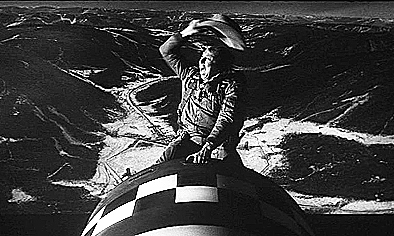
Set mostly in US military bunker populated almost exclusively by men, it charts the steps to nuclear armageddon as emotionally bereft warmongers charge into madness.
Terrified by sex and are obsessed with bodily fluids and super-phallic nuclear weapons the politicians and military plan to use an unseen army of women as breeding machines to re-populate the world with a fascistic race of supermen.
This fear drives their retreat into a toxic all-male environment such as a gang, the army, or a space mission. Free from troublesome complexity of emotions, the energy of their sexual insecurities can safely be channeled into violence.
Kubrick is fascinated, appalled and amused by men’s behaviour, their fear of sex and the seeking of sanctuary in combat.
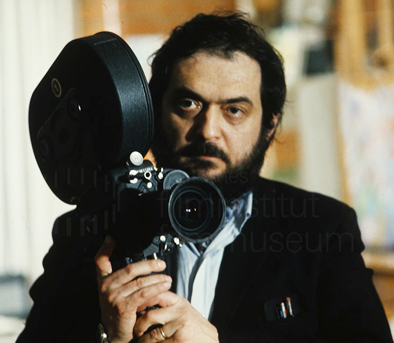
Stanley Kubrick
The director delights in repeatedly pointing out these idiocies and finds their behaviour so entertaining, he turned up the dial all the way to eleven for his next work, 2001: A Space Odyssey.
Importantly, Kubrick described Dr. Strangelove as possessing a ‘sexual framework from intromission to the last spasm’. So does 2001.
The director employs visual metaphors to explain his thoughts on man’s attitude towards sex. Men are insecure, fearful and in response, violent. Kubrick employs outlandish bombast and an exaggerated self-important tone to satirically mock men’s failings.
In 2001 Kubrick mocks his macho technological aesthetic, by placing it within an over-arching visual framework of sexual reproduction.
Dr Strangleove
The sex in 2001: A Space Odyssey is hidden in plain sight within the trippy and awe inspiring imagery, and the ground-breaking special effects.
2001 begins in humanity’s pre-history with a tribe of starving hominids discovering an immense black monolith
Kubrick uses this void to inform us of how he believes men regard women. Drawn by its mysterious beauty, the hominids regard the powerful and, importantly, silent intruder with fascination and fear.
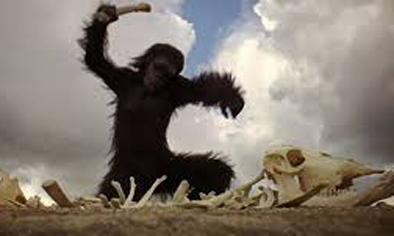
Soon the lead ape is banging his bone in an angry frenzy. Here Kubrick explicably links fear, sex, selfishness and violence. A rival tribe is slaughtered and ownership of a water hole is established.
2001: the first monolith
Then we see the triumphant hominid leader banging his bones with orgasmic exultation.
Dutch master Paul Verhoeven applied a similar extravagance when executing the relentless cartoon-like violence in his satirical 1987 sci-fi Robocop.
The hominids ferocious behaviour is set to the militaristic romanticism of Richard Strauss’ Thus Spake Zarathustra, based on Friedrich Nietzsche’s philosophical novel of the same name.
2001: a hominid gets excited
The writer’s work was famously co-opted by Nazi’s to justify their beliefs in the Master race, another link back to Dr. Strangleove and underscoring the link between sex, violence and madness.
Anyway, the ape returns to whacking off and courtesy of the most famous match cut in cinema, his bone(r) becomes a nuclear-powered penis, sorry, spacecraft. How’s that for a money shot?
2001: a nuclear powered spacecraft
If, by the way, you believe sexual metaphors are beneath the lofty talent of a consummate filmmaker such as Kubrick, you probably don’t recognise the wank jokes in Shakespeare.
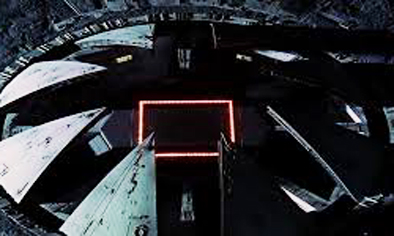
We see the rocket manoeuvre to penetrate the spinning space station. So scared of sex and emotions, all men have managed to achieve in three million years is reduce the sex act to a mechanical experience.
2001: attempting re-entry, sir
In fact, for Kubrick’s men this is progress. Kubrick’s use of the swooningly romantic Blue Danube Waltz by Johann Strauss is a hilariously caustic and ironic accompaniment.
See how tubelike the inside of the space station is. Those corpuscular chairs are engorged blood cells. The men i.e. semen, are deposited in to the female craft. Next stop, the Moon base.
2001: chairs
Look at those teeth! Quick, someone google vagina dentata!
The second, larger monolith represents the next stage of the semen’s journey further into the reproductive system. After the sex act the men stand staring in mute incomprehension, until they recoil as the monolith screams at them as if in great pain.
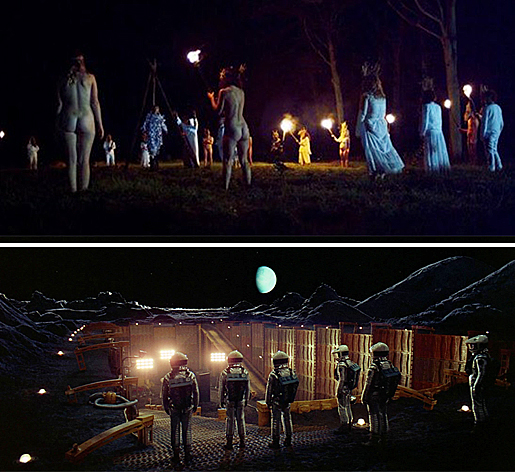
Gang rape is a theme Kubrick returns to in later film. Men seek comfort in numbers when ‘doing’ sex. Compare the second monolith gathering in 2001 to the ‘sacrifice’ scene in 1999’s Eyes Wide Shut.
2001: the Moon base
Kubrick is always bringing together the sex and violence. See the gang rape in 1971’s A Clockwork Orange, and the penis/gun metaphors employed by the drill sergeant in 1987’s Full Metal Jacket. Yes, that title is a condom metaphor.
Anyway, this encounter prompts the men to attempt to conquer a new monolith near the planet, Jupiter. i.e. they travel further through the reproductive system.
Above top: Eyes Wide Shut. Above: 2001
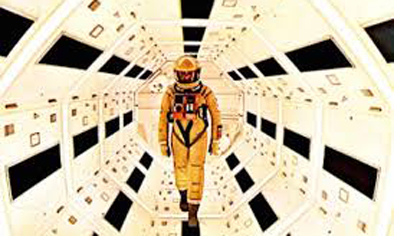
There’s a lot of walking and crawling through tunnels as astronauts make their way through the tubes, sorry, corridors of the spacecraft, Discovery.
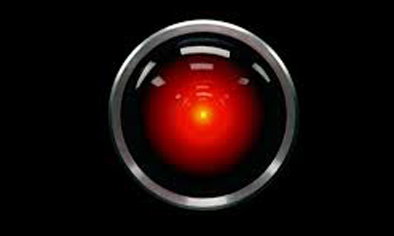
Although played by Douglas Rain, the spaceship’s computer HAL 9000 is the dominant female voice in the film. He’s almost the only ‘female’ voice in the film.
Portrayed by a soft blood-red orb, HAL 9000 is a maternal figure, tasked with keeping the crew warm and snug until their arrival at the next monolith, which is orbiting Jupiter. Only one sperm is necessary to fertilise the egg, and so the crew are killed off.
Kubrick uses HAL to demonstrate the paradox of human reproduction, where a system designed to create and nurture life also involves killing off the unsuccessful contenders.
2001: travelling the tube
And once reproduction has been achieved, the female host body is redundant. The ‘winning’ sperm immediately begins to destroy the mind of the woman who nurtured him.
The successful sperm/astronaut, Bowman, literally rips HAL’s brains out. Honestly, the injustice and ingratitude is enough to drive anyone mad.
Once the third monolith is reached, Bowman passes through the Stargate. This trippy passage represents the moment of fertilisation, the creation of a new life.
2001: HAL 9000
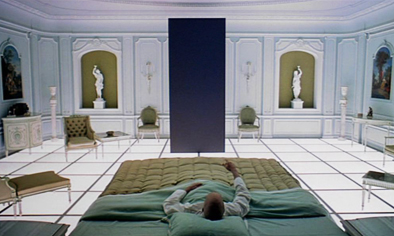
Here’s another of those vaginal black voids, oh yes, the new life will be pushed out soon enough.
Often misnamed a ‘star child’, The space foetus experiences a pre-birth vision of its life ahead, as an insecure, fearful and violent ape.
Our cyclical journey ends where we began, with Wagner’s music of war dooming us to make the same mistakes all over again.
2001: the ultimate trip
For all our pretensions and technology, we’re still a bunch of fighting primates. And Kubrick finds all this darkly funny. Men are idiots, he says, and he can’t help pointing and laughing at them.
Men’s irrational fear of women and resultant violence is a theme Kubrick returns to in A Clockwork Orange, Full Metal Jacket and Eyes Wide Shut. They’re all best read through the dark comedic prism, or possibly the monolith, of Dr Strangelove.
2001: birth, death, movies
From Jack Torrence in 1980’s The Shining to Dr. Bill Harford in Eyes Wide Shut, Kubrick’s men are puzzled, frightened and angry. And it’s the women who suffer.
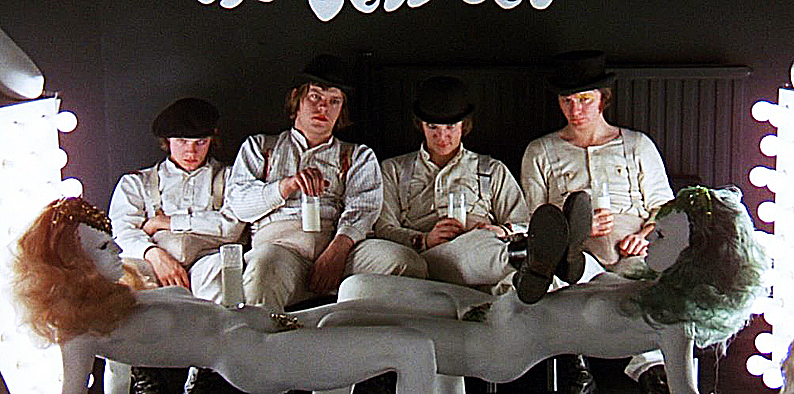
These tables from A Clockwork Orange illustrate how Kubrick believes men prefer women. Naked and subservient. Sexually available and non-threatening. Without intelligence or personality. Mute. As this image is darkly ridiculous, so men are darkly ridiculous.
2001: ‘star child’
When people think of Kubrick, it is of the polymath chess master and cinematic genius. A coldly arrogant and detached figure, an irate perfectionist who is dismissive of the day-to-day concerns of ordinary people. He’s probably glowering through a fog of cigarette smoke.
But the Kubrick who reveals himself to me is a satirical successor to Swift. Kubrick is so bewildered by the insanity of man, his barely controlled response is to create wildly exaggerated scenarios to try and explain them. But all he can do is mock and laugh at men’s behaviour because any other response would be mad.
A Clockwork Orange: milky bar kids
Of all the characters in the history of cinema, there is one who I imagine most captures Kubrick’s manically disbelieving outrage. It belongs to the little remembered actor Peter Butterworth in the role of Brother Belcher. In particular in the dinner scene in British comedy classic, 1968’s Carry on up the Khyber.
Postscript:I recommend you read Nicholas Barber’s recent excellent piece on humour in 2001: A Space Odyssey. Here
Nemo’s Fury is an exciting digital reinvention of Jules Verne’s classic steampunk adventure novel, 20,000 Leagues Under the Sea.
Download for free to your smartphone or tablet, search your app store for ‘Nemo’s Fury’.
A mobile interactive fiction game employing a bespoke combat system and hundreds of original illustrations, Nemo’s Fury is inspired by the 1980’s role-playing gamebooks such as ‘The Warlock of Firetop Mountain’, of the Fighting Fantasy series which celebrated its fortieth anniversary last year.
Each player joins the legendary Captain Nemo on board his fabulous submarine, the Nautilus, on a wild voyage of adventure, intrigue, loyalty, and betrayal.
There’s mayhem, monsters, maelstroms and murder as Nemo takes you from the South Pacific to the Northern Atlantic via Antartica and the Red Sea. And if they survive long enough, the player will of course fight a giant squid.
Available on your smartphone or tablet, (but not yet your desktop), click on your app store below
The future of our species is barely at stake in this sci-fi thriller which is characterised by a significant lack of tension or urgency.
Barely remembered for 2009’s Avatar, Sam Worthington is the de facto leader of a group of military volunteers subjected to experimental drugs designed to enhance their evolution.
This is to enable them to survive the hostile environment on Saturn’s largest moon, Titan, which humanity must colonise due to the Earth’s over-population and pollution.
However the majority of the film takes place in an idyllic mountaintop retreat, full of infinity pools and barbecues.
Potential side effects of the treatment include increased aggression, hair loss, vomiting blood, and death.
When the test subjects begin to develop tremendous underwater skills, the wife of one smells something fishy and begins a secret investigation of her own.
Chief scientist and modern day Dr Frankenstein is played by the venerable Tom Wilkinson, with former model Agyness Deyn sporting the latest line in laboratory casual wear as his assistant.









 chrishunneysett.uk
You must be logged in to post a comment.