Deadpool

This unpleasant spandex spin-off is a desperate lunge to sex-up superheroes.

It energetically thrusts a minor member of the X-Men franchise centre stage, but can only muster some limp entertainment.

A weak and formulaic origin movie, the non-linear narrative and meta-commentary on the genre can’t disguise myriad failings, not least the unappealing lead.

Ryan Reynolds is perfectly cast as Wade Wilson, a proudly irritating special forces agent turned mercenary.

The script has to fall back on inflicting terminal cancer to create sympathy for him.

A sadistic scientist called Ajax deliberately disfigured Wade while attempting to turn him into a super-powered slave.

Last seen replacing Jason Statham in dull reboot The Transporter Refuelled (2015) reboot, rapper turned actor Ed Skrein over acts as the dull villain.

Believed to be dead, Wade adopts the identity of the gun toting masked man called Deadpool.

Despite two members of the X-men team attempting to recruit him, Deadpool insists he is not a hero.

His signature move is to pirouette into action, a deliberately camp affectation in keeping with the supposedly transgressive character.

Convinced of it’s own outrageous hilarity, Deadpool replaces the intense boredom of the recent Superman film with a juvenile tone, flippant sexism and some light bondage.

Then it adds child abuse jokes and frequent threats of rape.

Slow motion action scenes are mostly powered by mediocre CGI, blood splatting violence and explosions.

Deadpool is hunting Ajax for revenge, and to discover the secret to having his leading man looks restored.

Without them he feels unworthy of his fiancee, the beautiful hooker Vanessa, played by Morena Baccarin.

This presupposes Wade recognises he possesses no other feature such as charm, wit or intelligence to which Vanessa might be attracted. Perhaps the character is written with more self awareness than Reynolds allows him.

Baccarin and Reynolds make an attractive pair and the few moments of quality are in their initial sparky banter.

Described as the first pansexual superhero, Deadpool is actually monogamously heterosexual.

Sadly all that’s required of the talented Baccarin in the role is to look fabulous in fishnets, talk dirty and be kidnapped.

This is in keeping with the pervasive sexism. All female characters are either ugly and therefore suitable subjects for mockery, or they’re gorgeous strippers and prostitutes.

Deadpool rooms with a blind old black woman whose sexual unattractiveness is a butt of much humour, none of which is funny.

Grossly pandering to the worst impulses of it’s target audience demographic of twelve year boys, the BBFC should be congratulated for putting Deadpool out of their reach.

Kingsman: The Secret Service (2015) which off a £56 million budget globally grossed £282 million. The lesson learned is there is a lot of money to be made in arse jokes.

Among the slight attempts at deconstructing the gene, there is a weak joke regarding The Matrix (1999) and at one point Reynolds’ riffs on Ferris Bueller’s Day Off (1986).

Marvel comics supremo Stan Lee cameos as a DJ in a strip club.

Most of the film consists of two fights, one on a freeway flyover and the other on a crashed Helicarrier from an Avengers movie.

There are some laughs along the way to the lacklustre climax, a word guaranteed to have Deadpool sniggering.

Oscars 2016

Best supporting actor nominees
Sylvester Stallone, Creed
Christian Bale, The Big Short
Tom Hardy, The Revenant
Mark Ruffalo, Spotlight
Mark Rylance, Bridge of Spies

Best supporting actress nominees
Jennifer Jason Leigh, The Hateful Eight
Rooney Mara, Carol
Rachel McAdams, Spotlight
Alicia Vikander, The Danish Girl
Kate Winslet, Steve Jobs

Best actor nominees
Bryan Cranston
, Trumbo
Matt Damon, The Martian
Leonardo DiCaprio, The Revenant
Michael Fassbender, Steve Jobs
Eddie Redmayne, The Danish Girl

Best actress nominees
Cate Blanchett, Carol
Brie Larson, Room
Jennifer Lawrence, Joy
Charlotte Rampling, 45 Years
Saoirse Ronan, Brooklyn

Best director nominees
Adam McKay, The Big Short
George Miller, Mad Max: Fury Road
Alejandro Gonzalez Inarritu, The Revenant
Lenny Abrahamson, Room
Tom McCarthy, Spotlight

Best film nominees
Spotlight
The Big Short
Bridge of Spies
Brooklyn
Mad Max: Fury Road
The Martian
The Revenant
Room

Goosebumps

Director: Rob Letterman (2016)

Magical mayhem materialises when book bound monsters come to life in this entertaining horror comedy.

It runs away at a decent pace, has fine performances from an attractive cast, isn’t short of laughs and tries hard to make you jump out of your seat.

The spooky fun is based on the massively popular Goosebumps books by R.L. Stine.

And as Stine says, it’s full of twists, turns, insights and some personal growth for the hero.

He appears as a character in the film and is played by Jack Black in one of his stronger performances.

Black abandons his frequently smug demeanour for a more acerbic and angry persona, and he’s all the more entertaining for it.

In a quiet suburb the reclusive Stine home-schools his teenage daughter Hannah, claiming it’s for her own protection.

A tentative romance begins when handsome high school student Zach Cooper moves in next door. Dylan Minnette and Odeya Rush share a sweet chemistry as they sneak out at night to an abandoned fair ground.

But Zach inadvertently unlocks one of Stine’s books, releasing an evil ventriloquist’s dummy, called Slappy, also voiced by Black.

The marvellously malevolent Slappy frees a multitude of fantastical fiends from Stine’s shelf of manuscripts and burns the volumes, preventing the creatures from being caged again.

The leaves the town at the mercy of aliens, zombies, killer clowns and in a spirited homage to the sci-fi monster movies of the 1950’s, a giant praying mantis.

Steven McQueen’s drive-in classic The Blob (1958) is also a key reference.

The film’s best scene is the emergence of the garden gnomes. It combines the comic violence of the job interview from The Full Monty (1997) and the creeping horror of the doll attack from Barbarella (1968).

Amanda Lund briefly steals the film as an overly enthusiastic police trainee and I wish we’d seen more of her.

The suitably scary score by Danny Elfman works hard to gloss over the less than groundbreaking special effects, which themselves are used to pad out at least a couple of scenes.

It’s probably too scary for very young kids. But everyone else, even big kids like me, are guaranteed the goosebumps of a good time.

Dad’s Army

Director: Oliver Parker (2016)

Don’t panic! Fans of the veteran TV series can stand at ease and enjoy this big screen adaption of the second world war sitcom.

It generally succeeds in it’s mild ambitions of providing charming entertainment and gentle laughs.

The director describes it as a celebration of the long running show and in respectful fashion the semi-skimmed sauce of the picture postcard humour is never crude or cruel.

Set in early 1944, the Daily Telegraph reading Nazi high rank send a spy codenamed Cobra, into Blighty.

Meanwhile the Walmington-on-Sea Home Guard, led by the pompous Captain Mainwaring and the diffident Sergeant Wilson, are thoroughly unprepared.

Toby Jones and Bill Nighy step into the boots of beloved actors Arthur Lowe and John Le Mesurier to breathe new life into the roles.

The top rank cast are hummed into action by the familiar theme tune alongside Tom Courtenay and Michael Gambon as Lance Corporal Jones and Private Godfrey.

Privates Pike, Walker and Frazer are also present and correct.

Catherine Zeta-Jones appears as glamorous journalist Rose Winters, who wants to write a story about the platoon.

Rose captivates the men which upsets their wives, resulting a fresh outbreak of hostilities in the battle of the sexes.

Action is always just out of reach for the men, who’s sense of masculinity has already been blitzed by being unable to fight overseas with the real troops.

But as chaos predictably ensues, the opportunity arises to earn their spurs in combat.

This is as much a celebration of British nature as anything else. So there’s snobbery, curtain twitching gossips and men acting like schoolboys.

But there’s also loyalty, bravery, friendship, good humoured amateurism and a determination to does one’s bit for the greater good.

Dad’s Army is such a peculiarly British institution it would be unpatriotic not to salute as it marches on.


Point Break

Director: Ericson Core (2016)

This shallow remake of Kathryn Bigelow’s 1991 surfing cop classic arrives dead in the water, lacking any sense of danger or fun. Or any sense at all.

The wild thrill ride of Bigelow’s action movie has been refashioned as a stumblingly  hyperactive extreme sports eco thriller.

Luke Bracey’s dons Keanu Reeves’ old wetsuit as an extreme sports ‘poly-athlete’ turned trainee FBI agent Johnny Utah. But he lacks the charm, looks and talent of his predecessor.

Edgar Ramírez replaces Patrick Swayze as the enigmatic Bodhi, the nirvana chasing leader of the criminal gang Utah has to bring to justice.

Following the plot of the superior first film, Utah goes undercover to infiltrate Bodhi’s crew of bank robbing, wealth distributing whale huggers.

Showcasing their tatts and abs at every opportunity, they surf, climb and batglide their way around the globe.

It’s as if they haven’t considered a consequence of dropping bundles of banknotes in impoverished rural areas will cause localised hyperinflation and make the residents poorer.

Or put another way, I was so uninvolved with the story I found myself applying economic theory to their actions, rather than cheering an act of audaciously performed philanthropy.

Utah’s backstory relies on a stunt borrowed from Taxi (1998), the not much remembered, Luc Bresson produced, action comedy. One fears this does not bode well for what’s to follow, but sadly said boding is far from adequate.

Director Ericson Core began his career as a cinematographer and it shows. Wearing both hats here he conjures some wonderful images, especially down in the fresh surf and up on the snow.

But as a storyteller he’s woeful, offering ciphers instead of characters who spout appalling dialogue.

The aesthetic is teenage cool, lots of posing in front of burning cars and graffiti’d underground gang hangouts.

Utah carries a Zippo because it’s a cool thing to do. He doesn’t go so far as to carry any cigarettes. Because smoking isn’t cool. Unless you’re offered a toke on a joint, which is edgy and therefore cool and allows for a cool pose.

Ray Winstone growls and tries to make himself useful as overseas FBI agent Angelo Pappas, but he has nothing to contribute to the plot.

Teresa Palmer’s position as bikini clad babe Samsara Dietz is to be leered over by the camera and prove Utah’s heterosexuality. And cook dinner for the chaps.

As a replacement for Lori Petty’s fierce and sculptured surfer from the original, Palmer is hopelessly out of her depth.

Delroy Lindo is Utah’s FBI controller who’s passion is for extreme exposition.

Employing three different editors suggests a reason why the movie feels so piecemeal, it’s a collection of set pieces strung together not a coherent story.

Plus edited in the irritated manner of a music video sells the stunts short. Much longer edits would sell us a frisson of much needed veracity, creating a threat the guys may at some point be hurt.

But as the stunts become bigger and higher, the stakes become lower. We’re not invested in the story and the physics defying leaps possess the dramatic depth of a video game.

There’s an absence of humour and no sense of the film is aware of it’s own preposterous nature.

Flagged up twice is the film’s one interesting idea, that the FBI are acting as the security wing of multinational corporations, inverting the good guy/bad guy dynamic and making Utah the villain.

But it’s not explored in any way and brushed aside in favour of yet more lightweight action.

The stunt team and camera operators deserve plaudits but for everyone else it’s a wipeout.

Trumbo

Director: Jay Roach (2016)

Romping through the career of a Hollywood screenwriter, this entertaining biopic suffers from a self-gratifying script filled with too much lightweight sentiment.

Enjoying a privileged lifestyle as one of Hollywood’s elite in 1947, Dalton Trumbo was one of many writers and actors illegally blacklisted for refusing to testify against communists to the US government.

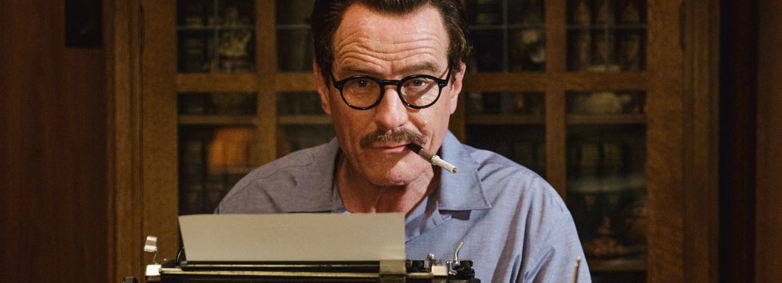
Breaking Bad star Bryan Cranston stars as the irascible scribe who types in the bathtub with a cigarette holder and glass of whiskey in hand.

Trumbo’s a less than loveable eccentric who patronises the masses who watch his movies and fund his comfortable lifestyle.

A honey throated spinner of yarns who invokes the constitution to serve his own ends, Trumbo reminds us of another historic US public figure given a recent cinematic makeover.

There’s a clear parallel between Cranston’s performance and Daniel Day Lewis’ Oscar winning turn as the ill-fated US President in Steven Spielberg’s Lincoln (2013).

The script even includes a similar moment wherein a colleague refuses to listen to any more of Trumbo’s stories, lest he be converted to his cause.

We fail to sympathise for the champagne communist when he suffers the indignity of downsizing from his country manor to a large house with a pool.

Being aggressively covered in fizzy pop isn’t nice and holidays are interrupted. But a brief and uneventful stint in prison aside, nothing too worrying happens to him.

As an illustration of the rarefied social circles Trumbo moves in, a friend can afford to sell the drawing room Van Gogh to pay for their lawyer’s fees.

Meanwhile Trumbo’s career goes from strength to Oscar-winning strength. Under various pseudonyms he works with Hollywood directors and stars of huge stature.

The timeline covers some forty years giving the handsome film a breathless feel despite it’s stately pace.

Part of the problem is a desire to cram in many era-famous faces. As the story lacks drama, this is possibly to compensate for a suspected deficiency of audience interest.

Michael Stuhlbarg as Edward G. Robinson is one of several examples of casting capable peformers as famous cinema actors. They’re not as charismatic or talented and physically aren’t great matches.

David James Elliot essays John Wayne as an unconvincingly magnanimous presence.

At least Dean O’Gorman as Kirk Douglas is given a gift of a line which is guaranteed to bring the house down with laughter.

Helen Mirren is terrific as the waspish society columnist Hedda Hopper. But by making her the villain of the piece, the male dominated hierarchies of cinema and politics are let off the hook for their behaviour.

Hopper suffers a poorly articulated rationale for for the intensity of her attacks on communism and there’s no hint her anti-union publisher is any way pulling her editorial strings for their own ends.

Diane Lane plays Trumbo’s wife Cleo with nothing to do except add glamorous scolding and sympathy.

Elle Fanning as their daughter Nikola fairs little better, being ushered down a civil rights movement cul-de-sac.

John Goodman plays to his strengths as a down market producer offering a broad comic performance which recalls his turn in ben Affleck’s Argo (2012).

Never convicted of any criminal charge, Trumbo presents himself as a fearless defender of the first amendment and the script bequeaths him a suspiciously retro-fitted sermon on the importance of the constitution.

There are great lines in the film but one suspects they’re lifted from the scripts or diaries belonging to one of the many scriptwriters portrayed on screen.

13 hours: The Secret Soldiers Of Benghazi


Director: Michael Bay (2016)

No guns are too big in this crunching and confusing action story.

It’s a typically glossy, macho and bombastic encounter from director Michael Bay, the man who unleashed four Transformers movies on the world.

This real story is set in 2012 in Benghazi, Libya, after the fall of Colonel Gaddafi.

Lead by the James Badge Dale as former Navy SEAL Tyrone Woods, six CIA employed mercenaries defend a US compound against a vastly superior force, in Benghazi, Libya.

With sweat, blood, tears and ammo they must hold out until reinforcements arrive.

But local allies can’t be trusted and the US military are held up by diplomacy.

In a weak attempt at humanising the men, we see them posing in cool blue shades and suits, working out and face-timing their families back home.

Presumably because the director can’t abide not having an attractive in his movies, Alexia Barlier is thrust into non-scenes in a non-role as an undercover CIA operative.

Despite the battles being staged on an impressively large scale, it’s a glossy, video game vision of war.

The kinetic camerawork aspires to make the land seem as alien and threatening as possible.

The use of strong colour recalls the work of Tony Scott and the subject matter the superior war film Black Hawk Down (2001) by his brother Ridley. But nothing here is as good as their best work.

Written to sound good in the  trailers, the jargon heavy dialogue is barked between bursts of gunfire.

An anti intellectual script abandons global politics and blames the resourceful men’s predicament firmly on military cutbacks and weak willed pencil pushers.

Not afraid to make comparisons to the famous defence of the Alamo, it’s a hymn to the second amendment right to bear arms and could be interpreted as a call for the US to adopt an isolationist international policy.

As hordes of nameless militia are gunned down with pin point blood splattering accuracy, I often had no idea which of our heroes was whom, making it hard to care who makes it out alive.


Spotlight

Director: Tom McCarthy (2016)

Stop the press for this Oscar nominated drama of award winning journalism.

Based on real events, a US newspaper team fight to reveal the industrial scale cover up of child abuse perpetrated by the Catholic Church in Boston.

It’s gripping tale which allows for the redemption of an individual, the validation of journalism and the recovery of civic pride.

So exactly the sort of worthy subject matter which allows Hollywood to feel good about itself and self-righteously pat itself on the back for making.

Consequently it’s garnered 6 Oscar nominations including best picture and director ,as well as for individual nods for performers Ruffalo and Rachel McAdams in the supporting acting categories.

It’s set in the early 2000’s in the basement office of the close knit Spotlight newspaper investigations team of The Boston Globe. The real Spotlight Team earned the 2003 Pulitzer Prize for Public Service.

Michael Keaton is weathered and wary as ‘Robby’ Robinson, veteran leader of the four strong department.

Sporting a supportive if volatile chemistry, they’re played by Mark Ruffalo, Rachel McAdams and Brian d’Arcy James.

They face the double threat of the burgeoning new media world and a new editor, played with softly spoken steel by Liev Schreiber.

Marty requests the team investigate complaints made against the church.

Being from out of town Marty is immediately considered someone not to be trusted. A situation compounded by being Jewish in a Catholic dominated city.

It is strongly in part to this insular attitude which allows members of the Catholic clergy to spend years abusing their flock, and for the hierarchy to systematically cover it up.

The powerful and wealthy institution has long put the fear of god into legal profession, justice system, police and even parts of the press.

We follow the team undertaking journalistic procedure of voluminous research, copious coffee consumption, door knocking, meetings with lawyers, prodigious note taking and telephone calls.

As files of evidence go missing from the courthouse, the team realise they can’t trust their colleagues, the police or the courts.

This is all familiar procedural stuff and it’s the high stakes and charisma of the actors which brings it alive.

We are drawn in by the performances, intrigued by their work and disgusted by the subject matter.

Covering a difficult subject in a dignified and sensitive manner, a strong narrative framework provides essential information in a clear manner.

But the film struggles to open out from a series of meetings into something more grand and cinematic.

More than one scene has the team gather around a telephone speaker to receive vital information from a Deep Throat type whistleblower.

As efficient as Spotlight is, it‘s the grim truth which keeps us watching, not the drama.


The Big Short

Director: Adam McKay (2016)

Take cover from an atomic bomb of fraud and stupidity in this knockabout drama based on the catastrophic financial crash of 2008.

Based on Michael Lewis’s account published as The Big Short: Inside the Doomsday Machine (pub. 2010) it’s been nominated for five Oscars including best film, best director and best actor for Christian Bale.

Ryan Gosling plays narrator Jared Vennett, an unrepentant bond salesman at Deutsche Bank.

Vennett meets the one-eyed Aspergers sufferer Michael Burry. Played by Bale in a bad haircut,  he’s a maverick hedge fund manager.

Burry’s discovered Wall Street has been selling mortgages to people with no jobs or income.

So he’s ‘shorting’ the housing market, i.e. betting it will crash and anticipates making billions of dollars by betting millions.

Vennett teams up with Steve Carell‘s permanently angry banker Mark Baum to get rich quick.

Yet no-one seems to have fun with the money they’re making or have any idea what to do with it, or even why they’re doing it.

The script wants us to like these guys, showing us their life traumas to garner sympathy.

They’re fictitious versions of real people and we’re encouraged to see them as heroic outsiders, uncovering the impending crisis.

But they willingly keep schtum and treat it as another investment opportunity.

Then the film’s millionaire movie producer Brad Pitt turns up looking like a retired geography teacher and flexing his social conscience, much like he did in his self-produced project 12 Years A Slave (2014).

Pitt plays another banker who makes a min out of the misery of millions..

Financial flicks Martin Scorsese’s The Wolf Of Wall Street (2014) and J.C. Chandor’s Margin Call (2013) have already covered much the same ground as The Big Short.

This hasn’t the blistering riotousness and moral vigour of the former in which Margot Robbie also appeared, and lacks the sober cynicism of the latter.

It’s all very Scorsese light with an up tempo pace and jokey tone created by pop tunes, freeze frames, frantic editing and characters regularly speaking directly to camera.

Plus it’s full of great performances, very energetic and niftily employs a game of jenga to explain what causes the banking meltdown.

But it’s misjudged in its sympathies and patronisingly employs Margot Robbie and Selena Gomez as themselves to explain the maths.

But The Big Short fails to condemn these hypocritical parasites – the bankers not the actresses – and instead dresses them as heroes.

They should be strung up from lamp posts with the rest of the bankers responsible.