Far From The Madding Crowd

Director: Thomas Vinterberg (2015)

Passion, obsession and betrayal burst from every frame of this compelling, fresh and faithful adaption of Thomas Hardy‘s classic Victorian novel.

His rustic romance of a headstrong heiress and her three wildly different suitors is powered by a first-rate cast on their best form. Carey Mulligan is captivating as Bathsheba Everdene, famously played by Julie Christie in the 1967 version.

The orchestral score swells over the green and pleasant land of a production rich in period detail. The handsome locations are shot on film  – not digitally – in the county of Dorset (Wessex) where the book was set. This beds the story deep in historical and local context.

In an economical piece of character sketching, we first meet the beautiful, intelligent and impulsive Bathsheba (Carey Mulligan) riding freely on horseback. She is seen by the good shephard Gabriel Oak (Matthias Schoenaerts) who is diligently watching his flock. She is sporting a sleek, red riding-jacket, he is dressed in practical working clothes.

Valuing her independence above all else, Bathsheba is saved from an uncertain future when she inherits her uncle’s farm and determines to restore it to it’s once prosperous profitability.

Bathsheba is a political beast who doles out praise and punishments to her workers in public, she not only helps on the farm but is careful to be seen to be helping out on the farm.

She’s aided and abetted by her servant Liddy (Jessica Barden) who’s a useful source of village gossip and accompanies Bathsheba in making merry mischief.

As circumstances turn darker so Liddy slips from the frame. This is a shame as they share a sweet and believable friendship and it offers Bathsheba an extra dimension, preventing her from being defined by her relationship with men.

Bathsheba recognises men are attracted to her but sees it as a trap with no value – until she struggles in the man’s world of business. At the local market she’s reduced using her charm to encourage the local merchants to at least try her merchandise.

Farming life is a wild meadow of activity. As well as harvests, sheep dips and recruitment fairs, there’s bare-knuckle boxing, swordplay, gambling, storms, fires, madness and the tragic death of an infant.

The plot revolves around the ill-considered sending of a valentines card. When she is kissed for the first time Bathsheba is shocked by the strength of her own reaction. It derails her social sure-footedness and leads to choices which shreds her independence and happiness.

Bathsheba receives three propose; from the honest shepherd Gabriel, swaggering soldier Sergeant Troy (Tom Sturridge) and the emotionally fragile landowner William Boldwood (Michael Sheen). She sings a duet with one, rides tandem with another and marries a third.

Though the script sensibly streamlines the novel, it remains emotionally articulate and frequently funny. The focus is so tight on Bathsheba, outside of her suitors and Liddy, there’s barely another character who has a speaking role of note.

This is the weakness of the film as we’d like to spend longer here, perhaps wander around the countryside and meet a few more of the interesting looking characters who populate the village.

As the tone grows darker and the story more violent, the assured pacing of Danish director Vinterberg delivers dramatic action which is always underpinned by strong character motivation.

At quieter moments he is able to capture the nuance of social status, such as when characters wordlessly shift seats around a dinner table to accommodate an unexpected, superior guest.

Vinterberg is assisted by the vivid cinematography of Charlotte Bruus Christensen and the briskly seductive editing of Claire Simpson.

Although unquestionably a fine and suitably physical actor with the requisite intelligence and stillness of purpose, it’s curious to cast the Belgian Matthias Schoenaerts in a role who embodies what Hardy saw as the great virtues of the English.

Michael Sheen demonstrates his tremendous ability to suggest torrents of inner turmoil with a bare twitch of the mouth. As Boldwood struggles for the correct words, his quiet pleading is magnificently crafted from tight smiles and difficult pauses.

It has echoes of Prince Charles questioning the meaning of love when announcing his engagement to the considerable younger Diana Spencer.

The remarkable Carey Mulligan gives a rich and nuanced performance of acute emotional resonance. Her doe eyes convey Bathsheba’s vulnerability, strength and desire as well as her growing self-awareness and changing values.

Mulligan may not win next year’s best actress Oscar or even make the final cut, but she’s the early high-score on the leader board.

It’s easy to fathom why the men fall for Bathsheba, it’s more of a wonder why more men don’t.

A Pigeon Sat on a Branch Reflecting on Existence

Director: Roy Andersson (2015)

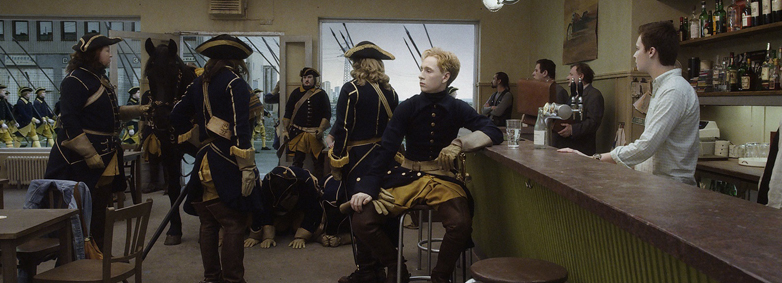
As befits a black comedy filmed in beige, there’s an absolute lack of glamour in this weird Swedish whimsy.

Like the slowest of comedy sketch shows, it consists of a series of scenes loosely connected by recurring actors, locations and characters.

In museums, bars, cafes and street corners we encounter dance students, singing barmaids, a newborn baby, a ferry captain and a King.

Jonathan and Sam (Holger Andersson and Nils Westblom) are morose grey-suited salesman selling novelty items because they want to make people laugh.

In a sly comic riff on hit-men in pulp thrillers, they also attempt to collect their arrears from shopkeepers.

Their journey takes them through the pain of existence, encountering war, love, depression and death. There is dance, song and music.

People rue their bad luck in life and search for excuses for their unhappiness. Their loneliness is exacerbated by the laughter of strangers.

Philosophy  and forgiveness are all brought to a premature end because people have to be up early in the morning for work.

The rigid adherence to a life centred on work stifles creativity, torture is ignored and several deaths cause bafflement; to paraphrase Douglas Adams, no one seems to know what to do about the bodies.

The art direction is as measured and controlled as the static camerawork (Istvan Borbas and Gergley Palos). It is equalled by the precise timing of the actors.

With a colour palatte taking in every shade of beige, the worn locations are lent a dreamlike timelessness.

The pigeon appears in a poem, as an exhibit in a museum and off-camera in song. Quite what he makes of it is anyone’s guess – but he probably thinks humans are all cuckoo.

The Falling

Director: Carol Morley (2015)

Mass hallucination, sexual exploration and death combine to cast a spell of barely believable boredom in this boarding school drama.

After tragedy strikes a strict English girls’ school, a mysterious fainting epidemic breaks out. With the authorities denying anything is wrong, it’s up to the pupils to deal with events.

Schoolgirl Lydia (Maisie Williams) is a moody, bookish brunette, her closest friend Abigail (Florence Pugh) is an annoying, more attractive blonde.

They spend their time embracing each other, licking each other’s fingers and sharing bubblegum. They also read poetry to one another and carve their initials in a tree like lovers do.

The actresses deliver literal line-readings and never come close to suggesting their characters possess interior lives.

Abigail sports love-bites and too-short hemlines. Despite her affection for Lydia she openly enjoys the attention of boys who drive fast cars.

Following nosebleeds and medical examinations, Lydia develops a serious twitch and there’s an outbreak of falling over among the school’s population. This becomes laughable the more people it affects.

There’s a suggestion it could all be caused by a magic spell cast by Lydia’s weird brother Kenneth (Joe Cole) – but doctors insist nothing is wrong with the girls.

Lydia’s mostly mute mother Eileen (Maxine Peake) is a homebound hairdresser who silently suffers a great deal of angry abuse from her daughter.

Greta Scacchi and Monica Dolan play stern school-heads who antagonise Lydia by refusing to take her seriously.

The 1969 setting seems designed to avoid the internet and isn’t exploited for any other purpose, certainly not to create a much needed sense of otherworldly timelessness.

Prosaic camerawork and lighting fail to generate any sense of operatic grandness while the pacing is erratic with scenes alternately dragging or rushing. The editor includes many slow-panning shots of leaves and trees.

There’s a lot of poetry and an alarmingly intrusive rock-folk soundtrack – but none of the disparate elements heighten the gothic undertone in the script; consequently an interesting mood of mystery or fear fails to materialise.

The Good Lie

Director: Philippe Falardeau (2015)

When refugees land in the US, their troubles are far from over in this moving and surprisingly gripping drama.

It’s a tale of love, family and sacrifice set against the background of war, immigration and isolation.

Rather than asking us to pity the immigrants or expect them to be grateful, The Good Lie makes us consider the wealth and privilege of our own circumstance.

Having fled war in Sudan as children, Mamere, Abital, Jeremiah and Paul (Arnold Oceng, Kuoth Wiel, Ger Duany, Emmanuel Jal) spend the next thirteen years in a Kenyan refugee camp.

They celebrate when they’re chosen to be air-lifted to the US to start a new life – but bureaucracy separates Abital from the boys and she’s sent to a distant part of the US. The subsequent terrorism of 911 makes it impossible for her brother Mamere to visit.

Well-meaning and justifiably proud of helping, Pamela (Sarah Baker) is a vaguely incompetent charity worker who houses the boys together.

It’s beleaguered and bemused job-broker Carrie Davis (Reese Witherspoon) who does most to help assimilate them by providing opportunities for paid employment. She has a complicated love life seemingly having slept with half the town; the male half.

An angry, attractive and formidable presence, Witherspoon crashes through her scenes. It’s not much of a role but she makes the absolute most of it as a baseball bat-swinging drunk who is surprised by her own conscience. Were it not for her charisma, the film would suffer being dominated by the men.

Everyday living provides mundane but enormous obstacles to the boys who’ve never operated a telephone before. They’re perplexed at the enormous waste of food and struggle with the American diet.

All are traumatised by their and seek comfort in different ways; one looks to the church, one to drugs and the other buries himself in work to avoid his survivor’s guilt.

The greatest threat to the success of The Good Lie is attempting to navigate the shifts in tone from a gripping survival adventure to a culture clash comedy and an uplifting tale of redemption. It’s to the great credit to its writer, cast and director it succeeds without jarring.

The final third seems rushed and consequently over-reliant on the emotional momentum generated much earlier in the film, despite this The Good Lie lands an effective emotional punch.

Avengers: Age of Ultron

Director: Joss Whedon (2015)

Bigger, darker, funnier and more explosive than ever; the world’s greatest superhero team return in the most spectacular action movie of the summer.

The Avengers take off on a do or die mission to save the world – but before confronting an army of killer robots, they must put aside their differences and overcome their crippling worst fears.

With ferocious fight scenes, dynamic design and sleekly organic CGI, it’s all underpinned by a busy, witty and coherent script.

The wise-cracking, squabbling team of Captain AmericaIron ManThorThe Hulk, Hawkeye and Black Widow are played with enormously energetic enthusiasm by regulars Chris Evans, Robert Downey Jr., Chris HemsworthMark RuffaloJeremy Renner and Scarlett Johansson.

Following on from Captain America: The Winter Soldier, the Avengers are hunting down Hydra, the terrorist organisation responsible the destruction of law-enforcement spy agency SHIELD.

Meanwhile in his civilian identity as billionaire inventor Tony Stark, Iron Man activates a dormant peace-keeping programme designed to keep the Earth safe form alien invaders.

However the villainous giant robot Ultron (James Spader) takes control and uses it to threaten the extinction of mankind. He is hugely powerful, beautiful, shiny, intelligent and funny – in all ways a threat to Iron Man and his monstrous ego.

Ultron is aided by super-powered twins who want Iron Man dead; Quicksilver and Scarlet Witch. He can move lightning-fast while she uses mystical powers to produce visions of fear to paralyse her enemies.

They’re played by Aaron Taylor-Johnson and Elizabeth Olsen, showcasing their talents on a far better forum than in last year’s terrible Godzilla.

Meanwhile as well as voicing Iron Man’s computer butler JARVIS, Paul Bettany plays a mysterious newcomer called The Vision.

As if this weren’t a surfeit of super-powers, screen-time is also found for a host of supporting characters including SHIELD agents Nick Fury, Maria Hill and Peggy Carter (Samuel L. JacksonCobie Smulders, Hayley Atwell) superheroes War Machine and Falcon (Don Cheadle and Anthony Mackie) and Asgardian warrior Heimdall (Idris Elba).

There’s no appearance by fan’s favourite Tom Hiddlestone as Loki and the absence of Pepper Potts and Jane Foster (Gwyneth Paltrow and Natalie Portman) is mentioned in passing.

Breathless and brilliantly executed action sequences move through Europe, America, Africa and Asia. Though it’s more fierce than Avengers Assemble, the steel-bodied violence is always laced with a tough coating of humour.

The final battle includes an extended composition of astonishing choreography, bearing all the grace and technical excellence we’re used to seeing from British effects house Framestore. They also provide the FX for an amazing freeway chase scene in downtown Seoul.

Visually and thematically Ultron references Moloch, the internet demon from Whedon’s TV series Buffy the Vampire Slayer. The writer also recycles an old Buffy line and puts it in the mouth of Nick Fury.

In his typically intelligent script, Whedon accomplishes the astounding juggling act of tying the large roster of characters to their various plot points, develop them emotionally and maintain their relative positions within the Marvel Cinematic Universe (MCU).

He’s also at impressively at ease including a joke about playwright Eugene O’Neill while bouncing around ideas of sacrifice and duty.

There are also ongoing discussions of evolution, the ethics of eugenics, the accountability of the military and the importance of defending freedoms without sacrificing them.

These are underpinned by visual allusions to the Second World War and references to two British Prime Minsters.

Meanwhile US President’s Teddy Roosevelt‘s maxim about a big stick is invoked and is neatly reflected in some merry horseplay involving Thor’s hammer Molinjor.

More great nuggets of humour are mined from Thor’s mythical self-regard but the focus is moved sideways away from the trio of heroes (Iron Man, Captain America and Thor) who all have their own individual franchise outside of the Avengers.

This allows for the development of the lesser characters of Hulk, Black Widow and Hawkeye.

Despite having starred in two poor films of his own in 2003 and 2008, it was in the Avengers Assemble (2012) where The Hulk became the breakout star, rampaging through the last half hour like, well, an enormous green rage monster.

This time Whedon puts him at the centre of the action from the beginning, squaring off against soldiers, robots and even Iron Man.

More importantly, alter ego scientist Bruce Banner is afforded a full character arc, one influenced by the fairytale of the beauty and the beast.

With his sharp intelligence wrapped up in magnificent brawn and powered by passion, the Hulk is very much the symbol of the Avengers – a super-powered combination offering the best hope Age Of Ultron will be the smash it deserves to be.

The Last Five Years

Director: Richard LaGravenese (2015)

This likeable musical is a stagey adaption of Jason Robert Brown‘s Tony Award-winning show of the same name.

Set mostly in New York and told almost entirely in song, it’s worth seeing for a fabulously fresh and nicely nuanced performance by the hugely engaging Anna Kendrick.

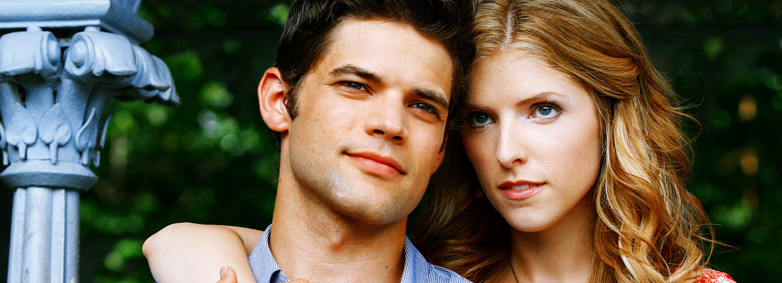
She plays Cathy, a struggling actress whose five year relationship to writer Jamie (Jeremy Jordan) has come to an end.

We see the rise and demise of the ambitious, attractive and sexy couple. As Jamie’s career as novelist goes stratospheric, Cathy’s acting career stalls. As she suffers humiliating auditions, he is flattered and applauded at public readings of his work.

Tensions increase and as he parties with publishers in New York, she performs in summer seasons in Ohio; the US equivalent of starring in the cabaret at a Butlins holiday camp.

The narrative is divided in two strands alternating between his and her points of view, emphasising their differences.

Cathy’s songs begin at the end of the marriage and move backwards in time to the beginning of their romance. Jamie’s songs move from the start of the affair to the final parting.

As Cathy becomes increasingly happy and confident, Jamie becomes frustrated and disillusioned. The tone of their songs synchronise in the middle of with their joyous marriage vows before diverging again.

This clever construction has it’s advantages. The frequent switchbacks between the duo’s viewpoints create momentum and prevent the failure of the relationship to become a maudlin slog to the end of the film.

It enables us to see the complex dynamics at work and offer sympathy to them as individuals. There’s sadness, anger, regret, confusion, deception and infidelity – but also passion, love, sweetness, and support.

Against this very few other characters even speak and there are too few duets. This means for the majority of songs the non-singing partner must simply stand and stare.

This creates awkward moments such as when Jamie sings excitedly in anticipation of an intimate encounter and Cathy is forced to stare silently at him while prone on the bed.

The relationship begins in glorious bright colours and a frantic camera dizzy with passion. It ends in a muted palette of blues and greys in the apartment they shared, the camerawork is more composed and the tunes mournful. The fine cinematographer responsible is Steven Meizler who has worked a great deal with Steven Soderbergh.

There’s a valiant effort to open up the stage production to take advantage of the bigger canvas cinema offers. New York offers some lovely locations but the few exterior scenes set there seem rushed, resulting in moments of not great lip-synching.

Kendrick showcases an impressive singing voice and provides lovely moments of subtlety and a great adaptability in tone and range, being comic or serious as the role demands.

Her co-star gamely gives his all in trying to keep up – but his toothy, stagey playing burns the screen instead of illuminating it. It’s not a poor performance but an overcharged one.

Kendrick’s career has included a role in the Twilight franchise and holding her own against George Clooney but she has yet to be a household name. Maybe, hopefully, this performance will push her towards a wider and much deserved recognition.

A Little Chaos

Director: Alan Rickman (2015)

When love is planted in Versailles, it takes blooming forever to flower in this wilting period drama.

As a pair of lovelorn gardeners work together to build the King an outdoor ballroom, the intrigues of the royal court and professional rivalries threaten their budding romance.

A far more serious impediment to happiness is his adherence to classicism in contrast to her embrace of modernism – but surely love will overcome these seemingly insurmountable obstacles.

It’s Paris in 1682 and King Louis XIV (Alan Rickman) has announced he will build a palace at Versailles. Andre Le Notre (Matthias Schoenaerts) is the gloomy landscape gardener commissioned to realise the King’s grandiose vision.

Despite being the son of France’s most famous gardener, Andre needs assistance to complete an outdoor ballroom before the King arrives for an inspection – so he tenders out the work.

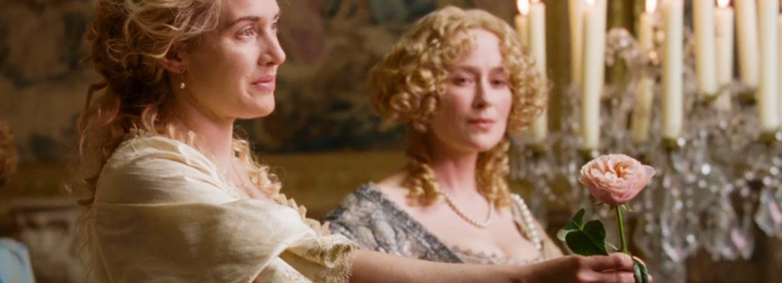
Widowed gardener Sabine De Barra (Kate Winslet) applies but is brusquely dismissed for incorporating chaos in her designs. But after one fleeting glimpse at Sabine’s private garden, Andre’s creative sap rises and he is inspired to offer her a job.

As well as being knowledgeable in horticulture and engineering, Sabine is well up for getting down and filthy. But the weather is against her and before anyone can say ‘Titanic‘, she’s up to he knees in mud and up to her neck in water.

Sabine’s immersed in her work to compensate for a childless life. Andre has lank hair and is trapped in a Byron-esque baggy shirt and an unhappy marriage to his rampant pest of a spouse, Francoise (Helen McCrory).

Tasteful sincerity, a talented cast and handsome costumes get bogged down in mannered and misjudged direction, forcing an unsmiling cast go about their work with grim conviction and making it unnecessarily hard work for us to like or sympathise with the characters.

There’s a carriage-coach crash, some jealousy, a bit of plotting, off-hand affairs and plenty of digging. The orchestra is on over-time, ushering emotions on and off stage.

As French labourers saunter off-site for croissants and coffee, it’s difficult to distinguish between pre-arranged professional sabotage and the natural French proclivity against hard work.

When women gather they compete with tales of child-rearing woe like a female version of Monty Python’s four Yorkshireman sketch.

The script assumes some knowledge of France geography – such as the distance between Paris and Versailles – then abandons it’s use allowing characters pop up at a moments notice with news and plots from afar. Or maybe a-near. Who knows?

Steven Waddington appears as a rough-voiced groundsman called Duras. He offers moral and practical support like a chaste Mellors from Lady Chatterly’s Lover.

McCory is full of anger, jealousy and brittle self-loathing but her character seems to have wandered in from Dangerous Liaisons by mistake. Stanley Tucci prances in on turbo-camp for a couple of scenes bringing much needed humour but little drama.

Schoenaerts performance is extraordinarily dull and Winslet – amazingly – isn’t much better. The fleeting moments of quality are in the rare scenes where she and Rickman appear together.

It is in these stagey moments Rickman the director is on confident ground, allowing Rickman the actor to demonstrate his consummate ability and stagecraft. Though it’s reflects poorly on Rickman that he makes Winslet play straight-man to his sad clown of a King.

Rickman unashamedly crowbars his character into proceedings. The King hears confession, absolves guilt and hands out directives for future behaviour, creating an environment where love can blossom.

It’s similar to the role played by Queen Elizabeth I (Judi Dench) in Shakespeare in Love – though I doubt Rickman will win an Oscar for his work here.

The Salvation

Director: Kristian Levring (2015)

Saddle up for this exciting and cynical Western shot through with murder, revenge and rape.

When a peaceful farmer swaps his ploughshares for pistols to exact retribution on his family’s killers, it results in a deadly feud threatening the interests of the rich and powerful.

Having reinvented police procedural TV dramas, the Danes cheekily train their sights on the archetypal Hollywood genre.

They deploy the usual dramatic furniture of six-guns, shoot-outs, saddles, saloons and a safe full of money – then dress them up with biblical overtones and contemporary issues such as government corruption and environmental concerns.

Filmed in South Africa with a European, predominantly Danish cast adds to the new perspective, emphasising the sweeping immigrant nature of the US of the period.

Seven years after serving in the Danish army in the 1864 war against the Germans, brothers Jon and Pete (Mads Mikkelsen and Mikael Persbrandt) are living a hardscrabble farming life in the US West.

They are finally joined by Jon’s wife Marie and son Kresten (Nanna Oland Fabricius and Toke Lars Bjarke) on the frontier.

Kresten is now a young teen while Marie is an elegant porcelain beauty in pale blue and blonde, appearing dangerously delicate in her new rough and dusty surroundings.

Travelling by stagecoach to Jon’s smallholding, Marie and Kresten are savagely murdered by a pair of recently released criminals. It’s the first of many terrifically tense scenes, played with minimal dialogue.

Though Jon exacts bloody revenge and kills the men, one of them is the brother of a vicious gang leader called Delarue (Jeffrey Dean Morgan).

He in turn wants revenge and holds the local townsfolk of Black Creek accountable until Jon and Pete are apprehended, leading to a violent and gripping showdown.

With a brisk running time of 91 minutes, the dialogue, direction and editing are delivered with a considered economy, consistent with Mikkelson’s controlled central performance.

In a role requiring her not to speak, Eva Green  shows what a strong actress she can be as Madelaine, Delarue’s disfigured sister-in-law.

Jonathan Pryce is as excellent as ever in a small but pivotal role as Mayor Keane, who in the manner of rural communities, doubles as the undertaker – an essential role in many Westerns.

Former footballer turned thespian Eric Cantona plays a henchman known as The Corsican, glowering from under his beetlebrow with menace.

His appearance is only incongruous if one’s strongest memory of him is turning out for Manchester United. But we should remember he’s been acting for the best part of twenty years. There’s nothing wrong with his performance; he’s pretty good.

Co-written by the director, the script is sharp with clear character motivation and well constructed conflicts fuelling consequences of greater acts of violence.

The violent personal dramas play out on a broader social canvas; the church and the law are under the control of Delarue who is playing a far bigger game than the townsfolk realise.

There’s a commentary on how corporate America uses military mercenaries to bully elected representatives, the law and the Church and serve their own interests over that of the people.

None of this slows down the action but enhances it by providing context and motivation. A dead body is deposited next to a pool of oil, the only building left standing in a burnt-out town is the bank.

As well as missing legs and tongues, there are many mutilated teeth and eyes befitting the biblical criteria for justice. Fire and water are elemental punishments, adding to the well-crafted Old Testament atmosphere.

Cinematographer Jens Schlosser burns his daytime colours. His rain lashed night-times have ferociously heavy and apocalyptic shadows.

Costume Designer Diana Cilliers dresses the cast in a variety of colours to reflect the swathe of languages and accents we hear from the throng of immigrant nationalities.

Just as in the 1960’s the non-Hollywood talent of Sergio Leone could use his perspective as an outsider to rejuvenate a well-worn genre with his operatic Spaghetti Westerns, so too does Levring.

Although operating on far smaller scale, he re-invigorates the genre with a passionate energy and fresh location. The magnificent South African landscapes are an imposing spin on using the venerable Monument Valley as a backdrop to the action.

Not only do they have the requisite majestic expanse but they hark back to the era of John Ford and John Wayne, steeping The Salvation in cinematic history and modern day excellence.

John Wick

Director: Chad Stahelski (2015)

An assassin goes on an entertaining one-man rampage of revenge in this bloody, brutal and bullet-ridden action thriller.

Filled with blistering action, fast cars and a cute puppy, it’s a slick return to form for Keanu Reeves.

Grieving the death of his wife, John Wick (Keanu Reeves) disses a Russian gangster Iosef (Alfie Allen).

Not a bloke to be dissed by a fifty year-old in stubble, classic sports car and brown leather jacket, Iosef beats Wick up, trashes his apartment, kills his dog and steals his motor.

On any other fifty year old, Wick’s fashion choices could be the sign of a mid-life crisis and but this is Ted ‘Theodore’ Logan, Johnny Utah and Neo – so he can dress how he likes and he’ll always be forgiven.

In flashback we see poor Bridget Moynahan as Wick’s late wife Helen. Despite being seven years younger than her screen husband, Reeves makes her look like a toyboy-chasing cougar. The illness that killed her could have been old-age.

Unfortunately for Iosef, Wick is a retired hitman who used to work for his dad, a beard-stroking villain called Viggo (Michael Nyqvist).

Wick has a killer rep, he once killed three men in a bar with a pencil and is famed for his focus, commitment and sheer will. Nyqvist delivers the word pencil with articulate relish.

To protect his spoiled son Viggo reluctantly puts a $2million dollar bounty on Wicks’ head. Meanwhile Wick is breaking out his arsenal of weapons and is in a bad mood. The muted blues and greys of his house are a stylish representation of his emotional state.

The film plays to Reeve’s strengths by giving him lots of screen-time, great suits to wear, fast cars to drive – and minimal dialogue. Plus he’s at the centre of plenty of crisply choreographed carnage set to a grinding rock soundtrack.

What’s best about John Wick is the script’s nicely created heightened sense of reality, it exists in a parallel universe of coded conversations, rigid rules of engagement, financial penalties and it’s own currency of gold coins the size of doubloons. We only ever see one cop and he apologises for doing his job.

Adrianne Palicki and Willem Dafoe appear as as fellow hitmen Ms. Perkins and Marcus. Her Mrs Peel leather and eyeliner combo adds to the timeless quality of this alternate reality.

Ian McShane saunters through as Winston, a sleazily ambiguous owner of the Hotel Continental where a lot of the action takes place, John Leguizamo has a small role as Aurelio, a mobbed-up garage owner.

The moments of humour are underplayed for the greatest effect. Reeves delivers laconic asides with confidence and there’s a variation on the classic ‘pause in the fight and listen to elevator music’ gag.

Editor Elísabet Ronaldsdottir cuts the action with as many long edits as possible, giving them tremendous dynamism. Reeves may well have used a stuntman but you’d be hard pushed to say where during the hand to hand fighting.

Cinematographer Jonathan Sela captures the ultra-violence in deep wells of light and adds increasing levels of colour as the story progresses – but sadly there’s a lack of poetry in the glossy aesthetic and too little re-invention of action tropes.

We don’t need the traditional sweeping helicopter shots of the city and we’ve seen too many times the rain-soaked night-time fight on the docks. Plus this showdown would be stronger if we considered the two men to be equals – as in Michael Mann’s Heat – rather than a super-assassin putting the hurt on his elderly former boss.

However it’s great to see the likeable Reeves in a well-executed action thriller – he even gets to walk towards the camera with the room on fire behind him in classic action hero style.

Hot Tub Time Machine 2

Director: Steve Pink (2015)

Anarchic and knowingly stupid, this gross-out comedy sequel goes back to the future with nobs on. And out.

Loud and lewd, it’s a booze, drugs, sex, vomit and gay-rape romp to the year 2025, a pop culture mash up of The Hangover and Back To The Future franchises.

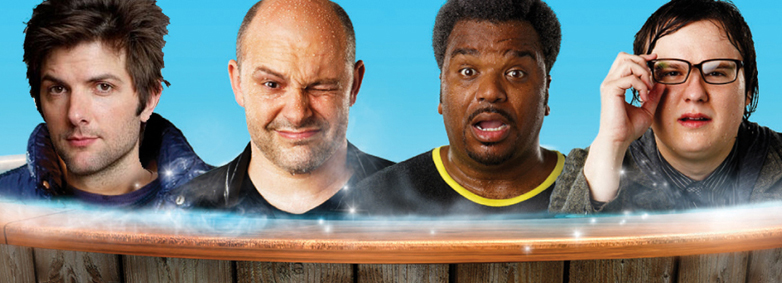
Having exploited their time-travelling hot tub to become billionaires, Nick (Craig Robinson) and Lou (Rob Corddry) are having a party in Lou’s mega-mansion.

Nick is importing music and claiming it as his own while Lou has invented Lougle, the dominant internet search engine. Lou’s son Jacob (Clark Duke) is employed by his dad as a butler.

An unidentified man shoots Lou so Nick and Jacob throw him in the tub to travel back in time to stop the shooting. But they go forward in time by mistake and have to find a supply of secret formula chemical to take them back home.

They hook up with Adam (Adam Scott) the son of the character played by John Cusack in the original film. Cusack obvioulsy decided this is a Hot Tub trip too far. The very game cast who do return put their all into the film.

The story doesn’t bear any analysis with regards logic. It’s a shameless hook to hang on as many badly judged and executed jokes as possible, the more rude, offensive and stupid the better.

There’s a driverless smartcar with murder in mind, hallucinogenic trips, drasic dancing and Christian Slater as a game show host

Very aware that 2015 is the year in the future Back To The Future II travelled ahead to, there’s a hoverboard joke. References to other time travel movies include The Terminator, Looper and of course the Back To The Future films litter the script.

Joke cameos from Lisa Loeb, Jessica Williams and Bruce Buffer as themselves may have been funny if I didn’t have to Lougle them to discover who they are.

Disposable and daft, the most acute joke is 2025 is only ten years away.