This downbeat road trip takes you on a mild goose chase with no particular place to go.
A messiah metaphor without a message, the story is bogged down by it’s own dour incoherence.
Stern Michael Shannon and vulnerable Jaeden Lieberher playRoy and Alton, a father and son on the run.
Alton is considered a weapon by the FBI and a saviour by the cult his father has just escaped him from.
Alton’s speaking in tongues has revealed location to which they are heading, but time is running out.
With his health is worsening, Alton has to wear goggles and headphones for protection – except for when he doesn’t.
Kirsten Dunst and Joel Edgerton offer solid support while Adam Driver brings as much humour to the role of an FBI analyst as he dare smuggle in.
Every line of dialogue is delivered with ponderous import but script has nothing to say about religion, belief or faith.
Car chases and shoot outs compete with earthquakes, meteor showers and power cuts but due to Alton’s increasing cosmic powers, there’s not much tension.
This moody Danish thriller has homelessness, rape, mental illness and murder plus teen drugs and sex.
A shame then the dour tone is a drag on momentum and the plot twists itself into the silliness of a revenge slasher flick.
Nikolaj Kaas and Fares Fares star as obsessive cop Carl and his laid back partner Assad. They’re dismissed in the precinct as the drunk and the Arab.
A suicide lead to them re-examine an old unsoved case of murdered school children.
They find a connection between the boarding school and current corruption in high society.
The split narrative flips between then and now with the flashbacks showing us layers of deceit and abuse, with potentially fatal consequences for the future.
Join me on a magical Mediterranean island and discover why Miranda is the most undervalued character in William Shakespeare’s canon.
A castaway from an early age, Miranda is the only speaking female speaking role in Shakespeare’s The Tempest, his final and greatest play. Her tragedy is to be the most high profile character in his canon to be dismissed as a supporting character in order to allow a male character to be dominate the play at her expense.
She’s a vibrant, forceful creation sidelined by generations of productions in favour of her grumpy, duplicitous and barely sane father, the wizard Prospero.
Miranda needs to be reappraised as one half of the father daughter axis central to the play. To promote Prospero above Miranda in importance is to misunderstand Shakespeare’s intention. She is a crucial summation of Shakespeare’s grand legacy to the world.
And of course, because she’s written by Shakespeare, she’s a fabulous character in her own right.
The Play
The Tempest is believed to have been written in 1610–11, and the first recorded performance is before James I on Hallowmas, November 1st, 1611.
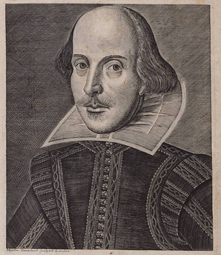
William Shakespeare. The Droeshout portrait. From the First Folio collection, published 1623
Although Shakespeare is credited with having contributed to two further and generally undistinguished plays, The Tempest is regarded as his final solo and definitive work.
With the perfect and dramatic timing of the seasoned performer he was, Shakespeare milked his exit for all its considerable worth. He took every trick he knew to be successful on stage and stitched it all together into the exciting, funny, challenging and crowd pleasing final act of his career.
The Tempest is a rollicking tale of shipwrecks, stolen kingdoms, murder plots, class warfare, magic, fairies, monsters, comedy, romance, satire and social commentary.
It was has variously been described as a comedy, a romance and a problem play. To limit The Tempest to a single category is absurd. It is an adventure, a romantic comedy, a reconciliation drama, an intimate family portrait and a deconstruction of Elizabethan politics and more. It is a dazzling combination of every art and technique at Shakespeare’s disposal, the pinnacle of his career, a four hundred year old play and the finest ever written.
It’s crowned with a moment of staggeringly self confident showmanship. In the closing speech Shakespeare demands the audience applaud his career achievements.
Shakespeare is the creator of the greatest female roles ever written such as Portia, Beatrice, Cleopatra and Lady MacBeth, to name a few.
And it is crazy to believe as many productions choose to, Shakespeare dressed this living testament, his final hurrah, with a simpering romantic female lead.
Prospero’s plans, the structure of the play and Miranda’s arc and behaviour demand she is played with strength, sexuality and humour.
The story
Patrick Stewart as Prospero, RSC, 2006. Photo zuleikahenry.co.uk
The Tempest takes place on an unnamed and remote mediterranean island. The sorcerer Prospero, rightful Duke of Milan has been exiled there by his brother Antonio, who stole Prospero’s crown. Prospero has been plotting for the 12 years of his exile to punish Antonio and restore his 14 year old daughter Miranda to her rightful place in society.
Exploiting the powerful magic of his fairy servant Ariel, Prospero conjures up a storm, the eponymous tempest. This delivers his usurping brother Antonio to shore where while terrorising Antonio and his party, Prospero arranges for Ferdinand, prince of Naples, to meet and fall in love with Miranda.
The problem with Miranda
Here is a typical description of Miranda, quoted by shakespeare-online.com from Shakespeare’s Comedy of The Tempest. (Ed. William J. Rolfe. New York: American Book Company. Pub. 1889.)
Miranda is a unique and exquisite creation of the poet’s magic. She is his ideal maiden, brought up from babyhood in an ideal way — the child of nature, with no other training than she received from a wise and loving father — an ideal father we may say
Ok, so it’s over a century old and written with the prejudices of the time but this perception of Miranda as ‘exquisite’ persists.
In all that she does, Miranda is sweet and pure, honest and loving.
My word she sounds dull. On this reading Miranda lacks any personal agency, reduced to a pawn of her father and married off to Naples secure the return of his Dukedom.
But this is the Shakespeare who wrote fiercely intelligent, adversarial, female characters. Not just in his tragedies such as the fiercely complex Cleopatra in Anthony and Cleopatra,but in his comedies. There is Hermione in A Winter’s Tale;Beatrice in Much Ado About Nothing andOlivia in Twelfth Night.
Miranda is the product of an arrogant, educated, driven man and has spent her entire life solely in his company. She has been educated and raised to rule by her father who not only wants to regain his own throne, but see her placed upon it.
Let’s consider what growing up with such a man would have on the psyche of the child. What effect would it have to live with and watch ones only parent plot for 12 years the downfall of his enemy? The ferociously single minded and revenge driven pursuit of power is behaviour which would seem normal.
Prospero indulges Miranda and terrorises the domestic staff. Wouldn’t it be more realistic and more fun for the audience if Miranda grows up to be truly her father’s child; manipulative, mendacious and power hungry? Someone able to conquer the world without her father’s assistance?
Before we look at how Miranda should be played, let’s examine Shakespeare’s structure to see why Miranda should be played in a far more forceful and interesting way.
The structure
The graphic (right) contains two break-downs of The Tempest by scene.
The first highlights the scenes which are broadly comic if the roles Miranda and Ferdinand are played in a traditional straight, demurely romantic manner.
If the romance of Miranda and Ferdinand is not played as comic, then laughs are sparse in The Tempest. It becomes a severe essay on an old man’s personal and political legacy, essentially King Lear with a suntan.
The sullen spirit of Prospero looms darkly over proceedings and the bright figure of Miranda is marginalised, her agency and character denied the light in which to grow.
We’re left with only the drunken antics of Stephano, Trinculo and Caliban to provide comic relief to Prospero’s repetitive machinations.
Yes, Ariel’s impudence and Alonso’s jibes at the elderly courtier Gonzalo have a pointed sarcasm. But this leaves a great deal of the play without comedy.
The second shows how many more scenes are broadly comic if Miranda is played as a person with motivation and ambition.
Immediately the overall tone of the play is raised, injecting more light and therefore more shade.
And yes, playing The Tempest as a comedy alters the tone of parts to something more frivolous, but Prospero is always lurking about to ground the humour. And if these scenes are not played as humorous then the play sags.
It becomes more digestible to a wider audience who are offered a considerable amount of sugar to help swallow the bitter taste of Prospero’s revenge.
Plus of course, Shakespeare. One of the joys of his writing is the unparalleled ability to switchback between comedy, tragedy, pathos, bathos and any other tone he cares to strike. Often in a single line.
Plus watching two strangers meet and profess love without the joy of flirting is insufferably dull. Shakespeare has already demonstrated his mastery of portraying flirting couples. For example, Beatrice and Benedick in Much Ado About Nothing.
It’s bizarre to imagine in what Shakespeare knows to be his final play he would provide a limp romance, especially when in all other scenes he’s pulling out all the big guns of his theatrical armoury.
Aristotle. Roman copy in marble of Greek bronze bust by Lysippus c. 330 BC
So The Tempest needs Miranda to be funny, clever and spirited. Our interest in her romance relies on her being so. Shakespeare knows we will only approve of her sailing away to become queen of Naples if we warm to her. And no-one would ever warms the damp dishcloth she is commonly presented as being.
On a broader structural point, The Tempest is rare in being Shakespeare’s only second play after The Comedy of Errors to abide by the classical structure of the three unities.
Greek philosopher Aristole’s unities are limits placed upon the dramatist to restrict the use of time, place and action. Shakespeare’s sudden adoption of them in his final work seems a two fingered salute to the establishment for criticising his previous refusal to adhere these strictures.
The arc of Miranda
Miranda undergoes a remarkable journey of personal growth from immature desert island urchin to a commanding future queen of Naples. This is as fascinating a character arc as any in literature.
The Tempest opens with Miranda as a 14 year old, the same age as the doomed Juliet in Romeo and Juliet. In the Jacobean era of King James I she would be considered an adult woman.
King James I, by John de Critz the Elder (before 1647)
But having spent her life from the age of 2 on a desert island, she is suffering from arrested development and consequently acting like a child when we first meet her. This gap between her adult age and her childish behaviour is a seam of humour to be mined.
She shares the island with her father Prospero, the rapacious monster Caliban and Ariel the fairy. There’s not much to choose from in terms of romantic suitors there.
Caliban’s attempt at rape tells us she understands the sex act, but importantly she has not connected it to her own sexuality and doesn’t understand lust or the nature of romantic love.
However once Miranda spies Ferdinand, her sexuality is awakened, triggering her rise to adulthood and authority.
And Miranda sets out to pursue dominion over sex and love with all the single minded energy of the daughter of a man who has spent 12 years plotting revenge on his enemies.
Just like her father, Miranda knows no half measures when her mind is set. Indeed she surpasses Prospero’s expectations by dominating Ferdinand in a manner her father undoubtedly approves of.
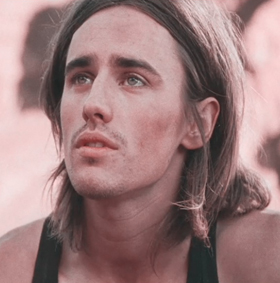
Reeve Carney as Ferdinand, The Tempest (Dir. Julie Taymore, 2010)
A great deal of the fun in The Tempest is seeing the arrogant and unsuspecting Ferdinand swept away by the force of Miranda’s assault. As Miranda becomes a woman, so Ferdinand becomes her plaything and a means to facilitate her ascent to the throne.
By the time Ferdinand claims all he wants is a quiet life, it is said with the absolute ruefulness of a man exhausted and spent.
Miranda proves to be the one wearing the metaphorical trousers. When they sail away to Naples to be wed, Miranda has outgrown her father and her ascent is complete.
Humour, sex and magic
Every character in The Tempest lies, plots or seeks to persuade another person to take a course of action. This is no less true of Miranda.
Only the faithful Gonzalo does so for the benefit of someone other than himself. In his case, the worst he is guilty of is painting an optimistic picture of the island in order to cheer the grieving Alonso.
Each performer has to emphasise the difference between what their character says and does.
When Ferdinand swears to Prospero he will respect Miranda’s virginity, the actor playing Ferdinand must communicate to the audience his character has absolutely no intention of abiding by his own words. He must project arrogant belief he is cynically seducing a hapless maid while pretending to be madly in love.
Similarly Miranda must demure to her father but be clear to the audience she shares Ferdinand intentions. She must offer supplication to Ferdinand’s smooth seduction while suggesting the awakening of ravenous desire which is about to consume the unsuspecting prince.
Plus it’s far funnier to suggest the young pair are at it like rabbits every time Prospero’s back is turned, rather than see them placidly obeying him.
How Miranda should be played
Act II begins with Miranda commanding her father to quell the storm she rightly suspects is his doing. She is fully aware of his power and his temper. Yet from her very first lines she is not the slightest bit afraid to face him down. From their very first exchange, Miranda and Prospero are engaged in a power struggle:
If by your art, my dearest father, you have Put the wild waters in this roar, allay them.
Feel the childish sarcasm in her first words ‘If by your art, my dearest father‘. Plus it tells us Miranda is aware of her father’s magic powers.
Prospero’s first words to Miranda and the audience are disingenuous:
Be collected: No more amazement: tell your piteous heart There’s no harm done.
Yes, Prospero saves the passengers of the ship. But only in order to carry out his dastardly plan an punish them at leisure. And of course he created the storm in the first place. The doting father and daughter are vying for the upper hand from the off.
We learn Miranda is highly educated:
and here Have I, thy schoolmaster, made thee more profit Than other princesses can that have more time For vainer hours and tutors not so careful.
It is reasonable to assume Miranda has knowledge of her father’s magic. Just because it is not acknowledged on the page, it is possible to infer Miranda possesses magical ability and to demonstrate it on the stage.
Miranda loses interest in Prospero’s story of exile. He repeatedly demands she pay attention:
Thou attend’st not.
And:
Dost thou hear?
But why? Well, these pauses help focus the audience attention on the lengthy exposition.
But why is she so skittish? Especially when the story is about herself?
Consider Miranda has spent nearly her entire life incarcerated on the island with Prospero and familiarity has bred a casual if loving contempt. She has been indulged for years and is a victim of arrested development. Although 14 years old and therefore an adult, she acts with the attention deficit of a 4 year old .
Having received her father’s reassurances about the storm, she’s returned to playing with her toys and is in fact ignoring her fathers story. Her tone is bored. So now the scene has humour to liven up the reams of exposition. She offers sarcasm:
Your tale, sir, would cure deafness.
Prospero doesn’t reprimand Miranda. His repeated questioning of Miranda’s attention in this scene is usually attributed to his agitated state of mind. His years of plotting are coming to fruition and he has many characters to manoeuvre. But this limited reading of Miranda relegates her to an expository device, an empty listening jar, a thankless task for an actress and a more sombre play.
Prospero puts Miranda under a sleeping spell so he can discuss his plans with his servant Ariel. But is Miranda asleep? Does Prospero have the power he thinks over his daughter? Is she surreptitiously listening to all which is being said? Is Prospero being played by his daughter?
Miranda’s sarcasm is mirrored by Ariel later in the scene. He too offers Prospero sarcasm:
All hail, great master! grave sir, hail!
But unlike Miranda, Ariel is beaten down for his impudence. Even his slave Caliban subjects Prospero to open subordination:
There’s wood enough within.
So although Prospero is tremendously powerful, domestically he is challenged at every turn. This makes him a somewhat more sympathetic figure and softens his vindictive persona enough to make his redemption feasible.
As an aside, with its emphasis on performance and illusion, The Tempest is often read as an allegory for the theatre. Here Prospero’s domestic vicissitudes are a parallel for a troubled stage director trying to herd his cast in line his creative vision.
When Miranda first spies Ferdinand it is at Prospero’s behest. It’s the last time Prospero has control over his daughter, if indeed he ever had any. Miranda gasps:
I might call him A thing divine
Note Miranda’s objectification of Ferdinand as a thing. And she goes on pantingly:
The first That e’er I sigh’d for
And from here on Miranda’s character begins to develop as Ferdinand’s arrival triggers her sexual awakening.
Prospero seems to have no little idea of the potential of the strength of her character. Certainly the unsuspecting Ferdinand has no idea of the storm of sexual aggression soon to be unleashed upon him.
Ferdinand sees Miranda as a cheap victory, quickly making a rash promise:
O, if a virgin, And your affection not gone forth, I’ll make you The queen of Naples
And we’ve no reason to suspect Ferdinand hasn’t made this offer countless times before. The greater the unthinking swagger in this scene, the further he falls later in the play.
Ferdinand freely admits through his flirtatious declaration:
Full many a lady I have eyed with best regard
With Prospero’s knowledge of court behaviour, he suspects full well the whole truth of Ferdinand’s statement of intent, causing the wizard to say:
this swift business I must uneasy make, lest too light winning Make the prize light.
But in his desire to protect his daughter and his own machinations, Prospero is hugely under-estimating his daughter.
Which takes us to Act 3.
When we see Ferdinand and Miranda alone on stage, the scene at face value is written as two lovers delivering lyrical but dramatically dull declarations of love.
But actually Shakespeare has gifted us a comic scene of one-upmanship where a predatory Ferdinand thinks he is is manipulating Miranda but actually he is doomed from the off.
Miranda may act the innocent but is in reality always one step ahead of her suitor. It is only at the end of the play Ferdinand comes to understand he has been played like a kipper and never stood a chance against his supposed prey.
Miranda is happy to deceive her father in order to pursue Ferdinand:
My father Is hard at study; pray now, rest yourself;
Note how the last two words are a command. She physically asserts herself over Ferdinand and wrestles him to the ground, the better to seduce him and emphasise her sexual conquest of him:
If you’ll sit down, I’ll bear your logs the while: pray, give me that
Again notice how the the last three words are a command. And Miranda establishes intimacy with Ferdinand by affecting the breaking a promise of not telling Ferdinand her name:
Miranda. O my father, I have broke your hest to say so!
Though she pretends to be unaware of her own behaviour, Miranda knows exactly what she is doing. There is a humorous gap between her fake naivety and aggressive pursuit of sexual experience:
The use of wood as a phallic symbol is not a modern invention:
for your sake Am I this patient logman.
Ferdinand freely admits his desire. And Miranda plays on his expectations by offering crocodile tears:
I am a fool To weep at what I am glad of.
..before drawing from Ferdinand a declaration of love:
Do you love me?
And extracts from him the promise of the throne which is her endgame:
My husband, then?
Note, she does not offer to be his wife, but he to be her husband. Ferdinand belongs to Miranda the same way Caliban and Ariel belong to her father. Ferdinand is Miranda’s ‘thing’, to play with as she wishes. She wishes to have sex and to take his throne.
And Miranda leaves a frustrated Ferdinand wanting more:
And mine, with my heart in’t; and now farewell Till half an hour hence.
We next meet the pair in Act 4 scene I.
They enter the stage. Lets have Miranda and Ferdinand blushed and with dishelved clothing, barely hiding their sexual activity from Prospero though clearly readable to the audience. If the scene is played as comedy it provides comic relief to the drama of previous scene and it lets the audience draw breath.
Plus it makes Prospero fallible and more likeable if the grand schemer fails to read what is happening under his nose. Is he blind or does he choose not to to see as a father may well choose to when his daughter becomes sexually active?
It adds humour to the scene if everything Miranda and Ferdinand say to Prospero is a lie, designed to hide the truth of their sexual activity from him.
When Ferdinand proclaims:
I warrant you sir; The white cold virgin snow upon my heart Abates the ardour of my liver.
Shakespeare here is piling deceit upon deceit as all three scheme against each other.
Prospero thinks he has the upper hand as Miranda is doing his bidding by becoming betrothed to Ferdinand. Ferdinand thinks he has the advantage over Prospero having consummated his relationship with Miranda. Miranda actually has Ferdinand utterly in her power. He is under her spell but doesn’t yet realise it.
Ferdinand is so dim as to what is really happening he tries to ingratiate himself with Prospero:
This is a most majestic vision, and Harmoniously charmingly.
While Prospero has been busy with his plans for Alonso, he even invites the pair to:
retire into my cell And there repose
at which the young lovers would be hard put to disguise their glee at being told to ‘rest’ together. Shakespeare wasn’t afraid to make his women sexually active. For example Juliet in Romeo and Juliet, Titania in A Midsummer Night’s Dream, or Cleopatra in Anthony And Cleopatra. Why not Miranda?
Then in Act V we next meet the lovers with the following stage direction:
Here PROSPERO discovers FERDINAND and MIRANDA playing at chess
And Miranda exclaims having been discovered inflagrante:
Sweet lord, you play me false.
With her words ‘Sweet lord’ as an exclamation of blasphemous surprise to herself and ‘you play me false’ directed not to Ferdinand but her father.
Ferdinand being not up to speed believes Miranda is talking to him:
No, my dear’st love, I would not for the world
And Miranda, on seeing her father with Alonso, berates him for any accusation of a double standard:
Yes, for a score of kingdoms you should wrangle, And I would call it, fair play.
Prospero seeks power in one way, she does it in another.
And Ferdinand, realising he has been caught with his trousers down, prostrates himself before Prospero and makes a plea for clemency:
Though the seas threaten, they are merciful; I have cursed them without cause.
And Miranda, upon seeing the crowd of courtiers, immediately recognises her universe and therefore her power base has expanded:
O, wonder! How many goodly creatures are there here! How beauteous mankind is! O brave new world, That has such people in’t!
And Prospero acknowledges Miranda’s journey to a sexually active adulthood, authority and independence and power over Ferdinand with the words:
Where I have hope to see the nuptial Of these our dear-beloved solemnized
Prospero accepts Ferdinand’s proposal not only because he is to be king of Naples and willing to make Miranda his queen, but because Miranda has Ferdinand’s arm twisted behind his back and she is clearly the one in command.
Miranda, child of Prospero and Shakespeare conquers the world
The Tempest is Shakespeare’s great goodbye to the theatre and a lyrical valedictory to his own career. If he uses Prospero as an on-stage proxy to deliver his last words, then what does Miranda represent?
Well, as all children are the creative endeavour of their parents, so Shakespeare’s canon are his children. Miranda symbolises his body of work, his great plays, sonnets and poems.
In the same way Prospero anticipates Miranda to rule not only Milan but Naples, Shakespeare expects his work to rule the kingdom of theatre long after his death.
Miranda symbolises Shakespeare’s work and encapsulates his desire for it to outlive and prosper without him. This is why Miranda deserves to be considered and portrayed as a character possessed of vitality, intelligence and wit. After all, if the bard considers her to be the epitome of his work, who are we to argue?
Nemo’s Fury is an exciting digital reinvention of Jules Verne’s classic steampunk adventure novel, 20,000 Leagues Under the Sea.
Download for free to your smartphone or tablet, search your app store for ‘Nemo’s Fury’.
A mobile interactive fiction game employing a bespoke combat system and hundreds of original illustrations, Nemo’s Fury is inspired by the 1980’s role-playing gamebooks such as ‘The Warlock of Firetop Mountain’, of the Fighting Fantasy series which celebrated its fortieth anniversary last year.
Each player joins the legendary Captain Nemo on board his fabulous submarine, the Nautilus, on a wild voyage of adventure, intrigue, loyalty, and betrayal.
There’s mayhem, monsters, maelstroms and murder as Nemo takes you from the South Pacific to the Northern Atlantic via Antartica and the Red Sea. And if they survive long enough, the player will of course fight a giant squid.
Available on your smartphone or tablet, (but not yet your desktop), click on your app store below
I’m the world’s foremost fan of Disney’s 1967 animated classic, so I had my claws out ready to savage this glossy remake.
But I was disarmed from my first footstep into this spectacular jungle, a terrifically realised mix of live action and state of the art CGI.
The astonishingly lifelike landscape are computer generated by the team who made sci-fi epic Avatar (2009). The animals are from The Lord Of The Rings (2001) WETA Workshop.
Next year’s Visual FX Oscar must surely be in the bag.
This warm hearted, fleet footed, big budget beast is a hybrid spliced from Rudyard Kipling’s novels, Uncle Walt’s original film and his company’s latter day smash The Lion King (1994).
It’s an exciting, funny and touching adventure, though perhaps too scary for the very little ones. Likeable characters are killed, though we never see the blood.
A confident and charming Neel Sethi plays resourceful man cub Mowgli, the only actor on screen.
Mowgli bravely chooses to leave his home and save his family from Shere Khan the tiger.
Idris Elba is tremendous as the clever and vicious villain. He’s blind in one eye and myopic in his pursuit of his prey.
Mowgli sets off to the man village accompanied by Bagheera the panther and Baloo the Bear.
Respectively played by Ben Kingsley and Bill Murray, the pairare enjoyably wise, brave and comic.
En route they encounter angry elephants, seductive snakes, stinging bees and aggressive monkeys.
As a representative of a now endangered species, from a 21st century perspective Shere Kahn almost qualifies as the good guy.
He’s a prophet of doom whose violent fate proves the accuracy of his apocalyptic predictions concerning the dangers to the jungle from the unfettered technology of man.
The script can’t bring itself to embrace the scar faced usurper despite being more far-seeing and independent minded to the allegiance pledging wolf pack. To a British ear the wolves behaviour is eerily fascistic.
Apocalypse is hinted at again in the Brando-esque introduction of the enormous King Louie, not an Orang utan but an outsized outspan Gigantopithecus. He commands an army from the ruins of a long dead civilisation.
Christopher Walken is an inspired and deranged casting choiceand delivers a performance to match.
Scarlett Johansson and Lupita Nyong’o have small roles with the former’s husk put to effective use.
When Mowgli learns of the death of a loved one, he decides to return and confront his mortal enemy.
The soundtrack includes the fabulous songs The Bare Necessities and I Wan’na Be like You.
So follow the jungle drums down to the cinema for a swinging good time.
We last saw Swedish actress Rebecca Ferguson stealing scenes from Tom Cruise in Mission Impossible: Impossible – Rogue Nation (2015), now she’s stealing state secrets and hearts in this soapy cold war romance.
Swooningly in love with its own conceits, it’s a thriller dressed and acted in the style of a 19th century period drama.
The multi-layered time hopping plot drifts between New York and Moscow in 1959, 1961 and 1992.
Ferguson valiantly attempts to hold it all altogether in a distracting double role.
As Russian dissident Katya, she falls in love with Sam Reid’s communist who she is using to procure state secrets for the US.
When she persuades him to defect, Katya is left behind and her fate is unknown.
Ferguson also plays Katya’s niece Lauren who travels to Russia years later to investigate her aunts disappearance.
Strategies of seduction and deception are employed as duty competes with passion. Vodka is drunk, chess is played and everyone visits the opera.
Adapting her own novel, Shamim Sarif directs in a straightforward manner, in thrall to her gorgeous cast as they pursue glamorous intrigues.
Discussions of art and food fail to generate urgency or paranoia and there’s an inexcusable lack of historical or political context.
The script is markedly uninterested in detail. We never learn exactly what the government secrets are or why there are important.
Oliver Jackson-Cohen, Antje Traue and Anthony Head offer support as best as they are able in the circumstances.
But when sprightly Charles Dance springs into a room to prompt an unveiling of secrets, the remaining credibility melts into soap opera slush. What’s left is as pretty and insubstantial as a snowflake.
What isn’t extraordinarily stupid in this brain dead thriller is astonishingly misjudged or alarming dull.
It’s a grey spongey mess of ageing stars, woeful dialogue, cheap looking stunts and preposterous plotting.
Gary Oldman and Tommy Lee Jones play CIA bosses who need to recover the memory ofof a murdered agent to locate a computer hacker who is selling nuclear codes to the Russians.
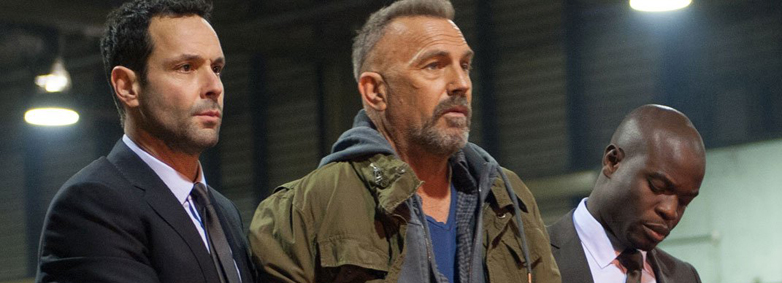
So using untested technology, they implant the dead agents memories into the mind of an emotionless killer, played bygrunting Kevin Costner.
Developing a conscience and language skills as a result of the operation, he goes off mission and pursues a creepy Patrick Swayze ‘Ghost’ style romance, giving a new meaning to the word spook.
Meanwhile Spanish anarchists try to muscle in on the nuclear action. There is expensive London location work and the screen is busy with military hardware.
It all goes Alan Partridge Alpha Papa (2013) as Costner evades a squad of police cars in an ambulance.
Various Brits bystanders are beaten up for comic effect. Plus there is a cut price reprise of Schwarzenegger in Terminator 2: Judgement Day (1991) when Costner steals a sandwich, a beanie hat and a van.
Fresh from playing Wonder Woman in Batman Vs Superman: Dawn of Justice (2016), Gal Gadot chats about her lingerie, parades on the beach and is tied to her bed.
Flush with success from his mega smash Deadpool (2016), Ryan Reynolds appears briefly at the beginning but is curiously underplayed on the advertising.
Antje Traue is an incompetent leather clad assassin called Elsa and while it’s great to see Alice Eve on screen, she needs to have serious words with her agent about this non-role.
The uncertain tone, scattergun editing and woeful storytelling hint at heavy handed interference in production. Costner’s performance seems out of control. There a host of executive producers credited.
Just when you start considering the value of your own lobotomy, TV host Piers Morgan appears as himself to convince you there’s always a more suitable candidate.
This slushy sports biopic of an amateur ski jumper chasing his Olympic dream fails to fly.
The sentimental tone is light but the humour lands as heavily as its hero, but with far less frequency and grace.
A gurning Taron Egerton captures the spirit of of Eddie ‘The Eagle’ Edwards in all his gormless glory.
He’s a teetotal, socially awkward, bespectacled sporter of alarming knit wear. The possessor of a chin the late Jimmy Hill would be proud of.
After Eddie suffered a childhood illness, doctors told him he shouldn’t play sport.
So with an Alp sized chip on his shoulder,this otherwise very ordinary bloke is driven to become an Olympian to prove them wrong.
He’s not fussy about at which sport he fails at so plumbs for the ski-jump.
With no other British competitor in the field it gives him the best chance of qualifying for the 1988 Calgary Winter Olympics.
In a less than olympic effort from the IOC, also on the same bill were the Jamaican bobsled team who inspired the film Cool Runnings (1993).
It was watching that film which inspired producer Matthew Vaughn to tackle this project. Egerton also starred and more successfully in Vaughn’s sexist spy caper Kingsman: The Secret Service (2015).
The obstacles littering Eddie’s way are a lack of finance, ability and parental support.
Plus he must face down mockery from fellow competitors and institutional bullying from Tim McInnerny’s snooty British Olympocrat.
The story turns into an odd couple comedy when he teams up with a fictional coach called Bronson Peary.
Aussie charmer Hugh Jackman plays disgraced former ski star turned cynical alcoholic.
Eddie’s no chicken and lacks a fear of heights. Headless on the slopes, he’s too dim to be wary of the potential lethal nature of the sport.
Adding to this lack of heroism is the knowledge he can’t win, so there’s nothing at stake and no drama.
Actor turned director Dexter Fletcher made the feel good musical Sunshine On Leith (2014) but can’t make this material lift off.
He does a great job of conveying the awe inducing spectacle of the slopes but it’s downhill in all other aspects.
When even the presence of reliable old stager Jim Broadbent can’t raise a smile, your film really is in trouble.
Christopher Walken wanders in very late in the games as ski guru Warren Sharp and looks as comfortable in his surroundings as Eddie does on the slopes.
Dialogue stresses Eddie’s reservations about appearing in the media spotlight. This is at odds with the real life footage shown at the film’s end of Eddie taking a very public bow at the closing ceremony.
And Edwards hasn’t been slow to exploit the media invented nickname of ‘Eddie the Eagle’. His real name is Michael.
Which in presenting this under achieving and over eager self publicist as a plucky underdog, this film duly takes.
A schnapps swigging clubber is swept up by criminals in this suffocating German thriller.
Laia Costa gives a virtuosa performance as the vivacious Victoria. Her engaging elfin spirit is the damaged flip side of Audrey Tautou’s ingenue in Amelie (2001).
There’s shades of epics such as Arthur Penn’s Bonnie And Clyde (1967) Michael Mann’s Heat (1995) in the story of likeable people doing bad deeds.
Breathtaking artistic and technical ambition surpasses the dexterity of Alejandro Gonzalez Inarritu’s faux single shot Oscar winner Birdman (2014).
Deliriously filmed in a single extended shot, the dizzying camerawork of Sturla Brandth Grovlen sweeps us around the clubs, cafes and corner shops of Berlin in real time.
As the characters dance, run and drive beside us, it creates an emotional connection and makes us complicit in their crimes.
The lighting, performances and dialogue are washed in naturalism, offering the impression of organic relationships and behaviour. Masterful use of music and sound mixing are key to the increasingly fraught and menacing atmosphere.
A chance meeting with four dubious local charmers leads Victoria to an impromptu after hours rooftop birthday party. Conversation is conducted in broken English as they steal, fight, smoke, drink and flirt.
Victoria’s evening becomes something wild when a phone call leads to her involvement in an armed raid.
With drugs, guns, blackmail and bloodshed at every turn, the young girl needs all her wits to survive as poor choices lead to increasingly desperate options and jaw clenching tension.
Frederick Lau, Franz Rogowski, Max Mauff and Burak Yigit offer strong support but it’s Costa who steals our heart and the film.
This rambling comedy has the Welsh mountains echoing to the sound of offbeat poetry – but not much laughter.
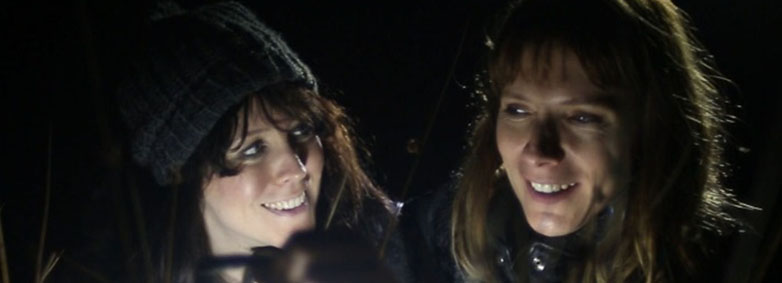
Alice Lowe and Dolly Wells bicker sweetlyas neurotic sisters who go on the run after failing to steal a JCB. One is aggressively rampant and the other uptight and longing for children.
They steal the identities and car of a pair of poets and hide out at a remote retreat where oddball poets are gathering for a weekend of inspiration.
Tom Cullen’s hunky Richard proves dexterous with his tent pole, leading to some midnight tent hopping.
There’s a large cash prize for the best beat poem and to stand a chance of winning the girls must discover their muse before the police arrive.
It’s edited, photographed and performed with the same improvised rhythm of the freestyle poetry readings.
Nicely turned moments of reflection are overwhelmed by an over reliance on attempts at humorous embarrassment and oneupmanship.
The game cast perform outdoors where the freezing wet weather puts a dampener on the the scripts attempt at a lyrical finale.
Director: Byron Howard, Rich Moore & Jared Bush (2016)
Spring an Easter surprise on your kids with this arresting animated tale of a crime busting bunny.
It’s a joyously bright eyed and bushy tailed adventure with a Disney heroine quite like no other.
Gone are the doll figured fairytale Princesss of old and replaced with a smart, sharp and agile doe who’s easily the equal to any buck. Or any other creature.
A small town rabbit with big time dreams, Judy Hopps goes against her cautious parents advice and enrols at Police academy before heading off to the soaring skyscrapers of Zootropolis.
It’s where animals of every stripe and hue live in mostly civilised harmony with none of that anti social eating of each other.
When Hopps’ reluctant chief gives her forty eight hours to crack the case of a missing Otter, it leads to the discovery of a plot to unleash the animal nature of every predator in the city.
She teams up with Nick Wilde, a streetwise Fox who opens her eyes to the challenges of living and working in the big city.
Far from being the dumb cute bunny she’s patronised as, Hopps is brave, hard working, and determined to be the best.
Ginnifer Goodwin and Jason Bateman are inspired casting and bring sparky humour, chemistry and the slightest hint of romance.
Idris Elba plays Chief Bogo, the buffalo chief of Police and offers a brilliantly concise and funny critique of Disney’s irritating mega smash Frozen.
J.K. Simmons plays the Lionheart the Mayor and singer Shakira is Gazelle, a famous beauty and singer of forgettable songs.
Being filled with charming invention make the laboured riffs on The Godfather and TV’s Breaking Bad all the more disappointing.
The script twists time and scale to comic effect and there’s a blue flower nod to the work of Philip K. Dick, which may well be a first for a mouse house movie.
Of course underpinning all the fun is a typical Disney message of universal tolerance and understanding, but don’t let that stop you having a thumper of a good time.



 The structure







 chrishunneysett.uk
You must be logged in to post a comment.