The Nice Guys

Director: Shane Black (2016)

Since his first writing success with Mel Gibson’s Lethal Weapon (1987), writer/director Shane Black has spent his career creating crowd pleasing action comedies.

After recent blockbuster superhero success with Iron Man 3 (2013) he’s back with another smartly written, explosive and character driven adventure, riffing on Los Angeles detective noir such as Chinatown (1974) LA Confidential (1997) and The Big Lebowski (1998), among many others.

If you’re as in the dark to what’s going on as the dimwitted detective duo, don’t worry. An opaque plot is a vital element of the genre. Other hallmarks present and correct are the voice over, a dead glamour model, a bag of cash, sinister doctors and a corporate conspiracy.

In typical style Black ramps up the action but finds his normally sharp comic dialogue is subdued by the pot headed sun kissed California vibe. Nor can he resist including an unnecessary trademark Christmas scene.

However Black’s writing has reached sufficient maturity to splice together porn movies and car adverts in a scathing commentary of both industries.

Plus a degree of satirical self knowledge is needed to write a script set in Hollywood where a character dodges bullets to save a canister of celluloid of utmost importance to solving a murder.

Heavy weight Russell Crowe teams up with a comically dim Ryan Gosling as the ironically titled leads.

As mismatched down market private detectives Healy and March, they’re employed to solve the case of a missing teenager in 1970’s Los Angeles.

Though a pair of cynical, violent alcoholics in true noir style, this is disguised by their easy screen charisma and laid back chemistry.

Kim Basinger and Margaret Qualley are strong support as a mother and daughter at the centre of the story.

Our point of view of proceedings is guided by March’s 13 year old daughter Holly. Angourie Rice is terrific as the bright, brave, street wise moral conscience of the film.

Her sweet nature proves these nice guys aren’t all bad and Black is continuing to improve.

@ChrisHunneysett

Me Before You

Director: Thea Sharrock (2016)

Get your hankies at the ready for this modern day old fashioned romantic weepie.

Based on the best selling novel by Jojo Moyes, it’s derivative, sentimental and impervious to the charms of subtlety. But it is effective.

Two fabulously attractive young people are brought together by tragedy. Once they’ve fallen in love those same circumstances threaten to tear them apart.

Sporty banker William loses the use of his legs and arms while lowly waitress Louisa loses her job. Their fates collide when she takes a job as his carer.

Emilia Clarke and Sam Claflin have a hugely engaging chemistry and the film succeeds on the strength of their charm and talent.

The puppyish enthusiasm of Clarke and her incredibly expressive eyebrows contrast nicely with Claflin’s remarkably still sneer.

William teaches Louisa culture and she helps him lighten up. But his strong views on his condition threatens to cast a permanent shadow on their potential happiness.

It’s best imagined as a British version of Pretty Woman (1990) where Richard Gere is in a wheelchair and Julia Robert’s hooker is now an obliging nurse played by the ditzy younger sister of Bridget Jones (2001).

A snow clad castle dominates the chocolate box scenery as they visit the races and a concert of classical music.

It would be too easy to mock the One Nation Tory politics underpinning this twist on the Cinderella story.

It’s a fairytale world where the landed gentry casually bestow jobs on the feckless and bitter unemployed working classes. Plus there’s a singular avoidance of the practical hardships of being quadriplegic.

However Me Before You doesn’t pretend or aspire to be a movie with a social conscience.

There isn’t any ambition beyond making you smile through a bucket of tears and on that score it’s an undoubted success.

Charles Dance and Janet McTeer provide gravitas as William’s parents and Dr Who’s Jenna Coleman appears as Louisa’s single parent sister. Joanna Lumley breezes through as a fragrant wedding guest.

Clarke is famed for her frequent nudity on TV’s Game of Thrones but here keeps her curves under wraps.

This tearjerker won’t be the last performance which has Clarke’s fans reaching for the tissues.

@ChrisHunneysett

Warcraft: The Beginning

Director: Duncan Jones (2016)

Feeling defeated after two hours of crushing cartoon violence, I beat a hasty retreat from this fantasy adventure.

Two worlds go to war in this combination of live action and state of the art animation.

Using motion capture technology, every sabre toothed hairy backed orc is lovingly rendered by photorealistic motion capture. They combat actors sporting lovingly detailed suits of armour.

It’s based on a hugely popular online video game and is set in a extraordinarily designed Tolkienesque world of humans, orcs, dwarves, elves and wizards.

But it’s a sadly underpowered drama of unfathomable mythology and unexplained geography.

Jim Henson’s The Dark Crystal (1982) seems to be a distant visual relative though Warcraft lacks its charm and clear narrative.

Although there’s no A list cast names, Warcraft possesses a recognised brand, a healthy budget and an up and coming director with a passion for the project.

But after this humdrum opener, it’s tricky to see how it will power the intended franchise to continued success.

There’s little sense of the early promise of Jones directorial career which kicked off with the smart and intimate sci fi thriller Moon (2009). It is an intelligent and intimate chamber piece. His follow up Source Code (2011) was less strong and now Warcraft completes a downward trajectory from which I hope he will recover.

A self confessed super fan of the game, Jones creates a world of extraordinary visual depth. With the excited air of a wayward puppy he rushes about to include as much of it as possible.

This is to the detriment of the dramatic tone which mostly occurs within a narrow bandwith, hovering at the level of Saturday morning kids TV.

A major contributing factor in the magnificence of Peter Jackson’s The Lord Of The Rings (2001-03) trilogy was having the good fortune to be based on the writings of an Oxford scholar and the canny casting of experienced Shakespearean actors to give his dialogue gravitas. An under reliance on computer imagery helped enormously to ground the fantastical elements.

There’s a noticeable lack of such rich cultural heritage here. This is a shame as buried deep down is a cracking old fashioned story of family, betrayal and star crossed lovers.

Daniel Wu glowers as Gul’dan, a powerful orc shaman whose world is dying. Human sacrifice powers his evil green magic which he uses to open a portal into the peaceful human kingdom of Azeroth.

He sends through his fearsome orc warriors to conquer it, crushing their enemies with a signature move of using huge hammers to slam them bloodlessly into the ground.

The orcs are awesome looking eight foot tall humanoids. Pneumatically muscled and sabre toothed, they dress in in the skulls and furs of defeated foes.

Defending their land against the horde are a collection of wizards and warriors. They’re led by a puzzled looking Dominic Cooper who plays King Llane.

I shared his confusion as the story whizzes from castle to battle to floating fortress in the sky.

Travis Fimmel’s knight and Paula Patton’s green skinned half orc captive are given the best of the scarce humour. The way these two characters are brought together and assume greater prominence is one of the film’s few strengths.

As orcs who question Gul’dan’s vicious regime, Toby Kebbell and Anna Galvin give the most effecting performances and share a personal chemistry notably lacking almost everywhere else.

On the eve of the final battle, the King gives us two words from Shakespeare’s Henry V Agincourt speech before rushing off for yet another fight. This suggests a lack of confidence in the attention span of the audience.

As everyone struggles with the functional dialogue, CGI armies slash, stab and slay. A lot of casualties are reduced to husks when their life force is sucked out of them.

It’s a risk unwary viewers will share.

@ChrisHunneysett


The Daughter

Director: Simon Stone (2016)

This gloomy family drama is a sombre reflection on class, wealth, infidelity and betrayal.

A respectful adaptation of Henrik Ibsen’s play The Wild Duck (pub. 1884 as Vildanden) it successfully migrates from 19th century Norway to modern day Australia.

A languid pace and sumptuous cinematography encourages us to wallow in the brooding atmosphere. Varied locations from stately home to derelict mill suggest the texture of history.

They anchor the poised performances from a top drawer cast which includes veteran Aussie actors Geoffrey Rush and Sam Neill. They play estranged former business partners Henry and Walter.

With an endearing and frank freshness, pink haired teenager Odessa Young plays Hedwig. She’s Walter’s grand-daughter and the daughter of the title. Bright and sensitive, she’s pursuing a romance with a school friend.

As Henry prepares to marry his young housekeeper Anna, his confrontational and alcoholic son Christian has returned from abroad.

Although never dull, we spend a long time waiting for a dark secret to power the violent finale where lives are shredded.

@ChrisHunneysett


Alice Through The Looking Glass

Director: James Bobin (2016)

It’s six long years since the staggeringly successful but forgettable Alice In Wonderland (2010) from director Tim Burton.

And time drags in this muddled sequel which has even less connection to the fantastical novels of Lewis Carroll.

There’s no lyrical sense of wonder just hack handed sentiment, blunt slapstick and plodding special effects.

It jettisons familiar characters into two distinct and parallel plots of its own invention, respectively involving time travel and female empowerment. The resolution of family conflict joins the two strands loosely together.

Never forget Hollywood’s golden rule of scriptwriting; a film is always about family, regardless of how appropriate it is to the material.

Burton butchered Carroll’s whimsical masterpiece, replacing its playful intelligence, charm and wit with flamboyant gothic design and an excruciating mannered performance by Johnny Depp as the Mad Hatter.

Against the odds, Burton’s replacement James Bobin has made an even more unwieldy and incoherent film.

Previously Bobin directed The Muppets (2011) and Muppets Most Wanted (2014). He began in TV with The 11 O’Clock Show (1998) where he collaborated with Sacha Baron Cohen. The comic actor features heavily if sadly not hilariously in Looking Glass.

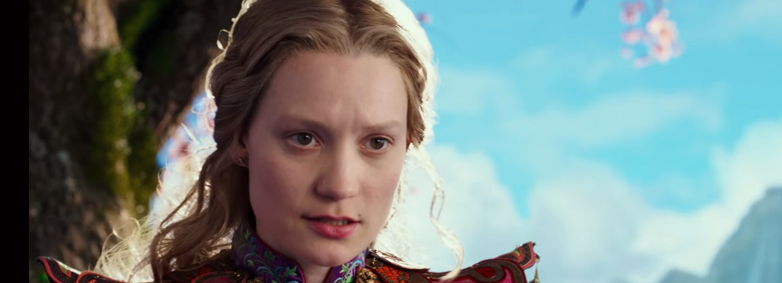
Despite Alice being reinvented as an action heroine, the pale Mia Wasikowska gives a pallid performance as Alice. Perhaps she’s miffed she’s billed a humble third after Depp and Anne Hathaway.

Alice steps through a mirror and falls into Wonderland, immediately signalling to us nothing in this world can hurt her. Which destroys any potential sense of danger in one dull thud.

She is told her friend the Mad Hatter has gone more mad but in a bad way, and is dying.

In white face paint, orange wig and tweeds, Depp’s Hatter resembles Ronald McDonald’s eccentric great uncle after confinement to a suitable attic.

To cure him Alice must do the impossible task of stealing a device called the chronosphere and go back in time to rescue his long lost family.

Removing the time travelling machine risks destroying Wonderland and everyone in it. But this threat is quickly forgotten about as the film is more interested in whizzing Alice about. There’s a surprise incursion to an insane asylum.

Alice is chased by Time who wants his contraption back. The film can’t decide if the black clad and German accented Sacha Baron Cohen is the baddie.

Also vying to be the baddie but failing in villainy are Helena Bonham Carter and Hathaway. They make a squabbling return as respectively the large headed and rude Red Queen and the elegant and duplicitous White Queen.

The presence of Bonham Carter, his now ex-wife, may explain Burton’s exclusion from the director’s chair.

The sepulchral tones of the late Alan Rickman offers a fleeting moment of gravity. While in her brief appearances as Alice’s mother, theatrical Scots stalwart Lindsay Duncan makes more of an impression than Wasikowska achieves.

Lending their voices to the advertising poster in some un-necessarily expensive casting choices are Stephen Fry, Michael Sheen, Timothy Spall, John Sessions, Barbara Windsor, Paul Whitehouse and Toby Jones.

Usually my heart despairs whenever Matt Lucas appears so it says a great deal about the film I found his presence curiously bearable.

Alice won Oscars for Best Art Direction and Best Costume Design, as well as being nominated for Best Visual Effects.

No doubt Looking Glass will follow the first film in being in the running for similar awards. It’s rich and detailed production design gives us plenty to look at while everyone busily runs around.

The chronosphere is a golden mechanical marvel Alice sits in to blast back in time, a design nod to George Pal’s teen culture embracing adaption of HG Well’s The Time Machine (1960).

Alice visits vast gothic halls and traverses a tumultuous ocean of time. The world is populated by  mechanical assistants, vegetable guardsmen, giant chess pieces, a fire breathing Jabberwocky, walking frogs, talking dogs and of course the disappearing Cheshire Cat.

Bookending the film is a framing device featuring Alice’s adventures at sea pursued by pirates. Because the world needs another big budget CGI fest involving Johnny Depp and pirates.

The story stresses the importance of not wasting ones time. Which is strange as I wasted two hours of my life watching this joyless merry go round of a movie.

Mind you, it felt much longer.

@ChrisHunneysett


Chicken

Director: Joe Stephenson (2016)

Intense performances, an assured tone and a textured landscape shot with an appreciative eye are the strengths of this earnest and occasionally raw drama.

But as the characters struggle with poverty and abandonment, the script fails to free itself of the burden of its theatrical roots, failing to ignite the painstakingly constructed emotional bonfire.

Morgan Watkins and Scott Chambers play brothers with learning difficulties who live in a derelict caravan on farmland.

Polly is older, aggressive and more capable than Richard, he earns beer money as a casual labourer.

During Polly’s daily absence, the sweet natured Richard strikes up an unlikely friendship with spoilt middle class teenager Annabelle, played brightly by Yasmin Paige.

The deterioration of the boys challenging circumstances accelerates the decline of their relationship, unearthing a life changing family secret.

@ChrisHunneysett


A Hologram For The King

Director: Tom Tykwer (2016)

The desert sun shines a soft light on a middle age crisis in this culture clash comedy drama.

Handsome, sentimental and undemanding, it relies heavily on the charm of a hangdog Tom Hanks to hold our attention.

He plays a salesman in a slump called Alan Clay, who jets off to Saudi Arabia to sell an innovative holographic conference call system to the King.

But he finds himself trapped in a Kafka-esque routine of cancelled appointments, stone-walling receptionists and elusive contacts.

This multiplies Alan’s many anxieties which manifest themselves as a cyst on his back and panic attacks.

Seeking treatment he’s befriended by glamorous doctor Zahra and his wild haired driver Yousef.

They’re played with graceful intelligence by Sarita Choudhury and a deceptive deapan delivery by Alexander Black. Ben Whishaw and Tom Skerritt appear briefly.

Hologram opens with an agitated Clay singing Talking Heads 1980’s ode to existential angst Once In A Lifetime.

This fabulous if too short sequence is the only time the film offers any daring. After which it settles into a comfortable rhythm, rolling along as gently as the desert dunes which stretch interminably along Clay’s horizon.

There’s a running joke involving Clay falling off his chair and watching Hanks tapping out flirtatious emails at his computer has echoes of Nora Ephron’s comedy You’ve Got Mail (1998).

Adapted from Dave Eggers novel of the same name, the script leaves politics and religion in the shade and offers a sunny outlook on the possibilities which exist in even the most unpromising terrain.


Bad Neighbours 2

Director: Nicholas Stoller (2016)

I strongly suspect this sequel to the successful 2014 frat boy comedy was only made so Zac Efron could be paid once again to oil his pecs and dance semi naked in front of a crowd of college girls.

Mind you, I’ve made worse career decisions myself.

However this proudly politically correct comedy is alarmingly enjoyable in its own undemanding bad taste way.

Efron returns as Teddy Sanders, now with a criminal record after event in the previous movie.

Wanting revenge on his former next door neighbours, Efron teams up with Chloe Grace Moretz who has rented his previous home to establish her own sorority.

Seth Rogen and Rose Byrne are again the family under siege while Selena Gomez, Lisa Kudrow and Kelsey Grammer cameo.


Florence Foster Jenkins

Director: Stephen Frears (2016)

Big screen diva Meryl Streep launches a ferocious assault on your ears in this biopic of the worlds worst opera singer.

As the title character, her ignorance of a lack of talent is a punishing off note joke.

But if you can endure Streep’s cacophony of comic caterwauling, there’s a lot of enjoyment in the tender chemistry created with her on screen husband St. Clair Bayfield, played by Hugh Grant.

It’s New York 1944 and heiress Florence is an overly generous patron of the arts whose entourage exploits her good nature for cash.

Determined to aid the war effort, she books herself a gig at Carnegie Hall and gives a thousand servicemen free tickets.

This threatens St. Clair’s luxurious life as neither he, tutors or muscians dare tell Florence the painful truth about her lack of ability, for fear of being put out on their arias.

Director Stephen Frears’ lack of visual ambition is compensated by adhering to the narrative and focusing on character.

He’s rewarded with two marvellous performances as the leads stretch their throats in extraordinary ways.

Grant has never better. With the fading of his still considerable leading man looks, his tremendous talent shines ever brighter. He gave a light comic masterclass in The Man From U.N.C.L.E. (2015) and here he dances like a young James Stewart.

Streep was last seen singing on screen as a bar room rocker in the weak Ricki And The Flash (2015) and here gives a performance of grand neurotic eccentricity.

The stars essay a complex relationship while the script saves its mockery for the sycophants who surround them.

Rebecca Ferguson is under served as St. Clair’s lover but Nina Arianda is show stopping as a ticking blonde bombshell, threatening blow up the whole charade whenever she speaks her mind.

This is the second telling of the story this year, after the French language version Marguerite (2016) which won 4 prestigious Cesar awards.

This version is undemanding with broad appeal, and you don’t have to appreciate opera to enjoy it.


These Final Hours

Director: Zak Hilditch (2016)

With the end of the world only twelve hours away, society has descended into an orgy of sex, suicide, booze, drugs and violence.

And that’s just the first five minutes of this scorchingly apocalyptic Australian road movie.

A meteorite has caused Europe, Africa and the Americas to be engulfed in an rolling inferno, and Perth is last on the list.

Nathan Phillips is well cast as buff surfer dude James, desperately racing to a party to be with his girlfriend.

With it’s vehicle hopping, dry humour and brutal violence, this is arguably an unofficial and worthy prequel to George Miller’s magnificent Mad Max: Fury Road (2015). It offers an explanation of how society reached there from here.

The smart script by the director Hilditch offers James choices whose actions flesh out his character. Further bonus points are gained by never compromising the central premise.

Cinematographer Bonnie Elliot exploits the local light in extraordinary ways by saturating the screen in blistering red, orange and yellow.

Plaudits also to the production designer Nigel Davenport for stretching the budget and providing vehicles in a suitably searing shades of ochre.

Similarly to Max, James is defined by the relationships he has with the women in his life.

Jessica De Gouw and Kathryn Beck offer bikini clad support as James’ girlfriends Zoe and Vicky. Lynette Curran steals a scene as his mother.

En route to see Vicky, James’ rescues a young school girl from a pair of paedophiles.

Angourie Rice gives a remarkable performance as the sweet and straight talking Rose, who insists on being taken to her waiting father.

These reluctant fellow travellers offer each other the possibility of redemption as they work out what is really important in the short time they have left.