This brisk sixty minute animated adaptation is hand drawn in the style of the famous TinTin cartoon series, and delights in its similar sense of old fashioned derring do.
Faithful to Verne in its story, character, US Civil War-era setting and spirit of adventure, it sees am intrepid band of balloon-wrecked castaways and their dog attempt to colonise their new island home.
Fighting pirates and escaping the erupting volcano are given prominence, and the characterisation is appropriately two dimensional.
Nemo appears early, a watchful, mysterious and potentially malevolent figure, but is eventually revealed as an old dying man, and though his appearance alludes to his background as Verne describes it, his identity of Dakkar, Indian prince is not mentioned, nor is his vendetta against the British. Neb is introduced as a manservant, but is otherwise treated as simply another member of Captain Harding’s team.
The Nautilus is an enormous, palace-like vessel, bearing little relation to Verne’s description and unlike Verne’s version is capable of firing torpedoes.
Unremarkable yet straightforward, faithful and enjoyable, and played at a pace it’s target audience of young kids may have been content with at the time, but to a modern generation it will seem painfully slow.
This definitive big screen big budget adaptation of Jules Verne’s 1870 science fiction novel is a handsomely-staged family adventure mostly remembered for Kirk Douglas star performance and fabulous design. Yet there’s also a surprising degree of Cold War concerns bubbling beneath the surface, making this hugely entertaining version far more interesting than most subsequent adaptations.
Running at just over two hours, the filmmakers sensibly abandon the vast majority of Verne’s self-aggrandising scientific posturing in successful pursuit of huge box office success.
Broadly faithful to the wide-eyed adventurous spirit and plot of Verne, we follow a Professor, his servant and a harpooner, who’re kidnapped at sea by the mercurial and revenge-driven submariner, Captain Nemo, and join him for several escapades onboard his submarine, the Nautilus, while plotting their own escape.
The trio were recruited by the US government in San Francisco, a reassuringly ‘Western’ opening location for the audience, before sailing to the South seas to confirm or deny the existence of a sea monster which has been sinking ships.
The smooth but shady US recruiting agents want to to beat other nations in capturing this sea monster in order to establish and exploit any military capability it may possess. And thus the 1950’s audience is immediately plunged into an allegory of the post-war arms race with the Soviet Union.
Whereas the French writer Verne had the US government employ Professor Aronnax in order to have a compatriot hero to appeal to Verne’s home readership, here Aronnax is not only valued as a scientific advisor but his nationality offers the cover of political neutrality to a US military expedition in contested overseas territory.
This accurately reflects the use of other nation proxies to project US power and further its national interests during the then developing Cold War and establishes a degree of paranoia which the film later develops when it deploys mushroom cloud imagery.
However while the film demonstrates the destructive power of nuclear weapons, it also offers an argument in their favour and sympathy to those who developed them. More of which later.
Peter Lorre is a wonderfully cowardly cynic as Conseil, servant to the dull Professor Aronnax, played by Paul Lukas, who’s performance suggests the Hungarian actor fully understands he’s not there to upstage the top-billed star, Kirk Douglas, who plays the two-fisted harpooner, Ned Land.
Already a household name and a double best actor nominee for 1949’s Champion, and 1952’s The Bad and the Beautiful, Douglas perfectly understands the material, and delivers a wonderful cigar- chomping, scenery-chewing and scene-stealing performance, which screams ‘movie star’.
A role tailor-made to demonstrate his athleticism, humour, charisma and boisterous comic ability, Douglas also commits fully to the required singing and dancing, and if he’s not the greatest at either, well I doubt there was anyone on set with the authority or nerve to tell him.
It would be hard to find a scene in his career more joyous than the one where he shares a song and kiss with a pet seal, and their duet is a piece of wonder that is comic, angry and tender. If only Douglas had always been this generous to his co-stars.
And in the fight scenes you have to worry for the stunt team as the 38 year old Douglas, still six years from playing rebellious Roman slave, Spartacus, seems determined to never pull his punches. At times he seems to be auditioning for a live action version of Popeye the sailor.
Director Robert Fleischer would re-team with Douglas two years later with The Vikings, and in a lengthy career, Fleischer would go on to make 1967’s serial killer drama, The Boston Strangler, 1973’s sci-fi conspiracy thriller, Solyent Green, 1980’s musical remake, The Jazz Singer, and 1984’s Sword-and -Sorcery sequel, Conan the Destroyer.
The mysterious Captain Nemo is revealed by turns a brilliant scientist, ruthless, an intellectual and a sympathetic victim, an ‘other’, i.e. a non-WASP, who serves his ‘guests’ ‘unusual’ food.
All this is true to Verne, but although early film incarnations of Verne’s novel recognised Nemo’s royal identity as an Indian prince, here Nemo is played by white British actor, James Mason. His other major role that year was alongside Judy Garland, in A Star is Born.
Here the template is set for subsequent interpretations to whitewash the role and those who follow in Mason’s footsteps include the very non-Indian actors, Herbert Lom, Michael Caine and Patrick Stewart.
But Mason’s character is more interesting than many later interpretations, with Nemo’s non-white otherness being coded as Jewish, and Nemo’s struggle for revenge on the British empire being substituted for the fight to use nuclear power to defend the state of Israel.
Verne’s Nemo wants revenge for the slaughter of his wife and child by the British during the 1857 Indian War of Independence, but Mason’s Nemo is a widowed state-less refugee, a survivor of slavery in a mine producing phosphate for war weapons.
We later see the mine which is visibly intended to evoke the Holocaust of the Second World War. Nemo was sent there after refusing to divulge the secret of the power source of the Nautilus, implied as nuclear power. Anyone with a passing knowledge of the EuropeanJewish emigre scientists who worked on the ManhattanProject and its development of the first nuclear bombs, will be able to see the intended parallels.
The world’s first nuclear-powered submarine, USS Nautilus (SSN-571) was delivered to the US Navy in 1955. Thus Nemo using nuclear power for world peace dovetails nicely with contemporary US military policy, he’s also trying to protect his island sanctuary from assault, a haven which can be read as a proxy for the recently established state of Israel. Nemo repeats, ‘There is hope for the future, when the world is ready for a new and better life then all this will someday come to pass in God’s good time.’
There is hope for the future, when the world is ready for a new and better life then all this will someday come to pass in God’s good time.
The giant squid which threatens the Nautilus is direct from Verne’s novel, but allied to the theme of nuclear power aligns 20,000 Leagues with sci-fi monster movies of the day, which saw humanity threatened by insects and other creatures mutated to enormous size by nuclear sources.
Nuclear paranoia of sci-fi classic, The Day The Earth Stood Still, had been released in 1953, and Ray Harryhausen’s 1955 The Beast From 20,000 Fathoms, saw a hibernating dinosaur released by an atomic blast to terrorise the world.
Released the same year as 20,000 Leagues, Them! saw huge radiation-affected ants bring terror to the US, and Godzilla stomped into cinemas in 1954. The US was threatened by aliens in 1953’s It Came From Outer Space, and by giant spiders in 1955’s Tarantula! Whether aliens, monsters or giant insects, and whether nuclear powered or not, 1954 was hotbed of paranoia about the Soviet nuclear threat.
It must also be noted that 1954 was the height of McCarthyism, the Red Scare, and the communist ‘witch-hunts’ in Hollywood. Ever the patriot, Walt Disney had testified before the HUAC hearings in 1947, and it’s interesting that the ultimately sympathetic Nemo argues in favour of the benefits of nuclear power, and the film ends on an audience-reassuring note in faith in god, science and the future.
The nuclear subtext is dressed up in art direction and special effects and 20,000 Leagues deservedly won Oscars in both those categories, as well as scoring a nom for the editing.
The sets, model ships and submarines are great and the locations are epic, representing Hollywood at the top of its game. If the Nautilus is more a metallic fish than the tube of Verne’s imagination, the submarine is a gorgeous steampunk creation, with brass fittings, red upholstery and a magnificent organ. And long before Spielberg’s 1993 dinosaur adventure Jurassic Park, the animatronic work of the giant squid is spectacular.
Although stock footage of whales and dolphins is occasionally mixed in with scenes on deck clearly filmed in a studio, there’s an impressive commitment to the underwater diving sequences, made when aqua diving was a novelty not an easily-accessible holiday activity.
These sequences were filmed in the photogenic waters of the Caribbean, as was the silent 1916 version of 20,000 Leagues, and if that gives some sections the air of a travelogue, it’s worth remembering foreign travel was an expensive luxury at the time and this form of visual escapism was very much intended to drive box office.
Still, the shark attack is very impressive and the location work helps retain Verne’s tone of wide-eyed wonder and his view of the sea as a resource to be worked. Mind you, the man-handling of crabs and giant turtles by the underwater performers wouldn’t be allowed today.
Sadly the same couldn’t said for the depiction of the South sea islanders, who Nemo describes as ‘cannibals’, and whose appearance is played for laughs, and their portrayal is no less sophisticated than similarly portrayed people in the Pirates of the Caribbean franchise.
And though Nemo drolly asserts the ‘cannibals’ right to attack the Nautilus, true to the book he then defends the Nautilus with electric shock treatment.
Similarly to the Pirates of the Caribbean movies, there’s no denying the scale of the action is impressive, perhaps ever more so than then, in our CGI era. And seeing Douglas run through the jungle reminds us of his son Michael, in 1984’s Romancing the Stone.
Despite the film throwing a series of grandly staged set-pieces at us, it’s possible a modern multiplex audience may find the pace plodding. Yet the crowd-pleasing ticking clock plot and punch-ups of the finale are pure Hollywood entertainment, harking back to Flash Gordon serials of the 1930s, and anticipating the missions of 007 of the following decades.
And though the final scene of the novel is downbeat, the filmmakers compromise by cleaving closely to Verne yet also providing a note of uplift, in which Kirk Douglas’s seal is seen to survive, and Nemo is given the last word.
To do this a cinematic sleight of hand is used which would be echoed two years later in Elvis Presley’s big screen debut, Love Me Tender. The enduring fascination with and longevity in popular culture of Verne’s greatest creation, Captain Nemo, lies with his mercurial nature which allows for continual reinvention. However, never did I think when I began writing this that I would end with a comparison with the King of Rock ’n’ Roll.
A frothy and glossy escapist musical romantic comedy of 1956, High Society is a terrific example of the ability of filmmakers from Hollywood’s golden age to draw on existing material and fashion a sparkling fresh and brilliant entertainment.
It can also be understood as a great example of producer power, was a commercial and critical hit, and was nominated for two Oscars in the musical categories.
Employing irresistible star wattage of Bing Crosby, Frank Sinatra, Grace Kelly and Louis Armstrong, the timeless tunes of Cole Porter and fabulous costume design of Helen Rose, it’s unmistakably the product of MGM, the studio which made the best musicals of the era, including 1951’s An American In Paris, and 1952’s Singin’ In The Rain.
Using a well established dramatic structure, and drawing on elements of American literature, it was produced as the post-war US consensus was being supplanted by the dawn of the teenager as a social phenomenon, and the film’s struggle to wrestle with the real world are all too evident. High Society is politically reactionary and has no sense of itself as herald to the end of the jazz age in which its stars and genre were mired, and sadly for lovers of the studio’s defining genre, High Society is the last great hurrah of the MGM musical.
I absolutely love it.
Kelly, Crosby, Sinatra, & Holm
Based on 1944’s Oscar winning comedy The Philadelphia Story, itself an adaptation of a Broadway play, High Society glides through its 111 minute running time in bubbles of glamour, charm and wit, as we watch a pair of tabloid journalists covering the upcoming high society wedding of a spoilt socialite who’s being courted by three different men.
Bringing four leads together all of whom were previous Oscar winners, Bing Crosby, Grace Kelly, Frank Sinatra and Celeste Holm engage in song, dance, and repartee as they resolve various romantic entanglements over the course of one night and two days in a mansion in the wealthy enclave of Newport, Rhode Island, the high society of the title.
Crosby heads the romantic leads as C. K. Dexter Haven, a wealthy composer who lives next door to his ex, Tracy Samantha Lord, played by Grace Kelly. Meanwhile Frank Sinatra and Celeste Holme are the down at heel muckraking journalists, Mike Connor and Liz Imbrie, who arrive to cover the wedding for their magazine.
When Crosby isn’t singing, he strolls about in cardigans or black tie, and though it’s not a performance of great range or energy, he delivers his popular brand of avuncular charm, is given a veneer of cool by his association with musicians of the calibre of Armstrong, and is offered some reflected glamour by the glittering star power of Kelly, best known at this point for her work with Alfred Hitchcock.
Kelly
Kelly is perfectly cast in her last Hollywood appearance before abandoning Los Angeles for life in Monaco. Whether in slacks or a ball gown, the luminous Kelly sweeps all before her in a series of gorgeous costumes, including a far from revealing but indecently sexy swim suit.
Plus she delivers a terrifically accomplished performance in the mould of screwball-era Katharine Hepburn, and whether being deliberately over the top, drunk, angry or playful, Kelly can wordlessly make us aware of what she’s thinking, in the manner of another Hitchcock blonde, Ingrid Bergman.
Presumably the casting call asked for an actress less attractive than Kelly to play the second female lead. On this showing that would be every other woman in the world at the time. Which is hugely unfortunate for the wonderfully droll Celeste Holm, who’s teamed up with Sinatra in my favourite big screen performance of his.
Sinatra plays well with Holm, and he’s either smart enough to allow her space to shine, or possibly barely able to keep up with her, and Holme brings a level of dignity and self-awareness lacking in other characters. But Holm was repeatedly ill-served by Hollywood, and after High Society she didn’t make another film for five years.
Elsewhere Lydia Reed is winningly confident and sparky alongside Kelly as her young sister Caroline Lord, and John Lund plays George Kittredge, the culturally barren, nouveau rich cattle baron who’s Tracy’s intended beau.
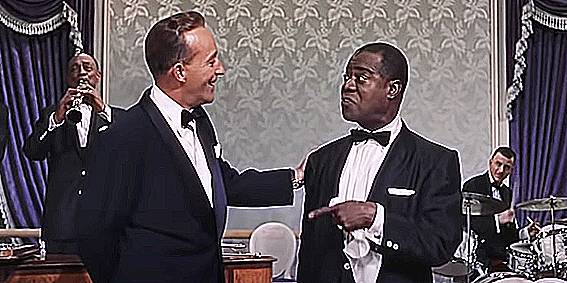
Playing himself, Louis Armstrong is an invitee performer at a jazz festival Crosby’s character is holding on his estate, a plot device which allows Armstrong to pal about with Crosby and duet together on the number ‘Now You Have Jazz‘, which is supposedly – but clearly isn’t – filmed in front of a wealthy white festival crowd.
Jazz musician Louis Armstrong is granted not inconsiderable screen time, performs three songs and is granted the first and last words. This is fitting for his screen ‘character’ is a Greek chorus to the comedy, a dramatic device used by later musicals such as 1972’s Cabaret, 1975’s The Rocky Horror Picture Show, and 1978’s Grease. I could write an entire post about radio broadcasters in movies acting as a Greek chorus by starting with 1979’s The Warriors and taking it from there.
Acting as a Greek chorus to the story, introducing the setting and then commenting on events as they unfold, as well as being a character in the story, Armstrong is mostly at one remove from the narrative and he could be excised from the film entirely without his absence changing the story.
In contrast to the previous year’s drama, Blackboard Jungle, the film which made a star of future Oscar winner Sidney Poitier, High Society’s principal black star is clearly at times not on same set at the same time to white actors and has to be edited into scenes in which he is ostensibly a part.
Check out the final scene (from 2.27mins) where although nominally in the same scene, he never shares screen time with Grace Kelly. Armstrong is included but never incorporated.
A generous reading of Armstrong’s separation from the main narrative would be to suggest his performing and recording scheduling conflicts prevented a deeper integration in the narrative. A less charitable reading would be the studio were wary if not frightened of too much interaction of a black character with white ones, and Armstrong’s certainly not allowed to interact with the white female cast members in any way. And good luck spotting a black female actor.
Crosby & Armstrong performing ‘Now You Has Jazz‘
It’s important to recognise High Society was released in 1956, and although the segregation of public schools had been declared unconstitutional by the U.S. Supreme Court in 1954, it was many years before this decision was universally implemented. Other laws of segregation weren’t overruled until the Civil Rights Act of 1964 and the Voting Rights Act of 1965.
With race being the defining political fault line of the US, High Society wants to exploit Armstrong’s cache as a long established and popular crossover artiste by contributing his jazz bona fides to the soundtrack and bringing his own fanbase to the films audience, but his role suggests a nervousness on behalf of the filmmakers who had to sell the film in a US market place.
MGM had at the time previous form with being vary of the controversial subject of race. The studio’s 1951 version of Show Boat notably tones down any ‘controversial’ racial elements compared to previous cinematic adaptions of the stage show on which it’s based.
However in theme and plot the film enforces existing racial boundaries. As one might expect of a mainstream entertainment which recognises social division in its title, maintenance of the status quo is a key theme of the film.
The script was written by a playwright John Patrick who’d previously written the NBC radio series Streamlined Shakespeare, and there’s a strong influence of Shakespeare scattered through the script – more of which later – so Armstrong’s narrator role may well have been included in the earliest draft. If so then casting Armstrong as the Chorus could be read as a deliberate act of segregation rather than a creative solution to a scheduling issue.
Patrick doesn’t steer away from the plot of the original film adaptation or the stage play which preceded it, but adding the Chorus – which Shakespeare used in Henry V for example – the audience to be guided into the heightened and otherworldly setting of High Society, as if leading us into a magical forest of one of Shakespeare’s arboreal comedies, one populated by the fairy Kings and Queens such as found in A Midsummer Night’s Dream, perhaps.
The Chorus is a visitor to this world of wealth and definitely not of or from it, a point underlined by Armstrong’s casting, and the musician’s persona can also be read as ‘blue collar’ and so acts as surrogate for all those in the audience not born to wealth. The film wants us to be amused by the superficiality of the Lord’s family behaviour and regard them with a mocking if warm detachment, and having the Chorus played by Armstrong helps to underline the idea the wealthy do things differently to the rest of us, they are apart, they are ‘other’.
This is story is about maintaining society’s status quo, keeping the high safe and separate in their gilded mansions and the rest of us, well, anywhere else. There is to be no storming of the barricades here, no tearing down of social division, but a determined raising of the drawbridge. This is a piece of high end comfort cinema, lavishly dressed with great tunes. If you want social conflict and a conscience, check out the Poitier flick instead.
Fitting the Shakespearean comic pattern there are two central couples, and all four must gain insight into themselves to find happiness with the correct person, and ‘correct’ is defined as with one whom not only shares a social standing, but also the person who reinforces the rigidly defined social divisions. The rich and the poor have their place, and are happier when the rigid social hierarchy is maintained.
We’re safe in assuming the family name at the top of this society is ‘Lord‘ is deliberately in keeping with Shakespeare’s habit of nominative determinism.
Taking place in a gilded world of enormous drawing rooms, private pools and a butler who offer visitors the south parlour as a waiting room, the film can feel as distinct from reality and as gloriously make-believe as a fairytale, a feeling underlined the magical appearance of a secret mechanical private bar from a book-lined wall.
Gatecrashing this magical realm are two journalists – rude mechanicals in Shakespeare terms – who cast a wry and cynical eye over the fabulous wealth the residents seem to treat with barely a second thought. And though they are drawn to it, they realise they are and cannot ever be part of it. Mike Connor’s brief fling with Tracy is comparable with the encounter between Bottom and Titania the Queen of the Fairies in A Midsummer Night’s Dream. That Sinatra is playing Mike, comparable with the idiot turned donkey, Bottom, is surely am unacknowledged joke at the actor’s expense by the film’s producer. More of him, later.
This is a fantasy which asks us to engage and sympathise with a wealthy white upper class family as they negotiate concurrent romantic entanglements. And the softening of the cynical stance of a pair of muckraking journalistic interlopers encourage us to find sympathy in ourselves for this madly wealthy household rather than maintaining or hardening of our critical stance.
The head of the Lord household has placed his ‘kingdom in a state of chaos due to his latest extra-marital affair, a scandalous fling with a ballerina, and in doing so has become estranged from his daughter, Tracy. Peace and order will only be brought to the kingdom when father and daughter are reconciled, which will only happen when she choses the correct romantic partner and comes to understand her parent’s worldview, making her fit to succeed her father in due course.
Father knows best, especially where his daughters love life is concerned, is a thoroughly 1950’s attitude. This is also a coming of age tale, and if Sidney Blackmer as patriarch Seth Lord isn’t given a huge amount of screen time as the stern but loving father who uses his own discretions to teach his daughter about the adult world, it’s their reconciliation which signals the end of the movie. And the curtain comes down with a pleasing and impressive speed which some modern day filmmakers could learn from.
Like Ayesha, the white queen of H. Rider Haggard’s 1887 adventure novel, ‘She’, Tracy’s power seems only to exist as long as she remains in her own world, and the suggestion is if John Lund’s character, the cattle baron George Kittredge, is successful in his courtship of Tracy and takes her away, then she will become ordinary, a mortal being almost. Much is made of George’s wanting to put Tracy on a pedestal and adore her.
One thing the wealthy do differently to the rest of us is put on a music festival in their home. Crosby plays a composer whose house is full of musicians. And the life of Tracy Lord is full of the arts. She and her sister dance, sing, and play piano. They have no regard, interest or knowledge in the ordinary or everyday.
In part George Kittredge is a poor fit not because he’s self-made – Crosby’s character is only second generation wealthy – but because he values commerce above art.
Cole Porter’s fabulous songs have endured even more successfully than the film itself and have achieved a life of their own beyond the confines of cinema. ‘True Love‘ was Oscar nominated for best song but lost out to ‘Que Sera, Sera’ from Hitchcock’sThe Man Who Knew Too Much. Some of them have been successfully re-recorded by later generations, such as ‘Well, Did You Evah!‘, the film’s best song, which was originally written for 1939’s DuBarry Was a Lady, and latterly recorded by Debbie Harry and Iggy Pop as part of a HIV/AIDS benefit project.
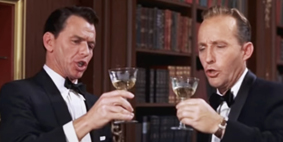
Sinatra & Crosby performing ‘Well, Did You Evah!‘
Being the greatest lyricist of his generation, Porter was capable of writing lyrics reflecting the film’s sense of magic and otherworldliness. He drops in classical references such as ‘Circe‘ the Greek goddess in ‘Little One‘, while also referencing more contemporary concerns, such as uranium, in ‘Who Wants to Be A Millionaire?‘ And yes, the song did inspire the name of the popular TV quiz show. And ‘she got pinched in the Astor Bar‘ from ‘Well, Did You Evah!‘ is as sly and funny now as it was then, especially with Sinatra’s astutely comic phrasing.
Not all the songs have aged as well, ‘Now You Has Jazz‘ is a decent example of the form, but the lyric ‘Jazz is the king, jazz is the thing that folks love the most.‘ seems unduly optimistic as jazz was about to be swept off the pinnacle of popular culture by rock ‘n’ roll.
However that’s aged nowhere near as badly as the icky staging of the torch sing Crosby sings to Kelly’s screen sister, which summons up the spectre of child sexploitation rife at the time in the Studios, and should be shocking to a modern audience in the era of #MeToo. And were High Society be remade today it’s the song that wouldn’t make the cut. As highly problematic as it is, it sadly it fits in with other songs of the era, notably ‘Little Girls‘, from MGM’s 1958 musical, Gigi.
Director Charles Walters was a choreographer turned director who as as well as directing films for Ginger Rogers and Esther Williams, made 1948’s Easter Parade with Fred Astaire and Judy Garland, received a Best Director Oscar nomination for 1953’s Lili, and directed the Frank Sinatra and Debbie Reynolds 1955 comedy, The Tender Trap. There’s no signature artistry, just the absence of ego of a professional going about his business. When your star is also your producer, there’s rarely opportunity to do anything other than what you’re told. Certainly there’s none of the daring brush with 3D technology of 1953’s Kiss Me, Kate, or Gene Kelly’s experimental dance and design found in 1951’s An American In Paris.
Cinematography Paul Vogel as an Oscar-wining studio veteran journeyman who went on to shoot George Pal’s 1960 sci-fi adaptation, The Time Machine. His shots are always well balanced and composed so the audience know who’s the most important person in the room. Characters are usually fairly static within the frame, making it all the more startling when Kelly or or her screen sister flurry across a room.
The best we can say of his camerawork is it’s efficient and economical, with occasional daring pans from left to right, and though the camera becomes more agile in the musical numbers, it’s movement generally reflects Crosby’s laid back performance style.
There are no big theatrical set pieces and even the big ballroom scene at Tracy’s hen party, a great excuse for a swirl of costumes if ever there was one, hints rather than shows a crowd. And the big song and dance during the hen party is set in a drawing room where Crosby and Sinatra hide away.
In fairness the number is the storming duet ‘Well, Did You Evah! and remains not only only my favourite song in the film, but also one of my favourites in the Hollywood musical canon. Even the one crowd scene at the festival during the number ‘Now You Has Jazz‘ seems an out-take from a different picture.
Ralph E. Winters editing style allows the performances to breathe and to hold the audience in the moment. This is in contrast to the more excitable contemporary and haphazard style seen, for example, in 2019’s musical monstrosity Cats.
High Society’s production budget was an unadjusted-for-inflation $2.7 million, and US box office was a healthy and profitable $8.2 million. This compares favourably with 1952’s Singin’ In The Rain which scored for $7.2 million on a budget of $2.5 million.
Holme & Sinatra performing ‘Who Wants to Be A Millionaire?‘
Distributed by MGM, High Society sits high in their pantheon of great musicals, but was a joint production between two production houses, Sol C. Siegel Productions, and Bing Crosby Productions. Presumably the first provided the finance and the latter the talent, with the whole concept intended as a vehicle for Crosby.
Appearing in cinemas two years after Seven Brides For Seven Brothers, and Brigadoon, High Society is notable for what its not doing that those prior films did. Due to Crosby’s limited dancing ability there’s no outrageously macho and colourful ballet such as the barn building dance in Seven Brides, or the muscular staging of a Gene Kelly number. In fact none of the leads or support are famed for dance skills, though Sinatra could hoof his way through a scene if required.
Although never upstaged Crosby is canny enough to let others have their time in the spotlight. However there’s an unmissable line concerning how handsome he used to be, and by implication still is to a degree. This doesn’t soften the achingly clear and embarrassing age and glamour gap between romantic leads Crosby and Kelly.
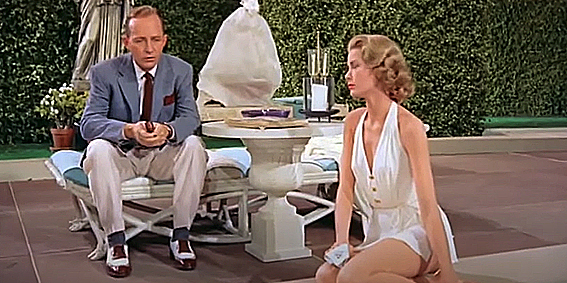
Crosby, 5′ 7″ & Kelly, 5′ 7″
Having an older male starring a younger female seems to remain every Hollywood producer’s dream pairing. And Crosby certainly isn’t immune to the fantasy. Crosby was 53 years old at the time, Kelly was 27. Helen Rose’s costumes achieve their aim of making Kelly look divine.
Though the use of studio sets, projected backdrops and second unit location work with extras driving cars pretending to be the leads now look decidedly false, they were common practice and would have been accepted by audiences at the time.
Lacks the scale of non-MGM musicals which shortly followed, such as 1961’s West Side Story, or 1965’s The Sound of Music, which addressed the themes of social conflict and Nazism head on. Compared to those behemoths High Society is a frothy endeavour, with even Julie Andrews’ movie featuring a singing nun-turned-nanny who marries her rich boss, seem hard hitting.
The golden age of MGM musicals kicked off with Fred Astaire and Judy Garland in 1948’s Easter Parade, includes 1949’s On The Town, and you can argue amongst yourselves whether 1954’s An American in Paris is ‘better’ than 1952’s Singin’ In The Rain. I love both but always favour the latter for a rewatch as its joyous frivolity makes for the easiest of watches.
High Society saw the MGM studio declining as a creative force. It’s principal stars were ageing – by Hollywood standards – and cinema was threatened by the usual suspects such as the growth of TV, changing demographics and tastes, and the social creation of the teenage generation. But for a run of flamboyant escapist entertainment, the MGM golden age is hard to match.
MGM released ten musicals in 1948, then nine in 1951, and ten more in 1953. It released eight musicals in 1955, before High Society became one of four films released in 1956. There were five the following year, only one in 1960, none in 1961, and only five in total in the 1960s. There was one original musical in the 1970, and the anthology That’s Entertainment!, a showcase of MGM’s greatest hits and a great introduction to their musicals. Two more anthologies followed, though they were seen primarily a way of generating cash in the pre-home video era for MGM’s new owners.
Of two hundred MGM musicals listed on IMDB.com, High Society is number 177 by release date. The only ones of note which follow it are 1957’s Silk Stockings featuring Cyd Charisse, and 1958’s wildly problematical Gigi.
From the sense of other worldliness, images of ruined houses and the backdrop of fin de siècle, the ghosts of F. Scott Fitzgerald’s 1925 Jazz-age novel The Great Gatsby, are inescapable. The book was enjoying a renewed interest and re-evaluation and its influence is clear. It can be seen in Crosby’s character throwing not only an extravagant party in his house but an entire festival, one clearly designed to attract the attention of his beautiful soon-to-be-married-to-someone else next door neighbour. And he pointedly describes himself as inheriting the wealth of his bootlegger father, the same means by which Gatsby acquired his fortune.
Tracy holds her hen party in one of the many emptied decaying mansions which line the coast, a situation described in the novel, and it’s possible to imagine long after the credits roll, that the characters and otherworldly kingdom the movie conjures up continue to exist in their own magical bubble of reality quite separate from our mundane reality.
High Society celebrates its 75 years anniversary this year, and as I’ve yet to watch it on the big screen, maybe I’ll get lucky and it will find itself released back into cinemas to celebrate. What a swell party that would be.
Disney’s latest big budget sci-fi fantasy adventure is a glossy yet muddled adaptation of Eoin Colfer’s 2001 novel, which makes up with some fun action, great design and impressive special effects what it lacks in strong characters or interesting narrative.
Emerald-clad elves and leprechauns add an Irish flavour to this hodgepodge of Harry Potter and junior James Bond, with most of the action taking place in or around a stunning Irish clifftop residence, and the plot concerns the possession of a magic weapon of mass destruction, attempted genocide and missing fathers.
Kenneth Branagh is no slouch to this sort of romp, having previously directed Disney’s live action Cinderella and Marvel’s first Thor movie, and due to the huge amount of voice-over telling us information the brisk running hasn’t time to show us, I suspect Branagh shot a richer, longer and more coherent version than the one we’re presented with.
With eight books in the series this was clearly intended as a franchise starter, but I doubt we’ll see a sequel.
In a fun departure for Geordie stand up-comic Ross Noble, he lends his voice to this cute and amusing Australian animated eco-friendly adventure based on the children’s book series ‘Tales from Sanctuary City’.
He adopts an avuncular and eccentric persona as Yarra, the keeper of the Wishmas Tree, guardian of the true spirit of Wishmas, and manager of the annual tradition of wish making.
Aussie actress Miranda Tapsell voices the possum Kerry, whose impetuous behaviour sees their secluded paradise homeland threatened by snow, ice and the evil forces of extinction, and so forcing herself and Yarra on a perilous quest to save their land.
The animation is more solid than spectacular but they’ve gone bananas on the cheerful colour palette and the story skips along in a well meaning manner and it should keep your little kids entertained.
Though it feels a little weird watching a festive themed film in June, it’s probably a sign we can expect Christmas decorations in the shops any second now.
Harrison Ford takes the lead from a canine co-star in this epic, expensive and determinedly old fashioned family outdoors adventure based on the 1903 novel by Jack London.
Every bit as monumentally craggy as the gorgeously photographed scenery, Ford plays a frontiersman who forms a bond with a dog named Buck, who was stolen from his home in California.
Buck may be a CGI creation but is as full of character, loyalty and bravery as any other big screen dog. Which is more than you say for the characters played by Dan Stevens and Karen Gillan.
Sadly denied cinema distribution by the lockdown, Jacqueline Wilson’s 2012 novel is brought entertainingly to life in this handsome, fresh family fantasy about a group of holidaying kids facing the perils of being granted wishes by a magical creature, voiced by Michael Caine.
Wilson based her book on E. Nesbit’s 1902 classic, Five Children and It, and updated it with a modern setting and contemporary concerns.
Ireland’s gorgeous countryside and beaches stand in for Cornwall and a lively young cast are supported by Russell Brand as a local eccentric and singer Cheryl Tweedy as a pop impresario.
This brightly wrapped Christmas present from the Dreamworks Studio is a fast moving, heart warming CGI animated adventure story with some very familiar voices behind the mythical characters.
Jack Frost is a carefree flying spirit who spends his days using ice and snow to cause mischievous mirth among children, whose life of puckish fun is abruptly ended when he’s recruited by the Guardians.
They’re a band of fairytale figures led by Santa Claus, and include the Easter Bunny and the Toothfairy, who tneed him, to help them stop the Boogeyman giving all the world’s children nightmares. Forever.
Chris Pine leads the excellent supporting cast which includes Hugh Jackman, Alec Baldwin and Isla Fisher, while The Boogeymanis played with devilish self-pitying glee by a terrific Jude Law, who’s clearly having a ball.
He dwells in a foreboding tower from where he dispatches terrible black steeds on dark clouds to spread fear among sleeping children.
This is an enjoyable and well crafted magic box of entertainment containing exciting rooftop fights, some hefty slapstick and a hissable baddie, all tied up with ribbons of dazzling animation.
It’s generous in providing the audience with a multitude of small touches such as the Northern Lights being a Bat-Signal for the fairytale heroes, while the yetis and elves of Santa’s grotto who are the unsung heroes of the movie.
Some of the dialogue isn’t as sharp as it could be and the focus of the festive holidaysseems more concerned with receiving than giving, but it all barrels along with warmth, peace and goodwill to all mankind. If you don’t enjoy this you probably don’t like Christmas.
This bare bones animated adventure is a cheap-looking knock-off of the first The Secret Life of Pets caper, and a mongrel mix of slapstick, satire, romance and sports film wrapped in British union flag.
Jack Whitehouse voices a smug, snobby, entitled and unfunny Corgi called Rex, which means it’s an easy payday for the posh comic.
A present from Prince Philip to the Queen, Rex falls from his status as royal favourite, and ends up first in the dog house and then out on the street, from which he tries to return home.
Meanwhile in Buckingham Palace there’s a character called Charlie who’s in dogged pursuit of the position of top dog, and long-suffering Footmen are peed on by pampered pedigree pets, so at least some of the political jokes have a little bite, unlike the toothless nips at Donald Trump.
It’s busy and simple enough to just about pass muster for the most undemanding of little kids.
Laughter fails to light the way in this gentle generational culture clash comedy, a pedestrian piece of parental prejudice which involves illicit cake eating, toilet emergencies and abortive playdates but no surprises and little of interest.
The film shuffles along saddling itself with a message of family tolerance so sickly sentimental it would shame a Disney TV movie from the 1970’s.
Marisa Tomei and Tom Everett Scott are an over-protective couple who reluctantly attempt to leave their children in the care of grandparents, played by Billy Crystal and Bette Midler.
Eternal showbiz troupers that they are, the pair give everything in a desperate attempt to entertain but for all their prickly charm and practiced comic timing, they can’t raise a spark from the dated and toothless script.
The talented cast deserve a great deal better and so do the audience.



 chrishunneysett.uk
You must be logged in to post a comment.