Golden Years

Director: John Miller (2016)

With grand designs on Hollywood, TV presenter and star of DIY SOS Nick Knowles has knocked out this very British comedy.

His workmanlike script is an off the shelf construction of stately homes, incompetent cops, cups of tea and bare arses.

As mild mannered retiree Arthur, Bernard Hill leads a solid cast that includes Una Stubbs, Alun Armstrong, Simon Callow and Virginia McKenna.

They give this gentle crime caper a dash of colour and a veneer of respectability.

Accidentally discovering an aptitude for bank robbery, Arthur plans to save the local bowling club from closure and sets about raising the funds in a Robin Hood stylee.

The story highlights the contemporary issue of OAP’s being fleeced of their pensions by robber banks, and makes a point of the invisibility of the elderly in society.

It bestows vitality on its characters and respect to its audience by wisely saving its mockery for the media attention seeking copper in charge of the robbery investigation.

Brad Moore as Detective Stringer channels his inner David Brent in a perma-tanned performance.

Although it offers mild entertainment and is difficult to object to, it all feels like the movie version of a never seen 1970s TV sitcom.

Breaking the golden rule of cinema finance, Knowles has used his own cash to fund the project.

There’s definitely a screw loose somewhere.

Victoria

Director: Sebastian Schipper (2016)

A schnapps swigging clubber is swept up by criminals in this suffocating German thriller.

Laia Costa gives a virtuosa performance as the vivacious Victoria. Her engaging elfin spirit is the damaged flip side of Audrey Tautou’s ingenue in Amelie (2001).

There’s shades of epics such as Arthur Penn’s Bonnie And Clyde (1967) Michael Mann’s Heat (1995) in the story of likeable people doing bad deeds.

Breathtaking artistic and technical ambition surpasses the dexterity of Alejandro Gonzalez Inarritu’s faux single shot Oscar winner Birdman (2014).

Deliriously filmed in a single extended shot, the dizzying camerawork of Sturla Brandth Grovlen sweeps us around the clubs, cafes and corner shops of Berlin in real time.

As the characters dance, run and drive beside us, it creates an emotional connection and makes us complicit in their crimes.

The lighting, performances and dialogue are washed in naturalism, offering the impression of organic relationships and behaviour. Masterful use of music and sound mixing are key to the increasingly fraught and menacing atmosphere.

A chance meeting with four dubious local charmers leads Victoria to an impromptu after hours rooftop birthday party. Conversation is conducted in broken English as they steal, fight, smoke, drink and flirt.

Victoria’s evening becomes something wild when a phone call leads to her involvement in an armed raid.

With drugs, guns, blackmail and bloodshed at every turn, the young girl needs all her wits to survive as poor choices lead to increasingly desperate options and jaw clenching tension.

Frederick Lau, Franz Rogowski, Max Mauff and Burak Yigit offer strong support but it’s Costa who steals our heart and the film.


Spotlight

Director: Tom McCarthy (2016)

Stop the press for this Oscar nominated drama of award winning journalism.

Based on real events, a US newspaper team fight to reveal the industrial scale cover up of child abuse perpetrated by the Catholic Church in Boston.

It’s gripping tale which allows for the redemption of an individual, the validation of journalism and the recovery of civic pride.

So exactly the sort of worthy subject matter which allows Hollywood to feel good about itself and self-righteously pat itself on the back for making.

Consequently it’s garnered 6 Oscar nominations including best picture and director ,as well as for individual nods for performers Ruffalo and Rachel McAdams in the supporting acting categories.

It’s set in the early 2000’s in the basement office of the close knit Spotlight newspaper investigations team of The Boston Globe. The real Spotlight Team earned the 2003 Pulitzer Prize for Public Service.

Michael Keaton is weathered and wary as ‘Robby’ Robinson, veteran leader of the four strong department.

Sporting a supportive if volatile chemistry, they’re played by Mark Ruffalo, Rachel McAdams and Brian d’Arcy James.

They face the double threat of the burgeoning new media world and a new editor, played with softly spoken steel by Liev Schreiber.

Marty requests the team investigate complaints made against the church.

Being from out of town Marty is immediately considered someone not to be trusted. A situation compounded by being Jewish in a Catholic dominated city.

It is strongly in part to this insular attitude which allows members of the Catholic clergy to spend years abusing their flock, and for the hierarchy to systematically cover it up.

The powerful and wealthy institution has long put the fear of god into legal profession, justice system, police and even parts of the press.

We follow the team undertaking journalistic procedure of voluminous research, copious coffee consumption, door knocking, meetings with lawyers, prodigious note taking and telephone calls.

As files of evidence go missing from the courthouse, the team realise they can’t trust their colleagues, the police or the courts.

This is all familiar procedural stuff and it’s the high stakes and charisma of the actors which brings it alive.

We are drawn in by the performances, intrigued by their work and disgusted by the subject matter.

Covering a difficult subject in a dignified and sensitive manner, a strong narrative framework provides essential information in a clear manner.

But the film struggles to open out from a series of meetings into something more grand and cinematic.

More than one scene has the team gather around a telephone speaker to receive vital information from a Deep Throat type whistleblower.

As efficient as Spotlight is, it‘s the grim truth which keeps us watching, not the drama.


Captive

Director: Jerry Jameson (2015)

Based on a true story but failing to hold the attention, this kidnapping drama becomes an empowering experience for at least one of those involved.

With a shaved head and a pec-tastic physique, lauded British actor David Oyelowo stars as paranoid psychopath Brian Nichols.

He also produces and gives his wife a small role, so he must shoulder some of the blame for this uninspiring turgid mess.

After shooting his way out of a courthouse, Brian breaks into a random house to use a hide out.

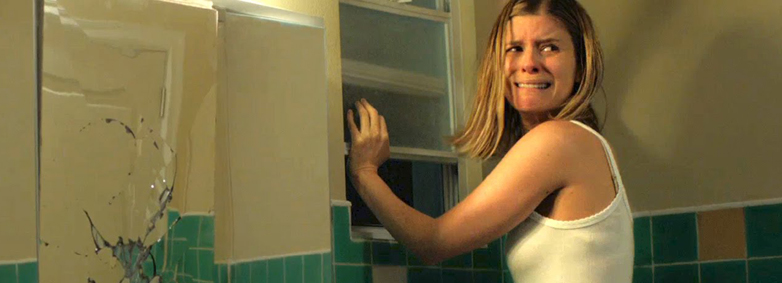
This is bad news for Kate Mara playing home alone meth addict Ashley.

She’s desperate to be at a fashion show in the morning.

After years of addiction it’s her last chance to prove she’s capable of looking after her child. If she fails to turn up, her cute as a button infant daughter won’t be allowed home.

In this high stress situation she goes cold turkey. It’s her story and she’s sticking to it.

She reads self-help manuals and makes pancakes while he waffles to himself and watches TV.

Feeling like an advertorial for said self-help book, it features an appearance by the TV queen of over-empathy, Oprah Winfrey.

Michael K. Williams is in charge of SWAT teams as the none too sharp and distractingly named Detective Chestnut.

Move along, there’s nothing to see here.

Precinct Seven Five

Director: Tiller Russell (2015)

This funny, violent and arresting tale about corrupt cops in New York is the Goodfellas of police documentaries.

It follows the rise and fall of disgraced former cop Michael Dowd.

He talks, dresses and looks like one the wiseguys in director Martin Scorsese’s mob masterpiece. He even looks like Tony Darrow the actor who played Sonny Bunz, the owner of the ill-fated Bamboo Lounge. The actor was later charged with extortion.

In the early 1980’s, the 75th precinct was the most dangerous in the city, suffering 1000’s of shootings and 100’s of homicides a year. It’s described as ‘the land of f***’ by the officers’ who have to patrol it.

In extensive interviews Dowd admits to extortion, drug dealing, drug use, theft and estimates he has committed thousands of crimes as an officer.

There were bundles of cash and barrels of drugs alongside the kidnappings and murders.

Dowd claims he was taught to bend the rules in the Academy before he even graduated to the streets.

It was there he was taught the code of Omerta (silence) and a sense of brotherhood  – which Dowd exploited to make breaking the law easier.

Poor levels of police pay and the daily grind contribute to corruption. As the criminals are so much more wealthy, crime is seen to pay.

A handsome and charismatic Domenican drug dealer called Diaz cheerfully provides a criminal insight. Dowd admits to providing a police escort for him.

With it’s use of freeze frames, fast cuts and rock soundtrack, there is a similar energy to Scorsese’s finest work.

Among the talking heads, court footage, crime scene reconstructions and some terrific contemporary footage, maps detail exactly where crimes were taking place, anchoring Dowd’s storytelling in reality.

Dowd never believed he would be caught, but ruefully acknowledges his attitude may have been a consequence of the copious amount of cocaine he was consuming.