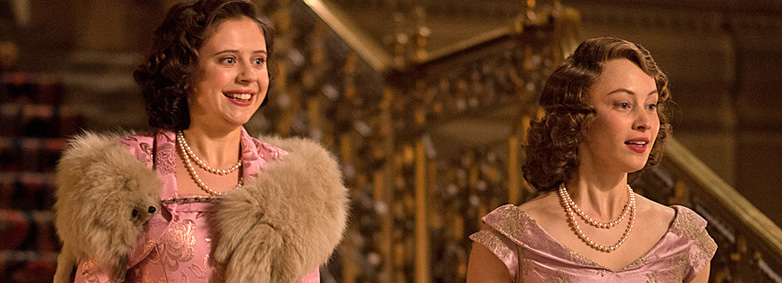
A Royal Night Out

Director: Julian Jarrold (2015)

A pair of incognito princesses roll out the barrel and celebrate VE Day among their unsuspecting subjects in this entertainingly light-hearted fictional romp.

It’s the evening of 8th May 1945 and the UK is having a right royal knees up. Heir to the throne Princess Elizabeth (Sarah Gadon) and younger sister Margaret (Bel Powley) are determined to join in the fun they can see from their palace window.

Their plan is drop in on the festivities in Trafalgar Square and head on to The Curzon Club before an crashing all night party at Chelsea barracks.

Margaret is the more wayward, wilful and ditzy of the two and happy to lead Elizabeth astray. In a switch from real-life, Margaret is presented as the more dowdy when compared to the raging beauty of Elizabeth.

It’s a lovely and lively comic performance by Powley who gives it plenty of royal welly. Gadon is ravishingly bewildered as her big sister.

There’s more than a hint of Cinderella and The Prince and the Pauper and it’s played with the infectious feel-good energy and saucy innocence of the original St Trinians movies.

Among much enthusiastic flag waving, fisticuffs and spiked drinks, there’s a pair of engaging central performances, some choice period dialogue, all manner of alarming accents and Glen Miller on the soundtrack.

Julian Jarrold has form with quality period drama having previously directed Great Expectations (1999) Becoming Jane (2007) Brideshead Revisited (2008). With energy and an eye for detail he convincingly recreates the foggy demob-happy delirium of the sepia-tinged era.

Sipping champagne and slipping their chaperones, the girls head to the teeming Trafalgar Square and adopt the names ‘Lizzie’ and ‘Mags’  – perhaps not travelling as incognito as they imagine.

Soon separated by the throng of celebrants, Lizzie must locate Mags and return her to the palace before midnight and the king realises they are missing.

The stammering King George VI is played by Rupert Everett haunted at every turn by Colin Firth‘s Oscar-winning role as the same character in The King’s Speech (2010). Everett also appeared in the successful if lacklustre St Trinians remakes.

His screen wife Queen Elizabeth the Queen mother is played by Emily Watson.

Unsure of her way around and naturally not carrying any cash, Lizzie falls in with a hunky working class airman called Jack (Jack Reynor).

She coyly persuades him to help her in her mission and he reluctantly agrees – even though her cloistered worldview keeps landing her republican-leaning would-be saviour in trouble.

Among the characters they encounter in the gambling dens and knocking shops of Soho are royalist gangsters, Scottish henchmen and warm-hearted whores. The British officers are weak-chinned, drunk, philandering incompetents – which seems fair enough.

If I ever thought the royals were this much fun in real life I’d almost consider voting for them.

Clouds Of Sils Maria

Director: Olivier Assayas (2015)

Three fine talents are wasted in this indulgent and exasperating mediation on age, acting and art.

Actress Maria Enders (Juliette Binoche) appeared in the play Maloja Snake, kickstarting her career and making her famous. From the dialogue we hear the play sounds unbearable.

Maria’s role was a young intern called Sigrid who is involved in an exploitative relationship with her boss Helena. Now years later, Maria is invited to take part in a new production but this time taking the part of Helena.

Her personal assistant Valentine (Kristen Stewart) acts as a driver, confident and drinking buddy who helps Maria prepare for the role.

Pitched to be the new Sigrid is Jo-Ann Ellis (Chloe Grace Moretz), a gun-toting, rehabbing, paparazzi-magnet who is an amalgam of the worst headlines of Lindsay Lohan and Britney Spears. She brings much needed spite and bile to the self-satisfied proceedings.

Maria is an irritating combination of affectations; a needy, attention-seeking, pill-popping alcoholic who flirts with anyone offering work. Everyone is duplicitous and solicitous and every expression of feeling is a calculation.

This may an accurate reflection of the life of an actress but it’s far from an original one and gives us little reason to warm to Maria. Susan Sarandon sent up the self-obsessive nature of actors far more entertainingly as a guest star in TV’s Friends.

When the directionally-challenged Maria and Valentine struggle up a mountain brandishing a map, it’s impossible not to be reminded of the similarly themed and equally dull and indulgent Maps To The Stars (2014).

There are frequent mountain walks, a little drunk-driving, some skinny dipping, endless rehearsals and too many discussions of age changing perspective. It’s high-handedly critical of celebrity culture, the internet and Hollywood films.

Riffing on the film’s exploration of age-defined femininity, Binoche embraces nudity and Stewart doesn’t.

This is a theatre acting class masquerading as cinema but I’m not sure I’m sufficiently communicating the extreme turpitude of the viewing experience.

The Swiss scenery is beautiful and shot with crisp veneration by cinematographer Yorick Le Saux.

The Clouds Of Sils Maria is an example of aiming to make art and failing to create anything as humble as an entertainment.

Lambert And Stamp

Director: James D. Cooper (2015)

This knockabout documentary promises to be a profile of maverick mis-matched music managers but is really a potted history of the rock band The Who.

In 1961 two assistant directors at Shepperton studios bonded over a love of French films and a desire to direct their own films.

Confident Kit Lambert was a multi-lingual, Oxford-educated, former public school boy while Chris Stamp was the working class son of tug boat pilot. He’s also the younger brother of the actor Terence – who makes a brief appearance.

They hatched a plan to find a band, promote them by making a film about them and to use that film to secure a directors deal.

The High Numbers were discovered in a bar and quickly re-named The Who. The two surviving members Roger Daltrey and Pete Townshend are given a tremendous amount of screen-time to mostly contribute waffle.

It’s suggested the anger of their guitar-smashing stage performances was as an artistic representation of their experience as war babies – but this intriguing explanation passes uncommented on and unchallenged.

An unusual creative synergy between band and management obscured how successfully a manipulator Lambert was. Recognising a songwriting talent in Townshend, he nurtured the musician and treated him more favourably than the others.

There’s tantalising glimpses of roguish behaviour such as selling vinyl records on the black market to Russia from a Viennese palazzo. But the script is light on financial detail – or any detail at all and it’s too in thrall to its subject matter to achieve much objectivity.

Too many irrelevant characters appear such as ‘Irish Jack’. Plus there are many stretches where it resembles the most unquestioning of nostalgia segments on BBC’s Football Focus where former players offer rambling anecdotes and decades old banter.

There’s lots of great music but no dissenting voices; no tales of debauchery and a general lack of scurrilous muck-raking. There is an absence of outraged former colleagues, spurned former girlfriends, alimony-demanding ex-wives or such.

It ends with an acrimonious split between all parties fuelled by creative tension, heroin addiction and death.

Like the Who’s albums, there are loud, electric moments but it lacks focus and is far too long.

The Age Of Adaline

Director: Lee Toland Krieger (2015)

A woman who never grows old falls for a much younger man in this weird fantasy romance.

Adaline Bowman (Blake Lively) lives alone, is kind to her dog, speaks in a breathy register and laughs at her own jokes.

Although really 107 years old, a mysterious event when she was 29 has prevented her from ageing.

Ever since the FBI tried to arrest her for being a suspected threat to the US, she’s been dodging the authorities and running away from love and commitment.

She changes addresses and identities every ten years, allowing the Costume and Make-up deptartments (Angus Strathie, Monica Huppert) to make Lively look lovely in all the major fashions of the twentieth century.

Plus it usefully acts as a visual shorthand for whatever decade we find ourselves in during one of the many flashbacks.

Her only friend is piano player Regan (Lynda Boyd) which suggests Adaline has been seeking out blind people to hang with as they don’t recognise her lack of ageing.

At a New Year’s Eve party she meets the hunky, needy, pushy yet altruistic internet millionaire Ellis (Michiel Huisman).

He’s not as endearing as the film imagines him to be and Adaline tries to reject his advances due to their secret age difference.

There are several dates, shooting stars, snow storms, two car accidents and a drive-in movie.

Despite Adaline’s reservations she agrees to visit Ellis’s parents where someone kindly explains the rules of Trivial Pursuit for those watching who haven’t played it.

It leads to a big surprise for his dad Bill (Harrison Ford) on the eve of his fortieth wedding anniversary to Kathy (Kathy Baker).

Ford seems energised for the first time in years and is allowed a door-smashing moment. Perhaps being back home on the Falcon is therapeutic.

However it’s at this point the heavy air of sentimental nostalgia curdles and becomes creepily uncomfortable.

A gravelly voice over by Hugh Ross offers the only grit available as well as the illusion of a patina of science.

San Francisco looks fabulous and the true romance on show is between the city and cinematographer David Lanzenberg.

Scriptwriters J. Mills Goodloe and Salvador Paskowitz are also enamoured of the city, highlighting it’s history as a leader of technological innovation.

Somebody ought to point out to the writers gifting first editions of famous novels only counts as romantic if there is a financial, emotional or other cost to the donor.

A millionaire dishing out rare works to relative strangers they wish to bed smacks not of romance but thoughtless opportunism.

The Age Of Adaline suggests grey hair and wrinkles are the gateway to true love; a sly commentary on women who can’t accept growing old and resort to going under the knife.

But if you want to send this sort of message then it’s important to create an effective and engaging delivery system first.

Big Game

Director: Jalmari Helander (2015)

A President, terrorists and wild bears are the targets in this goofy action adventure romp which provides a forest full of explosive entertainment.

The son of a famous hunter, 13 year old Oskari (Onni Tommila) is sent into the remote mountains of his native Finland.

Armed only with a sharp knife and a bow and arrow he can barely control, the determined teen must spend a day and night hunting wild bear in a traditional coming of age ceremony. Guns are not allowed.

Meanwhile high above, Air Force One ferries the unnamed US President (Samuel L. Jackson) to a G8 summit in Helsinki. The plane is shot down by terrorist Hazar (Mehmet Kurtulus).

He’s the psychotic son of a Sheik who’s so enjoyably evil he shoots a man in the back with a surface-to-air-missile, and then is rude about the quality of the Chinese made weapons.

Ejected to ground in an escape pod, the barefoot and hapless President is found by a startled Oskari.

However the boy has commendably little respect for the authority of the Oval Office. Even with Hazar in pursuit, Oskari will only take the President to safety after his bear hunt is successfully completed.

Another survivor loose in the wood is the girdle-wearing, pill popping Chief-of-security Morris (Ray Stevenson). He once took a bullet for the President.

Meanwhile back in the Pentagon‘s command bunker, a tank-top wearing, sandwich eating analyst called Herbert (Jim Broadbent) is offering advice to the Vice President (Victor Garber) and General Underwood (Ted Levine).

They’re rapidly falling to pieces quickly at the situation, having definitely picked the wrong day to quit smoking, drinking etc.

Arching an eyebrow alongside the men is the token woman with a speaking role; the CIA Director (Felicity Huffman).

As the script builds betrayal upon betrayal, the most well-intentioned is the most affecting.

Among the the sky-diving, missile attacks and shoot-outs, the special effects aren’t terribly special –  and some of the outdoor locations look suspiciously indoor.

At every possible interlude rousing blasts of orchestral music are accompanied by sweeping helicopter shots of the glorious mountains.

The director coaxes a guileless performance from the young Finnish lead actor and Jackson enjoys himself playing against type as a man definitely not in control of events. Kurtuluş has fun channeling Hans Gruber (Alan Rickman) from Die Hard (1988).

With it’s young hero suffering daddy issues and familiar visual gags and stunts, it’s easy to recognise inspiration drawn from the ’80’s work of Steven Spielberg; specifically E.T. and The Temple Of Doom – but the tone is closer to that of Richard Donner’s The Goonies (1985). (Story and Executive produced by S. Spielberg)

However exciting and fun as it all is, the message one is not a man until you’ve killed something is far from typically Spielberg.

Phoenix

Director: Christian Petzold (2015)

Greed, betrayal and revenge are surgically spliced in this intriguing post-war thriller.

Holocaust survivor Nelly (Nina Hoss) is a former singer rescued from the ‘camps in the East’ and brought to a private asylum to recuperate.

With doctor’s using techniques still in their infancy, Nelly undergoes plastic surgery to rebuild her shattered face.

The motives of her friend and saviour Lene (Nina Kunzendorf) are ambiguous. She is evangelical about escorting Nelly to Palestine and using Nelly’s wealth to help establish a homeland for the Jewish diaspora.

Also her physical intimacy suggests a more emotional, less platonic reason for keeping close to Nelly.

Rejecting Lene’s plans for the future, Nelly haunts the bombed out buildings of Berlin looking for her husband Johnny (Ronald Zehrfeld) – who may have betrayed her to the Nazi’s.

She’s finds ‘Johannes’ working in The Phoenix cabaret club. He doesn’t recognise her but thinks with a make-over and coaching she could pass as his late wife, enabling him to collect her inheritance.

With brisk deliberation the script questions the truth of relationships and raises issues of identity and trust. With Nelly’s memories as fragile as her skin grafts, everyone’s motivation is suspect.

The involving finale gathers close friends together and the casual way they’re introduced to us suggests entire scenes were trimmed in the edit – but not at the expense of the measured tone, subtle performances and claustrophobic, nightmarish atmosphere.

Girlhood

Director: Celine Sciamma (2015)

Teenage tribulations are a trial in this un-involving French drama.

When Marieme (Karidja Toure) fails her final year at school, she rejects the offer of vocational courses.

Instead she embraces the limits of her horizons and joins the local girl gang. The glamorous Lady (Assa Sylla) is the leader of Adiatou and Fily (Lindsay Karamoh, Marietou Toure) and Marieme brings their number up to the seemingly requisite four.

Together they’re loud, aggressive, popular with the opposite sex but content to accept their circumstances.

Even my pidgin French understands the French title ‘Bande de Filles’ doesn’t translate as Girlhood, but ‘gang of girls’ or less literally ‘girl hood(ies), so it’s safe to assume the title was created to catch the coat-tails of residual goodwill from last year’s brilliant coming of age drama Boyhood.

Marieme – re-named Vic, for victory – is soon sporting the obligatory black leather jacket and straightened hair. Then she’s off out smoking, drinking and robbing along with the others. Her character development is traced though her changing haircuts.

Cinematographer Crystel Fournier has nice eye for colour and texture but the plot is weak and the girls are dull. We’re asked to sympathise with them but they’re impressive only in their ordinariness.

Their behaviour may be typical but it’s not pleasant – especially the way work-shy Vic amuses herself by bullying shop girls and organising fights against other gangs.

Eventually she takes the only job she’s prepared to do – working as a drugs mule for the local dealer Abou (Djibril Gueye) but even this potentially interesting development fizzles out.

Girlhood is being lauded for being an unpatronising portrait of black female French teenagers rather than the refined middle class types we’re more frequently presented with.

Unfortunately the story lacks insight; presenting the girls as real people is not the same as showing them in an interesting light.

The girls’ give nicely natural performances but like the gang, the film needs a stronger sense of urgency instead of ambling along without direction and achieving little.

Anti-social

Director: Reg Traviss (2015)

Illegal street art and armed robbery collide with no great interest in this poorly executed London thriller.

Just as the talent of a graffiti artist offers an escape from his sink-estate upbringing, his hard fought-for future is threatened when he’s dragged into brother’s criminal world.

Believing in the script far more than I did, the earnest cast give their all in this functional collection of uninspired confrontations, punctuated by woeful dialogue.

It has no views on contemporary Britain other than a concrete belief in the integrity of the street and keeping it real.

Neither slick and flash or gritty and hard-edged, it’s edited with energy but not enough control – too many scenes are padded out for no particular reason.

Meanwhile it’s shot through with whip-pans, fast-cuts and lots of shaky-cam – with the occasional slow-motion dropped in.

The soundtrack is loud, busy and contemporary, adding to the overall sense creative decisions were made on the basis of being cool – instead of serving the story.

Skilled and daring artist Dee (Gregg Sulkin) is on the cusp of international fame. He has a model girlfriend, a part-time job as courier and spends his evenings being chased by the police for defacing property with spray cans.

Meanwhile his step-brother Marcus (Josh Myers) is out robbing diamonds with his gang of axe wielding super-bike riders. Myers has a rough-edged lairy charm and a suitably imposing physique but is given the very worst of the dialogue.

They have a likeable chemistry; part brother, part father/son relationship.

When Marcus invests his big score in a drugs deal, he falls foul of the violent West Grove crew leaving him in debt to a feared firm and the target of hit-men. There’s also a police grass at large on the estate.

Dee is called on to help out among the welter of drugs, sex, shoot-outs, rapes and beatings, putting pressure on his fledgling career and on his relationship with girlfriend Kirsten (Meghan Markle).

His mother Nadine (Maria Fernadez Ache) is Spanish and spends her time stoned in her flat and is one of the many weakly written woman who suffer abuse in a variety of ways and are forgotten about by the end.

The unfortunate molls Emma and Tara (Sasha Frost and Sophie Colquhoun) take the worst of it. Only Rochelle (Caroline Ford) serves the story in any way and even her plot arc is left dangling as loose as her over-sized ear-rings.

Though more than one person dies, no-one learns anything or develops as a character. There may be a decent idea buried underneath the geezer posturing and street language the film-makers are overly-enamoured of, but it’s not worth persevering with to unearth it.

We Are Monster

Director: Anthony Petrou (2015)

Based on a true crime, this slow-burning psychological drama explores the build-up to a brutal prison murder.

Due to failings in a famously not-fit-for-purpose criminal justice system, petty thief Zahid Mubarek (Aymen Hamdouchi) is forced to share a cell in Feltham Young Offenders Institute with known violent racist Robert Stewart (Leeshon Alexander).

As the system sleepwalks a tragedy unfolds with horrific consequences; the result of missing personal files, reports un-actioned and pleas to be rehoused in a different cell ignored.

A weak mental state is exacerbated through the indifference of officers charged with the welfare of inmates.

Isolation breeds Stewart’s paranoia, fear and anger at the perceived injustices of his circumstances.

He is increasingly lost in a world of literal and metaphorical shadows as his psychological dark side envelopes him.

There’s domestic violence, self-harm, bullying and strong language.

This is a confidently hypnotic film with strong cinematography by Simon Richards who delivers excellently framed shot composition and masterful control of light.

Fred Portelli provides the music and helps create a bewildering soundscape of unsettling noises that help create an atmosphere of alienation.

By offering a sympathetic light on the troubled personal history of Stewart, the horror of what happens to his cellmate Mubarek is undermined, making him a minor character in his own murder.

Samba

Director: Olivier Nakache & Eric Toledano (2015)

This inter-racial romance among immigrants in Paris breaks hearts and cultural barriers with an abundance of humanity and humour.

Working-class Senegalese trainee chef Samba Cisse (Omar Sy) has lived illegally for ten years in Paris. He is arrested at work and placed in a detainment centre next to the airport.

Highly-strung case-worker Alice (Charlotte Gainsberg) helps him with his court case. They are both passionate and give good anger. She’s warned by the younger, sexier, more cynical Manu (Izia Higelin) not to become involved with her clients.

Released and required to leave France but under no pressure to do so, Samba returns to work in a succession of unskilled, casual, cash in hand jobs in security, construction, window cleaning and so on. They all posses an element of danger.

Samba is accompanied by his effervescent Brazilian friend Wilson (Tahar Rahim) and they make a likeable double-act, helping and protecting one another from criminals and the police.

As the tentative relationship between Samba and Alice develops, they have a beneficial effect on the other’s personalities – but Samba’s all too human needs and weaknesses return to threaten his potential happiness and fragile stability.

The ambitious opening scene is a lengthy shot beginning in a lively, wealthy wedding reception. We follow a fabulous wedding cake as it’s transported off the dance floor through the hotel corridors and into the depths of the kitchen where the camera stops and lingers on the men washing dishes.

It is no coincidence these are the first black faces we see and in one wordless, dynamic shot, the film’s occupations with identity, status and employment are established. The shot has echoes of both the opening of The Great Beauty (2014) and the Copacabana scene form Goodfellas (1990).

There is also a virtuoso and vertiginous shot looking down an office block which was sufficiently well constructed to make me dizzy.

Stephane Fontaine’s cinematography avoids making Paris a chocolate box of delight but is presented as a busy, complex, working city. In this film of contrasts, light and colour are used to differentiate between calm and chaos, wealth and poverty.

The music is sparse but used to terrific effect. We hear a confusion of languages which helps the exploration of identity; how it is defined for us but also how we can choose to define ourselves.

An intelligent script takes great delight in pointing out the absurdities and failings of the bureaucratic immigration system, not least in making the observation people are seeking asylum from places the French middle-class go on holiday.

Alice and Samba are hard-working, charming and flawed. In a cafe they’re filmed in shallow focus to block out the world around them, encouraging us to concentrate on their beautiful faces.

They enjoy each other’s company and we enjoy being with them. They’ll always have Paris.