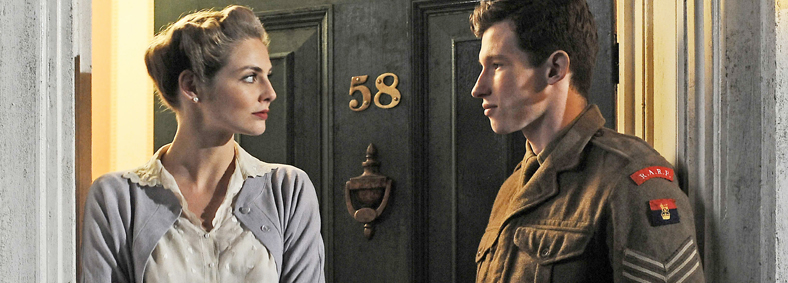
Queen and Country

Director: John Boorman (2015)

A young conscript fights emotional battles on the home front in this stately coming-of-age post-war drama.

Based on the experiences of writer/director John Boorman, it’s a sequel to his well-received Hope and Glory (1987).

It’s handsome but unsteady in tone, lurching between army larks, misfiring satire, languid romance and dull family drama.

In 1952 the idyllic life of Boorman’s daydreaming alter ego Bill (Callum Turner) is interrupted by his conscription into the British army.

The script is keen to highlight the absurd rigours and regulations of army life, a closeted world of petty point-scoring, arbitrary discipline, paranoia and stupidity.

There’s a healthy contempt for superior officers, embodied by the brandy drinking and desk bound Major Cross (Richard E. Grant).

They are far more concerned with a missing clock from the mess than adequately preparing the troops to fight in Korea. A campaign of which the film is deeply cynical.

Alongside fellow conscript Percy (Caleb Landry Jones) Bill is quickly promoted to sergeant. Percy clearly has issues and veers alarmingly from charming lad about town to angry, officer-baiting seditionary.

They fall in with Irish skivver Redmond (Pat Shortt) and fall foul of Regimental Sergeant Major Digby (Brían F. O’Byrne) and stiff-backed stickler Bradley (David Thewlis).

We’re told Digby is an horrific bully but apart from one brief wrestling exercise and a lot of bigoted shouting, we’re forced to take the boys’ word for it.

Telling not showing is a mistake in any film and not one we’d expect from as experienced a director as Boorman.

An odour of locker-room homo-eroticism drifts through the barracks in several semi-clad fights and there is frequent questioning of heterosexuality.

It becomes more prevalent when a trooper is charged with ‘seduction of a soldier from the course of his duty’.

However once outside the barracks Percy is chasing a pretty nurse called Sophie (Aimee-Ffion Edwards).

Meanwhile Bill is entranced by an elegant, unobtainable blonde. Without embarrassment he nicknames her Ophelia (Tamsin Egerton) after the tragic figure in Shakespeare’s Hamlet.

The return from Canada of Bill’s sister Dawn (Vanessa Kirby) complicates his life, not least due to her racy personal history and seemingly incestuous leanings.

Despite the female performers gamely following the director’s lead, none of their characters convince as people. Each is more of a projection of a teenage boy’s idea of womanhood.

Maybe that’s the point but it’s far from clear. Maybe Boorman finds it difficult to write female characters.

The script is sympathetic to those suffering the effects of war but the issue of post-traumatic stress – which is taken very seriously – sits uneasily with the humorous elements such as the choreography of a typing room.

Bill is not a particularly engaging chap and the exception of Ophelia aside, not much of a participant in his own life. Though events happen to him, he isn’t much affected.

With no-where else to fall, our sympathies land upon Bradley. Thewlis chalks up another excellent performance and not for the first time he’s the best thing in somebody else’s movie.

Sets and wardrobe perform a first rate job of convincing us of the era. Seamus Deasy’s graceful and seductive cinematography captures the period with a palette of greens and browns with a tender regard.

The coronation of Queen Elizabeth II is watched on a new-fangled TV set. It signals a changing of the generational guard and the ushering in a less deferential, media-led age.

But the friction of small class distinctions generates little dramatic heat while the inter-generational conflict passes with barely a ripple of interest.


Survivor

Director: James McTeigue (2015)

This tedious terrorist thriller is a po-faced celebration of the secret security services trying to masquerade as entertainment.

It has unintentionally ridiculous dialogue, enormous plot-holes, little tension and no humour.

Kate Abbott (Milla Jovovich) is the new security chief of the American Embassy in London. She’s in charge of the young team who process visa applications to the US.

She spends a huge amount of time running down corridors and may be having a relationship with her boss Sam (Dylan McDermott).

Following a bomb attack on a restaurant, Abbott follows Embassy safety protocol and immediately goes to a pub toilet to check on her hair. Not being British she doesn’t even stop for a drink.

Abbott realises being the only survivor of the blast makes her a suspect.

When a colleague is murdered Abbott goes to the top of the most wanted list and even her own Ambassador (Angela Bassett) wants her taken out.

No-one in the myriad intelligence services thinks to stake out Abbott’s flash apartment.

As Abbott’s colleague Sally, actress Frances de la Tour does well not to look embarrassed at events. James D’Arcy plays Police Inspector Paul Anderson, a stiff-assed Brit.

The film emphasises the extensive use of CCTV in the the UK’s capital but doesn’t pursue the idea.

Meanwhile an even bigger atrocity being planned by a munitions expert known as ‘The Watchmaker’ (Pierce Brosnan).

He is steely-eyed, silver haired and occasionally sports a moustache. Playing a terrorist at large in London recalls Brosnan’s brief role in The Long Good Friday (1980), back when the Irishman appeared in great films.

Danny Ruhlmann’s cinematography casts rich shadows and is the best feature of the movie. It creates a suitably menacing environment not matched by the plotting, pace or performances.

As Survivor is set in December – there are Christmas trees and everything – the decision by the distribution company to release it in June suggests a fear of finding an audience for it.

Electric Boogaloo: The Wild, Untold Story of Cannon Films

Director: Mark Hartley (2015)

This lively documentary is a joyous journey through the trashy works of two manipulative and mould-breaking mavericks of movie-making.

Oft-maligned and not much missed by cinema audiences anywhere, Israeli cousins Menahem Golan and Yoram Globus became a bye-word for B movie mediocrity.

With juvenile zeal they delighted in producing popcorn fodder with adult content, churning out low budget, soft-porn horror flicks typified by terrible dialogue, cheap special effects and exploitative subject matter.

Despite seemingly blinkered to the slapdash and slipshod nature of their films, they craved artistic recognition.

High-school comedy Lemon Popsicle (1978) was their first big hit and paved their way to Hollywood in 1980 where they bought the struggling Cannon Films studio.

Consummate deal-makers, they invented the concept of selling distribution rights to fund the film they were selling – before the film was made. It’s now a common practice but innovative at the time.

They would make a poster, sell the idea on the global film circuit and then go away to make the movie while inventing the film’s story on the hoof.

They were never short of ideas: Ninja 3: The Domination (1984) was a conceived as a mash-up of Flash Dance (1983) and The Exorcist (1973) – with added ninjas.

The Ninja trilogy (1981-84) were mammoth hits and hugely profitable due to their low cost base.

Whereas Sahara (1983) starring Brooke Shields was intended as a combination of The Blue Lagoon (1980), Lawrence of Arabia (1962) and The Great Race (1965).

It was significantly more expensive to produce, failed to find an audience and produced large losses.

Their production methods ensured a fast turn-around from idea to screen. This allowed them to take news stories such as the nascent hip-hop street dance scene and the 1985 TWA hijacking into Breakdance (1984) and The Delta Force (1986).

Their ambition to be major players lead to a deal with the mighty MGM, but the venerable studio were constantly disappointed with the quality of the the product Cannon provided for distribution.

Quality for Cannon was always optional – except where their bare-breasted leading ladies were concerned, as anyone who has seen Bolero (1984) and Lifeforce (1985) can attest.

Their restless and unfocused ambition resulted in a massive expansion and rapid collapse – but not before they’d developed the careers of Chuck Norris, Jean Claude Van Damme and Dolph Lundgren.

The latter is merrily self-effacing about his roles in their movies, as are most of the interviewees; Richard Chamberlain, Bo Derek and Elliott Gould included.

There are kind words from the likes of Franco Zeffirelli who directed for Cannon but no-one has a good word for Sharon Stone.

Despite paying Sylvester Stallone double digit millions for the arm-wrestling flop Over The Top (1987), he doesn’t feel compelled to contribute.

There’s lots of nudity but no scandal; only one person is accused of being on drugs and alcohol – which seems a low figure for Hollywood.

Plus there’s a frustrating lack of financial figures and no analysis of how Cannon’s collapse affected the industry.

Electric Boogaloo includes many clips from films not least Death Wish 2 (1982) (plus sequels 3,4 & 5) Superman IV: The Quest For Peace (1987) and Masters of The Universe (1987).

It’s very funny and far more entertaining than watching many of the films in their entirety.

Spy

Director: Paul Feig (2015)

The world of espionage will never be the same after this enjoyable action caper smears poo and puke jokes over the glossy veneer of a James Bond parody.

As one-time 007 star George Lazenby once put it: ‘this never happened to the other fella‘.

Following the hugely successful Kingsman (2015), it’s the second Bond inspired movie of 2015. In October we’ll see Spectre, Daniel Craig’s last roll of the dice as the British spy.

It offers big budget foul-mouthed laughs though the blunt-edged comedy of leading lady Melissa McCarthy are more likely to dislocate your funny bone that tickle it.

It’s the third time after Bridesmaids (2011) and The Heat (2013) she’s teamed with writer/director Paul Feig but this time the result is less successful.

A nuclear bomb in a suitcase is being touted around the bad guys of Europe.

With key agents incapacitated the CIA are forced to send clumsy back-room computer operative Susan Cooper (McCarthy) undercover.

She is so unsuited to fieldwork she faints at the sight of blood and must fight not only heavily-armed bad guys – but her own inexperience and insecurity.

Decorated with the typical Bond furniture of casinos, helicopters, fast cars and gadgets, the plot moves briskly through the familiar locations of Paris, Rome and Budapest.

As Theodore Shapiro’s music reaches a satisfactory Bond-esque pitch, the action is technically well executed.

However it’s handled leniently by the editor; one explosion is seen from at least seven different camera angles.

If this is intended to be exaggeration for comic effect such as mastered by Paul Verhoeven in Robocop (1987) and John Landis in The Blues Brothers (1980), it’s insufficiently developed.

More likely it’s aping the current trend in editing for repeating the same shot from different angles to exploit the budget for maximum onscreen effect.

Either way it slows the pace and contributes to the generous running time. This lack of ruthlessness in the edit is a big problem and Spy keeps repeating it.

The unnecessary appearance of rapper 50 Cent is another example, as is the weary repetition of an excellent joke about the consequences of having an Operations room in a basement.

There’s a great knife in a kitchen with glamorous assassin Lia (Nargis Fakhri) where comedy and action combine instead of competing – the film would be much improved with more scenes like it.

Jude Law’s champagne swilling tuxedo’d super-spy Bradley Fine offers a glimpse of a James Bond we’ll never have.

The British star is happy to send himself up as the vainest man on the planet but labours under an American accent and a script offering him few decent lines.

Fortunately Jason Statham and Peter Serafinowicz abseil in with expertly calibrated comic performances and rescue the Americans from a mire of directorial appeasement.

Their deranged performances steal their every scene. Rick Ford (Statham) is a barking mad rogue agent while Aldo (Serafinowicz) is an undercover Italian operative with unsuppressed passions.

It’s fair enough the men are vain idiots and the women do the actual work – but Spy seems overly-pleased with itself for this reversal and the result is more indulgence.

Miranda Hart riffs on her TV persona as Cooper’s dowdy sex-starved colleague Nancy B. Artingstall. She’s a not-so best friend who’s happy to embarrass Cooper in front of glamorous agent Karen Walker (Morena Baccarin in not much more than a cameo).

As criminal mastermind Rayna Boynaov, Aussie actress Rose Byrne dresses up in a cut-glass accent and trashy outfits and commendably commits herself to ridicule in a broad performance.

McCarthy’s a fine and engaging actress who capably charts the journey from put upon underling to confident ass-kicker. But her ad libbing is rarely as funny as the film thinks it is.

A running joke sees McCarthy in a variety of terrible outfits and looking at one point not unlike Dawn French in the Vicar Of Dibley. One or two inspired lines aside, she’s also about as funny.

Danny Collins

Director: Dan Fogelman (2015)

Al Pacino goes full showbiz as a jaded rock star seeking redemption in this entertaining comedy drama.

It’s vaguely based on the true story of folk singer Steve Tilston who belatedly received a letter from John Lennon long after the Beatle’s death.

Although unforgivably sentimental fluff, it’s saved by the talent and charm of its cast.

Plus the soundtrack of John Lennon’s greatest hits doesn’t hurt.

Danny Collins (Pacino) lives in a world of private jets, fast cars, mansions and age-inappropriate women.

In a girdle, fake tan and stack heels he looks alarmingly like TV’s David Dickinson on dress down Friday.

But Danny is weary from playing his greatest hits to his ageing fan-base.

His insufferably catchy pop anthem ‘Hey Baby Doll’ (written by Ciaran Gribbin and Greg Agar) sounds like something Neil Diamond would have discarded as too populist.

On Danny’s birthday his manager Frank (Christopher Plummer) gifts him a framed letter bought from a memorabilia collector.

It was written by John Lennon – but never delivered – 40 years earlier.

It inspires Danny to abandon his tour, give up drugs and drink (sort of) and check into a cheap hotel to start writing songs.

He also wants to correct his life’s mistakes and reaches out to his estranged son Tom (Bobby Cannavale).

Jennifer Garner plays Tom’s knowingly sweet wife Smantha.

Through sparky banter with hotel manager Mary (Annette Bening) Danny rediscovers his muse and his mojo.

The engaging actors plough their years of craft and experience into making their performances seem natural and effortless.

It’s an enjoyably loose performance from Pacino who refrains from his usual hoohah histrionics and is all the more engaging for it.

One wonders how much autobiography drew Pacino – himself a titan of 1970’s cinema and hasn’t had the most successful run in the last twenty years – to the role of a man who was huge in the 70’s and has been coasting on former glories ever since.

Pacino is very generous towards his co-stars, allowing them to dominate scenes and has his thunder stolen repeatedly by a motor-mouthed moppet; Tom’s precociously cute daughter, Sophie (Giselle Eisenberg).

Pacino’s not a terrible singer but he’s forced to growl his way through a dirge called ‘Don’t Look Down’ like a latter-day Johnny Cash.

The script holds up John Lennon as a paragon of artistic integrity – which is interesting as his musical estate is the biggest sell-out in the movie.

It also lacks confidence in being able to sell it’s tale of redemption to the audience, so it throws in ADHD (Attention Deficit Hyperactivity Disorder) and cancer to keep our sympathies on board.

This isn’t hugely successful as Danny’s solution to any problem is to throw money at it or write a song – not options many people can identify with.

As a result the film runs out of steam and ends abruptly – with the happy benefit of not out-staying its welcome.

Results

Director: Andrew Bujalski (2015)

Feel the lack of comic burn in this gym-based romcom which is stubbornly resistant to breaking a sweat in order to raise a smile.

Impressively buff former lovers Trevor and Kat (Guy Pearce, Cobie Smulders) are happy working in the same gym even though he  is a mellow new-age financial incompetent and she is an aggressive control freak.

When millionaire pizza-eating slob Danny (Kevin Corrigan) signs up to get fit, the professional and personal lives of all three become entangled.

Not that we care as all three characters  are irritating and lack any chemistry.  This is due to the actors failing to display any flair for comedy – despite at least two of them normally being warm and engaging on screen.

Plus they labour under depressingly witless dialogue – but as a great deal of it seems ad-libbed they only have themselves to blame.

There’s a montage which weakly parodies training scenes in far better movies.

Haphazard editing allows too many scenes to linger and yet still end abruptly.

While lacklustre cinematography is kept lowkey in an attempt to create a naturalistic almost documentary feel.

The uncharitable or the clear-eyed may describe the effect achieved as cheap, uninspired and dated.

Though it’s commendably avoids being lascivious when approaching the studio full of gym bunnies, the ending is misjudged and creepy.

Moomins On The Riviera

Director: Xavier Picard (2015)

Enjoy a well-earned staycation and avoid this slow sojourn to the sunshine of southern France.

This is the first full-length feature based on the Moomin comic strips by Tove Jansson and Lars Jansson.

The Moomins are strange, cow shaped-creatures – possibly trolls – from Finland. Moominpappa (Nathaniel Parker) wears a top-hat, Moominmamma (Tracy Ann Oberman) an apron and their son Moomin (Russell Tovey) goes without.

His sort of girlfriend Snorkmaiden (Stephanie Winiecki) wears nothing but an ankle bracelet but frets about showing off too much flesh when wearing a tiny bikini.

It’s a strange message to send – especially to kids as young as the presumed target audience. I doubt they’ll understand the mild social satire either. I’m not sure I did.

Living in the peaceful Moomin Valley they keep pets and plant potatoes. Moominpappa has worrying pyrotechnic tendencies which attracts the attentions of pirates.

After reading about the glamorous lives of celebrities, they sail to the French Riviera braving storms, sharks, sea urchins and an irritating stowaway en route.

Once there Moomin (Russell Tovey) is jealous when his girlfriend Snorkmaiden (Stephanie Winiecki) is romanced by the raffish Clark Tresco (Dave Browne).

Among the gossipy jet-set are stampeding gendarmes and starving artists. The Moomins suffer snobbery, fine art, cocktail parties, roulette and a duel.

The traditional hand-drawn animation has  a lovely innocent hand-drawn style and the music is jolly and vaguely familiar. But the weak jokes and gentle tone won’t prevent you from enjoying a decent snooze.

Tomorrowland

DIrector: Brad Bird (2015)

Take a smooth roller-coaster ride with George Clooney in this well-oiled but preachy theme park-based adventure.

Inspired by the Disneyland Tomorrowland attraction which opened in 1955, the film wants to inspire us to be creative and free – but only if we follow the Mickey Mouse rules.

Disney have had huge success turning their Pirates of the Caribbean ride into a Johnny Depp starring mega-movie franchise and no doubt secret plans are already afoot for a sequel.

Young Casey Newton (Britt Robertson) sneaks out at night to blow up the bulldozers who are due to tear down Nasa‘s defunct launch pad at Cape Canaveral.

Not only will the closure of the base put her engineer Dad Eddie (Tim McGraw) out of work – but it will also signal the end of humanity’s dreams of a gleaming future among the stars.

Casey finds a small badge decorated with a corporate logo which miraculously transports her to another dimension.

The badge only works when it touches Casey’s skin – with heavy-handed symbolism she has to literally grasp the future.

It transports her to the futuristic city of Tomorrowland where citizens use jet-packs to fly among the soaring silver skyscrapers. It gleams with orderly sunshine and prescribed happiness – and she’s wowed.

Amusingly Casey has to navigate the geography of both world’s simultaneously, allowing for some well-executed physical comedy.

When the battery power of her badge runs out, Casey finds herself back home but determined to return.

Tracking down another badge, Casey is attacked by sharp-suited robot agents with laser-guns and rescued by a mysterious 13 year old called Athena (Raffey Cassidy).

Part bodyguard and part spirit-guide, Athena is named after the Greek goddess of wisdom, courage, and inspiration who’s also the patron saint of cities. She delivers Casey to the home of reclusive and grumpy inventor Frank (Clooney).

He was ejected from Tomorrowland for building a machine which broke the future – but he’s persuaded Casey can fix the machine he created. So the three of them team up to try to save the world.

Brad Bird has a mixed directorial track record; The Incredibles (2004) is brilliant, Ratatouille (2007) is dull and Mission Impossible: Ghost Protocol (2011) is excellent but only in parts.

With it’s love of the space-age, hints of government conspiracy and a young boy with a robot best friend; Tomorrowland is similar to Bird’s wonderful The Iron Giant (1999) – though not as entertaining.

Demonstrating Tomorrowland’s admirable if misguided confidence in itself, the opening scene riffs on The Princess Bride (1987). Also easily recognised as influences are The Wizard of Oz (1939), The Phantom Toll Booth (1970) and The Matrix (1999). The ghost of Pinocchio is never far away.

The wheels of this roller-coaster are greased by glorious design. Referencing the work of modernist architect John Lautner and filmed in the City of Arts and Sciences in Valencia; the sleek buildings and costumes have a retro-futuristic feel.

This contrasts with the gorgeous Jules Verne-inspired steampunk rocket-ships which riff on Disney’s Nautilus from 20,000 Leagues Under the Sea (1954).

Charming performers navigate the decent action scenes with aplomb and employs freeze rays, time bombs and flying robots to dazzle the eye.

But it never reaches the emotional pitch it aims for or delivers the magic and wonder the orchestral score by Michael Giacchino frequently promises.

The plot is powered by an on-brand corporate message rather than drama, excitement or internal logic, and it’s too easily distracted by its own whizzy visuals.

The talented trio of bickering leads do their best to distract you from a message-laden script. In true baby-boomer fashion the film suggests all the the world needs to be a better place is to transmit a positive vibe. Man.

It also demands we choose to feed the wolf of our optimism not the wolf of despair. It’s a small world after all.

The closest there is to a villain is rival inventor David Nix (Hugh Laurie) – but the subdued TV star seems reluctant to project any of the menace, gravitas or camp the role needs and he desperately resorts to comedy swearing.

Even when playing grumpy Clooney is reliably charming. He is generous to his younger co-stars and careful never to overpower their performances. Not that they give him much opportunity to do so.

Robertson gives Casey a feisty energy and is courageous, smart and likeable. However the real star of the film is Cassidy who has a deft comic touch and whose calculated poise is remarkably effective at suggesting wisdom beyond her years.

In order to save the world Frank must reclaim his childhood innocence and imagination by symbolically destroying the source of his unhappiness and negativity.

However this means he also rejects adulthood and those messy adult complications such as love, sex and fear.

The film openly derides the dystopias of Orwell’s 1984, Bradbury’s Fahrenheit 451 and Huxley’s Brave New World and their negative view of the future, while Frank equates politics and bureaucracy with greed.

But Frank’s vision of utopia is an exclusive enclave of beautiful creative thinkers with admission by invitation only. It’s a sterile, sexless land of infantilised adults and scarily squeaky-clean children who could have sprang from The Village Of The Damned (1960) – now where does that remind you of?

If suitable names are already taken, perhaps Frank could call it Hollywoodland.

Spring

Director: Justin Benson and Aaron Moorhead (2015)

A young American suffers the holiday romance from hell in this seductive supernatural shocker.

Having lost his mother and his job and finding himself wanted by the police, Californian cook Evan (Lou Taylor Pucci) high-tails to Italy to sort his head out.

Having hooked up with foul-mouthed Brits Tom and Sam (Nick Nevern, Jonathan Silvestri) Evan accompanies them on a road trip to the beautiful port of Bari.

Once there Evan is picked up in a bar by a raven-haired beauty in a startling red dress. She says she’s called Louise (Nadia Hilker).

She’s a forthright and well-travelled genealogy student who has a secret skin-care regime and may be lying about her age. Louise is also averse to having her photograph taken and says she tries to be vegetarian.

Evan is smitten and as his Brit friends disappear to Amsterdam, he takes a labouring job on a farm in order to stay close to the enigmatic Louise.

His boss is taciturn widower Angelo (Francesco Carnelutti) whose melancholic devotion to his crops adds depth to the slowly gestating romantic tone.

Evan tries to woo Louise with dinner dates, boat trips and museum visits. Together they’re charming and funny and we want them break through the emotional barriers keeping them apart.

Unknown to Evan, Louise suffers a condition and it’s getting worse. Macabre tones twist up through the romance as maggots, insects and snakes begin to intrude.

For reasons which become horribly clear, Louise enjoys unprotected sex and there are discarded needles on her bathroom floor.

We appreciate the danger Evan is in long before he does and the fate of their relationship is dependent on the arrival of the imminent spring equinox.

Inventive, intriguing and gently hallucinogenic, Spring benefits from deliciously visceral physical effects, a confident and precisely constructed script and two likeable leads who share an engaging chemistry.

Their deadpan banter is cut from a similar vein to the horror classic An American Werewolf In London (1981) – but also sweet and tart like the fruit of Angelo’s grove.

Co-director Benson wrote the script and his partner Moorhead acted as cinematographer. Both are in healthy command of their respective disciplines and combine to create a film substantially more than the sum of its low budget parts.

Moorhead’s camerawork is fluid and controls the rhythms of the story, contributing to the sly and slightly trippy tone. He makes the old town quarter of Bari look fabulous, as much a character as Vienna was in Don’t Look Now (1973).

The romantic touchstones would be Richard Linklater’s Before Sunrise (1995) and of course F.W. Murnau’s masterpiece Sunrise: A Song Of Two Humans (1927).

With it’s expertly mixed combination of horror, comedy and romance, Spring is a smart, enjoyable and accomplished addition to the cinema of 2015.

Mad Max: Fury Road

Director: George Miller (2015)

This barkingly brilliant reboot of the 1979 action classic brings the Road Warrior thundering back into cinemas in a cacophonous cloud of craziness.

Writer/director George Miller returns and though the central character is a former cop called Max (Britain’s Tom Hardy in the role Mel Gibson made famous) there are few connections to the original trilogy.

The Mad Max franchise began with the low budget Mad Max (1979) followed up with the western influenced Mad Max 2: The Road Warrior (1981) before concluding with the weak Beyond Thunderdome (1985) which co-starred Tina Turner.

This is altogether a bigger, badder and more bonkers movie. Clearly there was a meeting where all ideas were left on the table and ended up on the screen.

A reckless pursuit of spectacular entertainment which could have easily ended up as a six lane motorway pile-up. It’s credit to Miller and his team we’re not watching another Dune (1984) or Jupiter Ascending (2015).

They’ve created a frantic metal circus on wheels and populated it with clowns, midgets, acrobats, showgirls and bare-chested warriors. Then they’ve sent it blasting across the desert to the power chords of it’s own onboard guitarist.

An exhilarating chase, it is far closer in epic sweep, energy and colour to Mel Gibson’s Apocalypto (2006) with which it would make a dazzling demented double-bill. Gibson has no connection to this production.

It’s another left turn for Miller who directed Babe (1995) the charming family fantasy about a talking pig. He then went on to win the Academy Award for Best Animated Feature for Happy Feet (2006).

The  script is co-written by artist Brendan McCarthy who first achieved success as an artist on 2000AD‘s Judge Dredd comic strip. Dredd himself was visually influenced in part by the poster for Death Race 2000 (1975) which itself was an influence on the first Mad Max movie.

The dialogue is as sparse and hard as the desert location with location work in Namibia, South Africa and Miller’s native Australia – where the first films were made.

Miller is aided in his pursuit of a no-holds barred cinema experience by cinematographer John Seale, editor Margaret Sixel and production designer Colin Gibson.

Seale’s colour palate is dominated by blues and oranges with controlled explosions of white and green, a moving canvas created with the absolute control of Mondrian. His saturated colour levels add to the intensity of the action.

Sixel’s manic and itchy editing puts us inside the addled mind of Max. Although it generates a ferocious pace it allows time for us to draw breath before the next assault on our senses.

Colin Gibson’s designs are nasty, brutal and far from beautiful – but they are brilliant. 150 wildly different vehicles are fused from different eras and give a new meaning to the expression ‘hybrid motor’.

The greatest of them is Furiosa’s War RIg, a character in itself and one resembling a giant rusting Ninky Nonk. There are also design nods to The Cars That Ate Paris (1974) and The Dark Crystal (1982).

Dutch multi-instrumentalist, producer Junkie XL provide an incredible, raucous, unforgiving soundtrack.

There’s conspicuous CGI to facilitate the 3D experience but the CGI used for the background vistas is convincingly realised.

In the original film, Max is driven to righteous anger by the murder of his family – this time he is insane from the start; a feral, lizard-eating animal. He gradually acquires a new identity and Max’s emerging sanity is reflected through his shifting appearance.

Interested only in his personal survival, Max is haunted by the loss of his daughter in the oil wars that have turned the world into a barren wasteland. It’s a post-apocalyptic future and all resources are in short supply, especially gasoline and water.

Captured by the tribe of War Boys, Max is made a slave of the Citadel and chained to a warrior called Nux (Nicholas Hoult) who is farming Max for his blood.

The Citadel is a water-producing fiefdom owned by Immortan Joe (Hugh Keays-Byrne – he played the psycopathic villain Toecutter in the first film). People are property; cattle for producing milk, blood and babies.

Max escapes and reluctantly teams up with the renegade Imperator Furiosa (Charlize Theron) who’s stolen a War Rig and a tanker full of precious fuel.

Also on board are are Immortan Joe’s five wives. He’s not best pleased at losing his valuable property and unleashes three heavily armed war parties to bring them back.

The wives are angelic beauties who possess economical clothing and extravagant names  – such as The Splendid Angharad (Rosie Huntington-Whiteley).

Whereas the rest of the toothless population are blistered and ravaged by disease, these girls resemble chastity belt-wearing Victoria Secrets models.

Though suspicious of each other Max and Furiosa team up to and what follows is a ridiculously rollicking race from A to B across the desert to the Green Zone of Furiosa’s youth.

There is no romance but through deeds not words the two lost souls begin a healing process in each other. Character is action and there is nothing here but character and action.

Both are the product of a tight script and propelled by demented performances. The actors are uniformly excellently, especially the three leads; Hardy, Theron and Hoult.

Hoult puts his youthful zeal to good use and commits to the madness in a strikingly physical performance and also contributes much to the tender heart of the film.

Theron eschews glamour for cast-iron attitude and she’s as damaged and driven as Max; a feminine hard-nut to rival Ellen Ripley of Aliens (1986).

Although women are treated badly they are portrayed as tough, courageous, resourceful, compassionate and in all ways the equal of men.

In Locke (2013) Hardy did nothing but talk – here he barely talks at all, mostly grunting and occasionally barking out demands.

The mythology is as patched together as the vehicles and just as entertaining. The name Fury Road is an allusion to the Greek furies; goddesses of vengeance – Furiosa is their battle-hardened representative on Earth.

Her cargo of wives represent the classical virtues, identified by Furiosa as hope, life and redemption. The War Boys seek a glorious death to enter their viking Valhalla.

Though madness screams from every character, scene and stunt, it’s optimistic about humanity’s return from the brink of destruction and offers green shoots of hope.

In conception and execution this is a thrill-ride of chaos, an extraordinarily epic and apocalyptic nitrous charge of pure cinema.

You’d be mad to miss it.