Dawn of the Planet of The Apes

Director: Matt Reeves (2014)

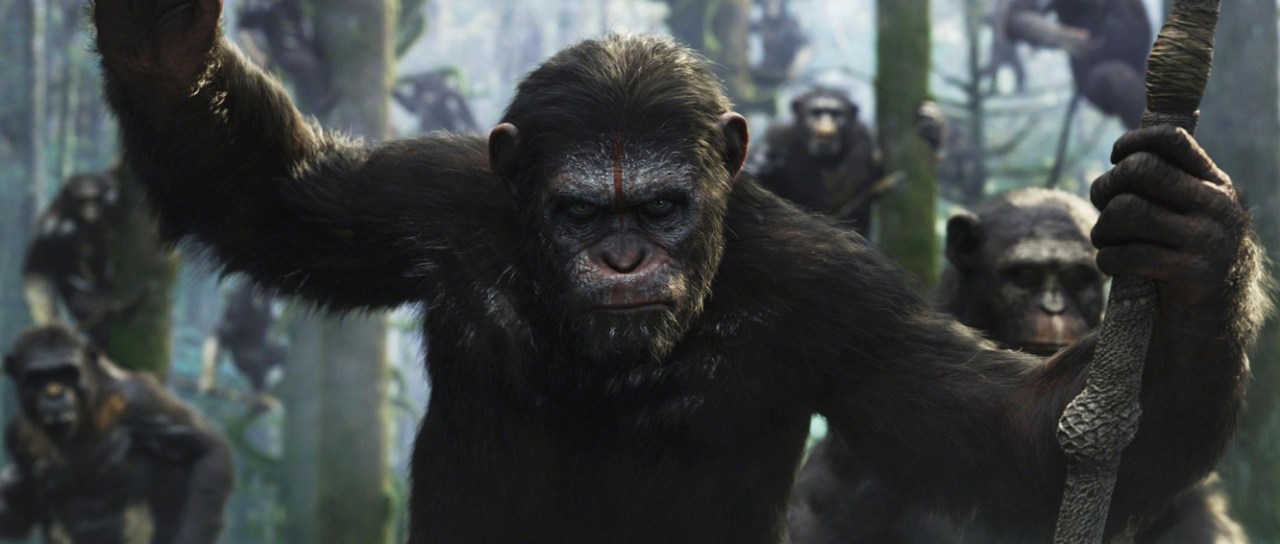
Few creatures are more terrifying than an angry ape with a grudge and a gun – and this spectacular sci-fi epic has a forest full of them.

It pits ape against human and each against their own kind in a series of hugely exciting battles.

The movie is also majestic to look at and the intelligent script touches on issues such as an energy-supply crisis and how the treatment of prisoners can lead to radicalisation.

It is ten years since super-intelligent chimp Caesar (Andy Serkis) escaped to the Californian forest.

His species has developed art, architecture and a peaceful society while a virus has devastated human civilisation.

In a sly nod to George Orwell’s Animal Farm, the apes have rules marked on to a wall. No1 is: “Ape does not kill ape.”

Human survivor Malcolm (Jason Clarke) leads a recce into the apes’ domain looking to kickstart a hydro-electric dam.

There’s a bloody stand-off and in a desperate attempt to avoid more violence, Malcolm and Caesar tiptoe to a tentative truce.

In San Francisco, Dreyfuss (Gary Oldman) gives Malcolm three days to succeed or he’ll use his arsenal to annihilate the apes.

Meanwhile, the brutal Koba (Toby Kebbell) plots to overthrow Caesar, isolate his son Blue Eyes (Nick Thurston) and make war on humans.

Serkis is brilliant as Caesar. With his heavy brow and slow deliberations he echoes Marlon Brando in The Godfather – but with added teeth and muscle.

Director Reeves cleverly uses long edits to create tension and put the audience at the very centre of the action such as when an ape on horseback attacks a tank.

Marvellous visuals, engaging performances and dramatic plot twists made this one of the action movies of 2014.

Enemy

dir. Denis Villeneuve

Fantasy, identity and memory are twisted in this dark, expressionist, psychological thriller.

Sly and finely-crafted, it is based on José Saramago’s 2002 novel The Double.

There’s minimal dialogue and a mournful soundtrack while the absence of clocks and times add to the alienating atmosphere and contribute to a memorable finale.

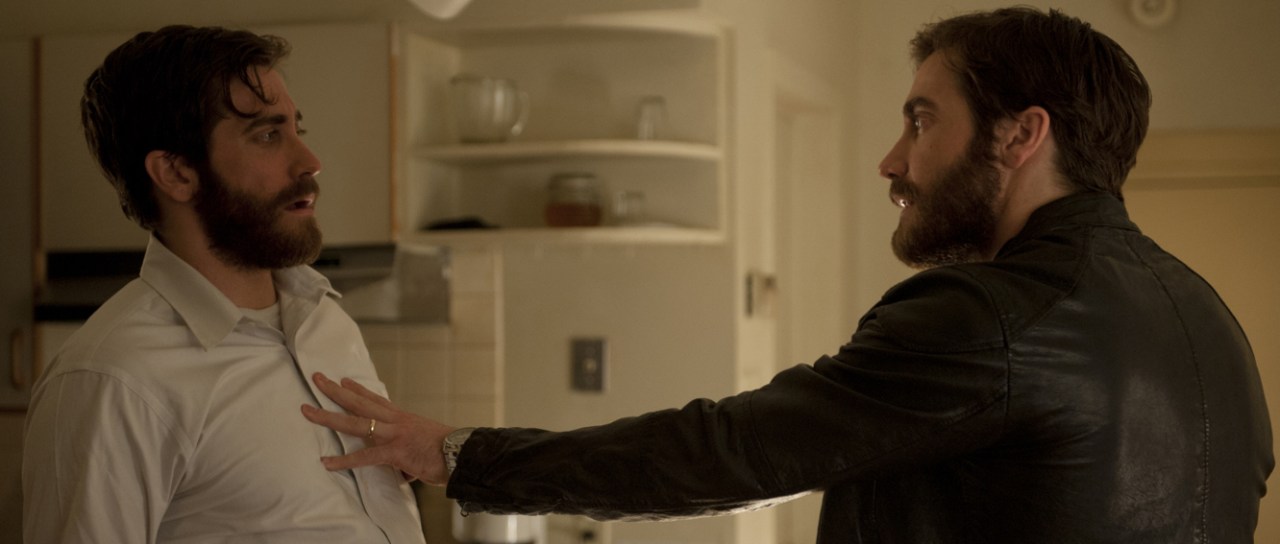
After a chance conversation, history professor Adam Bell (Jake Gyllenhaal) is caught in an opaque web of intrigue, mistrust and betrayal.

Stuck in a failing relationship with the beautiful Mary (Mélanie Laurent) Adam is a listless drone with a life of dull routine, failing to inspire his bored students with his lectures on the political denial of self expression.

Only his mother, Isabella Rossellini is concerned or interested in him, leaving voice mails he doesn’t respond to.

One day a casual exchange with a nameless colleague leads Adam to watching a locally filmed movie ‘Where There’s a Will There’s a way’.

It’s a colourful comedy, disturbing the Enemy’s carefully established austere mood. In the background Adam sees a bellboy, played by an actor who looks uncannily similar to himself.

Intrigued, Adam discovers he’s called Anthony Saint Claire (Gyllenhaal again) and hunts down his other movie appearances.

Anthony is signed to a local agency and when Adam visits their offices he’s mistaken for his doppelganger, exploiting the mistake to pick up a parcel intended for the actor.

Behaving like an excited stalker, Adam instigates a meeting with Anthony which develops into a confrontation.

They’re physically identical but different in attitude, lifestyle and crucially in relationships. Anthony’s pregnant wife Helen (Sarah Gadon) is suspicious of her husband – with very good reason.

With deft deliberation Nicolas Bolduc’s camera follows as character stalks character, capturing scenes in unhealthy yellow register and bold shadows.

Architecture is an oppressive character while cars are cocoons for their faceless, voiceless commuters as they drive around the stark cityscape.

Gyllenhaal’s character is a memorable addition to the cinematic gallery of actors portraying identical characters on screen, joining luminaries such as Leonardo DiCaprio, Jesse Eisenberg, Jeremy Irons, even Elvis has done it

Made in 2013 it’s released now to capitalise on the success of Gyllenhaal’s excellent movie Nightcrawler.

It’s hard to believe the same creative team of Gyllenhaal and Villeneuve who made this were also responsible for 2013’s preposterous  thriller, Prisoners.

★★★★☆

Prisoners

dir. Denis Villeneuve

Hugh Jackman and Terrence Howard are vigilante fathers fighting for justice in this damp, dull and silly thriller.

In this rain-drenched small town that seems to have a deranged individual twitching behind every curtain, there are a seemingly endless number of torture chambers.

Riddled with stupidity, inconsistency, alarming coincidence and a gun-toting granny, it corkscrews a path through plot-holes into a pit of preposterousness.

Survivalist carpenter Keller Dover (Jackman) and his neighbour Franklin Birch (Howard) are relaxing after sharing Thanksgiving dinner with their families.

Jackman pairs a ragged beard with a knitted frown and acts with a fist waving intensity while Howard gawps along with the audience.

As Dover’s wife Maria Bello has little to do but stagger in a pill-popping daze and Viola Davis as Mrs Birch is given less than that.

Their two young daughters fail to return home from playing outside and a desperate search begins for them.

As every cop in the state are brought in to hunt for the girls, Detective Loki (Jake Gyllenhaal) is assigned to lead the investigation and is known for never failing to solve a case.

Gyllenhaal is impressive as the tattooed and slick-haired cop, offering with wry humour the merest specks of light in the gathering gloom.

Keller tracks down the suspected killer himself, beating up the suspectAlex Jones (Paul Dano) and pleading with Franklin to interrogate him.

Brilliant British cinematographer Roger Deakins creates an air of bitter chill that emphasises the bleakness of tone but his talent is squandered on this material.

★★☆☆☆

Still Life

Director: Uberto Pasolini (2015)

With plenty to say about the current state of Britain this contemplative drama is a graceful reflection on the importance of honouring the dead.

John May (Eddie Marsan) is a middle-aged, mac-wearing local civil servant.

He’s responsible for contacting relatives of the recently deceased, if none can be found he must organise the disposal of the bodies.

Dedicated, meticulous and compelled to give his clients as much dignity as possible, he draws on their belongings to write eulogies, choose appropriate music and opts for expensive church services rather than cheaper cremations.

Working from a prodigiously neat basement office and living in an equally grey and organised flat, John has a quiet and unassuming life with no friends, family or social life.

Though never complaining being over-involved in his job is a clearly a coping mechanism for his loneliness.

When John recieves his notice at the council from the unctuous Mr Pratchett (Andrew Buchan) he is determined to successfully close his last case but has only three days in which to do so.

Unknown to each other Billy Stoke lived on John’s anonymous housing estate in the flat opposite, suffereing a sad, lonely and alcoholic demise.

Well-honed detective techniques sees John travel the country by road and rail, meeting family and former colleagues, trying to find Stoke’s daughter Kelly (Joanne Froggatt).

The Italian writer-director turns a coldly critical eye on contemporary Britain, seeing a land of abandoned ex-servicemen and uncaring institutions.

Among the alienation, homelessness and terrible food, we love our dogs, hate our families and neglect the elderly.

Cinematographer Stefano Falivene makes a virtue of stillness, capturing an urban landscape with a harsh, eerie beauty and adding to John’s keenly observed sense of isolation.

There are subtle suggestions John could be a modern day version of Raymond Chandler’s Philip Marlowe, a good man keeping true to his personal code of honour.

Or possibly he’s a non-denominational celestial do-gooder trying to save the world one funeral at a time.

Marsan carries the film with maximum economy, conveying a variety of moods with tiny changes of expression while Downton star and Golden Globe winner Froggatt is as engaging and excellent as ever – but it would be nice to see her having on-screen fun in a glamorous role for a change.

For a moment the script seems to lurch towards a conventional conclusion instead it supplies a sweetly haunting and gently optimistic ending.

☆☆

Jupiter Ascending

Director:  The Wachowskis

There’s little that makes sense and less that’s interesting in this mega budget mess from the sci-fi siblings who many moons ago made the magnificent The Matrix.

There’s majestically designed spaceships, gadgetry and costumes but that counts for little due to flat characters, terrible plotting, woeful dialogue, incoherent action scenes and a vacuum of a performance by Mila Kunis in the title role.

Impoverished illegal immigrant Jupiter Jones (Kunis) and her squabbling comedy Russian family clean the houses of the wealthy Chicago elite.

Her cousin Vladie (Kick Gurry) – the scamp – persuades her to sell her eggs to a fertility clinic so he can buy a really big TV and she a telescope. But as she lies on the operating table she’s attacked by space imps.

Fortunately she’s rescued by a gun-toting former space legionnaire. Hunky man-wolf Cain Wise (Channing Tatum) is temping as a bounty hunter for interstellar bad guy Titus (Douglas Booth) – a member of the powerful cosmic dynasty, the House of Abrasax.

Cain and Jupiter find fellow ex-legionnaire Stinger (Sean Bean) beekeeping in a country shack. It’s these bees that identify her as a queen and she takes it in her sullen stride.

Stinger and Cain beat each other up for a bit until Stinger’s daughter is sarcastic at them. Then she’s forgotten about and there’s another kidnap attempt.

It turns out Jupiter is the reincarnation of a queen who bequeathed to herself her most prized possession – the planet Earth.

Meanwhile Titus is competing against his siblings Balem (Eddie Redmayne) and Kalique (Tuppence Middleton) to control Jupiter and her inheritance.

This trio of fine Brit actors deliver their lines with as much camp energy as they can muster – possibly out of frustration at the quality of the script.

Earth is the richest supply of raw product for the lucrative market in human genetic material, used to keep everyone in space forever young.

Jupiter Jones is a dull, gullible, joyless soul, blithely accepting of her promotion to queen of the galaxy and owner of Earth.

Alien worlds, space travel and terrifying creatures with murderous intent are all greeted with the same doe-eyed indolence.

Formalities dictate she has to truck on down to the dole office to get her stamp before she is formally recognised in her new position.

Desperate stabs at humour are provided by queues of simpering lawyers and corrupt bureaucrats, all performed with embarrassing grotesque campery which are not funny as presumably intended.

Terry Gilliam appears in cameo and must be appalled at the multi-millions of dollars squandered when he can barely scrape together pennies for his own far superior work.

This is a universe which has nudity and space orgies but no sexual energy. Kunis and Tatum share zero chemistry but she falls for him anyway, without hesitation, conviction or reason.

Tatum enjoyed a fantastic 2014 with wonderful, wildly different performances in 22 Jump Street and Foxcatcher. But here he’s lumbered with dodgy tattoos and scar tissue in a generic action role where he spends most of his time sternly whizzing about on flying space boots.

Cinematographer John Troll chooses to drown cosmic cityscapes in a honey glow which is thematically sound but wearing after a couple of hours. There’s nothing groundbreaking among the visual effects to wow us the way bullet-time did back in the day.

The orchestral score of Michael Giacchino tries manfully to suggest excitement but to no avail.

There’s battles, betrayals, kidnappings and then another battle; each more confusing, longer and repetitive than the last. Then there’s another kidnap attempt but despite how busy it all is, there’s little fun or excitement.

Not since The Phantom Menace have shenanigans in the inter-galactic stock-market seemed so dull.

☆☆

Amour Fou

Director: Jessica Hausner (2014)

Slow paced and painterly, this suicide drama is so still and composed it could be lying in state.

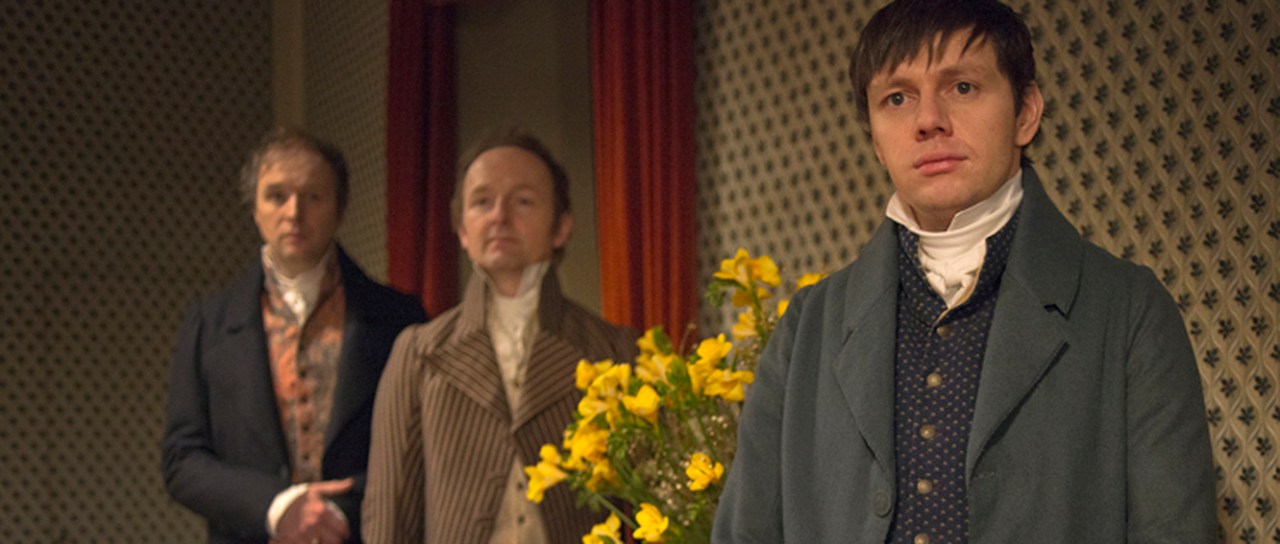
Set in Berlin in 1810, bourgeoisie life revolves embroidery, flower arranging, letter writing and music and poetry recitals, but there’s an alarming lack of laughter, fun, anger or any other emotion, though there are some quiet jokes.

Barking mad romantic poet Heinrich von Kleist (Christian Friedel) craves death and proposes a double suicide to married mother Henriette Vogel (Birte Schnöink).

Being a sensible if unadventurous soul she demurs, remaining loyal to her husband Vogel (Stephan Grossmann) a tax collector.

When she collapses at the dinner table, a tumour is discovered. Her family stoically receive the news and a succession of doctors and quacks recommend a series of cures. The least mad include fresh air, bed-rest, blood-letting and camomile tea.

When the highest medical authority Charite Medical in Berlin say it is terminal and she has a short time to live, Henriette reconsiders Heinrich’s offer. Such is the lack of engagement with any of the characters, we care little if the couple carry out their plan or not.

Taking inspiration from the works of Vermeer, cinematographer Martin Gschlacht use of light is terrific, adhering with patient dedication to the geometry of formal composition.

It consists of a series of tableaux where everyone acts from the neck up and every shot is arranged with immaculate formal precision. This serves to reinforce the rigid social etiquette.

With sound editing and mixing successfully evoking a wider world outside the home, it’s a shame Amour Fou has no compelling drama to support its impressive technical achievements.

★☆☆☆

Foxcatcher

Director: Bennett Miller (2015)

In this chilly, complex and exceptionally crafted thriller based on a true story, actors more famous for action and comedy give great dramatic performances.

In mood, tone, subject matter and careful execution it is similar to Miller’s Capote (2005) for which the late Philip Seymour Hoffman won the best actor Oscar.

US gold medal wrestling champ Mark Schultz (Channing Tatum) is being coached for for the Seoul Olympics by older brother Dave (Mark Ruffalo).

Aggressive in the ring, the emotionally stunted Mark lacks social confidence and struggles financially. Dave has acted as father as well as brother but now prioritises his wife Nancy (Sienna Miller) and children.

As in American Sniper, Miller demonstrates she’s capable of excellence given the opportunity, it’s a shame that in both films she isn’t given more to do.

At no point does Dave consider himself to be a contributor to Mark’s issues.

Mark is overwhelmed when patriotic multimillionaire wrestling enthusiast John du Pont (Steve Carell) demands to help the US Olympic cause, flying Mark out to his secluded Foxcatcher estate where he has built a state of the art training facility.

From behind prosthetic nose, paunch and grey hair, Carell offers a mesmerising performance, hinting at a complex internal conflcits, not least his feelings towards his emotionally cold mother Jean (Vanessa Redgrave).

Flexing his financial muscle, du Pont brings on board the entire US wrestling team, names them Foxcatcher after his estate and hires Dave to train them for Olympic glory.

The wrestling scenes are convincing and comprehensible while the muted tone, autumnal colours and nuanced performances create a creeping foreboding.

Desperate for affirmation by his wealthy associates, du Pont parades his pet project around town while tension develops between du Pont and Dave as they compete to exercise an unhealthy degree of control over Mark.

With a shocking violence, the cold blooded and tragic end offers further punishment but no redemption.

★★★★★

The Imitation Game

Director: Morten Tyldum (2014)

Get quizzical with Benedict Cumberbatch in this compelling wartime thriller about real-life code-breakers.

The star of TV’s Sherlock puts in an Oscar worthy performance as Alan Turing; cryptologist, mathematician and inventor of the world’s first computer.

It unlocked the Nazi‘s Enigma code machine and so helped win the second world war – but he was later prosecuted for being gay.

A cleverly constructed narrative switches between between his arrest in 1951, unhappy schooldays and successful war years.

In 1941 he is recruited by MI6 spook  Major General Menzies (a scene-stealing Mark Strong) and placed under the sceptical Commander Denniston (wonderfully caustic Charles Dance).

Although prodigiously brilliant, Turing’s lack of social graces annoys everyone but Joan, the only female team member played by a winning Keira Knightley.

In a laboratory in Bletchely Park they try to decipher German communications before the daily code is changed.

There are over 159 million million possible combinations and every seconds delay means more Allied deaths.

So starts to Turing build his computer, an astonishing room-sized contraption of wires, wheels and whirligigs.

He nicknames it Christopher after a schoolfriend, a perfect name for anything super-intelligent but he’s unable make it work quickly enough.

Denniston wants to close the laboratory down and the paranoid atmosphere is heightened by the possible presence of a spy.

Being a British affair, the terrifically moving moment of eureka happens in the pub.

Despite saving an estimated 14 million lives and shortening the war by two years, his work is classified top secret.

So no-one is aware of his work when he is later tried and punished for indecent behaviour.

This excellent film is an insufficient legacy to a genius and British hero – but it’s a damn fine place to start.

★★★★☆

Unbroken

Director: Angelina Jolie (2014)

Celebrating the human capacity for endurance, this true-life tale of Second World War survival is barely believable – and not for the faint-hearted.

It’s based on the book by Lauren Hillenbrand which covers the life of USA Olympian and airman Louis ‘Louie’ Zamperini.

Director Angelina Jolie demonstrates she’s far from the minimally talented spoiled brat that recently leaked Sony emails would insist, crafting a handsome and traditional movie with exciting flying sequences and strong acting from watchable performers.

But it does suffer from repetition and so fails to achieve the emotional pitch it strives for.

Born into a poor family young Louie (Brit star Jack O’Connell) learns resilience when he’s bullied for being an immigrant. His older brother Pete (Alex Russell) encourages him to channel his energy on the athletics track to avoid getting into serious trouble.

After representing the US as a distance runner at the 1936 Berlin Olympics, Louie enlists as an airman. While on a rescue mission his plane crashes in the Pacific.

Adrift in a lifeboat with two Mac and Phil (Finn Wittrock and Domhnall Gleeson), they survive sharks, sunburn, sickness and being shot at.

This is the strongest part of the movie as dialogue is kept to a minimum allowing the orchestra and the scenery do the talking, captured with customary finesse by ace British cinematographer Roger Deakins.

Picked up by the Japanese navy the survivors are subjected to interrogation, beatings and solitary confinement before being transferred to a savage POW camp.

It’s ran by the sadistic warden nicknamed ‘The Bird’, played competently by Japanese musician Miyavi in his first acting role. But the fraught relationship between guard and prisoner is forced and unconvincing.

Louie is offered by an easy life in exchange for allowing his celebrity runner status as Japanese propaganda in radio broadcasts but instead is returned and sent to a dockside coal-yard – where The Bird is once again in charge.

An early Oscar front runner Unbroken only picked up nominations for cinematography, sound mixing and sound editing and it will be interesting to see if Jolie can build a second career from her solid efforts here.

★★☆☆

How To Train Your Dragon 2

Director: Dean DeBlois (2014)

This animated family-friendly sequel soars and roars in a fabulous flight of fantasy.

It’s a handsomely designed adventure with extraordinary animation that conjures up magical images – especially of dragons flying en masse.

The coming-of-age story of Hiccup and his fight to save his village is well-crafted and exciting but a lack of laughs is a major flaw.

Brave and resourceful viking Hiccup (Jay Baruchel) is 20 and his home of Berk is living in harmony with the dragons. His dad, chief Stoick the Vast (Gerard Butler) expects him to take the throne but Hiccup is unsure about ruling or his own future.

So, armed with a fiery sword, he flies off on his dragon Toothless to discover himself and explore the northern lands.

There he meets mysterious Valka (Cate Blanchett) who warns him of warlord Drago’s plan to enslave all dragons. Meanwhile Hiccup’s adventurous girlfriend Astrid (America Ferrera) and her friends are captured by Drago and his pirate fleet.

The ensuing battle between dragons, vikings, pirates and bewilderbeasts – giant alpha dragons with mind-control powers – is spectacular but ends in the death of a loved one.

Hiccup must try to defeat Drago’s army, rescue the dragons, free his village and generally live up to his father’s expectations.

Dragon 2 is good natured and tender at times but the few jokes are mostly gentle slapstick, such as people falling into snow drifts or getting their faces licked by dragons.

While weak sidekick characters fail to provide enough fun and their amorous behaviour is ill-judged in a film aimed at younger kids.

The viking village has lots of nicely designed mechanical gizmos but no-one seems to realise the bat-suit wings that Hiccup sports to glide around may one day make the dragons redundant.

But Dragon 2’s lesson – that it’s never too late to start listening to your dad – is an important one that my son may learn… one day.

★★☆☆