20,000 Leagues Under The Sea (1916)

Breathtaking in its pioneering use of underwater photography, this silent two-hour feature is a globetrotting epic of action adventure, romance and comedy, and though contains some problematic elements, it’s an early high water mark in Hollywood spectacle, an impressive early entry into the canon of Jules Verne adaptations, and by far the biggest box office success of its year of release.

An adaptation of not one, but two major works of the man often referred to as the ‘Father of science fiction’, 20,000 Leagues combines elements of two of Verne’s novels, namely 1871’s adventure, 20,000 Leagues Under The Sea, and 1875’s semi-sequel, The Mysterious Island, bringing together the twin adventures of Verne’s most celebrated creation, the mercurial billionaire genius inventor and subaquatic explorer, Captain Nemo.

The novel

From this rich material we experience a tale of rape, murder, child abuse, kidnap, and betrayals. Plus there are fistfights, a sea battle, a colonial uprising, a reconciliation of long lost family members, as well as ghosts, devils, and real live sharks.

For those not overly familiar with the source material, 20,000 Leagues is set in 1866, and sees Professor Aronnax and two male companions kidnapped by a middle aged and vigorous Nemo, who takes his captives sailing around the globe in his technologically advanced submarine, The Nautilus. Meanwhile The Mysterious Island is set during the US Civil War (1861-1865) sees a group of Union prisoners escape by hot air balloon to the titular Pacific Ocean island, where an elderly and dying Nemo secretly assists their survival and only reveals his presence at the end of the novel.

The Professor & niece

When it came to adapting this material for his 1916 production, for the sake of cinematic expediency, Verne’s appallingly contradictory timeframe is rightfully given the old heave-ho by Scottish director and screenwriter Stuart Paton, who sensibly also jettisons much of the ballast of Verne’s ponderous scientific explanations, and in true Hollywood fashion introduces female characters to provide romance and intrigue to Verne’s nearly all-male world.
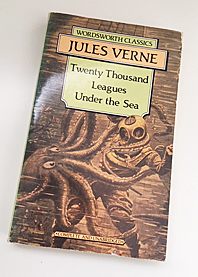
Deep dive into Verne

Paton also introduces female characters such as Aronnax’s adult niece, who replaces the manservant Conseil as one of Aronnax’s companions, and on the Mysterious Island there is a young woman wearing a leopard print dress, who replaces the male castaway of the novel. Although Aronnax’s niece plays little part in the film, the female castaway ‘A Child of Nature’ as she’s billed, is central to the story. And yes, though much of what she does is invented by Paton, there’s no denying it’s an exuberant and captivating performance by actress Jane Gail.

Paton’s script cuts back and forth between the parallel stories of Aronnax on The Nautilus, and the escaped balloonists, eventually bringing the plot-lines together in a terrifically staged finale before ending on a note of poignant dignity which I suspect Verne would approve. This is a great example of how to ruthlessly hack an unwieldy source material into a platform for great cinema.

Child of nature, right

Typical of the era, the Asian characters of Nemo and ‘A Child of Nature’ are played in brownface, a now rightfully discredited technique. Yet A Child of Nature’s inclusion allows for an inter-racial Caucasian-Asian romance between her and a balloonist, which is quite the something in a film released the year after D. W. Griffith’s infamously racist, The Birth of a Nation.

This romance doesn’t occur in Verne, and is possibly inspired by Shakespeare’s The Tempest, which features a crew of shipwrecked men encountering a beautiful girl and her wizard father on a desert island. Nemo is explicably described as a ‘wizard’, and also deals with issues of colonialism and race.

On another note, the romance as portrayed may not be interpreted as such as by a modern audience, there’s no explicit kissing for example. However if we the audience are expected and required to interpret two rape scenes as rape scenes, and not ‘just’ assaults, then we’re similarly beholden to interpret their flirtatious behaviour in scenes as romantic and sexual in intent.

Neb, right

However the film is less kind to the balloonist, Neb, Verne’s sole Black character in these books. Treated with jaw-dropping racism in the novel, The Mysterious Island, this film introduces Neb only to quickly cut him from the film. This happens so alarmingly abruptly I first assumed the copy of the film I was watching was missing a reel.

However Neb’s very noticeably absent from an important scene at the end where the cast are brought together. We can only speculate what happened to poor Neb, and why he ended up so ruthlessly dispatched to the cutting room floor. The treatment of Neb and the casting of Nemo in subsequent adaptations is something I’ll address in another post.

Nemo himself stands alongside Sherlock Holmes as a great example of a literary character whose cultural existence has a life beyond his creator, and who’s longevity in the popular consciousness relies far more on countless and varied media interpretations for fame than for people reading the books. Many more people will be familiar with their names than will have ever read the source material.

Featured in graphic novels, cartoons and now in video games, such the 2015 Japanese mobile game Fate/Grand Order, Nemo’s been portrayed by Russian, Egyptian, Czech, and Puerto Rican actors, as well as by Indian and Pakistani ones. And it’s in The Mysterious Island, not the more famous 20,000 Leagues Under The Sea, that Verne reveals Nemo is an Indian Prince whose wife and child was murdered by the British during the historical Indian Rebellion of 1857, also known as The First War of Independence.

Nemo

It transpires Nemo is really Prince Dakkar, son of the Hindu raja of Bundelkhand, and a descendant of the Muslim Sultan Fateh Ali Khan Tipu of the Kingdom of Mysore. When Verne was writing The British Empire and the Third French Republic were competing for global superiority, and painting the British as the villains would no doubt be a winning strategy for the French writer, and not damage his sales either at home or in the US, a country often celebrated and the source of heroic characters in Verne’s work.

In 1914 when filming of this version of Nemo began production, the world had changed again, with The Great War, as The First World War was then known, was beginning in earnest. And here Nemo’s story is fudged considerably by Paton, who removes some historical context and shifts the blame away from the British.

The map showing India

We learn instead that Nemo’s life in aquatic exile aboard The Nautilus began after he was falsely accused of inciting a rebellion in the unnamed Asian country of his birth, one under colonial rule by an unnamed European. A map on the wall in one scene indicates it is indeed India. However the military uniforms appear more generically European, perhaps French or German than British. It’s possible all Europe colonialism looks the same to Americans. I’m not an expert in military uniform and perhaps the costume department had a surfeit of those costumes readily available.

Nemo’s tragic backstory role in the rebellion is relegated by Verne to a couple of paragraphs, however here it’s portrayed in flashback at the end of the film, with the rebellion allowing for some impressive sets and crowded battle scenes. Rather than being purpose built the sets look suspiciously as if they were borrowed from another production, but they add to the sense of spectacle and allow for a fittingly huge finale.

Williamson bros.

Despite readers of The Mysterious Island being familiar with Nemo’s origin story, interestingly, and presumably for publicity purposes, a title card claims Prince Daakar’s {sic} tragic story has never been told by Verne. The author died in 1905 and so wasn’t available to dispute the claim.

The title cards are fascinating in themselves. The first grandly proclaims this to be ‘The First Submarine Photoplay Ever Filmed’ which is catnip to fans of submarine films such as myself, as well as making this film hugely significant in the realms of special effects and cinematography.
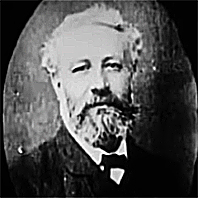
Jules Verne

The second tells us it was directed by Stuart Paton and photographed by Eugene Gaudio, then the third card states the submarine photography was possible by using the inventions of the Williamson brothers, who ‘alone have solved the secret of under-the-ocean photography’ and we’re introduced to the Ernest and George Williamson themselves, who smilingly doff their hats for us. They can be justly proud of their work. And then we’re shown a still photograph of Verne himself, a shame he wasn’t around to see himself honoured so. Imagine if JRR Tolkien had been so honoured by Peter Jackson in his magnificent 2001-2003 Lord of the Rings trilogy.

The shark hunt

There’s a strong commitment to exterior location filming, and the underwater work is phenomenal. An astonishing underwater shark hunting trip is executed with the type of contemporary disregard for health and safety associated with the worst excesses of Cecil B. DeMille, which makes for a very exciting watch.

This undersea footage was shot in the Bahamas where Walt Disney 38 years later shot his 1954 James Mason-starring version of 20,000 Leagues, and for the same reasons, a great deal of natural light and very clear water.

In 1916, underwater cameras weren’t used to shoot the underwater scenes staged in shallow sunlit waters, but the Williamson brothers used a system of watertight tubes and mirrors to allow the camera to shoot reflected images of the scenes as they took place.

The exterior of The Nautilus looks very close to how Verne described it, a very smooth cylindrical hull with a wooden platform on top for the crew to stand on. Whether in or on the water, it’s these scenes that make the film such a joy.

According to IMDB.com, 20,000 Leagues was produced at the unadjusted eye-watering cost of $500,000 by The Universal Film Manufacturing Company, a precursor to todays Universal Pictures. And it took a staggering $8million at the box office, comfortably outgrossing the second biggest hit of the year which could only scrape together $2.18million, thank you and goodnight, D. W. Griffith’s non-apology of an historical epic, Intolerance.

For the pioneering underwater photography which captures Verne’s love of technological innovation, this is madly impressive. When added to it being respectful and faithful to the source while offering spectacle, romance, comedy and action adventure, this sets an extraordinarily high bar that many of the subsequent adaptations of Verne fail to reach.

Nemo’s Fury is an exciting digital reinvention of Jules Verne’s classic steampunk adventure novel, 20,000 Leagues Under the Sea. 

Download for free to your smartphone or tablet, search your app store for ‘Nemo’s Fury’.

A mobile interactive fiction game employing a bespoke combat system and hundreds of original illustrations, Nemo’s Fury is inspired by the 1980’s role-playing gamebooks such as ‘The Warlock of Firetop Mountain’, of the Fighting Fantasy series which celebrated its fortieth anniversary last year.

Each player joins the legendary Captain Nemo on board his fabulous submarine, the Nautilus, on a wild voyage of adventure, intrigue, loyalty, and betrayal.

There’s mayhem, monsters, maelstroms and murder as Nemo takes you from the South Pacific to the Northern Atlantic via Antartica and the Red Sea. And if they survive long enough, the player will of course fight a giant squid.

Available on your smartphone or tablet, (but not yet your desktop), click on your app store below

Or go to Nemo’s Fury for more info

High Society and me. A musical true love

A frothy and glossy escapist musical romantic comedy of 1956, High Society is a terrific example of the ability of filmmakers from Hollywood’s golden age to draw on existing material and fashion a sparkling fresh and brilliant entertainment.

It can also be understood as a great example of producer power, was a commercial and critical hit, and was nominated for two Oscars in the musical categories.

Employing irresistible star wattage of Bing Crosby, Frank Sinatra, Grace Kelly and Louis Armstrong, the timeless tunes of Cole Porter and fabulous costume design of Helen Rose, it’s unmistakably the product of MGM, the studio which made the best musicals of the era, including 1951’s An American In Paris, and 1952’s Singin’ In The Rain.

Using a well established dramatic structure, and drawing on elements of American literature, it was produced as the post-war US consensus was being supplanted by the dawn of the teenager as a social phenomenon, and the film’s struggle to wrestle with the real world are all too evident. High Society is politically reactionary and has no sense of itself as herald to the end of the jazz age in which its stars and genre were mired, and sadly for lovers of the studio’s defining genre, High Society is the last great hurrah of the MGM musical.

I absolutely love it.

Kelly, Crosby, Sinatra, & Holm

Based on 1944’s Oscar winning comedy The Philadelphia Story, itself an adaptation of a Broadway play, High Society glides through its 111 minute running time in bubbles of glamour, charm and wit, as we watch a pair of tabloid journalists covering the upcoming high society wedding of a spoilt socialite who’s being courted by three different men.

Bringing four leads together all of whom were previous Oscar winners, Bing Crosby, Grace Kelly, Frank Sinatra and Celeste Holm engage in song, dance, and repartee as they resolve various romantic entanglements over the course of one night and two days in a mansion in the wealthy enclave of Newport, Rhode Island, the high society of the title.

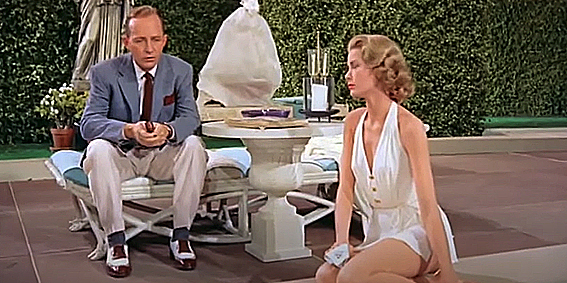
Crosby heads the romantic leads as C. K. Dexter Haven, a wealthy composer who lives next door to his ex, Tracy Samantha Lord, played by Grace Kelly. Meanwhile Frank Sinatra and Celeste Holme are the down at heel muckraking journalists, Mike Connor and Liz Imbrie, who arrive to cover the wedding for their magazine.

When Crosby isn’t singing, he strolls about in cardigans or black tie, and though it’s not a performance of great range or energy, he delivers his popular brand of avuncular charm, is given a veneer of cool by his association with musicians of the calibre of Armstrong, and is offered some reflected glamour by the glittering star power of Kelly, best known at this point for her work with Alfred Hitchcock.

Kelly

Kelly is perfectly cast in her last Hollywood appearance before abandoning Los Angeles for life in Monaco. Whether in slacks or a ball gown, the luminous Kelly sweeps all before her in a series of gorgeous costumes, including a far from revealing but indecently sexy swim suit.

Plus she delivers a terrifically accomplished performance in the mould of screwball-era Katharine Hepburn, and whether being deliberately over the top, drunk, angry or playful, Kelly can wordlessly make us aware of what she’s thinking, in the manner of another Hitchcock blonde, Ingrid Bergman.

Presumably the casting call asked for an actress less attractive than Kelly to play the second female lead. On this showing that would be every other woman in the world at the time. Which is hugely unfortunate for the wonderfully droll Celeste Holm, who’s teamed up with Sinatra in my favourite big screen performance of his.

Sinatra plays well with Holm, and he’s either smart enough to allow her space to shine, or possibly barely able to keep up with her, and Holme brings a level of dignity and self-awareness lacking in other characters. But Holm was repeatedly ill-served by Hollywood, and after High Society she didn’t make another film for five years.

Elsewhere Lydia Reed is winningly confident and sparky alongside Kelly as her young sister Caroline Lord, and John Lund plays George Kittredge, the culturally barren, nouveau rich cattle baron who’s Tracy’s intended beau.

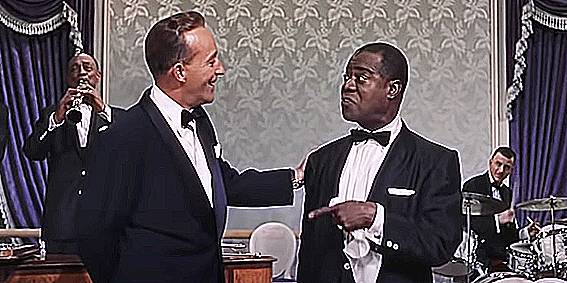
Playing himself, Louis Armstrong is an invitee performer at a jazz festival Crosby’s character is holding on his estate, a plot device which allows Armstrong to pal about with Crosby and duet together on the number ‘Now You Have Jazz‘, which is supposedly – but clearly isn’t – filmed in front of a wealthy white festival crowd.

Jazz musician Louis Armstrong is granted not inconsiderable screen time, performs three songs and is granted the first and last words. This is fitting for his screen ‘character’ is a Greek chorus to the comedy, a dramatic device used by later musicals such as 1972’s Cabaret, 1975’s The Rocky Horror Picture Show, and 1978’s Grease.
I could write an entire post about radio broadcasters in movies acting as a Greek chorus by starting with 1979’s The Warriors and taking it from there.

Acting as a Greek chorus to the story, introducing the setting and then commenting on events as they unfold, as well as being a character in the story, Armstrong is mostly at one remove from the narrative and he could be excised from the film entirely without his absence changing the story.

In contrast to the previous year’s drama, Blackboard Jungle, the film which made a star of future Oscar winner Sidney Poitier, High Society’s principal black star is clearly at times not on same set at the same time to white actors and has to be edited into scenes in which he is ostensibly a part.

Check out the final scene (from 2.27mins) where although nominally in the same scene, he never shares screen time with Grace Kelly. Armstrong is included but never incorporated.

A generous reading of Armstrong’s separation from the main narrative would be to suggest his performing and recording scheduling conflicts prevented a deeper integration in the narrative. A less charitable reading would be the studio were wary if not frightened of too much interaction of a black character with white ones, and Armstrong’s certainly not allowed to interact with the white female cast members in any way. And good luck spotting a black female actor.

Crosby & Armstrong performing ‘Now You Has Jazz

It’s important to recognise High Society was released in 1956, and although the segregation of public schools had been declared unconstitutional by the U.S. Supreme Court in 1954, it was many years before this decision was universally implemented. Other laws of segregation weren’t overruled until the Civil Rights Act of 1964 and the Voting Rights Act of 1965.

With race being the defining political fault line of the US, High Society wants to exploit Armstrong’s cache as a long established and popular crossover artiste by contributing his jazz bona fides to the soundtrack and bringing his own fanbase to the films audience, but his role suggests a nervousness on behalf of the filmmakers who had to sell the film in a US market place.

MGM had at the time previous form with being vary of the controversial subject of race. The studio’s 1951 version of Show Boat notably tones down any ‘controversial’ racial elements compared to previous cinematic adaptions of the stage show on which it’s based.

However in theme and plot the film enforces existing racial boundaries. As one might expect of a mainstream entertainment which recognises social division in its title, maintenance of the status quo is a key theme of the film.

The script was written by a playwright John Patrick who’d previously written the NBC radio series Streamlined Shakespeare, and there’s a strong influence of Shakespeare scattered through the script – more of which later – so Armstrong’s narrator role may well have been included in the earliest draft. If so then casting Armstrong as the Chorus could be read as a deliberate act of segregation rather than a creative solution to a scheduling issue.

Patrick doesn’t steer away from the plot of the original film adaptation or the stage play which preceded it, but adding the Chorus – which Shakespeare used in Henry V for example – the audience to be guided into the heightened and otherworldly setting of High Society, as if leading us into a magical forest of one of Shakespeare’s arboreal comedies, one populated by the fairy Kings and Queens such as found in A Midsummer Night’s Dream, perhaps.

The Chorus is a visitor to this world of wealth and definitely not of or from it, a point underlined by Armstrong’s casting, and the musician’s persona can also be read as ‘blue collar’ and so acts as surrogate for all those in the audience not born to wealth. The film wants us to be amused by the superficiality of the Lord’s family behaviour and regard them with a mocking if warm detachment, and having the Chorus played by Armstrong helps to underline the idea the wealthy do things differently to the rest of us, they are apart, they are ‘other’.

This is story is about maintaining society’s status quo, keeping the high safe and separate in their gilded mansions and the rest of us, well, anywhere else. There is to be no storming of the barricades here, no tearing down of social division, but a determined raising of the drawbridge. This is a piece of high end comfort cinema, lavishly dressed with great tunes. If you want social conflict and a conscience, check out the Poitier flick instead.

Fitting the Shakespearean comic pattern there are two central couples, and all four must gain insight into themselves to find happiness with the correct person, and ‘correct’ is defined as with one whom not only shares a social standing, but also the person who reinforces the rigidly defined social divisions. The rich and the poor have their place, and are happier when the rigid social hierarchy is maintained.

We’re safe in assuming the family name at the top of this society is ‘Lord‘ is deliberately in keeping with Shakespeare’s habit of nominative determinism.

Taking place in a gilded world of enormous drawing rooms, private pools and a butler who offer visitors the south parlour as a waiting room, the film can feel as distinct from reality and as gloriously make-believe as a fairytale, a feeling underlined the magical appearance of a secret mechanical private bar from a book-lined wall.

Gatecrashing this magical realm are two journalists – rude mechanicals in Shakespeare terms – who cast a wry and cynical eye over the fabulous wealth the residents seem to treat with barely a second thought. And though they are drawn to it, they realise they are and cannot ever be part of it. Mike Connor’s brief fling with Tracy is comparable with the encounter between Bottom and Titania the Queen of the Fairies in A Midsummer Night’s Dream. That Sinatra is playing Mike, comparable with the idiot turned donkey, Bottom, is surely am unacknowledged joke at the actor’s expense by the film’s producer. More of him, later.

This is a fantasy which asks us to engage and sympathise with a wealthy white upper class family as they negotiate concurrent romantic entanglements. And the softening of the cynical stance of a pair of muckraking journalistic interlopers encourage us to find sympathy in ourselves for this madly wealthy household rather than maintaining or hardening of our critical stance.

The head of the Lord household has placed his ‘kingdom in a state of chaos due to his latest extra-marital affair, a scandalous fling with a ballerina, and in doing so has become estranged from his daughter, Tracy.
Peace and order will only be brought to the kingdom when father and daughter are reconciled, which will only happen when she choses the correct romantic partner and comes to understand her parent’s worldview, making her fit to succeed her father in due course.

Father knows best, especially where his daughters love life is concerned, is a thoroughly 1950’s attitude.
This is also a coming of age tale, and if Sidney Blackmer as patriarch Seth Lord isn’t given a huge amount of screen time as the stern but loving father who uses his own discretions to teach his daughter about the adult world, it’s their reconciliation which signals the end of the movie. And the curtain comes down with a pleasing and impressive speed which some modern day filmmakers could learn from.

Like Ayesha, the white queen of H. Rider Haggard’s 1887 adventure novel, ‘She’, Tracy’s power seems only to exist as long as she remains in her own world, and the suggestion is if John Lund’s character, the cattle baron George Kittredge, is successful in his courtship of Tracy and takes her away, then she will become ordinary, a mortal being almost. Much is made of George’s wanting to put Tracy on a pedestal and adore her.

One thing the wealthy do differently to the rest of us is put on a music festival in their home. Crosby plays a composer whose house is full of musicians. And the life of Tracy Lord is full of the arts. She and her sister dance, sing, and play piano. They have no regard, interest or knowledge in the ordinary or everyday.

In part George Kittredge is a poor fit not because he’s self-made – Crosby’s character is only second generation wealthy – but because he values commerce above art.

Cole Porter’s fabulous songs have endured even more successfully than the film itself and have achieved a life of their own beyond the confines of cinema. ‘True Love‘ was Oscar nominated for best song but lost out to ‘Que Sera, Sera’ from Hitchcock’s The Man Who Knew Too Much. Some of them have been successfully re-recorded by later generations, such as ‘Well, Did You Evah!‘, the film’s best song, which was originally written for 1939’s DuBarry Was a Lady, and latterly recorded by Debbie Harry and Iggy Pop as part of a HIV/AIDS benefit project.

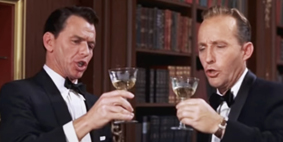
Sinatra & Crosby performing ‘Well, Did You Evah!

Being the greatest lyricist of his generation, Porter was capable of writing lyrics reflecting the film’s sense of magic and otherworldliness. He drops in classical references such as ‘Circe‘ the Greek goddess in ‘Little One‘, while also referencing more contemporary concerns, such as uranium, in ‘Who Wants to Be A Millionaire?‘ And yes, the song did inspire the name of the popular TV quiz show. And ‘she got pinched in the Astor Bar‘ from ‘Well, Did You Evah!‘ is as sly and funny now as it was then, especially with Sinatra’s astutely comic phrasing.

Not all the songs have aged as well, ‘Now You Has Jazz‘ is a decent example of the form, but the lyric ‘Jazz is the king, jazz is the thing that folks love the most.‘ seems unduly optimistic as jazz was about to be swept off the pinnacle of popular culture by rock ‘n’ roll.

However that’s aged nowhere near as badly as the icky staging of the torch sing Crosby sings to Kelly’s screen sister, which summons up the spectre of child sexploitation rife at the time in the Studios, and should be shocking to a modern audience in the era of #MeToo. And were High Society be remade today it’s the song that wouldn’t make the cut. As highly problematic as it is, it sadly it fits in with other songs of the era, notably ‘Little Girls‘, from MGM’s 1958 musical, Gigi.

Director Charles Walters was a choreographer turned director who as as well as directing films for Ginger Rogers and Esther Williams, made 1948’s Easter Parade with Fred Astaire and Judy Garland, received a Best Director Oscar nomination for 1953’s Lili, and directed the Frank Sinatra and Debbie Reynolds 1955 comedy, The Tender Trap.
There’s no signature artistry, just the absence of ego of a professional going about his business. When your star is also your producer, there’s rarely opportunity to do anything other than what you’re told. Certainly there’s none of the daring brush with 3D technology of 1953’s Kiss Me, Kate, or Gene Kelly’s experimental dance and design found in 1951’s An American In Paris.

Cinematography Paul Vogel as an Oscar-wining studio veteran journeyman who went on to shoot George Pal’s 1960 sci-fi adaptation, The Time Machine. His shots are always well balanced and composed so the audience know who’s the most important person in the room. Characters are usually fairly static within the frame, making it all the more startling when Kelly or or her screen sister flurry across a room.

The best we can say of his camerawork is it’s efficient and economical, with occasional daring pans from left to right, and though the camera becomes more agile in the musical numbers, it’s movement generally reflects Crosby’s laid back performance style.

There are no big theatrical set pieces and even the big ballroom scene at Tracy’s hen party, a great excuse for a swirl of costumes if ever there was one, hints rather than shows a crowd. And the big song and dance during the hen party is set in a drawing room where Crosby and Sinatra hide away.

In fairness the number is the storming duet ‘Well, Did You Evah! and remains not only only my favourite song in the film, but also one of my favourites in the Hollywood musical canon. Even the one crowd scene at the festival during the number ‘Now You Has Jazz‘ seems an out-take from a different picture.

Ralph E. Winters editing style allows the performances to breathe and to hold the audience in the moment. This is in contrast to the more excitable contemporary and haphazard style seen, for example, in 2019’s musical monstrosity Cats.

High Society’s production budget was an unadjusted-for-inflation $2.7 million, and US box office was a healthy and profitable $8.2 million. This compares favourably with 1952’s Singin’ In The Rain which scored for $7.2 million on a budget of $2.5 million.

Holme & Sinatra performing ‘Who Wants to Be A Millionaire?

Distributed by MGM, High Society sits high in their pantheon of great musicals, but was a joint production between two production houses, Sol C. Siegel Productions, and Bing Crosby Productions. Presumably the first provided the finance and the latter the talent, with the whole concept intended as a vehicle for Crosby.

Appearing in cinemas two years after Seven Brides For Seven Brothers, and Brigadoon, High Society is notable for what its not doing that those prior films did. Due to Crosby’s limited dancing ability there’s no outrageously macho and colourful ballet such as the barn building dance in Seven Brides, or the muscular staging of a Gene Kelly number. In fact none of the leads or support are famed for dance skills, though Sinatra could hoof his way through a scene if required.

Although never upstaged Crosby is canny enough to let others have their time in the spotlight. However
there’s an unmissable line concerning how handsome he used to be, and by implication still is to a degree.
This doesn’t soften the achingly clear and embarrassing age and glamour gap between romantic leads Crosby and Kelly.

Crosby, 5′ 7″ & Kelly, 5′ 7″

Having an older male starring a younger female seems to remain every Hollywood producer’s dream pairing. And Crosby certainly isn’t immune to the fantasy. Crosby was 53 years old at the time, Kelly was 27.
Helen Rose’s costumes achieve their aim of making Kelly look divine.

Though the use of studio sets, projected backdrops and second unit location work with extras driving cars pretending to be the leads now look decidedly false, they were common practice and would have been accepted by audiences at the time.

Lacks the scale of non-MGM musicals which shortly followed, such as 1961’s West Side Story, or 1965’s The Sound of Music, which addressed the themes of social conflict and Nazism head on. Compared to those behemoths High Society is a frothy endeavour, with even Julie Andrews’ movie featuring a singing nun-turned-nanny who marries her rich boss, seem hard hitting.

The golden age of MGM musicals kicked off with Fred Astaire and Judy Garland in 1948’s Easter Parade, includes 1949’s On The Town, and you can argue amongst yourselves whether 1954’s An American in Paris is ‘better’ than 1952’s Singin’ In The Rain. I love both but always favour the latter for a rewatch as its joyous frivolity makes for the easiest of watches.

High Society saw the MGM studio declining as a creative force. It’s principal stars were ageing – by Hollywood standards – and cinema was threatened by the usual suspects such as the growth of TV, changing demographics and tastes, and the social creation of the teenage generation. But for a run of flamboyant escapist entertainment, the MGM golden age is hard to match.

MGM released ten musicals in 1948, then nine in 1951, and ten more in 1953. It released eight musicals in 1955, before High Society became one of four films released in 1956. There were five the following year, only one in 1960, none in 1961, and only five in total in the 1960s. There was one original musical in the 1970, and the anthology That’s Entertainment!, a showcase of MGM’s greatest hits and a great introduction to their musicals. Two more anthologies followed, though they were seen primarily a way of generating cash in the pre-home video era for MGM’s new owners.

Of two hundred MGM musicals listed on IMDB.com, High Society is number 177 by release date. The only ones of note which follow it are 1957’s Silk Stockings featuring Cyd Charisse, and 1958’s wildly problematical Gigi.

From the sense of other worldliness, images of ruined houses and the backdrop of fin de siècle, the ghosts of F. Scott Fitzgerald’s 1925 Jazz-age novel The Great Gatsby, are inescapable. The book was enjoying a renewed interest and re-evaluation and its influence is clear. It can be seen in Crosby’s character throwing not only an extravagant party in his house but an entire festival, one clearly designed to attract the attention of his beautiful soon-to-be-married-to-someone else next door neighbour. And he pointedly describes himself as inheriting the wealth of his bootlegger father, the same means by which Gatsby acquired his fortune.

Tracy holds her hen party in one of the many emptied decaying mansions which line the coast, a situation described in the novel, and it’s possible to imagine long after the credits roll, that the characters and otherworldly kingdom the movie conjures up continue to exist in their own magical bubble of reality quite separate from our mundane reality.

High Society celebrates its 75 years anniversary this year, and as I’ve yet to watch it on the big screen, maybe I’ll get lucky and it will find itself released back into cinemas to celebrate. What a swell party that would be.

Nemo’s Fury

TENET

Cert 12A Stars 5

Delivering the blockbuster of the year, Brit director Christopher Nolan confirms his position as the foremost creator of high concept top quality popcorn entertainment with this bold, epic and ingenious mind-bending spy thriller.

As a CIA agent who’s prepared to die for his team and his cause, John David Washington commands our attention as the un-named protagonist who’s recruited by a shady agency to save the world from a Third World War, a fate claimed to be worse than armageddon.

He’s thrown into a complex time-twisting plot which circles around art forgery and arms dealers, but if you’ve seen Nolan’s 2010 smash Inception, then you’ll know to expect nothing is as straightforward as it seems.

The son of Oscar winning screen legend Denzel, Washington has inherited his father’s screen presence, charm and talent but is very much his own man, and seems utterly comfortable shouldering the responsibility for carrying a huge movie such as this.

It’s a privilege Nolan previously afforded established heavyweight stars Leo DiCaprio and Christian Bale – and Washington isn’t out of place in their company.

Washington is teamed up with former Twilight star Robert Pattinson who brings a wonderfully dry comic delivery to his lines, and his introduction is as a somewhat highly strung ex-pat gentleman thief, imagine Lawrence of Arabia being played by David Bowie.

They’re a great pairing and it’s easy to imagine either of them as the next James Bond, and Nolan’s well known love of 007 is apparent in every frame.

From the superb and thrilling stunt work which involves articulated lorries, catamarans and the crashing of a real life jumbo jet, and in the glossy location work which reaches from the US to India via Italy and Scandinavia, Bond’s influence shines through.

Among all the inventively-staged action it’s great to see former TV Eastender’s actor Himesh Patel getting a boost to the big league to complete a diverse trio of agents. And on that note it’s refreshing to see a film of this stature and sweep include important scenes between an African-American lead and an Asian woman of a certain age, the elegant Dimple Kapadia.

Recently announced as Princess Di in TV’s The Crown, Elizabeth Debicki is terrific despite being cast again as an abused trophy wife fighting for access to her young son.

There’s a welcome though brief appearance by Nolan stalwart, Michael Caine, and Kenneth Branagh is cold heartedly monstrous as a Russian oligarch.

A dizzying and explosive adventure to rank alongside Nolan’s Inception for its ability to confound the audience, the writer and director even feels compelled to warn us early on not to try and figure out what’s happening – but just to lose ourselves in the thrill of the chase. As Clemence Poesy’s scientist says. ‘Don’t try to understand, feel it.’

Nolan’s ability to craft crowd-pleasing spectacle remains undimmed and is so brimming with confidence he dares to employ one of cinema’s oldest visual tricks and succeeds in making it seem remarkably fresh and almost groundbreaking.

Thanks in part due to Ludwig Goransson’s thunderously propulsive score Tenet sounds fantastic, and it looks incredible, especially on a giant IMAX screen. This is the biggest cinema event of the year and you don’t want to miss it.

BEGINNINGS, ENDINGS

Cert 15 Stars 2

Shailene Woodley stars in this painfully introspective, indulgent and lethargic romantic drama as Daphne, a thirty-something woman in a love triangle with two she meets at a party.

An accomplished, intelligent actress with a strong screen presence, back in 2014 Woodley seemed set for Hollywood superstardom after starring in the smash romantic drama The Fault in Our Stars, but following the big budget sci-fi disappointment of the Divergent films her career has mostly been TV based.

Co-star Jamie Dornan is best known for the Fifty Shades franchise and so is more than comfortable getting his kit off, while Sebastian Stan – best known as Marvel superhero The Winter Soldier – isn’t a slouch in the pecs and abs department either.

Director Drake Doremus seems hugely influenced by arthouse maestro Terrence Malick, who’s far from my favourite filmmaker, plus he allowed his cast to employ a semi-improvisational method which actors love but it has mixed results for the audience, as is often the case. And just like in Daphne’s life we have to endure an awful lot of being stuck in the middle.

ARTHUR & MERLIN: KNIGHTS OF CAMELOT

Cert 15 Stars 3

There’s a strong northern accent to this admirably earthy take on Arthurian legend, as it’s written and directed by Yorkshireman Giles Alderson, and stars the solid presence of Geordie actor Richard Short as a battle hardened Arthur.

Freeing England by defeating the Romans has taken a toll on Arthur, who’s living in France as a drunk and bearded brawler and must overcome his personal demons in order to unite his unruly Knights of the Round Table to save England again, this time from his illegitimate adult son Mordred, a sneering and arrogant Joel Phillimore.

Stella Stocker’s solemn and steely Queen Guinevere is captive in Camelot. and though we see less than we’d imagine of Richard Brake as Arthur’s mercurial spiritual guru, the wizard Merlin, we’re not shortchanged of Lancelot or Percival, and the Lady in the Lake, and the Sword in the Stone of course appear.

Filmed only in natural light and making good use of locations, this is very much the Game of Thrones version of Arthur, as supernatural elements combine with a dour muddy realism to create a meaty experience.

THE OLD GUARD

Cert 15 Stars 2

Charlize Theron’s latest action thriller is a wannabe franchise starter but instead of being an extravagant exercise in gleeful mayhem promised by the outlandish concept, it delivers a curiously flat experience in a painfully pedestrian manner.

With centuries old immortal warriors battling their way across time, this could easily have been a storming feast of inventive comic book violence, like 1988’s Highlander updated for the 21st century.

Highlander is a big bag of swashbuckling nonsense and one of my favourite films, however where it featured a contest to the death for the ultimate prize, here they’re a sword-carrying band of do-gooding undercover mercenaries, a bit like TV’s the At-Team, but without the knowing sense of escapist fun.

Wanting to anchor the story firmly in the real world the script includes kidnapped African schoolgirls, Afghanistan action, and an exploitative pharmaceutical corporation.

But it takes itself far too seriously and is played with the earnest and weary tone of an existential drama as characters struggle to cope with the pain of never-ending life.

Worse the adequately-staged action is formulaic and nowhere near as thrilling as Theron’s blistering fights in 2017’s thriller Atomic Blonde. Here she’s the leader of the soldiers teaching the newly immortalised KiKi Layne how to survive as an outsider in a world which fears you.

As for Theron’s team, Matthias Schoenaerts is even more morose than usual, while Marwan Kenzari and Luca Marinelli are sympathetic but forgettable, and collectively they’re far from a bundle of laughs. But as the villain is tragically underpowered, they’ve little reason to raise their game.

The most interesting character is Chiwetel Ejiofor’s former CIA agent who commissions Theron’s team to stage a daring rescue, and terrific as the British actor can be, even he struggles with the misjudged tone, which is a criminal waste of talent as he’s more than capable of delivering the outrageous performance necessary to carry the material.

PAYBACK

Cert 15 Stars 2

West Midlands-born kick boxing champ turned actor Scott Adkins brings a Jason Statham-esque swagger and action skills to this low rent sequel to 2018’s brash action crime thriller The Debt Collector.

He makes a bickering double act with Louis Mandylor as they go to Las Vegas to see a criminal casino owner who owes money to their boss. Meanwhile, a notorious drug kingpin is after them to avenge his brother’s death.

British writer and director Jesse V. Johnson keeps everything simple and direct with a blood, bullets and banter approach, and while nothing’s very original I was never bored.

BURDEN

Cert 15 Stars 3

Racism, rednecks and repentance are the key ingredients in this earnest drama based on a true story from South Carolina in 1996.

Garrett Hedlund is unrecognisable from his biggest role in sci-fi action Tron: Legacy, and stars as violent bigot Mike Burden who falls for Judy, an impoverished single mother, who awakens in him a desire for a better life away from the Klan.

This is much to the disgust of his mentor at the local  Ku Klux Klan, who’s played with avuncular intimidation by Brit actor Tom Wilkinson.

Geordie actress Andrea Riseborough is a magnetic presence full of integrity and conviction as Judy, easily overshadowing her scowling, mumbling co-star.

One time Oscar winner Forest Whitaker brings dignified conviction to his impassioned and softly spoken role as Reverend David Kennedy who preaches peaceful protest as he attempts to save a sinner.

Although there’s no shying away from hatred and brutality, and scenes of assault are necessarily upsetting, as a drama Burden treads a well worn path, is a tad over-sentimental and doesn’t reach the Oscar-worthy levels of redemption it aims for.

BLACK WATER: ABYSS

Cert 15 Stars 4

Cinemas reopen with a big bite of adventure as a killer crocodile goes on the rampage in this brisk, tense and claustrophobic action thriller which delivers a torrent of terror and no-nonsense popcorn thrills.

Featuring everything I find most terrifying in nature such as small spaces, deep water, hungry predators and angry Australian women, it sees five attractive young holiday-makers explore a remote cavern under the wild forests of Northern Australia.

But a tropical storm cause the cave system to flood and traps them beside a subterranean lake with a rising water level, and they realise they must play chicken with a croc if they want to survive.

Four of the cast have served time on Aussie TV in either Neighbours and Home and Away, and top billed Jessica McNamee featured in Jason Statham’s giant shark thriller, The Meg, and as well as experience of underwater on screen peril she brings a fierce determination.

All of the actors put in a shift forced to spend most of the time in the dark, wet and cold, and dealing with a pregnancy subplot which is pure soap opera, and that’s ok as this is a movie where the fun is all about guessing who gets eaten next.

‘Don’t splash’ is about the best of their limited survival knowledge, and they kindly make jokes about Paul Hogan’s Crocodile Dundee, so I don’t have to.

Director Andrew Traucki was responsible for 2007’s Black Water which also featured a vicious croc, and also 2010’s killer shark flick The Reef, so he’s definitely on solid ground when filming in the water.

Making a virtue of his lean concept Traucki keeps up a decent rate of knots and sensibly keeps the croc at a menacing distance or up close and very personal, and this is a good fit with last year’s croc shocker Crawl, or 2016 shark thriller, The Shallows.

With preview screenings tomorrow {Saturday} it’s on release from next Friday.

INHERITANCE

Cert 15 Stars 3

Simon Pegg and Lily Collins star in this enjoyably preposterous US thriller which sees Collins play Lauren, a principled New York attorney who’s horrified to discover a prisoner in an underground bunker on her family’s estate.

Played with a wounded, grubby and gleeful menace by Pegg, the captive seems to know all about Lauren’s recently deceased father and offers to trade the truth for a juicy steak, some chocolate and a cigarette.

Lauren can’t call the police as a scandal would ruin her highflying career and that of her smoothly amoral congressman brother who’s running for re-election.

The pair’s exchanges deliberately echo scenes in 1991 cannibal horror Silence of the Lambs, and though the pair are decent neither are a patch on the Oscar winning stars of that classic. Anthony Hopkins in particular would have Pegg for breakfast.

Mind you as he whispers and growls in an American accent, Pegg’s presence lifts the quality of the film which suffers a noticeable dip in energy and interest whenever he’s absent. I haven’t enjoyed a performance of Pegg’s this much for years.