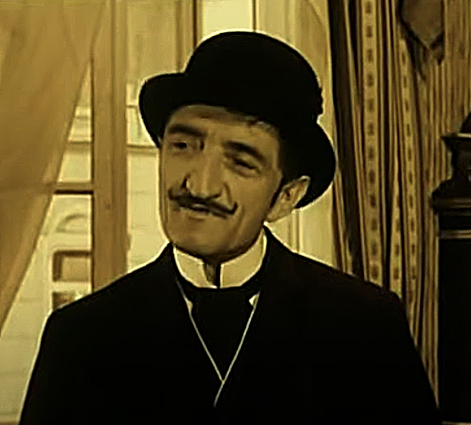
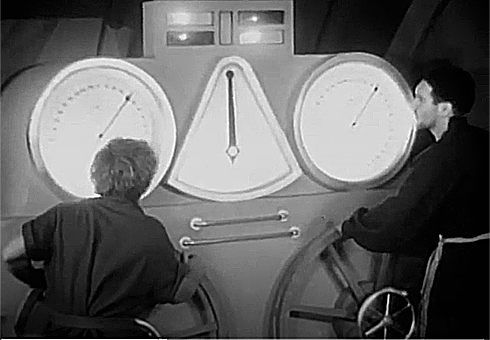
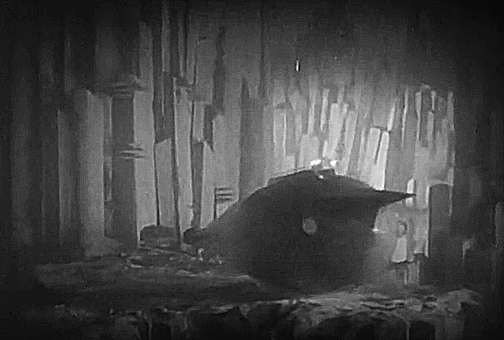
20,000 Leagues Under the Sea {1954}

This definitive big screen big budget adaptation of Jules Verne’s 1870 science fiction novel is a handsomely-staged family adventure mostly remembered for Kirk Douglas star performance and fabulous design. Yet there’s also a surprising degree of Cold War concerns bubbling beneath the surface, making this hugely entertaining version far more interesting than most subsequent adaptations.

Running at just over two hours, the filmmakers sensibly abandon the vast majority of Verne’s self-aggrandising scientific posturing in successful pursuit of huge box office success.

Broadly faithful to the wide-eyed adventurous spirit and plot of Verne, we follow a Professor, his servant and a harpooner, who’re kidnapped at sea by the mercurial and revenge-driven submariner, Captain Nemo, and join him for several escapades onboard his submarine, the Nautilus, while plotting their own escape.

The trio were recruited by the US government in San Francisco, a reassuringly ‘Western’ opening location for the audience, before sailing to the South seas to confirm or deny the existence of a sea monster which has been sinking ships. 

The smooth but shady US recruiting agents want to to beat other nations in capturing this sea monster in order to establish and exploit any military capability it may possess. And thus the 1950’s audience is immediately plunged into an allegory of the post-war arms race with the Soviet Union.

Whereas the French writer Verne had the US government employ Professor Aronnax in order to have a compatriot hero to appeal to Verne’s home readership, here Aronnax is not only valued as a scientific advisor but his nationality offers the cover of political neutrality to a US military expedition in contested overseas territory.

This accurately reflects the use of other nation proxies to project US power and further its national interests during the then developing Cold War and establishes a degree of paranoia which the film later develops when it deploys mushroom cloud imagery. 

However while the film demonstrates the destructive power of nuclear weapons, it also offers an argument in their favour and sympathy to those who developed them. More of which later.

Peter Lorre is a wonderfully cowardly cynic as Conseil, servant to the dull Professor Aronnax, played by Paul Lukas, who’s performance suggests the Hungarian actor fully understands he’s not there to upstage the top-billed star, Kirk Douglas, who plays the two-fisted harpooner, Ned Land.

Already a household name and a double best actor nominee for 1949’s Champion, and 1952’s The Bad and the Beautiful, Douglas perfectly understands the material, and delivers a wonderful cigar- chomping, scenery-chewing and scene-stealing performance, which screams ‘movie star’.

A role tailor-made to demonstrate his athleticism, humour, charisma and boisterous comic ability, Douglas also commits fully to the required singing and dancing, and if he’s not the greatest at either, well I doubt there was anyone on set with the authority or nerve to tell him.

It would be hard to find a scene in his career more joyous than the one where he shares a song and kiss with a pet seal, and their duet is a piece of wonder that is comic, angry and tender. If only Douglas had always been this generous to his co-stars.

And in the fight scenes you have to worry for the stunt team as the 38 year old Douglas, still six years from  playing rebellious Roman slave, Spartacus, seems determined to never pull his punches. At times he seems to be auditioning for a live action version of Popeye the sailor.

Director Robert Fleischer would re-team with Douglas two years later with The Vikings, and in a lengthy career, Fleischer would go on to make 1967’s serial killer drama, The Boston Strangler, 1973’s sci-fi conspiracy thriller, Solyent Green, 1980’s musical remake, The Jazz Singer, and 1984’s Sword-and -Sorcery sequel, Conan the Destroyer.

The mysterious Captain Nemo is revealed by turns a brilliant scientist, ruthless, an intellectual and a sympathetic victim, an ‘other’, i.e. a non-WASP, who serves his ‘guests’ ‘unusual’ food.

All this is true to Verne, but although early film incarnations of Verne’s novel recognised Nemo’s royal identity as an Indian prince, here Nemo is played by white British actor, James Mason. His other major role that year was alongside Judy Garland, in A Star is Born.

Here the template is set for subsequent interpretations to whitewash the role and those who follow in Mason’s footsteps include the very non-Indian actors, Herbert Lom, Michael Caine and Patrick Stewart.

But Mason’s character is more interesting than many later interpretations, with Nemo’s non-white otherness being coded as Jewish, and Nemo’s struggle for revenge on the British empire being substituted for the fight to use nuclear power to defend the state of Israel.

Verne’s Nemo wants revenge for the slaughter of his wife and child by the British during the 1857 Indian War of Independence, but Mason’s Nemo is a widowed state-less refugee, a survivor of slavery in a mine producing phosphate for war weapons. 

We later see the mine which is visibly intended to evoke the Holocaust of the Second World War. Nemo was sent there after refusing to divulge the secret of the power source of the Nautilus, implied as nuclear power. Anyone with a passing knowledge of the European Jewish emigre scientists who worked on the Manhattan Project and its development of the first nuclear bombs, will be able to see the intended parallels.

The world’s first nuclear-powered submarine, USS Nautilus (SSN-571) was delivered to the US Navy in 1955. Thus Nemo using nuclear power for world peace dovetails nicely with contemporary US military policy, he’s also trying to protect his island sanctuary from assault, a haven which can be read as a proxy for the recently established state of Israel. Nemo repeats, ‘There is hope for the future, when the world is ready for a new and better life then all this will someday come to pass in God’s good time.’

There is hope for the future, when the world is ready for a new and better life then all this will someday come to pass in God’s good time.

The giant squid which threatens the Nautilus is direct from Verne’s novel, but allied to the theme of nuclear power aligns 20,000 Leagues with sci-fi monster movies of the day, which saw humanity threatened by insects and other creatures mutated to enormous size by nuclear sources.

Nuclear paranoia of sci-fi classic, The Day The Earth Stood Still, had been released in 1953, and Ray Harryhausen’s 1955 The Beast From 20,000 Fathoms, saw a hibernating dinosaur released by an atomic blast to terrorise the world.

Released the same year as 20,000 Leagues, Them! saw huge radiation-affected ants bring terror to the US, and Godzilla stomped into cinemas in 1954. The US was threatened by aliens in 1953’s It Came From Outer Space, and by giant spiders in 1955’s Tarantula! Whether aliens, monsters or giant insects, and whether nuclear powered or not, 1954 was hotbed of paranoia about the Soviet nuclear threat.

It must also be noted that 1954 was the height of McCarthyism, the Red Scare, and the communist ‘witch-hunts’ in Hollywood. Ever the patriot, Walt Disney had testified before the HUAC hearings in 1947, and it’s interesting that the ultimately sympathetic Nemo argues in favour of the benefits of nuclear power, and the film ends on an audience-reassuring note in faith in god, science and the future.

The nuclear subtext is dressed up in art direction and special effects and 20,000 Leagues deservedly won Oscars  in both those categories, as well as scoring a nom for the editing. 

The sets, model ships and submarines are great and the locations are epic, representing Hollywood at the top of its game. If the Nautilus is more a metallic fish than the tube of Verne’s imagination, the submarine is a gorgeous steampunk creation, with brass fittings, red upholstery and a magnificent organ. And long before Spielberg’s 1993 dinosaur adventure Jurassic Park, the animatronic work of the giant squid is spectacular.

Although stock footage of whales and dolphins is occasionally mixed in with scenes on deck clearly filmed in a studio, there’s an impressive commitment to the underwater diving sequences, made when aqua diving was a novelty not an easily-accessible holiday activity. 

These sequences were filmed in the photogenic waters of the Caribbean, as was the silent 1916 version of 20,000 Leagues, and if that gives some sections the air of a travelogue, it’s worth remembering foreign travel was an expensive luxury at the time and this form of visual escapism was very much intended to drive box office. 

Still, the shark attack is very impressive and the location work helps retain Verne’s tone of wide-eyed wonder and his view of the sea as a resource to be worked. Mind you, the man-handling of crabs and giant turtles by the underwater performers wouldn’t be allowed today.

Sadly the same couldn’t said for the depiction of the South sea islanders, who Nemo describes as ‘cannibals’, and whose appearance is played for laughs, and their portrayal is no less sophisticated than similarly portrayed people in the Pirates of the Caribbean franchise. 

And though Nemo drolly asserts the ‘cannibals’ right to attack the Nautilus, true to the book he then defends the Nautilus with electric shock treatment. 

Similarly to the Pirates of the Caribbean movies, there’s no denying the scale of the action is impressive, perhaps ever more so than then, in our CGI era. And seeing Douglas run through the jungle reminds us of his son Michael, in 1984’s Romancing the Stone.

Despite the film throwing a series of grandly staged set-pieces at us, it’s possible a modern multiplex audience may find the pace plodding. Yet the crowd-pleasing ticking clock plot and punch-ups of the finale are pure Hollywood entertainment, harking back to Flash Gordon serials of the 1930s, and anticipating the missions of 007 of the following decades.

And though the final scene of the novel is downbeat, the filmmakers compromise by cleaving closely to Verne yet also providing a note of uplift, in which Kirk Douglas’s seal is seen to survive, and Nemo is given the last word.

To do this a cinematic sleight of hand is used which would be echoed two years later in Elvis Presley’s big screen debut, Love Me Tender. The enduring fascination with and longevity in popular culture of Verne’s greatest creation, Captain Nemo, lies with his mercurial nature which allows for continual reinvention. However, never did I think when I began writing this that I would end with a comparison with the King of Rock ’n’ Roll.

Available on Disney+.
Nemo’s Fury

Nautilus (2000)

A submarine crew from an apocalyptic future collides with present-day terrorists in this low rent action adventure mash-up of superior sci-fi fare. Functional at best with a lack of flair in cinematography, design, acting and writing, the enterprise is haunted at every turn by the spirit of Hollywood auteur, Ed Wood.

Taking its name from the submarine which featured in the classic novel 20,000 Leagues Under the Sea, by father of the science fiction Jules Verne, this seemingly hastily assembled affair unfairly subtracts rather than adds to his reputation. However the author may have been tickled by the time travelling plot, and the way his treasured eco-themes survive intact.

In the Mad Max-alike eco-ravaged future of 2099AD, we’re introduced to the crew of the Nautilus submarine, including its widower captain and his glamorous daughter.

Before you can say Star Trek IV: the Voyage Home, or even think of mentioning Terminator 2 or 1980’s The Final Countdown, our heroes activate a time travelling device and take the submarine back to the present to prevent a drilling exercise called The Prometheus Project and so save the future from eco disaster.

He is channelling Star Trek’s Square-jawed grey-haired Captain Pike, while his all-action gun-toting, truck-driving and scuba-diving daughter is obviously modelled on the then hugely popular video game character Lara Croft.

She’s played by Miranda Wolf with the talent of an actress whose other credits include the role of Prisoner #1 in a spin-off reboot of talking car TV show, Knight Rider, and a role in another submarine thriller where she’s billed as Lt. Hickey, which may be a reference to Corporal Hicks of James Cameron’s Aliens, or a cruel and tasteless in-joke.

Father and daughter run into a team of terrorists trying to steal Prometheus which is being defended singlehandedly, but with twice the biceps of the rest of the cast combined, by Richard Norton.

The former kick boxer plays a smug two-fisted mercenary, with whom our time travelling submariners reluctantly team up. Norton seems cast as close as the producers could afford to Kurt Russell or Bruce Campbell, which is to say, not close at all.

The central oil rig location is impressive as are the underwater sequences which presumably hoovered up the budget, there doesn’t appear to have been much petty cash remaining roost for the far from special effects.

I did like the submarine itself, though if you told me it was left over models of the Seaview submarine from 1960s TV series Voyage to the Bottom of the Sea, I’d believe you.

There’s some footage of a very real aircraft carrier and it’s jets, and I couldn’t tell if it was filmed with permission, stock footage, or test shots from the 1986 blockbuster Top Gun, filmed by a disgruntled and hungover 2nd unit before Tony Scott came onboard to direct Tom Cruise et al.

Director Rodney McDonald previously made submarine terrorist thriller, Steel Sharks, which also featured Wolf, and there’s no faulting his enthusiasm for this project. And it’s possible to suspect the producers dreamed this might be a pilot for a spin-off TV series, which not surprisingly has never materialised.

And given Nautilus is firmly mired in the bottom-feeder end of the action market, we’re gratefully spared a gratuitous shot of naked breasts which I suspected to see swimming over the horizon at any moment. It’s remarkable this is less sleazy than 2013’s Star Trek Into Darkness. This is generally a sexless experience with barely a sniff of romance.

What I did appreciate about Nautilus was the gonzo makeshift feeling of ‘let’s put the show on in the barn’, with the production having wrangled maybe a weekend’s shooting on a scheduled for demolition oil rig, found some stock footage, added the scraps of script held together by cliche, sellotape and willpower, and somehow managed to conjure up a coherent movie.

Despite its many long shortcomings this is a triumph, of sorts, of enthusiasm, graft and grift, over ability. And that is in itself something to celebrate.

Nemo’s Fury

DUNE (2021)

Extraordinary and epic, this new adaption of Frank Herbert’s classic 1965 sci-fi novel doesn’t just demand to be seen on the biggest screen possible, it questions whether there exists a screen large enough to do justice to this Lawrence of Arabia meets Apocalypse Now space opera.

Directed with a relentless majesty by Denis Villeneuve, the Canadian takes the tremendous sense of scale he essayed in Blade Runner 2049 and beats it mercilessly into a cocked hat as he crafts a tale of cosmic proportions.

Assembling the considerable weapons of the Hollywood arsenal such as a huge budget, state of the art special effects, a pantheon of big name stars and a well known intellectual property, Villeneuve allies them to his astonishing vision and outstanding technical ability to deliver thumping action and spectacle on an out-of-this-world scale.

Starring as Paul, a young man is stripped of his wealth and status, and outcast on a dessert planet where he begins to develop his mystical mind control powers, Timothee Chalamet further cements his heartthrob-with-talent status with a nuanced performance geared to character development.

If this setting all sounds familiar then you won’t be surprised to find there’s also an evil all-powerful empire and a brutal lord as the villain who commands an army of faceless stormtroopers.

Dune was one of the key texts influencing Star Wars supremo George Lucas, but where he leant into the comedy, Villeneuve’s broadly faithful and respectful version embraces the slowly unfolding tragedy.

With its litany of betrayals and battles Dune is at times extraordinarily exciting, yet the script has time to explore contemporary concerns such as resource scarcity and colonialism. It’s a film rich with its own internal history and yet also is remarkably intimate, exploding with charisma as humanity blooms across the desert with romance, loyalty and love to spare.

Paul’s dreams are filled with visions of a beautiful woman of the desert planet Arrakis, as she’s played by Zendaya this seems perfectly reasonable for a person of his age. And the accomplished actress brings much needed humour as she casts her lines with a delivery even more dry than Arrakis. Fans may feel short changed by her screen time, but her charisma allows her to make an impression even among this most manly of company.

Paul’s troop of macho role models are played by Oscar Isaac, Josh Brolin, Javier Bardem and Jason ‘Aquaman’ Momoa, and it’s the latter who’s swagger is closest the film has to a Han Solo character. Opposing them is the considerable muscle of Dave Bautista and Stellan Skarsgard.

This remorseless machismo is partially offset the icy presence of Charlotte Rampling, and a ferociously commanding Rebecca Ferguson, who’s quite astonishing at conveying the complex layers of emotions and pain involved in being Paul’s mother as she guides him to his destiny.

Meanwhile Sharon Duncan-Brewster is given the gender-flipped role of Dr. Liet-Kynes, and makes it her own with a subtly powerful performance of openly guarded wit and grace.

Villeneuve treats his audience as adults by throwing in Herbert’s vocabulary of ‘Fremen’, ‘Mentat’, ‘Bene Gesserit’ and so on, but this is no more puzzling than Sith, Jedi, and so on. Besides, the storytelling is so well rendered you could follow the story without the dialogue. Puny humans being terrorised by giant sand worms looks the same whatever language the characters are screaming in.

Plus with the outrageous phallic symbolism of the hero having to master an enormous worm as proof of his manhood, it’s difficult not to imagine Herbert smuttily giggling to himself as he conceived the idea, and laughing out loud as he dared himself to write it.

In a film of wondrous design, it’s the rotating winged aircraft resemble mechanical insects, called ‘thopters, which make you gasp, and stand alongside the Eagle craft of TV’s Space 1999 as a classic of sci-fi iconography.

Complementing the monumental cinematography of Greig Fraser, who’s work can next be seen in next year’s superhero neo-noir, The Batman, Hans Zimmer’s score is a teeth-rattling achievement, even for this noted composer of titanic-sized themes, and Zimmer seems to have invented a new language of noise, which blends seamlessly into the equally unique and thunderous soundscape.

David Lynch’s disowned 1984 film version has been not ungenerously described as ‘a glorious mess’. But I’ve respect for its imaginative leaps of hideous design, and it scores over this version in that it manages to complete the book in one sitting, whereas Villeneuve only delivers the first half or thereabouts of the book.

However the sheer Everest-like enormity of Villeneuve’s Dune ensures it never feels like half a film, instead it feels more like a myth fashioned in primordial clay and brought to life by the lightning of the gods. This is a planet-stomping titan of a movie, and for us not be presented with part two would be a crime against cinema.

Nemo’s Fury

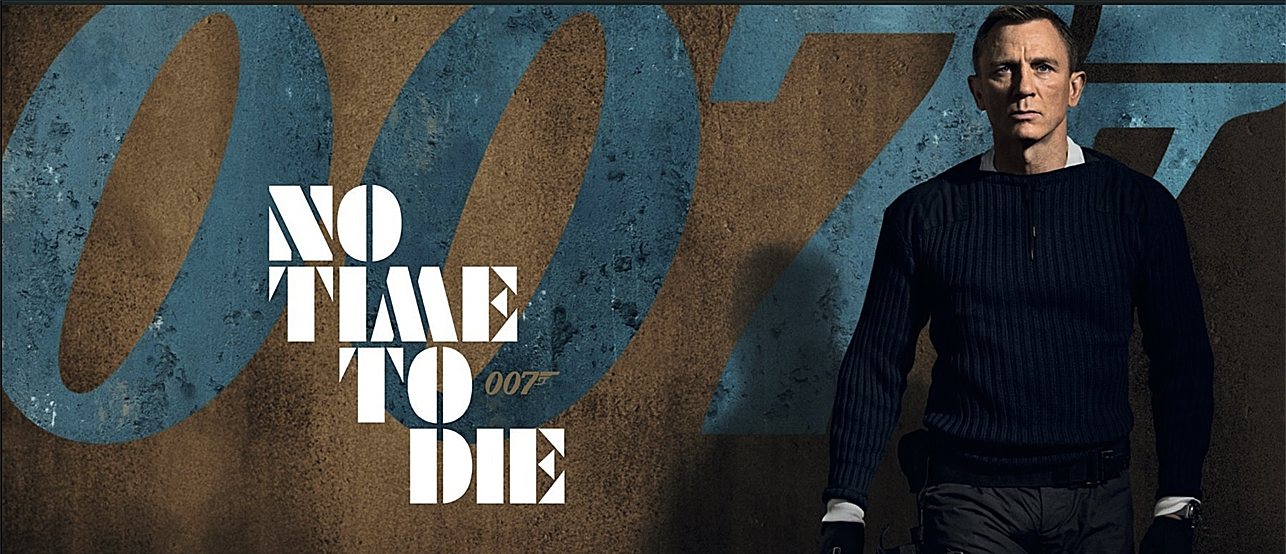
No Time To Die

Daniel Craig’s much delayed swan song as the world’s most famous spy concludes in spectacular style, proving once again that when it comes to being James Bond, nobody does it better.

Bond has always tailored himself in the cultural clothing of the time and now he’s refit for the #MeToo era, and his latest mission sees him not only saving the world but also being held to account for his litany of misogyny going back to the first Bond film, 1962’s Dr. No.

And the most powerful asset of this globetrotting action thriller is Craig’s willingness to the essay 007’s psychological pain, a bravura performance from a script which leans purposely on aspects of Greek tragedy.

Classical allusions include a scientific project called Herakles, a henchman nicknamed Cyclops, and Ralph Fiennes’ ‘M’ suffering an enormous bout of hubris. Meanwhile the traditional pre-title sequence plays as a prologue setting out the key characters as well as the more standard 007 action set-piece. And later we’re treated to a 21st century spin on a gouging of the eyes.

These elements are no cheap grab for cultural gravitas, but are embedded in the script’s DNA. Nor are allusions to myth and legend new to Bond, feel free to read about Skyfall placing Bond on a pedestal next to King Arthur, here.

Bond suffers emotional and physical punishment which leaves him bruised, bloodied and bereft. And the closer Bond gets to happiness the more his suffering and the dramatic stakes increase. It’s a dilemma which illuminates the dark heart of Bond.

Since Judi Dench’s ‘M’ called Pierce Brosnan’s Bond ‘a misogynist dinosaur’ in 1995’s Goldeneye, the franchise filmmakers have grappled with the sexism of Bond the man, and the franchise. However No Time To Die sees a reset of values, and Bond is made to suffer a series of humblings at the hands of a pair of high-achieving younger female agents.

British star Lashana Lynch and Cuban-Spanish actress Ana de Armas excel as play agents of MI6 and the CIA respectively, they’re equally as ruthless and skilled as Bond, and each essay a very different brand of humour. Plus the former answers the question, could we have a non-white and/or female 007, with a resounding yes.

This is all welcome but I wasn’t expecting for Bond to apologise and then attempt to atone for a lifetime of sexist behaviour. This would be a jaw-dropping move in any popcorn blockbuster, never mind the 007 franchise. Don’t assume this means Bond has gone ‘soft’. When the need arises he remains an absolute cold-blooded assassin.

With Rami Malek’s terrorist mastermind called Lyutsifer Safin plotting biological warfare, this leads to a not-so-subtle allusion to the dangers of Bond’s life of promiscuity. This is a long way from 1987’s The Living Daylights which arrived in during the AIDS epidemic, where the response of Timothy Dalton’s Bond was to keep the number of his sexual partners below three.

Having Bond confront the effect of his long-standing toxic relationship with women is presumably intended to wipe clean Bond’s ledger, a necessary step in the characters reinvention if he wants to successfully navigate the changing cultural landscape.

Billie Eilish’s haunting Grammy-winning title song sets the tone for this emotional smackdown, and the pre-title sequence offers a nod to Dr. No, before updating the long-since retired silhouettes of dancing naked women, with images of a fallen Britannia.

Craig carries us through this process with an extraordinary feat of acting, unlike anything we’ve seen in this franchise before. Having once rashly promised to ‘slash my wrists’ rather than play Bond again, the actor seems energised by the prospect of putting Bond to bed.

He strains every considerable muscle to deliver a performance which is not only hugely physically demanding for a man of our age, but dramatically impressive, wryly funny, and profoundly emotional. Craig gives it all he’s got left in the tank, and absolutely smashes it among the enormous explosions, high-speed chases and ferocious fights.

The car chases have a tremendous bone-shaking authenticity, and the four – spot them – different variations of Bond’s Aston Martin car, will have petrolheads purring with avaricious delight. Plus we have a return to the gadgets that Ben Whishaw’s ‘Q’ once dismissed.

Shot through with all the gun-toting glamour you’d expect, we see 007 gunning for Safin who operates from a secret lair worthy of the great Bond villains. Frankly we’ve been long overdue a proper Bond villain threatening death to millions of people, and the return to world-saving stakes are something of a relief.

Craig was cast as 007 in response to the Jason Bourne series. And having seen off that box office threat, the producers have turned their attention to Bond’s current box office adversaries, Tom Cruise’s Mission Impossible movies.

Similar to Cruise’s agent Hunt, Bond is now the leader of a diverse if undeniably posh and British team, with Naomie Harris, Whishaw, and Fiennes reprising their roles as Moneypenny, ‘Q’ and ‘M’, and they provide plenty of humour as Bond’s surrogate family.

Legacy and family are the key themes of this mission, not least with the return of Christoph Waltz as 007’s foster brother and arch-enemy, Blofeld.

Boy, this film does not disappoint. At an extravagant 163 minutes it’s the longest Bond film yet, and uses it’s running time to bring Craig’s five film 007 tenure to a satisfying climax, and comes extremely close to allowing him to depart on an all time high.

The end credits conclude withe familiar promise James Bond will return, and with Craig leaving the series in the rudest of health I can’t wait to see the face of the future.

Nemo’s Fury

James Bond 007: Top 10 villains

10 Francisco Scaramanga (Christopher Lee)

The Man with the Golden Gun (1974)

At 6 ft 4 in tall, Lee brings stature as well a smooth sophistication to his role of a former KGB agent turned world’s best assassin who charges one million dollars per kill.
His favourite weapon is a gold cigarette and pen combination which transforms into a pistol, and he flies a car with detachable wings.
As well as commanding a deadly martial arts academy, he has the murderous butler Nick Nack, played with venomous glee by the diminutive Hervé Villechaize, to assist him. And the lair is an idyllic Far East island armed with a solar-powered laser cannon.
But Lee is too relaxed to intimidate the audience, and the funhouse through which Scaramanga pursues his victims is a too much ‘end of the pier entertainment’, and his underwhelming evil plot to auction off a solar energy device to the highest bidder is less world dictator and more ripoff energy salesman.

9 Tiago ‘Raoul Silva’ Rodriguez (Javier Bardem)

Skyfall (2012)

Many women have flirted with Bond in his career, but none with the same degree of outrageous camp as this former MI6 agent turned cyberterrorist.
We’re never entirely sure if Silva wants to kiss or kill 007, but the film certainly questions just how far Bond is prepared tot go to defend Queen and country.
Silva targets his former colleagues at MI6 in revenge against Bond’s boss, M, against whom he holds a homicidal grudge after a faulty cyanide capsule left him needing some botox and dental work.
Attacking Bond with a tube train demonstrates imaginative theatrical flair, and a logistical ability not normally associated with London transport.
However there’s a handful of henchmen rather than an army, and as his ruined city lair lacks luxurious comfort and a shark tank, it has to compensate with a decent internet connection.

8 Gustav Graves / Colonel Moon (Toby Stephens / Will Yun Lee)

Die Another Day (2002)

Pierce Brosnan’s last outing as 007 sees him go head to head with millionaire entrepreneur Gustav Graves, an extreme sports enthusiast who’s also the alter ego of Colonel Moon, a North Korean military officer who‘s used gene therapy technology to change his appearance. However neither identity are terribly threatening.
His arctic gin and ice palace lair may lack a shark tank and underfloor heating, but it does have some nifty snowmobiles, a soft top car armed with a machine gun, and a deadly ice chandelier.
He also has a deadly henchwoman in Rosamund Pike’s aptly named Miranda Frost.
Diamond smuggling plays a part in Graves’ plot to allow North Korean troops to invade South Korea, and potentially trigger a third World War.
So at least Bond has something else to keep his hands full, when not tangling with Halle Berry’s high-diving CIA agent, Jinx.

7 Dr. Kananga / Mr. Big (Yaphet Kotto)

Live and Let Die (1973)

Roger Moore’s first outing as Bond was very much down to earth compared to the out of this world thrills of Moonraker, and finds himself up against a Harlem gangster, whose grand scheme is to become the monopoly supplier of heroin in the US.
Yes it’s a serious problem but it’s not quite in the same world-saving league as Sean Connery’s movies or even Moore’s later ones.
However the villain’s lair does contain a shark tank, so bonus points for that, and the dastardly plot is backed up by Jane Seymour’s beautiful tarot card reader called Solitaire, a coffin of venomous snakes, a team of henchmen driving speedboats through the Louisiana swamp, and a pool of hungry crocodiles from which Bond must hotfoot it away.
Kotto’s formidably charismatic presence more than compensates for his characters earth-bound ambition, and the deadly prosthetic arm of his primary henchman, Tee Hee, is no laughing matter.

6 Alec Trevelyan (Sean Bean)

GoldenEye (1995)

In his first outing as Bond, Pierce Brosnan has to face a villain who’s not only 007’s equal, but also a former friend and fellow British spy, 006, he allows the film to ask the question, what if Bond were the bad guy?
Bean is terrific as the agent-turned-villain, swapping his native Yorkshire accent for something more upper class, and enjoys taunting 007 as he rockets around post-Communist Russia in a fabulous lair, a nuclear missile-carrying train, from where he plots the theft of the technology controlling a super-powerful satellite-based weapon.
Yes, there’s a conspicuous lack of an army of henchmen, however his formidable henchwoman Xenia Onatopp, is a breathtaking fighter pilot who kills her enemies with her thighs.
Sadly Trevelyan doesn’t want to rule the world or re-start civilisation, and though he’s not the last former spy wanting revenge on the British government, he is the first, which boots him up the list.

5 Auric Goldfinger (Gert Fröbe)

Goldfinger (1964)

A villain so memorable he’s given the ultimate honour of being the first villain to put his name to a Bond film’s iconic theme song, performed by the awesome Shirley Bassey, with a thunderous take-no-prisoners conviction.
Goldfinger does take prisoners however, and enjoys tying them to a gurney and slicing them with a laser. But he doesn’t expect them to talk – or sing – while it’s happening.
German actor Fröbe plays the golf cheat bullion dealer with a carnivalesque energy, and as well as being assisted by a fleet of foxy female assassins led by Honor Blackman’s Pussy Galore, he has the bowler-hat throwing Oddjob, as a henchman.
However, despite having enough gold to drown his enemies in the stuff, Goldfinger has no real lair to speak of, and his lacklustre ambition to irradiate the US gold reserves is closer to a get rich scheme than world domination, making Goldfinger a silver medalist of villainy.

4 Karl Stromberg (Curd Jürgens)

The Spy Who Loved Me (1977)

A megalomaniac who prefers fish to people and is vaguely based on Jules Verne’s Captain Nemo, Stromberg lives in a luxurious space-age underwater lair called Atlantis.
A city-sized submersible, it comes complete with its own shark pool, to whom Stromberg despatches those underlings who fail him.
I miss the days when Bond villains kept sharks as pets.
However Stromberg’s other toys include a helicopter gunship, a fleet of mini-subs, and an enormous new supertanker big enough to swallow British and Soviet ballistic-missile submarines.
As well as the essential army of henchmen, he’s the first Bond villain to employ Jaws to do his dirty work.
Meanwhile his nefarious plan is to trigger a third World War and then recreate a new civilisation underwater. And that’s the kind of barking mad scheme that the villains which follow could take a few pointers from.

3 Dr Julius No (Joseph Wiseman)

Dr. No (1962)

A mad scientist possessing mechanical hands and a nuclear powered luxury secret lair on a Caribbean island, the very first Bond villain remains one of the best.
Urbane, sophisticated and with a taste for giant fishtanks in the dining room, Dr. No is a former treasurer of Chinese gangsters who after absconding with a stash of gold is now working for SPECTRE, and using a nuclear radio beam to destroy US missiles.
Dr, No insists his henchmen are equipped with cyanide-laced cigarettes so they can suicide if they’re caught, and arms them with a flame-throwing tank disguised as a dragon, as well as more standard weapons such as machine guns and err, tarantulas.
Believing criminal brains to be always superior, Dr. No offers Sean Connery’s 007 a job, before suffering one of the great dramatic Bond villain deaths, boiling in his own nuclear reactor.

2 Hugo Drax (Michael Lonsdale)

Moonraker (1979)

A bearded billionaire entrepreneur with dreams of colonising space seems far more relevant today than it did back in 1979, when this Bond baddie boldly went where no 007 villain had been before.
Roger Moore’s Bond is forced to blast off into orbit to prevent Drax from shooting a nerve agent at planet Earth, poisoning the atmosphere and killing off the human race.
And that’s only part one of the plan. After wards he‘s set to rebuild humanity in space with carefully selected humans, with many of his new ‘master race’ being highly attractive young women.
Helping Drax build this space nirvana is an army of laser rifle-toting astronauts, as well as was one of the greatest henchmen of the series, the metal-teethed giant mercenary assassin, Jaws.
However Drax’s dastardly plan is thwarted when Bond shoots him with a poisoned dart, after which Bond attempts re-entry with beautiful CIA agent, Dr Holly Goodhead.

1 Ernst Stavro Blofeld (Donald Pleasence)

You Only Live Twice (1967)

Boasting an army of henchmen housed in a hi-tech volcanic mountain lair which includes a heliport and monorail plus a pool of deadly piranha fish, the first proper appearance of bald and facially scarred arch-enemy Blofeld, shows him in all his iconic white cat-stroking, and Chairman Mao-suited glory.
The ruthless head of terrorist organisation SPECTRE not only overshadows every following Bond villain, but set the bar for all the world conquering spy villains everywhere.
The Nottinghamshire-born Pleasance brings a wonderfully articulate malevolence to the role, which was written by kids author, Roald Dahl, who knew a thing or two about creating memorable baddies.
And Pleasance’s reward is to have been endlessly copied, spoofed and parodied, most notably by Mike Myers as Dr Evil, in his Austin Powers comedy spy franchise.
Blofeld is being paid by China to provoke nuclear war between the US and the USSR, and what’s his price to execute this evil plan? One hundred million dollars.

Mike Meyers as Dr Evil

Nemo’s Fury

The Stolen Airship (1967)

Magnificent boys in their flying machine

A delirious fusion of live-action and animation very loosely based on Jules Verne’s 1875 novel, The Mysterious Island, this glorious fantasy is a heady kaleidoscope of boys’ own adventure, wild invention, political satire and knockabout action, with occasional moments of whimsy and a huge amount of humour.

Verne’s novel is set during the US Civil War and sees a group of Union prisoners escape by hot air balloon to the titular Pacific Ocean island. However Czech film director, Karel Zeman, often called the ‘Czech Melies‘, uses Verne as a jumping off point for madcap escapades as a group of schoolboys makes a bid for freedom from an oppressive and corrupt regime.

Brave, bright eyed, loyal and combative, they steal an airship and fly to a remote island, and in their absence are tried in their absence and sentenced to hang.

Zeman’s energy and imagination are boundless and we’re treated to a multitude of Heath Robinson-style devices and flying contraptions, as well as Mission Impossible-style face masks, sharks, shotgun-toting boot-makers, dancing ducks, and pirates.

Heath Robinson, I presume?

Among the fights, physical humour and acrobatic antics, a woman castaway becomes allies with boys and together they run rings around the men trying to subdue them.

Old buoy; Captain Nemo

In the middle of the madness, and lifted from The Mysterious Island, there’s a brief meeting with Verne’s most memorable creation, Captain Nemo, who’s portrayed as a tech-loving Methuselah, while his submarine, the Nautilus, is handily labelled ‘Nautilus’.

Ideas tumble over each other at dizzying speed in a bewildering mix of illustrative styles, musical interludes, and stock footage.

Much of Zeman’s style may seem familiar to you and that’s likely due to his influencing not only his countryman, the famed animator Jan Svankmajer, but also to the filmmakers Terry Gilliam, Tim Burton, Ray Harryhausen, and Wes Anderson.

Spies are us

More specifically, The Stolen Airship, with it’s love of steampunk tech, a fairground rumpus, zeppelin, an incompetent bowler-hatted spy, and with a corrupt official and his glamorous wife bearing more than passing resemblance to Baron Bomburst and his wife, it seems to have been a considerable influence on the Cubby Broccoli’s 1968 family musical fantasy, Chitty Chitty Bang Bang.

I suspect the screenwriter of that film, Road Dahl, would have enjoyed this occasionally macabre and surreal tale with its shades of Kafka. And Zeman’s merry mocking of social conventions and keen eye for the absurdities of life also takes aim at pomposity, greed and stupidity.

Scrumptious? Moi? Truly?

His film is undeniably underpinned by the thrill of freedom, and is unmistakably political in its ruthlessly condemnatory of the military, which along with the corrupt bureaucracy and a surveillance society, are ridiculed throughout.

And there’s also a great deal of courage in Zeman’s needling of authority as this was made in the period immediately before The Prague Spring, the period of political liberalisation and mass protest in the Czechoslovak Socialist Republic which ended abruptly at gunpoint on 21 August 1968, when the USSR invaded the country to suppress the reforms.

Absurdly charming, and occasionally just a little bit saucy, I watched it in its native Czech language without subtitles and so lost some of the nuance and detail.

What I received in perfect clarity was Zeman’s breathless collision of invention, cynicism and optimism. An absolute delight throughout, The Stolen Airship beat The Beatles’ psychedelic animation Yellow Submarine, to the punch by a year, and I loved every extraordinary minute of it. Please watch.

Nemo’s Fury

Mysterious Island (1961)

A showcase for the sublime talent of stop-motion maestro Ray Harryhausen, this sci-fi fantasy family adventure sensibly swaps the plodding civilisation building of Jules Verne’s source novel for monster action and romance.

Faithful to Verne’s novel, the story begins during the US Civil War where we see a handful of men escape the war in a hot air balloon and cast by a storm to a Pacific Ocean island. And it’s at this point the film and the book depart ways, only to be reunited towards the end with the appearance of Verne’s greatest creation, the legendary sub-aquatic explorer, Captain Nemo.

Nemo introduces the castaways to the Nautilus

Though not related in to Disney’s 1954 adaptation of 20,000 Leagues Under the Sea, which is Verne’s other novel featuring Captain Nemo, this version of The Mysterious Island is very much an unofficial sequel in tone and style, and was clearly intended to capitalise on the box office success of previous film, even if the $2m budget of Mysterious Island pales next to the $9m cost of Disney’s movie.

Very much in the Disney mould of the time, the men are suitably manly, the women exist to be rescued and romanced, and everyone is white, except for Neb who is black. He is however promoted from being the freed slave of Verne’s book to a ranking soldier, albeit only a corporal. There’s no pet dog or adopted orang-utan as in the novel, and I doubt Disney would never have failed to include those opportunities for cuteness.

A British production shot at Shepperton Studios, England, it’s directed by Cy Endfield, whose most enduring work is 1964’s action adventure, Zulu, a period war movie set during the 1879 Anglo-Zulu War in south-eastern Africa. Well worth a watch, Zulu features the terrific Stanley Baker, a rousing Welsh choir, and is responsible for introducing Michael Caine to the world.

In Endfield’s hands Zulu is a Western in all but name, with British imperialism taking the place of American imperialism. And Enfield similarly delivers Mysterious Island as a Western, and has the story play out – at least until Captain Nemo appears – as disparate frontiers-people coming together to face local challenges to survive. Only with mutated creatures are the principle threat, rather than ‘injuns’.

Plus the pyrrhic endings of both films are free of triumphalism and prefer to strike a downbeat note, suggesting a disillusionment with and a critique of the development of the US, viewing it as an errand of violence, exploitation and squandered utopia.

Sting in the tale

It’s no surprise these are works of Endfield, who was exiled in Europe as a result of being blacklisted by HUAC*.

*HUAC - The House Committee on Un-American Activities - an investigative committee of the United States which investigated alleged subversive activities of citizens and organisations suspected of being communist.

The monsters are crafted by ingenious care and dedication by the peerless stop-motion master, Ray Harryhausen, who enjoyed a lengthy partnership with American producer Charles H. Schneer, one which lasted up to Harryhausen’s final creature feature, 1981’s Clash Of The Titans.

Harryhausen introduces into Verne’s work an creatures of enormous size, including a flightless bird, a crab and giant bees, the latter also appearing in Dwayne Johnson’s 2012 adaptation, Journey 2: The Mysterious Island.

As well as the stop-motion work, the production uses scale models and giant props such as a crab’s claw. Plus some lovely matte paintings complement the decent location work in Catalonia, Spain.

Lady Fairchild is aiming to survive

The island’s volcano provides lots of bubbling lava which is always great to see on screen, especially when it flows in torrents in the explosive finale. And the underwater photography is fun, as is the ‘incredible’ electric gun.

Plus the lost sunken city finally gives the film something of the sense of the epic, as does the battle with another great Harryhausen addition – a giant octopus. Meanwhile the exterior of Nemo’s submarine, the Nautilus, owes far more to Disney than to Verne.

Leela, sorry, Elena

In contradiction of Verne’s strict ‘no gals allowed’ policy, a Hollywood sensibility catapults a pair of women onto the island in the glamorous upper class form of Lady Mary Fairchild and her niece Elena, whom the balloonists find washed ashore.

As Lady Fairchild, Joan Greenwood is wonderfully, assertive and courageous in cut-glass accent, and the notorious Rank Films starlet, Beth Rogan, is generally either screaming or swooning, and ends up dressed as Leela from TV’s Dr Who. There’s little room for working class women in the world Verne.

South African-born actor, Dan Jackson, appears as Neb, the only non-white character, and the first of the balloonists to be attacked on the island. Then true to the book, he’s relegated to the domestic sphere while the other four men go off manly adventuring.

But least in this film Neb has the two ladies to keep him company, which must be something of an improvement in circumstance, for in the book he’s left home alone with an adopted orang-utan called Joop.

Neb’s dead, baby. Neb’s dead (almost)

Michael Craig plays Captain Cyrus Harding* as a stolid leader of men, who relies on his rank to lead, instead of any noticeable charisma. Far from being the genius engineer of the book, Harding breaks the balloon’s only control device and is therefore responsible for casting them across the ocean.

*Smith in some versions

Once on the island Harding immediately imposes martial law, and ‘drafts’ into his command the two Confederate balloonists: Sergeant Pencroft and Gideon Spilitt, who serve as light comic relief to Harding‘s gruff leadership.

Firmly men of the Union in the book, they’re now Confederates, presumably to help garner an audience in those US states who were on the losing side of the war.

Having previously originated the role of Riff in West Side Story on Broadway, Michael Callan is enthusiastically energetic as the romantic lead, Herbert Brown and makes an attractive pairing with Beth Rogans Elena.

Best remembered for his role as an agitated police inspector in Peter Sellers’ Pink Panther franchise, Herbert Lom appears as Nemo. Presumably the budget didn’t stretch to a return for Disney’s Nemo, James Mason.

Lom’s late entrance was echoed in 2018’s superhero movie Aquaman, and the Czech-born actor’s accent gives Nemo a sense of being ‘other’, though he doesn’t reveal he’s the deposed Prince Dakkar of India, as happens in the novel. And instead of having a grudge against the British Empire, Nemo is trying to solve the world’s food crisis.

Nemo and the castaways. We’ve circled Neb’s shoulder so you can see him

As with Harryhausen’s other classic productions such as 1958’s The 7th Voyage of Sinbad, and 1963’s Jason and the Argonauts, the musical score was composed by Bernard Herrmann. Though it’s more than adequate for this film, the Oscar-winning composer for Hitchcock’s Psycho and Scorsese’s Taxi Driver would probably be the first to agree this is not among his finest work.

Mysterious Island hasn’t aged terribly well, the pace will seem slow for a modern action audience and the effects will feel very creaky and stiff. And they don’t represent Harryhausen’s finest work which is undoubtedly the skeleton fight in 1961’s Jason and the Argonauts.

Nevertheless Harryhausen’s work retains its charm and should be appreciated for the craft and dedication involved in its making, and of course it’s part of an important chapter of the history of movie special effects. Plus they anchor this still very watchable film, one of the superior adaptations of Verne’s book.

Nemo’s Fury

Mysterious Island (1951)

Treating Jules Verne’s 1875 novel The Mysterious Island as a leaping off point, this black and white sci-fi adventure serial of 1951 is a throwback to two decades earlier and the days when Larry Buster Crabbe took to the skies as Flash Gordon.

Yes it’s preposterous and silly, yet it’s also daftly enjoyable, due in large part to its enthusiastic and impressively straight-faced cast, as well as for possessing none of Verne’s reluctance to embrace cosmic romance.

Verne’s book is a semi-sequel to his 1871 novel, 20,000 Leagues Under The Sea, and is notable for featuring Verne’s most celebrated creation, the mercurial billionaire genius inventor and subaquatic explorer, Captain Nemo.

The novel: hot air

Set during the US Civil War, the book sees a group of Union prisoners escape by hot air balloon to the titular Pacific Ocean island, where Captain Nemo assists their survival.

This fifteen chapter movie serial from Columbia Pictures is subtitled ‘Captain Harding’s Fabulous Adventures’, with the upright engineering officer and leader of the balloonists is played with no-nonsense square-jawed heroism by Richard Crane.

It all begins faithfully enough, and spending a lot time at the Civil War allows for plenty of opportunity to hook in any Western fans who may be watching by mistake.

 My name is Darth Vader. I am an extraterrestrial from the planet Vulcan

Anyway, five intrepid men and a dog escape in a balloon from a stockade, and when a storm carries them to an island they have to – check notes – foil an alien invasion.

As Verne’s novel is a bit of a slog, I can’t help but think had the author known as the ‘Father of Science Fiction‘ built this kind of excitement into his story, it might be more widely read today. Sadly Verne never did and the world had to wait until HG Wells‘ arrived for Martians to invade.

Bring out the gimp

The alien invaders of this story however, are from Mercury, a nod perhaps to Orson WellesMercury Theatre, whose 1938 radio play of HG Wells’ ‘The War of the Worlds’ became infamous for terrifying those who listened to it. Well, perhaps not. There isn’t the budget here for that kind of meta-behaviour.

Referred to as ‘a girl’ who has ‘the appearance of one from another planet’, Karen Randle manages to maintain her dignity as the comely alien scientist, Rulu, whose mission is to extract a super explosive element in order to conquer the Earth, using a laser gun and a mind-controlling wand.

And then you simply reverse the polarity of the neutron flow

Caught between the Volcano People and Mercurians, err, Mercutions? Mercuroorians? Ohh, whatever. Caught between the Volcano People and aliens, the balloonists are assisted in saving the world by Leonard Penn as the suave and avuncular Captain Nemo, who appears early but doesn’t have much to do.

African American actor Bernard Hamilton, plays Neb. He’s billed last, is often stood apart from the others or excluded from the frame entirely, and is generally the last man in line as the balloonists queue up to escape from yet another threat.

There’s a huge amount of what looks suspiciously like stock footage used at the beginning, and the costumes and props have been recycled from a production with a more generous budget than this. Which I’m guessing is any other production.

Neb; not first

The emphasis is on action with many enthusiastic fistfights and shoot-outs. Director, Spencer Gordon Bennet, a name who you may feel compelled to partially invoke at the serial’s weaker moments, seems happy enough to always accept the first take of any shot, and the editor is seemingly under strict to always, but always, cut to the chase. Plus there’s a lot of running about the Southern California countryside, later to be a favourite location of TV’s sci-fi series Star Trek.

The story rockets breathlessly along as if it’s scared it might lose your attention at any moment, consequently the balloonists aren’t able to do any of the building and farming work which occupies much of their time in the novel.

Neb, not even third

On the plus side the writers know their audience and the myths and fears of the US are played upon by dressing the pirates as English merchant seamen, a decision which has echoes of the Revolutionary War, and the technologically advanced alien invaders point to 1950’s anti-Soviet paranoia.

I have a strong nostalgic liking for this kind of nonsense, especially as no-one involved in this is under illusion as to the value of what they’re making. Cast and crew are all aware they’re making a disposable action adventure for kids of all ages, but everyone gets stuck in like the pros they are, and their love of the game is just about enough to overcome myriad shortcomings and jolly the audience along with them for the ride.

Nemo’s Fury

The Mysterious Island (1941)

A USSR production, this historical action adventure is a straightforward and mainly faithful rendering of Jules Verne’s novel of 1875. Undermined by a varying mix of production values, it’s most notable for taking Verne’s celebration of the energy and innovation of the US and subverting it into a dire warning of capitalism’s threat to communism.

The Mysterious Island, is a semi-sequel to Verne’s 1871 novel, 20,000 Leagues Under The Sea, both featuring Verne’s most celebrated creation, the mercurial billionaire genius inventor and subaquatic explorer, Captain Nemo.

Being a Russian-language production of the Odessa Film Studio without subtitles, and not having the least command of Russian, all nuance within the film was lost on me, but the melodramatic broad strokes are clear.

A title card; please translate

True to Verne the film begins with a brief battle during the US Civil War and sees four men, a boy and a dog, escape by hot air balloon from a prison to a distant pacific island, where they battle pirates, redeem a wild man of the woods, adopt a pet ape and encounter the legendary Captain Nemo.

Captain Nemo; sleeping with the fishes

Eduard Pentslin’s only directed five features of which this was his second, and there’s nothing in his approach to filmmaking or to the material to suggest he should have directed more. His camera is too often and simply pointed at characters while they stand about in conversation, so on the rare occasions we’re treated to a screen wipe or whip pan, it’s quite alarming.

A midnight swim to recce a pirate ship is nicely staged, the subsequent shoot-out raises the spectre of excitement, and the volcano is impressive. But none of this is wildly exciting.

The novel

However the location work is strong, with the mountainous island composed of vertiginous slopes and wild crashing surf, all of which offers a much needed and welcome sense of the epic. And though I don’t know where it was filmed I do know the actors are risking life and limb in those breakers on the beach.

The acting style is perhaps best described as theatrically manly, and while there’s lots of joshing it never quite slips into full thigh-slapping panto-mode.

As the book spans several years, inter-title cards fill in time gaps in the narrative, and their use seem wildly outdated for a film arriving two years after the vivid Technicolor dream of Judy Garland’s The Wizard of Oz.

Stock footage is used to add colour rather than thrills or narrative, and though it was common practice for a considerable time after this movie, the monkeys and leopards which supposedly populate the island are so clearly library footage they feel as if they’re dropped in from a great height from a different continent.

In contrast to many other adaptations, the character of Jupe the orang-utan is included, and though his close-ups are inserts of a real orang-utan, actor Andrei Sova gets to monkey around in a hairy body suit among the rest of the cast.

Captain Smith: mean, moody, magnificent

Alexei Krasnopolsky is commanding and stern as Captain Smith*, leader of the balloonists, and to my mind resembles Rasputin, the supposedly degenerate ‘mad monk’ associated with the pre-revolutionary Russian royal family.

*Smith is named Harding in some versions of the story.

As the aged Captain Nemo, Nikolai Komissarov sports a biblical beard even more impressive than that belonging to Smith. Nemo’s advanced submarine, the Nautilus, swims very close to Verne’s description, and now submarines had dived from science fiction to science fact, the Nautilus looks ever more alien and advanced.

Of greatest interest is the subtext which twists Verne’s lauding the white male colonisation of the world into a piece of pre-Cold War anti-US propaganda, and double downs on Verne’s own apparent racism in order to do so.

The Nautilus; a craft of joy and beauty

As a determinedly militaristic score plays, the Western capitalist colonists build a thriving civilisation which includes a windmill, carts, boats and an electric telegraph.

Verne considered American expansionism a good thing, but I doubt the Russians agreed, and here American expansionism is very much portrayed as a threat. Americans are first encountered as a society at war with itself and at the end of the film the balloonists are sailing into the sunset leaving a burning paradise in their wake.

However there is a great deal of buffoonery as well and at times I was reminded of Claude Rains’ line in 1942’s classic romantic drama, Casablanca, and his description of the US ‘blundering into Berlin‘.

Central to the negative portrayal of Americans is the African American character of Neb, who in the book is a freed slave turned ‘faithful servant’ to Captain Smith. I’m unsure of the exact nature of their relationship in the film, but Neb is clearly subordinate to Smith.

According to IMDB.com, Robert Ross was an actor of African American descent who emigrated to the Soviet Union in 1928 and became ‘the first black man to become a citizen of the USSR’. Alongside Weiland Rodd, Ross was one of only two African American actors employed at Mosfilm, and was also an physical instructor at The Russian State University in Moscow.

Ross plays Neb, who true to the book, is the film’s sole non-white character, is relegated to the ‘female’ role of ‘the domestic’, and is paired with the orang-utan, Jupe*, as comic relief. Neb isn’t the only balloonist to be portrayed as a simple minded buffoon, but his presence is central to the anti-American slant of the film.

*named Joop in the novel

Neb; central to the slant of the film

Though I suspect Verne would decry any suggestion of racism in his work, his paternalist racism is evident in his treatment of Neb, and it fits easily alongside the US doctrine of Manifest destiny, the belief in the God-given superiority of the white race. The survivors of the book take the fortune bequeathed by Nemo to acquire ‘a vast domain in the state of Iowa‘.

Despite Verne being a firm Americanophile, there’s no acknowledgment this Iowan land was available to be bought as a consequence of the removal of the Native Americans to Kansas, allowing Iowa to be admitted into the Union as a state in 1846.

Some filmmakers who’ve adapted The Mysterious Island have displayed their own prejudice by dismissing or marginalising Neb as a character. And nearly all filmmakers have avoided including Jupe at all, though this is probably due more to the difficulties of animal wrangling rather than any sensitivities surrounding race.

I suggest the Russian filmmakers understood exactly Verne’s racism, and decided to use it to further their own political agenda. This version makes strong use of Neb, giving him plenty of screen time and emphasising his relationship with Jupe.

But where Verne regarded African Americans as a lesser race than white Europeans and found humour in elevating Jupe to Neb’s social equal, this film uses the Neb and Jupe comic relief double act to suggest their fellow balloonists, and therefore all Americans – and by extension all western capitalists – as one step closer to animals than the fine upstanding comrades of the USSR.

Hollywood director, D.W. Griffith, would have understood exactly what the Russian filmmakers were doing.

And no doubt ‘Uncle Joe’ Stalin’s Politburo considered this a helpful message to propagate on the brink of war, as the USSR would have understood themselves to be when this film entered production, and were most definitely at war with Germany by June 1941.

This is a middling adaptation of The Mysterious Island, fascinating for Verne completists and for those for with an interest in pre-Cold War propaganda. Mostly I was left feeling a doofus for not being able to speak or read Russian.

Nemo’s Fury is an exciting digital reinvention of Jules Verne’s classic steampunk adventure novel, 20,000 Leagues Under the Sea. 

Download for free to your smartphone or tablet, search your app store for ‘Nemo’s Fury’.

A mobile interactive fiction game employing a bespoke combat system and hundreds of original illustrations, Nemo’s Fury is inspired by the 1980’s role-playing gamebooks such as ‘The Warlock of Firetop Mountain’, of the Fighting Fantasy series which celebrated its fortieth anniversary last year.

Each player joins the legendary Captain Nemo on board his fabulous submarine, the Nautilus, on a wild voyage of adventure, intrigue, loyalty, and betrayal.

There’s mayhem, monsters, maelstroms and murder as Nemo takes you from the South Pacific to the Northern Atlantic via Antartica and the Red Sea. And if they survive long enough, the player will of course fight a giant squid.

Available on your smartphone or tablet, (but not yet your desktop), click on your app store below

Or go to Nemo’s Fury for more info

The Mysterious Island (1929)

This epic sci-fi melodrama feature is absolutely terrific fun due in no small part to its gleeful abandoning pretty much all of Jules Verne’s novel on which it’s based.

Discarding fidelity for crazed creative ambition, it hits the creative sweet spot between the high-minded social consciousness and outrageous spectacle of Fritz Lang’s German expressionist classic, Metropolis, and the all-out gung ho whizz bang of Buster Crabbe’s Flash Gordon adventure serial.

An army of mermen pull along a captured and tethered submarine

Verne is often referred to as the ‘Father of science fiction’, and 1875’s The Mysterious Island, is a semi-sequel to his 1871 novel, 20,000 Leagues Under The Sea. It’s notable for featuring Verne’s most celebrated creation, the mercurial billionaire genius inventor and subaquatic explorer, Captain Nemo.

Verne’s novel is set during the US Civil War (1861-1865) sees a group of Union prisoners escape by hot air balloon to the titular Pacific Ocean island, where an elderly and dying Nemo secretly assists their survival and only reveals his presence at the end of the story, and discloses himself to be Dakkar, an Indian Prince deposed by the British Empire.

The novel: absent

There’s an absence of Verne in terms of character or story, but a filmmaker’s love of their source material is never a guarantee of fidelity. Yet the author’s spirit is in every frame of this tremendous movie bursts with Verne’s spirit of adventure, love of exploration, and sublime imagination. Plus it’s wrapped up with a moving and respectful finale.

Plus we have land and underwater battles, a giant squid, an army of humanoid fish people with costumes inspired by Melies, and – I kid you not – a drunken orgy. Verne was a writer who hunted down every opportunity to avoid including women in his stories, and would presumably be aghast at the very thought. Great fun for the rest of us, though.

We’re treated to twice the usual number of submarines and other wondrous technology, plus there’s a volcano, a giant squid and rapacious European powers seeking to overthrow Lionel Barrymore’s Count Andre Dakkar, a generic European aristocrat, rather than the Indian Prince of the novel. The name of Nemo is never mentioned.

However we can sense Verne’s influence extending beyond this film, with Nemo/Dakkar cast as a proto-Dr Who, an irascible older scientist accompanied on his futuristic vessel by two younger and attractive companions to provide across some across-the-class-barricades romance.

You’ll forgive me for occasionally confusing the daughter Sonia here, for the granddaughter Susan in Dr Who. And yes, though the terrific Jacqueline Gadsden’s Susan spends a lot of time waiting to be rescued, is also sexually confident, violently combative, loyal, daring and scientifically trained.

The island itself is not isolated in the Pacific but just offshore the fictional European kingdom of Hetvia, and the story swaps the US Civil War for an attempted European coup. There are no balloonists, dog, castaways or pirates, and no sign of the former slave Neb, or indeed any non-white characters.

Dakkar is a scientist inventor and an egalitarian hero in this version, while the villainous black-caped Baron Falon and his army of henchmen resemble Cossack horsemen, whose invasion of Dakkar’s island home seems designed to invoke the 1917 Russian revolution and the threat of Communism. It also speaks against over-reaching power of European monarchy and in favour of the equality of all ‘men’. That is, it seems designed to play to the political prejudices of its audience in the New World by demonising the Old World.

‘I dunno boss, it sounds as if they’re singing. Something about, radio gaga?’

Produced on a grand scale which suggests this was intended as a Hollywood response to Lang’s 1927 masterpiece Metropolis, the filmmakers commit to their barking vision in quite magnificent style. We’re encouraged to gasp in awe at the glorious Art Deco design, extensive use of miniatures, large crowds of extras posing as workmen, futuristic control consoles and prodigious industrial machinery.

Plus they give us giant underwater lizards interacting with live action humans long before Ray Harryhausen did it in the stop-motion classic One Million Years BC. And the giant octopus is wonderful. Various sizes of submarines and parts of submarines are used, with the smaller scale models possessing a lovely Gerry Anderson charm, and clearly inspired the look and feel of 1936’s Flash Gordon. Watching this you realise Gordon‘s rocket ships were really re-tooled flying submarines.

It’s not all a hymn to modernity and the machine age though, with the story drawing on imagery of European legend as a beautiful maiden is used as a Siren to draw an enormous sea beast to its doom.

And we’re given actual hymns, with sweaty chest-baring workmen praising god in song as a prelude to a submarine launch, a surprisingly moving scene in itself despite it being presumably included as a calculated appeal to a US Christian audience.

The not-Nautilus is ready for blast-off

Writer and director Lucien Hubbard previously produced 1927’s Oscar winner, Wings, and he fills his 90 minute running time with all manner of great stuff, such as platoons of horse guards, sunken triremes, a duel to the death and a race to repair a sub before the crew asphyxiates.

Hubbard provides us with some very impressive underwater photography where he can, and the rest of the time he uses theatrical tricks, such as making the diving-suited actors mimicking the effect of walking in water, much as later films would have actors mimic the effect of zero gravity.

And the use of sound in this this hybrid production reminds us there was no clear divide between ‘Silent’ films, and Talkies’. Many of Barrymore’s scenes’ using synchronised sound for his dialogue, and inter-title cards used elsewhere.

Plus it’s as noisy as hell. The constant score is accompanied by wonderful and frequent array of industrial noise hisses and clanks, plus hoofbeats, gunfire, animal noises, sung prayers and general alarum.

Despite the name this tremendous entertainment bears almost no relation to the novel, but it captures something of the spirit of Verne, while speaking to the versatility of his ideas and the great flexibility of his greatest creation, Captain Nemo.

I enjoyed this immensely, and if you’re more a submarine than sci-fi fan, there’s still plenty for you to enjoy as well, so dive right in.

Nemo’s Fury is an exciting digital reinvention of Jules Verne’s classic steampunk adventure novel, 20,000 Leagues Under the Sea. 

Download for free to your smartphone or tablet, search your app store for ‘Nemo’s Fury’.

A mobile interactive fiction game employing a bespoke combat system and hundreds of original illustrations, Nemo’s Fury is inspired by the 1980’s role-playing gamebooks such as ‘The Warlock of Firetop Mountain’, of the Fighting Fantasy series which celebrated its fortieth anniversary last year.

Each player joins the legendary Captain Nemo on board his fabulous submarine, the Nautilus, on a wild voyage of adventure, intrigue, loyalty, and betrayal.

There’s mayhem, monsters, maelstroms and murder as Nemo takes you from the South Pacific to the Northern Atlantic via Antartica and the Red Sea. And if they survive long enough, the player will of course fight a giant squid.

Available on your smartphone or tablet, (but not yet your desktop), click on your app store below

Or go to Nemo’s Fury for more info