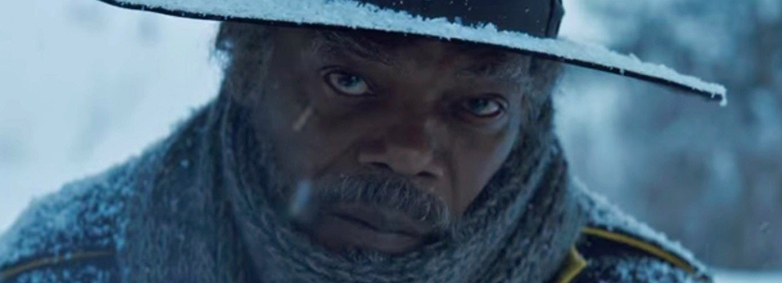
HOSTILES

Cert 15 133mins Stars 3

Ride the wild frontier with Christian Bale as he stars in this solidly handsome yet creaking western.

The Welshman stars as Blocker, an exhausted shell of a cavalryman ordered to escort a Native American chief and his family from New Mexico to Montana. They are long time foes with unresolved grievances.

Along with him is Rosamund Pike’s grief stricken frontierswoman. Despite her demented dirt-scratching performance, her flawless complexion and perfect teeth are in distracting contrast to the admirably authentic production design.

Plus the casting of Brits is at odds with the insular nature of the film. For all it’s well staged gunfights in the epic landscape, the script speaks inwardly to the US about its violent history.

Writer, director and producer Scott Cooper’s previous films such as Black Mass and Out of the Furnace have similarly explored US economic and social division.

And the lack of humour and ponderous pace make this grand journey a belligerent experience for outsiders.

BRIMSTONE

Cert 18 149mins Stars 3

There’s a powerful operatic air to this brutal western for which you may need a strong stomach to digest it’s gut ripping action.

When a new preacher arrives in town promising pain for sinners, he begins a campaign of terror against a local family.

Guy Pearce has a hoarse voice and a nasty facial scar as he pursues Dakota Fanning’s young wife and her children. As the story moves back and forth in time, biblical themes of revenge and punishment are explored.

Religion is used to justify treating women as slaves. They are bought, sold, beaten, raped, mutilated and hanged.

And there’s strong political commentary in the script as women are often gagged to deny them a voice with which to protest.

As this bleak and chilly epic sweeps across the harsh yet beautiful landscape, the ripe and bloody melodrama is ramped up with thunder and lightning.

Plus the relentless brutality and considerable length make for a demanding watch.


Free State Of Jones

Director: Gary Ross (2016) BBFC cert: 15

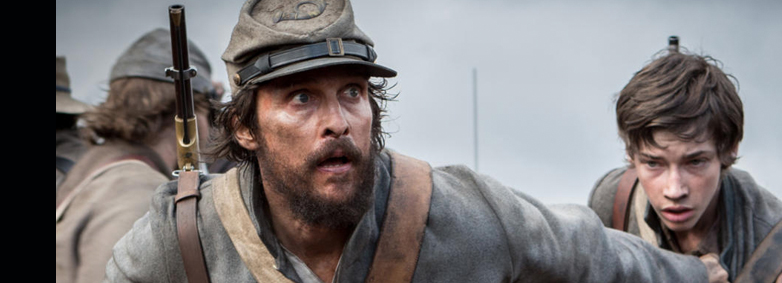
Matthew McConaughey is the Hollywood romcom star who so successfully reinvented his career he won an Oscar. In only his third leading role since his 2014 success in Dallas Buyers Club, he gives a brooding and impassioned performance in this high minded American civil war drama.

What begins as an exciting action movie develops into a sincere and somber look at how the wealthy white elite kept their grip on the lives of freed slaves when the fighting stopped.

Newton Knight is a confederate deserter who leads of an insurrection during the American civil war. McConaughey hides his leading man looks behind long hair and a ragged beard, mostly saving his charm for Rachel. The underused British actress Gugu Mbatha-Raw does well to bring depth to her role as a slave who joins his band of outlaws as they hide out in the local swamp.

The two leads ensure it’s always watchable and there’s no shortage of battles, burnings, hangings and evil deeds by the Ku Klux Klan. But brief flash forwards to a court room drama involving Knight’s great great grandson muddy the narrative flow, and the story becomes mired in the Mississippi swamp.

Although the film is keen to flag up its the accuracy of its historical accuracy via contemporary photographs and on screen captions, Knight is presented as an unrealistic combination of Robin Hood, Che Guevara and Jesus Christ.

As a revolutionary socialist who preaches from from a bible, Knight inspires slaves, farmers and women to take arms against the powerful and the rich. They declare themselves the free State of Jones.

However as Knight moves from pacifist medical orderly to merciless killer and then political activist, he suffers from an alarming lack of self reflection and none of his horrific experiences seem to affect him. And if he isn’t moved by what he sees, there’s no reason why we should be.

@ChrisHunneysett

The Magnificent Seven (2016)

Director: Antoine Fuqua (2016) BBFC cert: 12A

Compared to the truly magnificent 1960 original, this unlooked for western remake is unsurprisingly inferior. But after a summer of poor blockbuster fare, it’s passable entertainment in its own way.

Unburdened by any more ambition than a broad desire to be please, the film trots through the familiar story of a small posse of cowboys facing overwhelming odds.

There’s a liberal lifting of scenes and dialogue from the John Sturges version and a cheeky play of Elmer Bernstein’s majestic original score over the end credits. The new main score by the late James Horner is monumentally forgettable.

Reasons for watching include handsome photography, great period design and the no shortage of old school action. There are real sets, stuntmen and horses instead of CGI fakery. The $100M budget is all on screen.

Traditional western themes of comradeship, courage and loyalty are wrapped up in a glossy tale of redemption. This is an optimistic vision of how the US could still be won, with a rainbow society trying to overcome corporate greed and restore the church to the centre of civic life. This last point will resonate with US conservative Christians, a larger and more influential congregation across the pond than here in the UK.

Headliners Denzel Washington, Chris Pratt and Ethan Hawke are clearly enjoying themselves and their combined charisma is the film’s biggest strength. Vincent D’Onofrio adds more humour as a tracker, a fool who speaks truth to power.

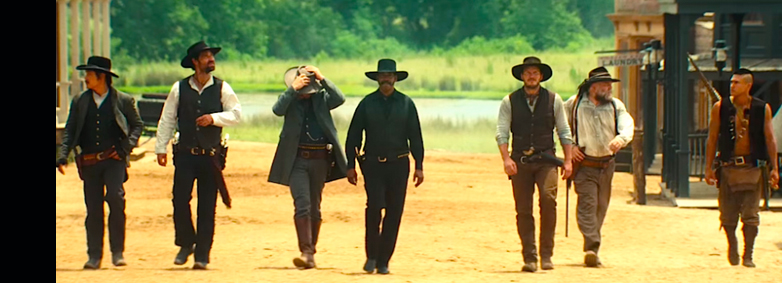
The casting attempts to accurately reflect the ethnic mix of contemporary US, and presumably hopes to attract the audience which makes the multi-ethnic Fast Furious franchise such a global success. So the remaining gunslingers are respectively Chinese, Mexican and Native American. Sadly they’re so poorly scripted, their race is pretty much the extent of their characterisation. One is described as an assassin but they may as well have gone the whole hog and called him a ninja.

Washington stars as bounty hunter Sam Chisolm, hired by a young widow who needs protection from a corrupt industrialist. Haley Bennett offers true grit as Emma, the only female speaking role of note.

It’s a shame there aren’t a few more women in the movie, or even – gasp – in the seven. Tarantino’s The Hateful Eight and Natalie Portman’s Jane’s Got A Gun featured strong willed gun-toting women. We could have done with more similarly natured women here.

Although Emma plays a small but crucial role, she definitely is not part of the all-male gang. As it is, she barely qualifies as the female Smurf. Amid all the back slapping diversity, fifty percent of the population are woefully under-represented. Except for whores, who are everywhere.

Chisolm has a personal reason for taking the job and recruits collection of desperadoes and misfits to defend the gold mining town. They include Pratt’s gambler and Hawke’s PSTD suffering civil war veteran.

Through a suitably sweeping landscape we move briskly from one action scene to another. The action is staged with occasional invention but at times the geography is unclear. This is especially true in the finale where our heroes face almost insurmountable odds and a seemingly infinite supply of ammunition. Until the smoke cleared I wasn’t sure exactly who had survived.

Peter Sarsgaard sketches without light or shade his consumptive black hearted villain, Bartholomew Bogue. He mostly acts apart from the Seven and with the protagonist isolated there’s a sense the film isn’t terribly interested in him. Consequently nor are we very much.

For long periods it’s agreeable crowd pleasing stuff. We’re reasonably entertained but never roused or excited. This not a disaster such as the recent Ben-Hur remake is, but it is quite far from magnificent.

@ChrisHunneysett


Hell Or High Water

Director: David Mackenzie (2016) BBFC cert: 15

With scorching violence, bone dry humour and a social conscience, this hard baked heist movie is an extraordinary ride into the dark heart of the new wild west.

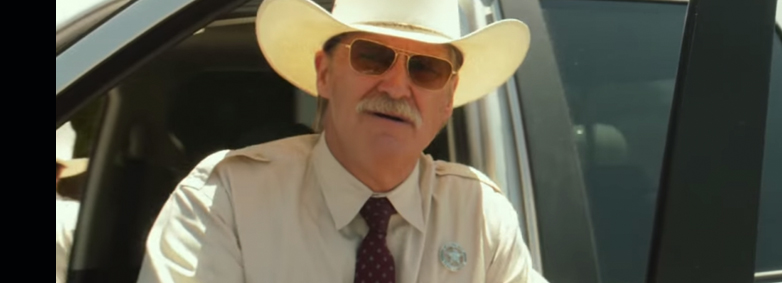
Jeff Bridges is magnificently grizzled as Marcus, a cantankerous Texas Ranger leading his Native American partner in pursuit of a pair of likeable bank robbers.

This finely balanced construction contains a timelessness and an immediacy as mythic archetypes canter across the cruel climes of current economic conditions. The four lead characters suggest reincarnations of Butch Cassidy and the Sundance Kid being pursued by The Lone Ranger and Tonto. And the film is frequently and intentionally entertaining as that sounds.

This acidic exploration of the American Dream touches upon the ownership of oil, land, money and its effects on life chances and family legacy. It reaches deep into the history of the nation to bring forward a lament for the state of the Union.

The of setting of Hell Or High Water is the macho world of dirt poor West Texas. An irony free world of cowboy hats, casinos and cattle drives, where every male of age carries a gun and drives a 4X4. Long shadows are cast by absent mothers and wives.

The action sequences are fast slaps to your face and the morally complex script bites with the venom of a rattlesnake. The melancholy tone is layered with lyricism via the earthy soundtrack provided by Aussie songsmiths Nick Cave and Warren Ellis. The cinematography of Giles Nuttgens captures the rust and neglect of abandoned farm machinery, symbols of a poverty line existence.

Director David Mackenzie’s last offering was the vicious prison drama Starred Up (2014). Once again he demonstrates his keen ear for dialogue, sharp nose for a story and an astute eye for an image.

Mackenzie references the crime movies Touch Of Evil (1958) and Rififi (1955). He does it not to demonstrate his own knowledge, pad the film’s length or to distract the audience during a lull. There are no lulls in this film. The references are chosen for thematic sympathy and used sparingly and appropriately.

Bridges’ turn is also a modern day riff on Rooster Cogburn, the US Marshall from the remake of True Grit (2010) for which the actor was Oscar nominated. Plus the star’s presence recalls the actor’s early career where he sparred with in Clint Eastwood in Michael Cimino’s crime road trip Thunderbolt and Lightfoot (1974). That film was based on Captain Lightfoot (1955) which also concerned a pair of highwaymen brothers.

The tremendous script by Sicario (2015) scribe Taylor Sheridan so acutely observes human behaviour  it could have been penned by the late great Elmore Leonard, the writer of novels from which sprung the films 3:10 To Yuma (1957 & 2007) Mr Majestyk (1974) and Out Of Sight (1998).

Marcus is partnered with Alberto, a native American officer played with a wearied reservation by Gil Birmingham. Knowing Marcus is days away from retirement, Alberto chooses to dismiss his casual racism as office banter.

Thieves Toby and Tanner are played by the film’s other excellent double act, Chris Pine and Ben Foster. They’re on a stealing spree from the very banks which are threatening to foreclose on their ranch. And they’ve only a couple of days to raise the cash. After every job they bury the getaway car, an exercise laden with grave portent.

Best known as Star Trek’s Captain Kirk, Pine’s leading man looks and easy on-screen charm often obscure his talent. He plays Toby, the younger, more bright and reflective of the siblings, an estranged father who owes months of child support.

Neither pair are abundantly blessed with great intelligence or skills and this ordinariness helps to incubate an empathy for all four protagonists.

Elegiac, bleak, funny  and always accessible and commercial, come hell or high water, you have to see this movie.

@ChrisHunneysett


I Saw The Light

Director: Marc Abraham (2016)

This befuddled biopic sheds little light on the life of country music maestro Hank Williams.

It begins with a spine tingling rendition of his classic ‘Cold Cold Heart’, but it’s sadly all down hill from there.

Though the star of TV’s The Night Manager Tom Hiddleston sings his heart out, he chooses to hide his looks and charm under a cowboy hat. He does a decent of copy of Williams’ agitated crab stage gait.

By the time Williams died in 1953 at the tragically young age of 29, he had became one of the most influential singer songwriters of his time.

But you wouldn’t know that from the episodic and jumbled narrative given to us here.

We first meet Hank when he’s already enjoying a degree of success with his band and a regular slot on local radio. He has ambitions to appear on The Grand Ole Opry, the number one TV destination for country singers.

An impetuous, tempestuous, immoral, feckless,unreliable husband father and artist, the narrative is a familiar rock biography checklist of an alcohol fuelled career slide as he loses gigs, wives and friends.

But it’s presented full of leaps, detours and evasions, offering random snapshots of his life instead of a coherent story.

We’re spoon fed a brief resume of his success at the end, but it’s provided without context and leaves us with no greater understanding of his importance to country music or wider cultural impact or degree of success.

The classic songs Williams wrote such as ‘Your Cheatin’ Heart’ are short changed.

And so are the women. They’re presented as grasping and fertile while Hank takes no responsibility for his own behaviour.

Elizabeth Olsen is a determined presence as his wife Audrey, but is portrayed as a humourless self serving money grabber.

Except for Hiddleston the performers don’t seem to be enjoying themselves, and I didn’t either.

Jane Got A Gun

Director: Gavin O’Connor (2016)

Since winning her best actress Oscar for ballet based drama Black Swan (2010), Natalie Portman’s career has been noticeably quiet.

In this small time western with occasional epic leanings, she’s back with a bang as Jane, a pistol packing farmer.

The genre that refuses to go to boot hill is on a decent run. Not just with high profile recent Oscar winners The Revenant (2016) and The Hateful Eight (2016) but also taut tales such as Mads Mikkelson’s The Salvation (2015) and Kurt Russell’s Bone Tomahawk (2016).

Jane Got A Gun is a blend of genre motifs and contemporary hot topics, offering a tale of revenge, rape, infanticide and sex trafficking among ranches, brothels and shoot outs.

Considering its troubled production history it’s remarkable how competent and coherent the finished film is.

In May 2012, it was announced that Natalie Portman would star in the film as the title  Lynne Ramsay would direct. Michael Fassbender was reported as cast in the hero role and Joel Edgerton was cast as the villain.

Scheduling conflicts lead to Edgerton replacing Fassbender and Jude Law stepping into Edgerton’s boots. When director Lynne Ramsey was replaced by Gavin O’Connor, Law was replaced first by Bradley Cooper and then by Ewan McGregor.

Cinematographer Darius Khondji also left the production, and was replaced by Mandy Walker. And rewrites followed.

Jane is saddled with grief, a dirt poor farm and a wounded husband Ham, the underused Noah Emmerich.

Her gun is a mumbling Joel Edgerton who plays Jane’s alcoholic war hero and ex lover.

Their personal chemistry is no more lacking than any other relationship in the film.

Jane employs Dan as protection from Ewan McGregor’s pantomime villain, a notorious outlaw who has vowed to kill Ham.

As Bishop’s scurvy faced posse arrive for revenge, the dead bodies mount up alongside the spare horses.

The familiar narrative has a strong through line, even if some of the scenes fit awkwardly together.

There are some splendidly cinematic sweeping vistas and agreeable rough and rugged design.

But there’s a lack of chemistry and though the climax doesn’t fire blanks, it never quite hits the emotional targets it’s aiming for.


Bone Tomahawk

Director S. Craig Zahler (2016)

Four cowboys ride out to the rescue in this brutal western horror.

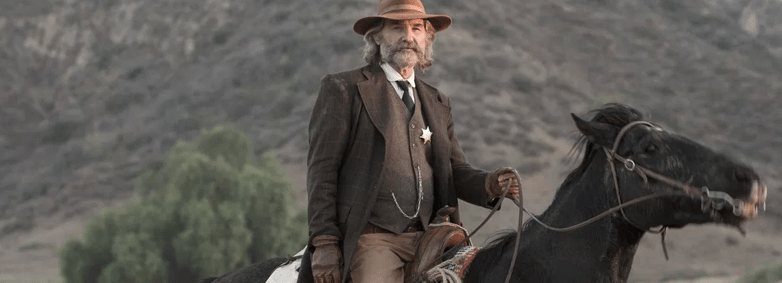
Kurt Russell is a crafty and charming Sheriff, leading his misfit posse against cannibal troglodytes.

The savages have captured his deputy, a young bride and an outlaw and we’re never sure if anyone is coming back alive.

There’s a welcome element of the supernatural and the sparse music and dry humour echo the barren landscape.

With well staged gory action scenes, it’s an effective visceral thrill ride which succeeds in upsetting the stomach.

But it’s never interested in engaging the brain.


The Hateful Eight

Director: Quentin Tarantino (2016)

Quentin Tarantino’s new western is a slow burning fistful of cinematic dynamite which explodes all over the screen.

In a set up surprisingly reminiscent of Agatha Christie, eight hateful desperadoes are brought together one night by a Wyoming blizzard.

The discovery of loose connections leads to the opportunity to settle old scores and much bloodshed.

It’s a major work from an important director and a minor masterpiece of the genre.

Building on the strengths of Django Unchained (2013), Tarantino’s burgeoning maturity after a mid career slump of Kill Bill 2 (2004) and Death Proof (2007) suggests the mouthwatering prospect his best work is yet to come.

The Hateful Eight (2016) is proclaimed as Tarantino’s 8th film. With one eye on his legacy the 52 year old director recently speculated he would only make 10 movies, adding he felt he would never dominate the Academy Awards with multiple wins for a single film.

His current upward trajectory suggests his tenth and possibly final film could easily sweep the Oscars board.

In any circumstances I very much doubt Tarantino will go quietly into the cinematic night of his own accord.

With two consecutive westerns under his gun belt, Tarantino seems to have found his meter in the genre, itself the great American art form.

His previous best work was Jackie Brown (1997) based on the novel Rum Punch (pub. 1992) by Elmore Leonard.

The inestimable crime writer produced a raft of novels, many of which ended up on screen. Notable examples are Hombre (1967) Get Shorty (1995) and Out of Sight (1998).

However he began his career as a prodigious writer of pulp westerns. Three-Ten To Yuma (pub. 1953) was filmed in 1957 as 3:10 To Yuma starring Glenn Ford and Van Heflin, and filmed again in 2007 with Christian Bale and Russell Crowe.

Should Tarantino feel the need for inspiration he could do worse than tackle another of Leonard’s many works.

Until then we have The Hateful Eight which as rich in character and performance as any movie Tarantino has made thus far.

The former enfant terrible of Indie cinema takes a more mature and traditional approach.

He throws out the pop cultural references in favour of discussions on justice and the morality of the civil war.

Also out are the eclectic rock soundtrack and in comes a score by the maestro of spaghetti westerns, Ennio Morricone.

As good as it is, it’s no disservice to suggest it’s not the greatest work from the composer of the score for The Good, The Bad and the Ugly, among many others.

And it’s worth the entrance fee to be able to savour it on a cinema sound system.

A majestic opening shot features a vast snow-filled plain with a stagecoach driving past a frozen crucifix.

This elegant, eloquent statement of intent gives an icy indication of the grand guignol the passengers are heading towards.

This is cinematographer Robert Richardson’s 5th Tarantino movie after Django Unchained (2013), Inglourious Basterds (2009) Kill Bill 2 (2004) and Kill Bill (2003).

His ridiculously impressive CV includes 6 Scorsese films, 9 by Oliver Stone and works by Robert Redford, Barry Levinson and Robert Reiner.

Plus he’s one of only two living persons to win 3 Oscars for his craft. There’s another 5 nominations in there as well.

Colorado stands in for Wyoming and camera movement is kept to practical minimum while capturing the magnificent icy vistas.

Once inside in the relative warmth, Richardson’s camera glides about the confined space to skilfully illuminate the dialogue.

Even with 2 screenplay winning Oscars from 3 nominations, his sharp wordcraft is among the best Tarantino has written, it’s no wonder actors return to work for him time and again.

Heading what is now practically of troupe of Tarantino regulars, Samuel L. Jackson plays Major Warren, a former Union soldier turned bounty hunter.

Our first encounter him reprises the entrance of John Wayne in John Ford’s Stagecoach (1939).

Other visual influences are Sam Peckinpah’s The Wild Bunch (1969) and Robert Altman’s McCabe And Mrs Miller (1971).

With his frozen bounty in tow Warren hitches a ride on a private stage hired Kurt Russell’s bounty hunter, known as The Hangman.

It’s always great to see Russell in anything  and seeing him in wrapped up in a blizzard raises pleasant memories of John Carpenter’s sci-fi chiller The Thing (1982).

The Hangman is transporting outlaw Daisy Domergue to the town of Red Rock to be hung. Jennifer Jason Leigh brings a fierce humour to her demented portrayal.

Her heavily bruised eye resembles the stylised look of Alex from Kubrick’s A Clockwork Orange (1971), and suggests some impending ultra violence.

Vying with Leigh as the most valuable player in the uniformly excellent cast is Walton Goggins. He plays a racist former confederate soldier called Chris Mannix.

Other returning Tarantino regulars include Michael Madsen, Zoe Bell and Tim Roth channelling Terry-Thomas.

Caught up in a blinding snowstorm the travellers reluctantly take refuge together in an isolated holding post where other guests are warming themselves.

This fraught atmosphere demonstrates Tarantino’s ability to and it frequently wrong foots us in our expectations of where the story is going.

All the characters have nicknames referring to their status, The Prisoner, The Sheriff and so on.

When doubt is shed on their self-declared personal narratives, this remove from their professed identities adds layers to the slowly building snow drifts of lies, fear and mistrust.

As we’ve come to expect from Tarantino, there is a non-linear narrative. This gives a greater opportunity for character development than a more straightforward approach to structure would allow.

There’s a crude and confrontational tale Major Warren tells Bruce Dern’s aged General and some may feel this scene is evidence the director hasn’t yet shaken off his juvenile sense of humour.

However it serves a narrative purpose and there’s a sense Tarantino can’t resist baiting his film with poisoned morsels for unwary detractors.

Domergue suffers repeated physical abuse. It’s not the violence itself which worries, that can be justified by the milieu and far worse treatment is meted out to women in the westerns of Leone and Eastwood.

What’s problematic about this violence is its use as a literal punchline. The abuse of a captive woman, the only female character of note, is intentionally used to draw laughs from the audience.

The defence could reasonably claim more and greater violence is trespassed against other characters and done in an equally intentionally comic and more grisly manner.

Plus her tolerance for pain and patience for revenge tells us a great deal about her character.

Production of The Hateful Eight ran parallel to the Leonardo DiCaprio vehicle The Revenant (2016).

Although superficially similar in their brutal nature and western setting, the two frozen features are very different beasts except in the extremes of their ambition.

With The Hateful Eight distributor Harvey Weinstein stealing a commercial march by opening in the UK a week earlier, it’s doubtful a mass UK audience could stomach two similar seeming films in quick succession.

With this in mind I expect The Hateful Eight to win at the box office but The Revenant to win bigger at the Oscars.