Legend

Director: Brian Helgeland (2015)

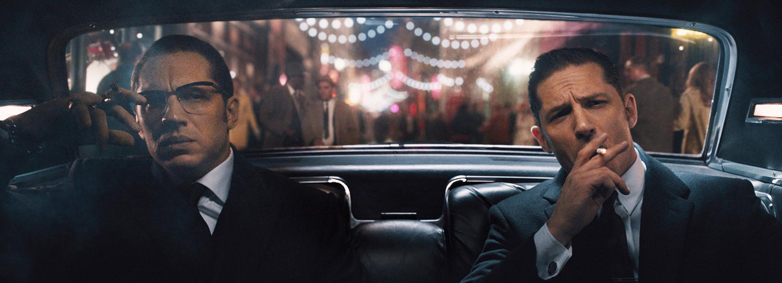
This barnstorming biopic of cockney crime lords the Krays is a double barrelled blast of brutal and funny entertainment.

The exhausted tale of London’s most infamous gangsters is given a fresh impetus by a pair of magnetic performances by Tom Hardy as twins Reggie and Ronnie.

So well defined are their characters at times I forgot I was watching the same actor.

London is in transition from fifties post war austerity to the swinging sixties. The Krays see an opportunity to expand from their poor East end roots to the moneyed lights of the celebrity-filled West end.

We see their rise through the eyes of Reggie’s wife Frances. Their mother who normally looms large in their legend is a minor figure.

The script rockets through the boys’ rivalries with the Richardson mob, their dealings with the mafia and the murder of Jack ‘the hat’ McVitie.

Reggie is the older of the brothers, a charmer with brains. He’s an ambitiously ruthless businessman who owns clubs, runs protection rackets and wants to break into the casino trade.

Ron is a philosopher fool with fists of iron. His tenuous grasp of reality and impulsive behaviour are disastrous for those nearest to him.

Though unquestionably devoted to each other, the nearest the boys come to affection is beating seven bells out of each other.

Their fall is framed as a tragedy with Greek references peppering conversations.

Reggie is seemingly destined for great things but is thwarted by his love for his brother Ronnie; the most unpredictable of loose cannons.

Frances is a fragile pill-popping poppet who struggles as her husband fails to become the straight businessman he professes he wants to be.

Ozzie actress Emily Browning is fine but forced to deliver a terribly written and utterly unnecessary voice over. It ruins every scene it witters over.

Tara Fitzgerald plays her disapproving mother and antagonises Reggie by wearing black to their wedding.

Prime Minister Harold Wilson is played with pipe-wielding gusto by Kevin McNally. Christopher Eccleston is always two steps behind as Keystone cop Detective Superintendent ‘Nipper’ Read.

There’s great support all round from Colin Morgan, David Thewlis, Paul Anderson, Taron Egerton and Chazz Palminteri. The latter plays Angelo Bruno, the head of the Philadelphia crime family with whom the twins strike a lucrative deal.

The occasionally larky tone may chafe with those who believe it inappropriate in a story where real people are murdered.

However it’s titled Legend for a reason. It makes no attempt to be definitive or exhaustingly accurate. Nor does it offer an apology for not being so.

It presents a glamourised, heightened view of a specific period and is anchored by the emotional truth it offers of the twins’ complex relationship.

Write-director Brian Helgeland won Best Screenplay Oscar for LA Confidential (1997), more recently he wrote Ridley Scott‘s Robin Hood and Paul Greengrass’ Green Zone. (Both 2010.)

Previously he directed Mel Gibson in the thriller Payback (1999) and baseball biopic 42 (2013).

Legend is extremely confident and ambitiously crafted. There is excellent production design by Tom Conroy and gorgeous costume by Caroline Harris.

The dynamic soundtrack and expertly executed camera moves are hugely influenced by Martin Scorsese’s gangster epic Goodfellas (1990).

HIs famous Copacabana tracking shot is transplanted to Frances’s introduction to Reggie’s club. It’s one of several ambitious and expertly executed camera moves.

It’s the work Brit cinematographer Dick Pope was Oscar nominated last year for Mr Tuner and is a regular Mike Leigh collaborator.

Hardy is currently 3 to 1 to be the next James Bond, but on this showing he might just be too good an actor.

Good People

Director: Henrik Ruben Genz (2015)

Temptation brings danger to a struggling young couple in this silly and dingy thriller.

Americans Tom and Anna are the good people making a fresh start in London after suffering a domestic tragedy. They’re neither especially bright nor particularly likeable.

Though we’re told they’ve been together for a long time, there’s an unfortunate lack of chemistry between James Franco and Kate Hudson in the lead roles.

Having inherited Tom’s grandmother’s large house, they’ve accumulated large debts trying to renovate it.

When they discover £220,000 of much needed cash in the flat of dead neighbour, they can’t resist helping themselves.

Danish director Gnez has his cinematographer Jorgen Johansson dress the city in the gloom typical of Scandinavian noir, adding an extra layer of dreariness to proceedings.

The moral question of taking the money is quickly glossed over as the plot descends into bloody, predictable, tension-free violence. It occasionally strays unintentionally close to farce.

Tom Wilkinson plays a grieving cop chasing Sam Spruell’s villain who is trying to recover his stolen drugs money.

As Omar Sy wanders through as an urbane Frenchman trying to muscle in on the London heroin trade, the always engaging Anna Friel is wasted in a role requiring her to cradle a baby, squeal at a washing machine and perch precariously up a ladder.

As threats are issued, hands broken and furniture is destroyed, nail guns and snooker cues are put to use which probably affect their warranty.

True Story

Director: Rupert Goold (2015)

Identity theft, serial killing and untrustworthy journalism make for a mire of mendacity in this chilly courtroom thriller.

It’s based on the memoir of Mike Finkel (Jonah Hill), a former New York Times journalist who was sacked for fabricating a story.

He receives a phone call asking for an opinion on homicide suspect Christian Longo (James Franco) who has been caught in Mexico using Finkel’s identity.

Longo is charged with murdering his wife and three daughters and faces the death penalty. As grisly details of the deaths emerge, he paints his family as a victim of harsh economic circumstance.

Sensing a book deal and career resurrection, Finkel interviews Longo in prison and a curious relationship develops based on questionable motives.

Longo is evasive about what happened and emphasises his ordinariness. Finkel equates his own lies to be crimes of a similar magnitude to those of the accused.

Spending a lot of time rubbing his eyes in front of a laptop in a lonely hotel room, Finkel is under pressure from the police, his publisher and his girlfriend Jill (Felicity Jones).

Hill, Franco and Jones have each been nominated for an Oscar. Hill in Moneyball (2011) and Wolf of Wall Street (2013). Franco in 127 Hours (2010) and Jones for A Theory Of Everything (2014).

Hill and Franco previously starred together in weak apocalypse comedy This Is The End (2013).

Principal photography on True Story began way back in March 2013 and it was released in the US in April 2015.

With Jones’ Oscar nomination announced in mid-January 2015, it’s tempting to imagine the producers threw in every useable piece of footage they possessed of her to capitalise on her resultant higher profile.

In any case her character Jill spends most of her scenes alone or not interacting with her fellow performers, such as in a courtroom scene where she simply stands and stares.

At other times she plays piano runs in the woods, immerses herself in work and takes baths. It all accentuates her isolation but has no bearing at all on the plot.

Jones and Hill’s characters have little screen time and she has no purpose other than to make Finkel seem a more rounded personality.

Without her – even with her – Finkel is self-absorbed, humourless, arrogant and professionally flawed. We wonder what attracted each to the other and why she stays with him.

It’s not the first film to dramatise a journalist’s attempts to exploit a prisoner for their own ends. Truman Capote’s book In Cold Blood (pub. 1966) provided a basis for Capote (2005) and Infamous (2006).

A mournful soundtrack, muted colours, studied editing and a measured pace allows for a focus on strong performances.

But it’s difficult to place your sympathy on either of the wholly unreliable storytellers.

Survivor

Director: James McTeigue (2015)

This tedious terrorist thriller is a po-faced celebration of the secret security services trying to masquerade as entertainment.

It has unintentionally ridiculous dialogue, enormous plot-holes, little tension and no humour.

Kate Abbott (Milla Jovovich) is the new security chief of the American Embassy in London. She’s in charge of the young team who process visa applications to the US.

She spends a huge amount of time running down corridors and may be having a relationship with her boss Sam (Dylan McDermott).

Following a bomb attack on a restaurant, Abbott follows Embassy safety protocol and immediately goes to a pub toilet to check on her hair. Not being British she doesn’t even stop for a drink.

Abbott realises being the only survivor of the blast makes her a suspect.

When a colleague is murdered Abbott goes to the top of the most wanted list and even her own Ambassador (Angela Bassett) wants her taken out.

No-one in the myriad intelligence services thinks to stake out Abbott’s flash apartment.

As Abbott’s colleague Sally, actress Frances de la Tour does well not to look embarrassed at events. James D’Arcy plays Police Inspector Paul Anderson, a stiff-assed Brit.

The film emphasises the extensive use of CCTV in the the UK’s capital but doesn’t pursue the idea.

Meanwhile an even bigger atrocity being planned by a munitions expert known as ‘The Watchmaker’ (Pierce Brosnan).

He is steely-eyed, silver haired and occasionally sports a moustache. Playing a terrorist at large in London recalls Brosnan’s brief role in The Long Good Friday (1980), back when the Irishman appeared in great films.

Danny Ruhlmann’s cinematography casts rich shadows and is the best feature of the movie. It creates a suitably menacing environment not matched by the plotting, pace or performances.

As Survivor is set in December – there are Christmas trees and everything – the decision by the distribution company to release it in June suggests a fear of finding an audience for it.

Phoenix

Director: Christian Petzold (2015)

Greed, betrayal and revenge are surgically spliced in this intriguing post-war thriller.

Holocaust survivor Nelly (Nina Hoss) is a former singer rescued from the ‘camps in the East’ and brought to a private asylum to recuperate.

With doctor’s using techniques still in their infancy, Nelly undergoes plastic surgery to rebuild her shattered face.

The motives of her friend and saviour Lene (Nina Kunzendorf) are ambiguous. She is evangelical about escorting Nelly to Palestine and using Nelly’s wealth to help establish a homeland for the Jewish diaspora.

Also her physical intimacy suggests a more emotional, less platonic reason for keeping close to Nelly.

Rejecting Lene’s plans for the future, Nelly haunts the bombed out buildings of Berlin looking for her husband Johnny (Ronald Zehrfeld) – who may have betrayed her to the Nazi’s.

She’s finds ‘Johannes’ working in The Phoenix cabaret club. He doesn’t recognise her but thinks with a make-over and coaching she could pass as his late wife, enabling him to collect her inheritance.

With brisk deliberation the script questions the truth of relationships and raises issues of identity and trust. With Nelly’s memories as fragile as her skin grafts, everyone’s motivation is suspect.

The involving finale gathers close friends together and the casual way they’re introduced to us suggests entire scenes were trimmed in the edit – but not at the expense of the measured tone, subtle performances and claustrophobic, nightmarish atmosphere.

’71

Director: Yann Demange (2014)

Collusion, coercion and violence are tied together by a compelling central performance in this tremendously tense British thriller.

With a pared-down plot it’s an action movie without a love interest, barely any humour and a great deal of pain. Assured pacing and confident editing complement a script remarkable for its sparse dialogue. It allows for Jack O’Connell to use his native accent and makes the most of his physical screen presence.

Private Gary Hook (O’Connell) is a raw recruit enduring a gruelling training programme. It’s mercifully brief and included to underline how unprepared these raw recruits are.

A deterioration of the political and social situation in Northern Ireland sees Hook’s platoon packed off in an emergency deployment. Dumped on the front-line in Belfast we’re carefully reminded this war-zone is part of the UK, not a foreign land.

With the city divided by the notorious Falls Road with the friendly Protestants to the east and hostile Catholics to the west, the squaddies are warned of the paramilitaries on both sides. It’s a monstrously messed up environment of graffiti, burnt-out cars and teenagers throwing rocks and dirty (urine and faeces) bombs.

Their fresh-faced and middle class commanding officer Lieutenant Armitage (Sam Reid) is hopelessly out of his depth.

Hook’s squad assist the brutal Royal Ulster Constabulary (RUC) searching Catholic houses and a rifle is stolen. As a riot breaks out Hook loses his weapon and is separated from his team.

Attempting to return to barracks he must dodge bombs and rioters. Not all locals are hostile but all face repercussions if caught helping him.

The upper ranks of either side have a shaky control of events on the streets. There are betrayals, blackmail and executions as they race to find the lost soldier.

Cinematographer Tat Radcliffe colours a dingy, damp world with an autumnal palette. An eerie and disorientating soundscape by sound mixer Rashad Omar emphasises Hook’s weak and vulnerable state and creates a general air of confusion.

Set a year prior to the infamous Bloody Sunday civilian massacre, ’71 offers an explanation but not an excuse for those events.

There’s no gung-ho flag waving but a bunch of scared working class lads trying to survive a situation they barely understand and have no control over. ’71 is a superior film to the similarly themed and lauded American Sniper. No-one survives without being affected.

Kill The Messenger

Director: Michael Cuesta (2015)

Despite a plot of international significance featuring political corruption, money laundering and drug dealing, this real-life thriller is surprisingly weak and muddled.

It’s a busy dramatisation of the fall from grace of investigative reporter Gary Webb (Jeremy Renner). Uncertain of tone it begins as a courtroom romp, rifles into an astonishing hard news story then dissolves into a dull human interest feature.

Renner hides behind a goatee bristling with self-righteous rage but his taciturn everyman act lacks charisma. His two Oscar nominations (The Town, The Hurt Locker) seem ever more indebted to strong direction than any tremendous ability.

A scruffy family man with a penchant for British cars, motorbikes and music, Webb works on the small San Jose Mercury newspaper.

In a 1996 newsroom teeming with now unimaginable numbers of staff, Webb is indulged by young editor Anna (Mary Elizabeth Winstead) and avuncular executive editor Jerry (Oliver Platt).

One day the glamorous Nicaraguan Coral (Paz Vega) drops a folder of confidential information into his lap. The first of many characters to pop up before being forgotten, she uses an unwitting Webb to have her boyfriend’s court prosecution collapse.

Following the info in the folder, Webb is soon interviewing incarcerated drug-dealer Rick Ross (Michael K. Williams). He claims the CIA turned a blind eye to Danilo Blandon (Yul Vazquez) importing industrial quantities of cocaine as it served their foreign policy purposes. The enormous sums of cash raised funded the Contra’s attacks on the communist Nicaraguan government.

It’s a doddle for Webb to bribe his way into a Nicaraguan jail to meet fearsome drug baron Norwin Meneses (Andy Garcia). Everybody is happy to tell the journalist exactly what he needs – which means there’s no tension or drama to his story-gathering.

Publishing his story online (a novelty at the time) attracts nationwide attention. Webb is nominated for journalist of the year but quickly competitors line up to challenge the story, mostly by pointing to his conspicuous lack of evidence.

Now painted as a conspiracy theorist, Webb himself becomes the story. He’s convinced the CIA are in cahoots with the Washington Post to discredit him and the pressure affects his relationship with wife Sue (Rosemarie DeWitt) and teenage son Ian (Lucas Hedges).

Blinded by his indignant anger to the realities of the world and consumed by a martyr complex, Webb is demoted to a backwater department but keeps obsessively working the case.

Government insiders Fred Weil and John Cullen (Michael Sheen and Ray Liotta) appear in cameos to confirm Webb’s theories. They could well be figments of his imagination.

As his paranoia increases Webb sees prowlers in the dark and enemies everywhere. When his bike is nicked he stupidly smashes up his own car and harangues passes-by. As Webb’s mental state deteriorates his attire becomes progressively sharper.

Webb suffers a tragic end but the film fails to provide sufficient evidence to support it’s theory as to why.

★☆☆

The Boy Next Door

Director: Rob Cohen (2015)

A reckless one night stand leaves school-teacher Jennifer Lopez fearing more than detention in this sensationally silly stalker flick.

Indifferent direction, terrible dialogue and a soundtrack that rumbles with unintentional comic effect make this a thriller to avoid.

Struggling mum Claire (Lopez) is rescued from a descending garage door by the hunky Noah (Ryan Guzman). New to the neighbourhood he’s the 19 year old great nephew of the cancer sufferer next door.

With chiselled good looks, perfect grooming and oiled-up abs, Noah looks and acts as if he’s stepped out of a coke commercial. It turns out he’s a transfer pupil to the high-school where Claire teaches.

Noah fixes the family car and makes himself useful around the house. He befriends Claire’s teenage son Kevin (Ian Nelson), intervenes with the local bullies, takes him for target practice and teaches him to box.

As soon as Claire’s estranged husband Garrett (John Corbett) takes Kevin on a camping trip, Noah and Claire are bonding over literature. He pops round to gift Claire a first edition of Homer’s The Iliad.

One dark and stormy night while the boys are away, Noah seduces Claire with the aid of a frozen chicken. She’s quickly demonstrating a nice line in lingerie and her own buff abs – but their steamy night of passion is secretly filmed.

When Claire wakes up she realises her career, family and life are at stake. But overnight Noah has developed a raging Oedipal complex and breathtaking anger management issues.

Claire’s attempts to gently reject him are not well received and Noah takes to playing rock music really loudly in his car as a sign of how truly peeved he is.

Noah tries to pressure Claire into a repeat performance by leaving incriminating graffiti and photographs around the school, so she confides in her vice-principal and best friend Vicky (Kristin Chenoweth).

There’s an unconvincing car crash, some computer hacking, a fractured skull and people are tied up in a barn.

Dutch camera angles, an awry colour palette and a shuddering dissonant soundtrack are employed to illustrate Noah’s inner anguish and rage. Possibly because Guzman is reluctant to project it himself.

Lopez is a decent actress who excels with strong direction, a decent script and talented co-stars – none of which she benefits from here.

This could have been a gleefully vicious and hilarious black comedy similar to The Guest, instead it’s an insipid and stupid compendium of recycled riffs and ideas.

☆☆☆☆

Nightcrawler

Director: Dan Gilroy (2014)

Cut-throat and violent, the dark world of TV news is under the spotlight in this slick satirical thriller that is sharply written, wonderfully observed and terrifically performed.

With his gaunt face, sunken eyes, manic grin, lank-hair and soft-spoken measured delivery, Jake Gyllenhaal is mesmerisingly intense as a nightcrawler; a feral TV paparazzo prowling for the most bloody news footage.

Ambitious, articulate and cunning, loner Lou Bloom (Gyllenhaal) is a fervent believer in the American Dream.

Seeing opportunity everywhere he is permanently touting his (limited) skill-set and promoting his enthusiasm to any potential employer.

Inspired when he sees TV cameramen film police rescuing a woman from a car crash, he buys a camcorder and begins cruising the streets of Los Angeles at night, filming crimes to sell to TV.

His inexperienced enthusiasm leads to taking risks, falling foul of the law and his competitors such as the abrasive Joe Loder (Bill Paxton).

But he quickly learns to manipulate criminal events to further his career,

He sells his graphic footage to morally compromised, ageing and acerbic TV News chief Nina (a wonderful Rene Russo and real-life Mrs Dan Gilroy).

Nina’s show is struggling in the ratings and despite Lou being infatuated, exploits her perilous employment situation to secure a sweetheart deal for himself.

A driver Rick (Riz Ahmed) is employed on exploitative terms and provides the film with more black comedy; but he’s mostly a script device to give Lou someone to spout corporate career advice to.

Without any moral framework to guide him and driven by his love of the dollar, he has no compunction manipulating events even they spiral into violence and gunplay.

Bloom is a cartoon monstrosity and had he an ounce of doubt or remorse the drama would be improved. Instead he’s a one joke act lecturing us on the vicious amorality of capitalism. It is however, one hell of a joke.

Coherence

Director: James Ward Byrkit (2015)

When a passing comet causes a space-time anomaly, it turns a dinner party into disaster in this dull and derivative sci-fi thriller.

Glossy, arty, unlikeable and poorly established characters bicker their way through a catastrophic storm of hyperactive camerawork and weak writing.

When phone signals, the internet and external power fail, Hugh (Hugo Armstrong) and Amir (Alex Manugian) head off to the only other neighbourhood house with lights on.

They intend to call Hugh’s physicist brother who warned about possible ill effects of the comet, it’s a wonder the brother isn’t called Bill Mason.

With no obvious leaders, the guests start squabbling like contestants on The Apprentice. Glamorous Emily (Emily Baldoni) starts to give partner Kevin (Maury Sterling) a hard time over a perceived slight at the table. Others make passes at each other’s partners. Their sense of priorities are more puzzling than their situation.

Someone turns to the bottle which seems a reasonable response to being cooped up with these idiots.

With close ups, shallow focus, jump cuts and restless shaky cam we’re treated to a full range of found-footage effects without this being a found-footage film – which is annoying when we realise there’s no character behind the camera to interact with the ones we can see.

Presumably the intention is to create intimacy and suggest forthcoming danger while visually preparing the ground for when these effects will be usefully employed.

But this distracting approach heightens the script’s failure to sufficiently identify the characters for the audience; we fail to engage with them or care what is happening. At times it would have been useful if they’d worn names on the backs of their clothes.

Having being lost in the dark space between houses, Hugh and Amir return injured and with a metal box. They’d encountered the inhabitants of the other house who were unfriendly and disturbingly looked exactly like themselves.

The box contains photos of themselves taken that very evening. Notes are stuck to their front door written in their own handwriting and personal items unexpectedly appear.

A book containing Hugh’s brother’s lecture notes is discovered in the back of a car. They offer a mercifully brief explanation using the coherence variation of quantum mechanics. Gwyneth Paltrow is mentioned alongside Schrodinger’s cat – which must be a first.

There’s more bickering and another splinter group wander off outside. A second Hugh arrives claiming to be the first Hugh and it dawns on the inmates there are more than two houses with identical occupants, increasingly mixed up between identical houses.

But when the comet passes the quantum anomaly will collapse and everyone must find their correct house – or be trapped in the wrong dinner party forever. Paranoia, suspicion and violence follow.

☆☆☆