IN SEARCH OF GREATNESS

Cert PG Stars 3

Sports fans who believe modern games are too regimented and unaccommodating of maverick talent will enjoy this inspirational and thought-provoking documentary from director Gabe Polsky, who previously made the little seen but brilliant Russian ice-skating doc, Red Army.

With loads of great footage and interviews with Serena Williams, Pele and Michael Jordan, it holds up legends such as boxer Rocky Graziano, and Brazilian footballer Garincha, as examples of great sportsmen who had to improvise new styles in order to overcome physical attributes which could have seen them rejected at the beginning of their careers.

Celebrating the behaviour of pioneering mavericks and diverse figures such as high jumper Dick Fosbury and err, musician David Bowie, the film argues though performance data is necessary in attainment, it can’t measure an individual’s competitive nature and creativity which are fundamental to achieving greatness.

Scathing of any educational system which demands conformity, the film claims unstructured play for the young is crucial for development, which means I’m totally ace-ing this homeschooling lark.

INFINITE FOOTBALL

Cert PG Stars 3

Football and philosophy collide in this poignant documentary as a quirky take on the beautiful game morphs into a sad portrait of desperate middle age and a glimpse behind the former Iron Curtain into the Kafka-esque running of the Romanian state apparatus.

Director Corneliu Porumboiu visits his hometown of Vaslui, Romania, to interview the guileless, earnest and evangelical Laurentiu Ginghina, who boldly claims to have invented a new less violent and more creative sport by changing the rules of football.

However a professional football coach shrugs and says the innovations are merely a variation on longstanding training techniques.

There’s an air of Billy Liar and Walter Mitty about the nondescript Ginghina, who explains at length how a series of thwarted opportunities has resulted in his being trapped in the grinding life of a government bureaucrat.

And the newfound freedom he declares players gain from his improvements involve the imposition of complex and restrictive rules, a contradiction our daydreaming would-be sporting pioneer seems oblivious to.

TROUBLE WITH THE CURVE

Stars 2

Clint Eastwood drags his old bones out of acting retirement for this amiable and undemanding tale of family set in the world of baseball.

As Gus Lobel, Eastwood is a baseball scout who is given one last chance to prove his worth or he’ll be forcibly retired.

He is joined by Amy Adams as his estranged daughter on a scouting trip to North Carolina, where he’s to check out the boy who maybe the next big baseball star.

Eastwood enjoys himself as a beer guzzling, growling, gimlet eyed, grim faced monolith, but it’s the always engaging Adams who grabs centre stage as a corporate lawyer who’s juggling love, life and lawsuits.

John Goodman and Justin Timberlake offering support, but struggle with everyone else with a predictable plot as creaky as Clint’s knees, and dialogue as weak as his eyesight.

Despite the cast valiantly doing their best to raise the script far beyond what it deserves, this will be a poor epitaph to Eastwood’s career if it proves to be his last screen appearance.

CREED II

Cert 12 Stars 4

Sylvester Stallone and Dolph Lundgren return to reignite the Cold War as they face off once more in a typically two-fisted and enjoyably bruising bout from Sly’s ‘Rocky’ boxing franchise.

A loose retelling of Rocky 4, the former fighters are now the trainers of the younger generation, which sees Michael B. Jordan’s world heavyweight champ take on the son of the Russian who killed his dad.

It scored a knockout £160m worldwide on a puny £40m budget due to the strong character work and screen history that gives emotional weight to the heavy punching.

BATTLE OF THE SEXES

Cert 12A 121mins Stars 4

Emma stone comes out swinging in this ace of a tennis drama. Fresh from her best actress Oscar for La La Land, she serves up another great performance as game changing tennis pro, Billie Jean King.

It’s smart blend of biopic, love story, sports movie and gender politics, with the famous 1973 exhibition match King played against Bobby Riggs as the focal point.

An astute businessperson King keenly understands her earning power is dependent on maintaining a saleable image to straight, Christian, white America.

While conducting a high profile public fight for workplace equality, the married King experiences a private sexual awakening. She begins a tender and passionate relationship with her hairdresser, played by Geordie actress Andrea Riseborough,

Steve Carell uses the full scope of his ability to unearth the humanity in the former US and Wimbledon champ, Riggs.

The rabble rouser is selling the match as the ‘male chauvinist pig versus the hairy legged feminist.’

Aged 29 and 55 respectively, Stone and Carell are the correct age or their roles. The tennis is convincing staged and though the speed of the game seems tame by modern standards, but the politics are vicious.

Not only is there a huge prize of $100,000 to win, but King knows her defeat would be as regarded as conclusive evidence of the inferiority of women.

These are the stakes which make this a more gripping film than this year’s other tennis film, the more introspective, Borg v McEnroe.

Entertaining, warm and funny, the script by The Full Monty writer Simon Beaufoy emphasises the importance of a level playing field in society, with winning being dependent on talent, dedication and courage.

Its a celebration of dignity, inclusiveness and a compelling argument for not having to compromise your identity in order to earn a living.

Though it’s game set and match to Emma Stone, the real winners are us all.

PECKING ORDER

Cert PG 88min Stars 3

Flock to this tasty New Zealand documentary which sheds a light on the drama of competitive chicken shows.

As in any beauty pageant the competitors are thoroughly groomed and fed on a diet of bird seed, though possibly with bigger servings than their human counterparts. Being plump here is encouraged.

It’s an increasingly tense affair as well seasoned veterans and raw youths of the Christchurch Poultry Club vie to knock the champ off their perch at the national show.

Plus there’s fowl play in the committee room where a battle between modernisers and traditionalists threatens the existence of 148-year-old club.

Feathers are ruffled as members scratch around for votes, and the simmering hotpot of politics are brought to boil with an attempted presidential coup.

Though the politics are vicious the enthusiasm for the show birds is endearing and the tone stays jolly throughout. This warm and affectionate portrait of semi-rural life offers a clucking good time for everyone.

GOON: LAST OF THE ENFORCERS

Cert 15 97mins Stars 2

A poor year for cinematic comedy continues with this violent ice hockey gross out comedy which left me cold.

Set in Canada’s minor league, this sequel to 2011’s sees many of the original cast reprise their roles. But the script leaves any decent jokes on the bench and whenever it strays from the playing arena, finds itself on thin ice.

Hard man team captain Doug has retired due to age and injury. Having taken a dull office job, he’s drawn back to the ice when his old team struggle without him.

Likeable actor Seann William Scott is strangely subdued in a film seemingly geared to his limited strengths. Thrust to fame as Stifler in the American Pie franchise and now 40 years old, he’s also struggled to adjust to a more adult career. 

The out takes over the closing credits are no more funny than anything include but you can console yourself the cast at least entertained themselves during filming.


BEST

Cert 12A 92mins Stars 3

For anyone who knows nothing about the alcoholic former footballer, George Best, this unauthorised documentary is a sympathetic and straight forward introduction to his life.

For those looking for fresh insight, it’s back to square one.

The Belfast boy’s playing career peaked aged twenty two, and his drinking lasted until his death from liver disease at fifty nine years old.

All too-familiar footage of his playing days is mixed with interviews with his wives, Angie and Alex.

Former colleagues wax lyrical of his virtues but admit they refused to visit him as he lay on his hospital death bed.

Best’s contribution to popular culture was to be the first to fuse football and celebrity, leading us to where it’s reported the far less skilful player, David Beckham, feels entitled to whinge about not being ennobled.

This film is at its best on the pitch, where Best’s outrageous ability still makes me grin like a schoolboy.

DIEGO MARADONA

Cert 12A 130mins Stars 4

This gobsmacking documentary about the magnificently flawed Argentinian footballing genius is a must-see for the ‘hand of god’ goal generation.

The infamous incident defeated England and helped him to almost singlehandedly, ahem, power his country to success at the 1986 Mexico World Cup, as well as cementing his contradictory image as a cheat and hero.

But that’s only the prelude to a glittering period of superstardom tarnished by a spectacular fall from grace, which involved cocaine addiction, and being banned from playing.

He drove unfashionable and unsuccessful Italian club side, Napoli, to two top-flight championships in Italy’s brutally savage Serie A, and to European success.

In doing so Maradona roused a proud city, inspired the region and became worshipped with an almost religious fervour, which is a terrible height to fall from.

Napoli’s Stadio San Paolo is a concrete gladiatorial arena full of flags and flares, and is packed for a riotous press conference where Maradona is first unveiled to the home supporters.

Whatever team you were supporting in 1987, it can’t have been as much fun as supporting Maradona’s Napoli. Mind you, if you thought the terrace songs of English football fans were sick and disgusting, you should hear the Italians in full voice.

It’s a look at a remarkable age of football from an age before players were obsessed with personal branding and access became limited to their immaculate online instagram lives, as for example, Lionel Messi, or Christiano Ronaldo.

Touching upon Maradona’s poverty stricken childhood, we see the pressure of his being the family breadwinner from age of 15 years old. And there are interviews with girlfriends and his personal trainer.

Oscar winning director Asif Kapadia, previously produced celebrated documentaries on singer Amy Winehouse, and racer Ayrton Senna, but where their untimely tragic deaths provide a strong narrative framework, here Kapadia has to create one, and it feels forced and arbitrary.

To emphasise the psychological importance of the accusation of his fathering a child, the narrative is mostly limited to Maradona’s career with Italy’s FC Napoli, meaning Argentina’s calamitous campaign in 1994’s USA World Cup is bizarrely excluded.

However it’s a victory for research and editing and uses a wealth of astonishing never seen before footage, accompanied by a soundtrack as winning as the football.


Creed

Director: Ryan Coogler (2016)

The long running boxing saga of Rocky Balboa is given fresh legs and a face lift in this knockout sixth sequel to Sylvester Stallone’s Rocky (1976).

It bursts out of its corner to challenge the box office clout of Star Wars: The Force Awakens (2015), itself the sixth sequel to Star Wars (1977).

Both new films utilise fresh talent while returning the familiar fan base-pleasing elements, enabling the franchises to maintain their core audience while attracting a younger demographic.

Of Star Wars: The Force Awakens (2015) and Creed (2016) it’s the latter which rejects the opportunity to wallow in nostalgia and sets out to make a name for itself, much like its titular character.

Coming to terms with one’s legacy is the dominant theme of Creed.

Although many plot points will seem very familiar to fans of the original Rocky, director Coogler is determined to give the franchise a new perspective while always respecting the spirit of the series.

Plus his talent, energy and superb eye allows him to carry off some moves of breathtaking technical accomplishment, especially considering it’s only his second feature after Fruitvale Station (2013) and he’s not even 30 years old.

Coogler has been astutely teamed up with the veteran cinematographer Maryse Alberti. Her CV boasts of working alongside Martin Scorsese, Todd Haynes, Michael Apted, Alex Gibney and recently M. Night Shyamalan for The Visit (2015).

Following the work of directors John G. Avildsen and Sylvester Stallone, Coogler references old characters, re-uses locations and gives new impetus and meaning to memorable scenes.

For long standing supporters of the franchise, the first whisper of Bill Conti’s outstanding theme tune will have your neck hair on end.

Composer Ludwig Goransson uses it intelligently and sparingly and incorporates it alongside more contemporary tracks.

They  share a similar approach to the casting, replacing the old white characters on centre stage with a young black talent, with the emphasis on talent.

The excellent John Boyega was pushed to the fore in Star Wars: The Force Awakens, in Creed it is the charismatic Michael B. Jordan as Adonis Johnson.

Black characters were supporting roles in the early films and unequivocally the bad guys. First Carl Weathers’ Apollo Creed, then Mr T’s James ‘Clubber’ Lang existed to be beaten down and metaphorically emasculated.

In Creed not only is Adonis the central character but he is absolutely the sympathetic and rampant beating heart of the story.

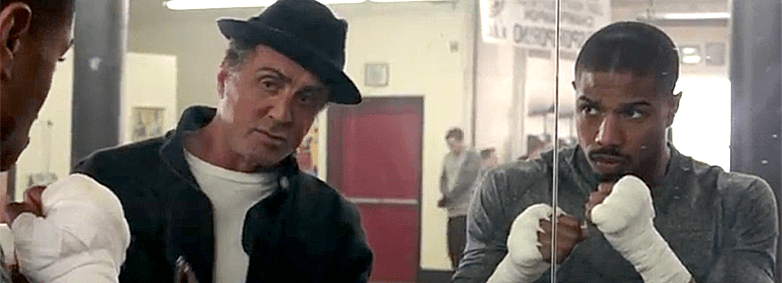
Stallone offers a poignant gravitas as Rocky, the former champ who’s still taking life on the chin.

Never more comfortable than in the Italian Stallion’s pork pie hat, the actor wisely refrains from donning his old gloves.

Rocky’s persuaded to train Adonis, the illegitimate son of one time adversary turned friend now deceased, Apollo Creed.

Creed’s death in the boxing ring weighs heavily in different ways on both characters.

Boxing offers Adonis the opportunity to come to terms with his father’s absence during his life, to honour his legacy while breaking free of his shadow.

Rocky has no desire to see another colleague and friend die from boxing injuries.

Living downstairs in Adonis’ Philadelphia apartment block is Tessa Thompson’s aspiring musician Bianca.

The fluid chemistry between the young actors serve as much as any aspect of the film to invigorate it.

Putting the focus on the pair allows for an introduction to a new generation of movie goers for whom the Rocky franchise may possess scant cultural cachet.

Events allow Adonis a title bout against the world champion Ricky Conlan.

Presumably real life boxer turned actor Tony Bellew was given his shot at the big time to add verity to the boxing scenes.

However he’s a less cinematic pugilist than Jordan and lacks the on-screen menace of the opponents in previous films.

Conlan is well short of Dolph Lundgren’s Ivan Drago from Rocky IV (1985) to name but one.

With artifice working more effectively for cinema than reality, this suggests it’s better to employ actors who can pretend to box than have boxers who aspire to act.

Despite this, the urgent and bloody bouts are pure Hollywood fiction in the best Rocky tradition and the story lands some brisk emotional punches.

The big fight takes place at Goodison Park, home of Everton FC. It’s the best drama seen there all season.