The Lego Batman Movie

Director: Chris McKay (2017) BBFC cert: U

The Caped Crusader returns in a dynamically entertaining spin-off from 2014s The Lego Movie.

Brightly coloured, rapid fire and full of jolly stupidity, I was laughing from the first word of dialogue. And by the end of the opening titles I was a giggling mess.

The fun is powered by state-of-the-art animation and the camp sensibility of the 1960s Batman TV show. It lovingly sends up Batman’s many screen portrayals and his bromance with his arch-enemy The Joker.

In order to prove he is Batman’s number one bad guy, The Joker unleashes a horde of villains from Hollywood history. To save Gotham City from Godzilla, King Kong and err, Daleks, Batman must confront his greatest fear.

The crime fighter is once again voiced by a gravel-throated Will Arnett, who brings the superhero to life with a deliciously angry delivery.

It’s stuffed with super-enjoyable cameos and revamped Bat-tunes, and the Bat-cave is a treasure trove of potential merchandise for your kids to drool over.

They will love this daft Bat-adventure, I definitely did.

@ChrisHunneysett

Resident Evil: The Final Chapter

Director: Paul W. S. Anderson (2017) BBFC cert: 15

Brace yourself for a ferocious return to the apocalyptic wonderland of Alice and the Red Queen.

The sixth in this zombie action franchise of variable quality, this demented trip improves on all but the brilliant first Resident Evil, which came out way back in 2002. It follows on directly from 2012’s Resident Evil: Retribution.

As Alice, Milla Jovovich once again teams up with her favourite writer and director, Paul W. S. Anderson. The talented Geordie is also the star’s husband and their daughter Ever Gabo Anderson, plays the scheming Red Queen.

So Alice sets off to the giant underground bunker, the Hive, where her adventures first began. Among the many threats facing Alice, are mutant pterodactyls and an army of rabid zombies.

With a love of the material feeding his down to earth showmanship, Anderson fills the screen with many inventive action sequences, all set to a thunderous soundtrack.

Refusing to worry about what he clearly considers to be silly and inconsequential things, such as plot holes, Anderson powers over them at a frantic pace, dragging us along behind him.

It’s not hard to detect the positive influence of British cult comic 2000AD in the sardonic response to the gleeful showers of ultra-violence.

The principal creatives claim this will be the series finale. However Sigourney Weaver starred in the Alien series at forty eight years old, and this year Kate Beckinsale starred in the latest of her Underworld films at forty three. Jovovich is only forty one, so age is very much on her side.

And with this degree of adrenalin fuelled entertainment, I hope this isn’t the final chapter.

@ChrisHunneysett

Passengers

Director:Morten Tyldum (2017) BBFC cert: 12A

Hollywoods hottest stars make cosmic love in this glossy sci-fi mystery romance.

On paper this looks like a winner: Jennifer Lawrence and Chris Pratt are talented, attractive and likeable, with a strong record of blockbuster success. Director Morten Tyldum comes straight from the Oscar nominated hit, The Imitation Game (2014.)

The huge budget allows for top draw special effects. And in a change from cinemas littered with adaptations, reboots, sequels and remakes, Passengers has an original story.

A shame then, the film is such a morally dubious and often dull mess.

Pratt plays a mechanic called Jim, in suspended animation alongside 5000 others on an automated spaceship heading to colonise a new world. An asteroid storm causes his sleep pod to malfunction, and he awakes to find his journey still has about 90 years to go.

This opening is the strongest part of the film, and it’s no hardship spending time with Pratt as he explores the ship. There are some decent jokes here about corporate identity and status.

Jim spends a year slowly going stir crazy with only an android barman for company. It’s played by the brilliant, movie stealing talent of Michael Sheen. Wandering through the ship, Jim falls in love with Jennifer Lawrence’s sleeping beauty, called Aurora.

Cyberstalking Aurora by accessing the ships files, Jim also holds vigils next to her glass pod before deciding to wake her up, knowing she will not survive the voyage.

He blames the ship and the film refuses to condemn him for this selfish evil act, portraying it as an act of love. Then the script rewards Jim with some hot space nookie as she finds his goofy yet capable man-child irresistible. This is Stockholm syndrome in space.

Not that it excuses Jim’s behaviour, but Aurora turns out to be an irritating investigative journalist with daddy issues. She only really comes to life when she’s angry.

For the second week in a row following Rogue One: A Star Wars Story (2016), the robot is the most sympathetic character.

The design and CGI are fabulous and there are interesting nods to Stanley Kubrick classics 2001: A Space Odyssey (1968) and The Shining (1980).

But the film abandons its early attempts at psychological horror to play the romcom card before becoming an action movie with some dull peril and explosions to bring the story to a close.

Being lost in space for ninety years together is the least this pair deserve. You have to feel sorry for the android though.

@ChrisHunneysett

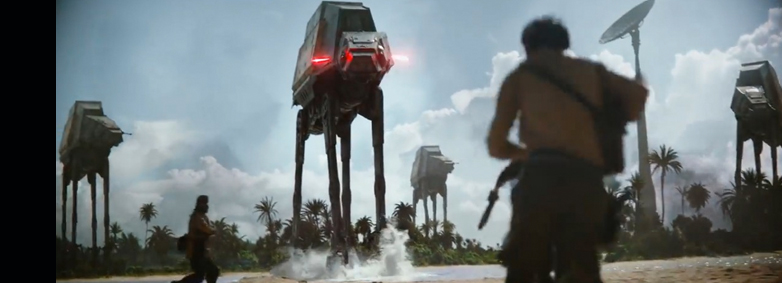
Rogue One: A Star Wars Story

Director: Gareth Edwards (2016) BBFC: 12A

This spin off of Disney’s Star Wars sci-fi franchise will please hardcore fans far more than the average audience member.

In terms of chronology and entertainment, Rogue One sits between the swashbuckling first Star Wars (1977) film and the ponderous bloat of the Phantom Menace (1999) prequels. 

It has all the virtues and flaws of director Gareth Edwards previous effort, Godzilla (2014). That monster box office success was visually stunning but dramatically inert, revealing Edwards tremendous ability for conjuring up beautiful images but a fatal lack of aptitude for character, dialogue or drama.

The strength of JJ Abrams billion dollar success The Force Awakens (2015) was to capture the joyous spirit of the 1977 original film, while paying service to the fans with the inclusion of favourite characters, scenarios and design. Lacking Abrams gift for zippy showmanship, self confessed super fan Edwards plays loudly to his fellow nerds in the gallery but forgets to bring the fun for everyone else. The attention to drama is perfunctory while cool looking space stuff is drooled over from too many angles.

This film isn’t short of ravishing vistas and gloriously detailed design and there’s no faulting Edwards attention to detail. Graphics, costumes, sets and uniforms are lovingly recreated in an appropriate style. The CGI is faultless, except when it’s deployed to bring back to life characters from the first film. At first shocking and intriguing, the longer we spend with these unconvincing creations the deeper we’re lost in an uncanny valley of dead eyed CGI.

The filmmakers are so proud of their technical cleverness they pause the film so the audience can gasp at the marvel of the inclusion of yet another minor character. This kills momentum and makes the galaxy seem a very small place indeed, undermining all the impressively epic world building.

Edwards seems to share a belief with Batman Vs Superman (2016) director Zack Snyder, that looking cool is more important than coherent cinematic storytelling. For example a moment of intended poignancy is undermined by the directors insistence we bask in the gloriously beautiful glow of laser powered mass destruction. We’re encouraged to passively admire a billowing cloud of annihilation as we would a particularly colourful sunset. This is at odds with our natural reaction which would be to recoil in horror.

It’s worth comparing how in Terminator 2 (1991) James Cameron treated a similar piece of large scale obliteration as angry and painful. In the hands of Edwards the tone suddenly shifts towards the romantic, because nothing says ‘I love you’ more than a mushroom cloud. Cameron did use a mushroom cloud to invoke passion, love and reconciliation in True Lies (1994), but did so in a cohesive manner which combined story and character in a succinct and tonally satisfying image. Edwards fails to do this, opting for ‘gee, doesn’t this look cool’, instead. We’re not looking at the characters which would us insight into their emotional state, the cameras eye is on the beautiful scenery. 

Similarly to Godzilla, we begin with a short scene which introduces the major characters while killing off a significant other. And again, all of this is immediately redundant as the story skips several years to find the child at the centre of the scene is now an adult. All the information we are given in this first segment is offered again at regular intervals. The dialogue is nothing if laboriously functional in providing us with what we need to know. 

With her face set to stern and her laser gun set to kill, Felicity Jones stars as Imperial prisoner Jyn Erso. She’s co-opted into the rebel alliance because her dad is the designer of the evil Empire’s new fangled super weapon, called the Death Star. A team of assassins, spies and saboteurs is gathered and off they pop to break into a highly secure imperial base to steal the technical plans, in order the Death Star can be destroyed. Far too much time is spent with Ben Mendelsohn’s career minded evil scientist, Orson Krennic.

Despite Jones being at the centre of the action, it’s a male dominated film, with all her key relationships being with men. She’s a daddy’s girl through and through. Her gang are racially diverse, but she is the token female smurf, err woman. There are as many robots on the team as there are women.

Alan Tudyk voices droid K-2SO and gives the comic sidekick a degree of warmth notably missing elsewhere. Though the heavy handed robot humour isn’t hugely funny, we should be grateful for these scraps. I suspect the widely reported weeks of costly reshoots involved crowbarring this character into as many scenes as possible, he’s a jack in the box of intrusive appearances.

For a leading proponent of sci-fi, George Lucas has never shown any interest in exploring the moral and dramatic possibilities inherent in Asimov’s three laws of robotics.

The rebel alliance is reliant upon deserters, traitors and fifth columnists. There are shifting allegiances and employments as people are variously press ganged, manipulated and sold down the river. In an attempt to add dramatic weight to acts of derring do, contemporary political signifiers such as militant splinter groups, friendly fire and the destruction of ancient religious artefacts are included. 

Ruling the galaxy with a tyrannical fist must be exhausting and we see how Darth Vader spends his down time. This removes another layer of mystique and menace from the most feared cyborg in the galaxy. Taking a cue form The Revenge of the Sith (2005), he also gets his own flying Yoda moment. The man has a million stormtoopers at his disposal, but honestly, you just can’t get the staff and he has to do it all himself. Still, it looks cool,and that’s Edwards primary interest.

Rogue One begins abruptly and ends in a similar fashion. It dispenses with the opening crawl and the  classic John Williams theme is mostly absent.

 Technically Rogue One is episode III and a 1/2, but that’s half a star too many.


Arrival

Director: Denis Villeneuve (2016) BBFC cert: 12A

Prepare yourself for an epic close encounter in this cerebral sci-fi creature feature. It’s an astonishingly involving, wonderfully acted, technically dazzling and breathtakingly beautiful paean to the pain of existence.

Superb in every department, the intelligent design and gorgeous cinematography are graced by sympathetic editing which reflects the themes of the film. The storytelling of this masterful work constantly wrong foots our expectations to provide this years most profound emotional kick.

I staggered from the screening, aping exactly the stunned expressions of stars Amy Adams and Jeremy Renner after their first contact with alien lifeforms. I was not quite believing of the intensity or meaning of my experience, but I knew it was somehow glorious.

The arrival of an alien fleet on Earth causes global panic and the US government calls a state of emergency. Adams is tremendous as Dr. Louise Banks, a gifted linguist who is recruited by the US military and represents humanity’s best hope. Her mission is to communicate with the extra-terrestrial visitors and ascertain their purpose on our planet. She is aided by Renner’s theoretical physicist, Ian.

The lengthy first view of the monumental alien craft has a gobsmacking power. Humans are pitifully fragile before the enormous alien shell-like ship which gently hovers yards above the ground. This is merely a light jab to soften our senses before the hefty emotional punches Villeneuve lands on us later.

Inside the grey giant egg of a craft, the aliens appear through a shroud of mist,separated from their guests by an invisible wall. The giant squid-like beings have an elephantine hide, and their seven fingered form has echoes of some of the startling imagery in director Villeneuve’s Enemy (2013). They communicate through a sign language composed of inkblots, reminiscent of rorschach tests.

However time is running out as the Chinese and Russians rattle their sabres in the face of the perceived threat. Plus the anxious trigger fingers of the US military are ready with radiation suits, rifles, helicopters and high explosives.

The relatively few action moments are given power by a sharp script which touches upon our understanding of love, language, memory and time. There are elements of the Cold War stand-off and biblical allusions to the tower of Babel and Moses ascending Mount Sinai.

Along with her lead in Tom Ford’s masterful thriller Nocturnal Animals (2016), Adams has two of the plum lead roles of the year, a singular achievement for a forty-something actress in a notoriously youth-orientated Hollywood.

As her scientist sidekick, Renner demonstrates why he’s Hollywoods finest second fiddle. Forest Whitaker and Michael Stuhlbarg offer strong, understated support as a US Colonel and an FBI Agent.

With communication and time key ideas, Arrival appropriately conducts its own dialogue with cinema. Combining the majesty of Stanley Kubrick’s 2001: A Space Odyssey (1968) with the humour and humanity of Spielberg’s Close Encounter Of The Third Kind (1977), Arrival is a far more successful blend of the two masters than Spielberg’s own mesmerisingly flawed A.I. Artificial Intelligence (2001). As well as his own films, Villeneuve includes a call back to the cult sci-fi Cold War thriller War Games (1983). This is the film Christopher Nolan can only dream of making.

The next film by Villeneuve is a sequel to Ridley Scott’s classic Blade Runner (1982), and it’s good to know it’s in the safest possible pair of hands.

But first you absolutely must see this one.

@ChrisHunneysett


Doctor Strange

Director: Scott Derrickson (2016) BBFC cert: 12A

Released on a Tuesday to capitalise on UK schools half term break, this is a movie which doesn’t need the leg up to take the number one spot in the box office chart. The eye popping visuals and star power of Benedict Cumberbatch means this sorcery-based superhero adventure will have you spellbound.

In an astute piece of casting every bit as inspired as having Robert Downey Jnr play Iron Man, the star of TV’s Sherlock star plays Dr Stephen Strange, a brain surgeon turned Sorcerer Supreme.

In the latest introduction of a minor character in the Marvel canon to the wider cinema audience, the impressively psychedelic stylings of this latest product off the assembly line are sufficient to distract us from the functional plot.

Plus its East meets West magic and martial arts action means it possesses it a far stronger sense of identity than some of its franchise fellows. Yes, I’m looking at you Ant-Man (2015).

Despite a distracting American accent, Cumberbatch is alarmingly dashing in goatee beard, glowing medallion and a red cape. Similarly to the magic carpet in Disney’s animated Aladdin (1994), the cape has a mind of its own and is a major character in its own right. It says a lot for the actor’s comic ability he can play straight man to his costume.

The strong supporting cast includes Chiwetel Ejiofor, Rachel McAdams and Benedict Wong. Stan Lee has one his better cameos. McAdams is focused, bright and underused in the role of Strange’s love interest. By coincidence she appeared in Guy Ritchie’s Sherlock Holmes (2009) as Holmes’ love interest Irene Adler.

A rampant egotist, the Doctor’s glamorous lifestyle and career are ruined when a car accident crushes his hands. In Nepal he is trained in the art of sorcery by Tilda Swinton’s mysterious Ancient One. Her sink or swim teaching methods include abandoning her pupils on Mount Everest to find their own way to safety.

Having fun in a role which is absolutely not stretch of his talent, former Bond villain Mads Mikkelsen sports glam rock eye shadow and periodically teleports in to cause carnage. As renegade mystic Kaecilius, he’s attempting to destroy the world with the help of Dormammu, a powerful demon from the Dark Dimension.

The story skips between London, New York, Hong Kong and Nepal in a series of gravity defying, time twisting, space curling, mind bending action set pieces. For a lot of the time it’s like watching Christopher Nolan’s Inception on acid.

This is easily the most visually ambitious, funny and entertaining superhero movie of the year.

@ChrisHunneysett


Morgan

Director: Luke Scott (2016) BBFC cert: 15

Kate Mara gives a blank performance as a corporate investigator in this wearingly predictable sci-fi thriller.

It’s a curious choice of material for a directorial debut by Luke Scott, who presumably would enjoy being recognised for more than being the son of industry titan, Ridley.

Grappling but never getting to grips with sci-fi’s key theme of sentience, Scott Jnr’s film desperately clings  to the coat tails of his father masterpiece, Blade Runner (1982). For long stretches Morgan feels like an unofficial fan fiction prequel. It is produced by Scott Snr’s production house.

Alex Garland’s debut Ex Machina (2015) covered much of the same ground and is a far superior model.

As the immaculately presented Lee Weathers, Mara arrives at a remote research facility to assess the viability of Morgan as a potential product stream in light of a violent episode.

Morgan is the result of synthetic DNA and nano-bot technology being subjected to an accelerated growth programme. It/she appears to be a teenager yet is really only five years old.

Anya Taylor-Joy endows her dead-eyed and hoodie-wearing character with a suitably sullen teenage malice and is capable of defending herself.

Toby Jones and Michelle Yeoh furrow their brows as scientists while Paul Giamatti arrives to administer a psyche evaluation which is definitely not a Voigt-Kampff test. The scientists regard Morgan as their child and are suspicious of Lee’s motives.

The evil corporate angle is over emphasised and under developed, humourless characters leave us cold and there’s a forgettable soundtrack. Though we’re presented with the occasional arresting visual composition, there’s a lack of ambition in the camera movement.

Despite nicely executed bloodshed and decent stunt work, this is a functional and uninspiring creation lacking the necessary heart and soul.

@ChrisHunneysett


Star Trek Beyond

Director: Justin Lin (2016) BBFC 12A

Beam yourself aboard the starship Enterprise for a non stop rocket ride of outer space adventure.

This third film in the rebooted sci fi franchise is a solid improvement on the muddled second episode Star Trek Into Darkness (2013). Lin has directed 4 of the Fast Furious films and he’s energised this series after JJ Abrams’ faltering tenure. There’s every suspicion Abrams’ head being turned by the opportunity to direct Star Wars: The Force Awakens (2014) resulted in the mess that was Into Darkness.

Chris Pine, Zachary Quinto, Zoe Zaldana, Anton Yelchin, John Cho and Simon Pegg slip easily into their natty new uniforms as Captain James T. Kirk, Mr Spock, Uhura, Chekov, Sulu and Scottie. Though it’s Karl Urban as the irascible Dr McCoy who is gifted the best lines.

Sofia Boutella enjoys herself in an aggressively  physical role as Jaylah, a non human. In the Federation, everyone is an alien. There’s no return for Alice Eve as Dr Carol Marcus and at no point are any women required to pose in their underwear, a gratuitous moment which embarrassed Into Darkness even more than the script did.

While on a rescue mission through an unchartered nebula, the Enterprise is attacked by a swarm of giant insect like steel spaceships.

Most of the crew are killed or kidnapped, the Enterprise is destroyed and the captain is stranded on a nearby planet. It’s home to a powerful warlord called Krall, played with muscular menace by Idris Elba.

There’s a jaw dropping action sequence on a beautifully designed space station, anti gravity combat and a mysterious ancient alien weapon. I can’t stress how fabulous the space station is. It’s fragile grace is one of the most remarkable pieces of design I’ve seen this cinema year.

As well as starring, uber Trekkie Pegg co-wrote. In his best work for years the script cleaves closely to the soaring spirit of joshing optimism and adventure of the original 1960’s TV show.

There’s a touching moment of remembrance for Leonard Nimoy who essayed the part of Spock for many years and the film is dedicated to Anton Yelchin who sadly died this year.

A fourth film has already been announced and on this form the series is set in the words of Mr Spock, ‘to live long and prosper’.

@ChrisHunneysett

The Call Up

Director: Charles Barker (2016)

I was tempted to go MIA while watching this misfiring sci fi action thriller.

Virtual reality gamers feeling the real pain of warfare is a strong premise. But the potential is carelessly squandered by the lack of polish in the script. This translates into a deficit of onscreen urgency, tension or humour.

Eight expert online gamers are invited to the top floor of a tower block.

Identified to each other only by their avartars, they’re squeezed into full immersion technology suits; an unforgiving combo of nylon jump suits and white armour.

Believing they’re playing a hi-tech version of paintball, they’re instructed to fight their way past ‘terrorists’ to the ground floor.

This is a similar scenario to the comic book adaptation Dredd (2012) and Indonesian martial arts movie The Raid: Redemption (2012). It worked brilliantly there but not so much here.

A strangely muted pace and the workaday action lacks the gleeful sadism of recent low similar budget flicks such as The Purge (2013).

The player with highest points will win £100,000 prize money. However the team quickly discover being shot involves pain, injury and even death. This is definitely not what they  signed up for.

Sadly the twist ending isn’t worth waiting for. Plus the characters are so thinly sketched we don’t care.

Morfydd Clark and Ali Cook are among the hard working actors struggling to inject life into a sterile environment.

There’s some sweet design in the costumes and technology but even assuming for the budget constraints, the location dressing is uninspired.

What should compensate is scorching action, great dialogue, the sense of a wider world, a critique of game playing or perhaps an examination of the correlation between on and off screen violence. And all of this is missing.

By setting itself low ambitions and barely achieving them, experiencing The Call Up was far too much a call of duty.

@ChrisHunneysett