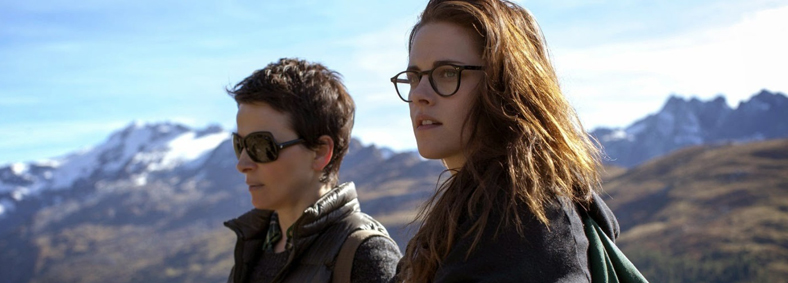
Clouds Of Sils Maria

Director: Olivier Assayas (2015)

Three fine talents are wasted in this indulgent and exasperating mediation on age, acting and art.

Actress Maria Enders (Juliette Binoche) appeared in the play Maloja Snake, kickstarting her career and making her famous. From the dialogue we hear the play sounds unbearable.

Maria’s role was a young intern called Sigrid who is involved in an exploitative relationship with her boss Helena. Now years later, Maria is invited to take part in a new production but this time taking the part of Helena.

Her personal assistant Valentine (Kristen Stewart) acts as a driver, confident and drinking buddy who helps Maria prepare for the role.

Pitched to be the new Sigrid is Jo-Ann Ellis (Chloe Grace Moretz), a gun-toting, rehabbing, paparazzi-magnet who is an amalgam of the worst headlines of Lindsay Lohan and Britney Spears. She brings much needed spite and bile to the self-satisfied proceedings.

Maria is an irritating combination of affectations; a needy, attention-seeking, pill-popping alcoholic who flirts with anyone offering work. Everyone is duplicitous and solicitous and every expression of feeling is a calculation.

This may an accurate reflection of the life of an actress but it’s far from an original one and gives us little reason to warm to Maria. Susan Sarandon sent up the self-obsessive nature of actors far more entertainingly as a guest star in TV’s Friends.

When the directionally-challenged Maria and Valentine struggle up a mountain brandishing a map, it’s impossible not to be reminded of the similarly themed and equally dull and indulgent Maps To The Stars (2014).

There are frequent mountain walks, a little drunk-driving, some skinny dipping, endless rehearsals and too many discussions of age changing perspective. It’s high-handedly critical of celebrity culture, the internet and Hollywood films.

Riffing on the film’s exploration of age-defined femininity, Binoche embraces nudity and Stewart doesn’t.

This is a theatre acting class masquerading as cinema but I’m not sure I’m sufficiently communicating the extreme turpitude of the viewing experience.

The Swiss scenery is beautiful and shot with crisp veneration by cinematographer Yorick Le Saux.

The Clouds Of Sils Maria is an example of aiming to make art and failing to create anything as humble as an entertainment.

Girlhood

Director: Celine Sciamma (2015)

Teenage tribulations are a trial in this un-involving French drama.

When Marieme (Karidja Toure) fails her final year at school, she rejects the offer of vocational courses.

Instead she embraces the limits of her horizons and joins the local girl gang. The glamorous Lady (Assa Sylla) is the leader of Adiatou and Fily (Lindsay Karamoh, Marietou Toure) and Marieme brings their number up to the seemingly requisite four.

Together they’re loud, aggressive, popular with the opposite sex but content to accept their circumstances.

Even my pidgin French understands the French title ‘Bande de Filles’ doesn’t translate as Girlhood, but ‘gang of girls’ or less literally ‘girl hood(ies), so it’s safe to assume the title was created to catch the coat-tails of residual goodwill from last year’s brilliant coming of age drama Boyhood.

Marieme – re-named Vic, for victory – is soon sporting the obligatory black leather jacket and straightened hair. Then she’s off out smoking, drinking and robbing along with the others. Her character development is traced though her changing haircuts.

Cinematographer Crystel Fournier has nice eye for colour and texture but the plot is weak and the girls are dull. We’re asked to sympathise with them but they’re impressive only in their ordinariness.

Their behaviour may be typical but it’s not pleasant – especially the way work-shy Vic amuses herself by bullying shop girls and organising fights against other gangs.

Eventually she takes the only job she’s prepared to do – working as a drugs mule for the local dealer Abou (Djibril Gueye) but even this potentially interesting development fizzles out.

Girlhood is being lauded for being an unpatronising portrait of black female French teenagers rather than the refined middle class types we’re more frequently presented with.

Unfortunately the story lacks insight; presenting the girls as real people is not the same as showing them in an interesting light.

The girls’ give nicely natural performances but like the gang, the film needs a stronger sense of urgency instead of ambling along without direction and achieving little.

We Are Monster

Director: Anthony Petrou (2015)

Based on a true crime, this slow-burning psychological drama explores the build-up to a brutal prison murder.

Due to failings in a famously not-fit-for-purpose criminal justice system, petty thief Zahid Mubarek (Aymen Hamdouchi) is forced to share a cell in Feltham Young Offenders Institute with known violent racist Robert Stewart (Leeshon Alexander).

As the system sleepwalks a tragedy unfolds with horrific consequences; the result of missing personal files, reports un-actioned and pleas to be rehoused in a different cell ignored.

A weak mental state is exacerbated through the indifference of officers charged with the welfare of inmates.

Isolation breeds Stewart’s paranoia, fear and anger at the perceived injustices of his circumstances.

He is increasingly lost in a world of literal and metaphorical shadows as his psychological dark side envelopes him.

There’s domestic violence, self-harm, bullying and strong language.

This is a confidently hypnotic film with strong cinematography by Simon Richards who delivers excellently framed shot composition and masterful control of light.

Fred Portelli provides the music and helps create a bewildering soundscape of unsettling noises that help create an atmosphere of alienation.

By offering a sympathetic light on the troubled personal history of Stewart, the horror of what happens to his cellmate Mubarek is undermined, making him a minor character in his own murder.

Samba

Director: Olivier Nakache & Eric Toledano (2015)

This inter-racial romance among immigrants in Paris breaks hearts and cultural barriers with an abundance of humanity and humour.

Working-class Senegalese trainee chef Samba Cisse (Omar Sy) has lived illegally for ten years in Paris. He is arrested at work and placed in a detainment centre next to the airport.

Highly-strung case-worker Alice (Charlotte Gainsberg) helps him with his court case. They are both passionate and give good anger. She’s warned by the younger, sexier, more cynical Manu (Izia Higelin) not to become involved with her clients.

Released and required to leave France but under no pressure to do so, Samba returns to work in a succession of unskilled, casual, cash in hand jobs in security, construction, window cleaning and so on. They all posses an element of danger.

Samba is accompanied by his effervescent Brazilian friend Wilson (Tahar Rahim) and they make a likeable double-act, helping and protecting one another from criminals and the police.

As the tentative relationship between Samba and Alice develops, they have a beneficial effect on the other’s personalities – but Samba’s all too human needs and weaknesses return to threaten his potential happiness and fragile stability.

The ambitious opening scene is a lengthy shot beginning in a lively, wealthy wedding reception. We follow a fabulous wedding cake as it’s transported off the dance floor through the hotel corridors and into the depths of the kitchen where the camera stops and lingers on the men washing dishes.

It is no coincidence these are the first black faces we see and in one wordless, dynamic shot, the film’s occupations with identity, status and employment are established. The shot has echoes of both the opening of The Great Beauty (2014) and the Copacabana scene form Goodfellas (1990).

There is also a virtuoso and vertiginous shot looking down an office block which was sufficiently well constructed to make me dizzy.

Stephane Fontaine’s cinematography avoids making Paris a chocolate box of delight but is presented as a busy, complex, working city. In this film of contrasts, light and colour are used to differentiate between calm and chaos, wealth and poverty.

The music is sparse but used to terrific effect. We hear a confusion of languages which helps the exploration of identity; how it is defined for us but also how we can choose to define ourselves.

An intelligent script takes great delight in pointing out the absurdities and failings of the bureaucratic immigration system, not least in making the observation people are seeking asylum from places the French middle-class go on holiday.

Alice and Samba are hard-working, charming and flawed. In a cafe they’re filmed in shallow focus to block out the world around them, encouraging us to concentrate on their beautiful faces.

They enjoy each other’s company and we enjoy being with them. They’ll always have Paris.

Far From The Madding Crowd

Director: Thomas Vinterberg (2015)

Passion, obsession and betrayal burst from every frame of this compelling, fresh and faithful adaption of Thomas Hardy‘s classic Victorian novel.

His rustic romance of a headstrong heiress and her three wildly different suitors is powered by a first-rate cast on their best form. Carey Mulligan is captivating as Bathsheba Everdene, famously played by Julie Christie in the 1967 version.

The orchestral score swells over the green and pleasant land of a production rich in period detail. The handsome locations are shot on film  – not digitally – in the county of Dorset (Wessex) where the book was set. This beds the story deep in historical and local context.

In an economical piece of character sketching, we first meet the beautiful, intelligent and impulsive Bathsheba (Carey Mulligan) riding freely on horseback. She is seen by the good shephard Gabriel Oak (Matthias Schoenaerts) who is diligently watching his flock. She is sporting a sleek, red riding-jacket, he is dressed in practical working clothes.

Valuing her independence above all else, Bathsheba is saved from an uncertain future when she inherits her uncle’s farm and determines to restore it to it’s once prosperous profitability.

Bathsheba is a political beast who doles out praise and punishments to her workers in public, she not only helps on the farm but is careful to be seen to be helping out on the farm.

She’s aided and abetted by her servant Liddy (Jessica Barden) who’s a useful source of village gossip and accompanies Bathsheba in making merry mischief.

As circumstances turn darker so Liddy slips from the frame. This is a shame as they share a sweet and believable friendship and it offers Bathsheba an extra dimension, preventing her from being defined by her relationship with men.

Bathsheba recognises men are attracted to her but sees it as a trap with no value – until she struggles in the man’s world of business. At the local market she’s reduced using her charm to encourage the local merchants to at least try her merchandise.

Farming life is a wild meadow of activity. As well as harvests, sheep dips and recruitment fairs, there’s bare-knuckle boxing, swordplay, gambling, storms, fires, madness and the tragic death of an infant.

The plot revolves around the ill-considered sending of a valentines card. When she is kissed for the first time Bathsheba is shocked by the strength of her own reaction. It derails her social sure-footedness and leads to choices which shreds her independence and happiness.

Bathsheba receives three propose; from the honest shepherd Gabriel, swaggering soldier Sergeant Troy (Tom Sturridge) and the emotionally fragile landowner William Boldwood (Michael Sheen). She sings a duet with one, rides tandem with another and marries a third.

Though the script sensibly streamlines the novel, it remains emotionally articulate and frequently funny. The focus is so tight on Bathsheba, outside of her suitors and Liddy, there’s barely another character who has a speaking role of note.

This is the weakness of the film as we’d like to spend longer here, perhaps wander around the countryside and meet a few more of the interesting looking characters who populate the village.

As the tone grows darker and the story more violent, the assured pacing of Danish director Vinterberg delivers dramatic action which is always underpinned by strong character motivation.

At quieter moments he is able to capture the nuance of social status, such as when characters wordlessly shift seats around a dinner table to accommodate an unexpected, superior guest.

Vinterberg is assisted by the vivid cinematography of Charlotte Bruus Christensen and the briskly seductive editing of Claire Simpson.

Although unquestionably a fine and suitably physical actor with the requisite intelligence and stillness of purpose, it’s curious to cast the Belgian Matthias Schoenaerts in a role who embodies what Hardy saw as the great virtues of the English.

Michael Sheen demonstrates his tremendous ability to suggest torrents of inner turmoil with a bare twitch of the mouth. As Boldwood struggles for the correct words, his quiet pleading is magnificently crafted from tight smiles and difficult pauses.

It has echoes of Prince Charles questioning the meaning of love when announcing his engagement to the considerable younger Diana Spencer.

The remarkable Carey Mulligan gives a rich and nuanced performance of acute emotional resonance. Her doe eyes convey Bathsheba’s vulnerability, strength and desire as well as her growing self-awareness and changing values.

Mulligan may not win next year’s best actress Oscar or even make the final cut, but she’s the early high-score on the leader board.

It’s easy to fathom why the men fall for Bathsheba, it’s more of a wonder why more men don’t.

The Falling

Director: Carol Morley (2015)

Mass hallucination, sexual exploration and death combine to cast a spell of barely believable boredom in this boarding school drama.

After tragedy strikes a strict English girls’ school, a mysterious fainting epidemic breaks out. With the authorities denying anything is wrong, it’s up to the pupils to deal with events.

Schoolgirl Lydia (Maisie Williams) is a moody, bookish brunette, her closest friend Abigail (Florence Pugh) is an annoying, more attractive blonde.

They spend their time embracing each other, licking each other’s fingers and sharing bubblegum. They also read poetry to one another and carve their initials in a tree like lovers do.

The actresses deliver literal line-readings and never come close to suggesting their characters possess interior lives.

Abigail sports love-bites and too-short hemlines. Despite her affection for Lydia she openly enjoys the attention of boys who drive fast cars.

Following nosebleeds and medical examinations, Lydia develops a serious twitch and there’s an outbreak of falling over among the school’s population. This becomes laughable the more people it affects.

There’s a suggestion it could all be caused by a magic spell cast by Lydia’s weird brother Kenneth (Joe Cole) – but doctors insist nothing is wrong with the girls.

Lydia’s mostly mute mother Eileen (Maxine Peake) is a homebound hairdresser who silently suffers a great deal of angry abuse from her daughter.

Greta Scacchi and Monica Dolan play stern school-heads who antagonise Lydia by refusing to take her seriously.

The 1969 setting seems designed to avoid the internet and isn’t exploited for any other purpose, certainly not to create a much needed sense of otherworldly timelessness.

Prosaic camerawork and lighting fail to generate any sense of operatic grandness while the pacing is erratic with scenes alternately dragging or rushing. The editor includes many slow-panning shots of leaves and trees.

There’s a lot of poetry and an alarmingly intrusive rock-folk soundtrack – but none of the disparate elements heighten the gothic undertone in the script; consequently an interesting mood of mystery or fear fails to materialise.

The Good Lie

Director: Philippe Falardeau (2015)

When refugees land in the US, their troubles are far from over in this moving and surprisingly gripping drama.

It’s a tale of love, family and sacrifice set against the background of war, immigration and isolation.

Rather than asking us to pity the immigrants or expect them to be grateful, The Good Lie makes us consider the wealth and privilege of our own circumstance.

Having fled war in Sudan as children, Mamere, Abital, Jeremiah and Paul (Arnold Oceng, Kuoth Wiel, Ger Duany, Emmanuel Jal) spend the next thirteen years in a Kenyan refugee camp.

They celebrate when they’re chosen to be air-lifted to the US to start a new life – but bureaucracy separates Abital from the boys and she’s sent to a distant part of the US. The subsequent terrorism of 911 makes it impossible for her brother Mamere to visit.

Well-meaning and justifiably proud of helping, Pamela (Sarah Baker) is a vaguely incompetent charity worker who houses the boys together.

It’s beleaguered and bemused job-broker Carrie Davis (Reese Witherspoon) who does most to help assimilate them by providing opportunities for paid employment. She has a complicated love life seemingly having slept with half the town; the male half.

An angry, attractive and formidable presence, Witherspoon crashes through her scenes. It’s not much of a role but she makes the absolute most of it as a baseball bat-swinging drunk who is surprised by her own conscience. Were it not for her charisma, the film would suffer being dominated by the men.

Everyday living provides mundane but enormous obstacles to the boys who’ve never operated a telephone before. They’re perplexed at the enormous waste of food and struggle with the American diet.

All are traumatised by their and seek comfort in different ways; one looks to the church, one to drugs and the other buries himself in work to avoid his survivor’s guilt.

The greatest threat to the success of The Good Lie is attempting to navigate the shifts in tone from a gripping survival adventure to a culture clash comedy and an uplifting tale of redemption. It’s to the great credit to its writer, cast and director it succeeds without jarring.

The final third seems rushed and consequently over-reliant on the emotional momentum generated much earlier in the film, despite this The Good Lie lands an effective emotional punch.

Woman In Gold

Director: Simon Curtis (2015)

A young lawyer and elderly woman team up to haggle over the ownership of a valuable piece of art in this dull plod of a true story.

Half courtroom drama, half Second World War thriller and all unremarkable, an uninformative script fails to inspire two mismatched leads.

Widowed US citizen Maria (Helen Mirren) is Austrian by birth and bossy, rude and talkative by nature. She spends a lot of screen-time staring into space and listening to music. She has come into documents suggesting a valuable painting of her aunt Adele may in fact belong to her.

Painted by famous artist Gustav Klimt and known as the ‘Woman In Gold’, it’s of such great importance it’s colloquially referred to Austria’s Mona Lisa, though it’s real name is ‘Portrait of Adele Bloch-Bauer I‘. As her aunt’s will specified it’s hanging on public display in the famous Viennese Belvedere Gallery.

Maria hires the inexperienced lawyer Randol Schoenberg (Ryan Reynolds). The grandson of a famous Viennese composer, Randol takes the case to further his career but after visiting the Holocaust Memorial it becomes a personal mission to secure for Maria the painting.

Together they scuttle off to Vienna to demand the paintings return from the gallery. She tries to shame the authorities into gifting her a painting worth over a hundred million dollars. Even to my inexpert legal mind it’s not a strategy likely to succeed.

Eventually Randol discovers a legal loophole and takes Maria’s claim to the US Supreme Court for permission to sue the Austrian State for the painting’s return.

In one scene a Ferris wheel is featured prominently in the Viennese background, prompting the mind to drift to this famous moment from cinema.

Randol’s argument rests on the exploitation of a technicality not sympathetic to the intention or spirit of her aunt’s original will. Although Maria has an emotional claim to the painting of her aunt, the legal ends seem to have been resolved correctly if not by the right means.

Sepia-toned flashbacks to Maria’s privileged childhood in Vienna shows us a little of a somewhat cold relationship with her aunt Adele (Antje Traue). This undermines her argument her legal case is underpinned by her love for her family.

We see far more coverage of her life as a young married woman under Nazi house arrest for being a Jew, allowing for leather-slapping SS guards to inject some menace into the film. They steal the family silver as well as the Holbein from the wall, her father’s Stradivarius cello and of course, the painting at the heart of the story.

Young Maria abandons her parents to the war and as she flees to the airport, is chased on foot and fights off armed Nazis. What a gal. I didn’t believe for a moment this is how she left Austria.

There’s too much disconnect between eras and the desperate tone of the war years clash with the gentle banter between Mirren and Reynolds.

Scenes in the Supreme Court which are played for laughs. Legal arguments are easily defeated in an uninteresting way and long lapses of time of 9, 6 and 4 months interrupt what little dramatic tension there is in court.

Whenever anyone is offered opportunity to display generosity of spirit, self-interested petulance is chosen instead.

Both leads are miscast and lack chemistry. Reynolds is static wooden pole Mirren gamely gambols about him, flirting with a mannered Austrian accent.

it’s always pleasant to see Katie Holmes on the big screen but in an inconsistently written role she’s relegated to being Randol’s stay-at-home wife. Tatiana Maslany as young Maria makes a convincing young Helen Mirren.

Poor Daniel Bruhl plays journalist Bertus Czernin. He pops up to handily explain Austrian bureaucracy and their funny ways. Peculiarly for a journalist he takes no notes, writes no stories and takes no payment, Astonishingly he’s the one buying the drinks. Mostly he serves the function of providing Reynolds someone to talk to.

We lean nothing of Klimt, his life, art or why his art is so vital to Austrian culture, relegating him to the second most famous Austrian artist in this story.

American Hustle

Director: David O. Russell (2014)

This brilliantly acted sleazy and greasy 1970s caper crackles with sexual tension like a cheap nylon suit.

The stellar cast consisting of three Oscar winners (Christian Bale, Jennifer Lawrence and Robert DeNiro) and three nominees (Bradley Cooper, Jeremy Renner and Amy Adams) is on excellent form in this slick, funny and dynamic crime comedy.

The fine performances combine with aggressive camera work, expert editing, a brilliant soundtrack and freaky 1970’s fashions to amp up an electric atmosphere ever higher.

Bale has rarely had so much fun with a role. He plays the balding, bearded, paunchy Irving Rosenfeld, a conman way out of his depth trapped between the mob and the FBI.

Rosenfeld and his mistress and partner in crime Sydney Prosser (Adams) are arrested by FBI Agent Richie DiMaso (Cooper) and compelled to assist him in cleaning up corruption in the new Atlantic City casino development.

The investigation expands to include expensive hotel suites, video surveillance, $2million in a suitcase and a Mexican who is posing as a fake sheikh.

The operation is threatened by Rosenfeld’s loose-lipped, loose-cannon of a wife Rosalyn – a dynamite performance by Lawrence.

They target passionate Carmine Polito (Renner), a corrupt mayor who is plagued by divided loyalties.

Russell even manages to squeeze a decent performance out of Robert DeNiro – something we haven’t seen for while.

Every character is forced to manipulate, lie, cheat and re-invent themselves as allegiances shift and con is built upon con but it’s not really interested in the plot as much as enjoying throwing the characters together and twisting the audience around it’s finger.

Deep down it’s also a critique of the film industry and of society’s cynical surrender to the power of capitalism – but don’t let that stop your enjoying the relentless ride as the toe-curling tension increases.

The scam continues to the very last line of the film.

Suite Francaise

Director: Saul Dibb (2015)

This World War II drama about star-crossed music lovers is handsomely orchestrated but suffers tone deaf storytelling,

When a married French woman falls for a German officer, she has to decide between the love of her life and the love of her country.

There’s some decent acting and a lovely period feel but it’s ruined by the unconvincing romance, unsympathetic characters, a pointless voice over and simplistic dialogue.

It is based on the novel written in secret during the war by Irène Némirovsky. Though she perished in Auschwitz the manuscript was recovered by her daughter and eventually published in 2004.

Filmed on location in Marville, the picturesque town is complemented by the richly authentic production design of Michael Carlin and captured by the graceful cinematography of Eduard Grau. Editor Chris Dickens brings welcome injections of energy.

Lucille (Michelle Williams) is an insipid soul who’s peeved at her sour-faced mother-in-law Madame Angellier (Kristin Scott Thomas) for locking shut her precious piano.

With Lucille’s husband Gaston missing in action, the women share a large house and occupy themselves collecting rent from tenant farmers.

Their privileged if unhappy rural existence is transformed when the German Wehrmacht roll into town.

They’re mostly a benign presence, lacking the SS Nazi zeal for shootings, beatings, floggings or rapes.

When not standing around the square flirting, the squaddies consign themselves to skinny dipping and getting drunk in a nearby chateau.

Meanwhile the locals are busy posting anonymous hate-mail about each other to the Germans in order to curry favour. The officer charged with investigating their contents is good Lieutenant Bruno von Falk (Matthias Schoenaerts).

Billeted with Lucille and Madame Angellier, not only is he a strapping young man but he plays piano beautifully. He even composes his own music. Swoon.

Bad Lieutenant Bonnet (Tom Schilling) fancies Lucille’s friend Madeleine (Ruth Wilson) and insults her husband Benoit (Sam Riley).

Bonnet quotes Nietzsche to underscore how nasty he is. It’s amazing he’s not goose-stepping to Wagner while he does it.

As soon as we see impoverished farmer’s daughter Celine (Margot Robbie) sporting silk stockings, we know how her storyline will unfold. Even before the German’s invade.

The rest of the French give cheese-eating surrender monkeys a bad name. They’re solicitous, duplicitous, hypocritical liars and collaborators; seeing the war as an opportunity to betray, cheat and exploit one another.

I was reminded of Walter Sobchak (John Goodman) in The Big Lebowski when he remarks: ‘say what you want about the tenets of National Socialism, Dude, at least it’s an ethos.’ The French portrayed here have barely a scruple between them.

Handing over an arsenal of weapons without a murmur, resistance amounts to throwing uniforms up a tree. It’s a wonder the Germans need to deploy quite so many troops.

As soon as Bruno unlocks the piano and tinkles the ivories, Lucille is all a quiver with barely concealed passion.

But other than being the nearest port in a storm it’s a wonder what he sees in her. She’s prettily vacant and is miffed by having calloused hands when forced to carry her own shopping. Doesn’t she know there’s a war on?

By the time Lucille and Bruno come to acknowledge their passion, half the town’s women have been at it with the invaders – so it doesn’t seem much of a transgression.

Plus Lucille absolves herself of guilt when an anonymous letter accuses her husband of infidelity; an accusation she’s astonishingly blase about accepting.

When they end up hiding in the hydrangeas from Madame Angellier, its too much effort not to snigger.

As townsfolk seek to exploit her blossoming relationship with the Lieutenant, half of them congratulate her for bravery, the other half condemn her as a collaborator.

Well one person does. We’re simply told by the persistent and annoying voice over what everyone thinks.

When Benoit is betrayed and goes on the run, Lucille has to decide where her loyalties lie.

Eventually the Germans start shooting but they’re so ineffectual it’s amazing they managed to blunder into Paris at all. Executing a door-to-door search they scare some nuns and frighten a few chickens.

While this is going on Bruno finds time to apologise to Lucille for breaking off their date. It’s Bridget Jones: The War Years – but without the laughs.

☆☆☆