Florence Foster Jenkins

Director: Stephen Frears (2016)

Big screen diva Meryl Streep launches a ferocious assault on your ears in this biopic of the worlds worst opera singer.

As the title character, her ignorance of a lack of talent is a punishing off note joke.

But if you can endure Streep’s cacophony of comic caterwauling, there’s a lot of enjoyment in the tender chemistry created with her on screen husband St. Clair Bayfield, played by Hugh Grant.

It’s New York 1944 and heiress Florence is an overly generous patron of the arts whose entourage exploits her good nature for cash.

Determined to aid the war effort, she books herself a gig at Carnegie Hall and gives a thousand servicemen free tickets.

This threatens St. Clair’s luxurious life as neither he, tutors or muscians dare tell Florence the painful truth about her lack of ability, for fear of being put out on their arias.

Director Stephen Frears’ lack of visual ambition is compensated by adhering to the narrative and focusing on character.

He’s rewarded with two marvellous performances as the leads stretch their throats in extraordinary ways.

Grant has never better. With the fading of his still considerable leading man looks, his tremendous talent shines ever brighter. He gave a light comic masterclass in The Man From U.N.C.L.E. (2015) and here he dances like a young James Stewart.

Streep was last seen singing on screen as a bar room rocker in the weak Ricki And The Flash (2015) and here gives a performance of grand neurotic eccentricity.

The stars essay a complex relationship while the script saves its mockery for the sycophants who surround them.

Rebecca Ferguson is under served as St. Clair’s lover but Nina Arianda is show stopping as a ticking blonde bombshell, threatening blow up the whole charade whenever she speaks her mind.

This is the second telling of the story this year, after the French language version Marguerite (2016) which won 4 prestigious Cesar awards.

This version is undemanding with broad appeal, and you don’t have to appreciate opera to enjoy it.


Eddie The Eagle

Director: Dexter Fletcher (2016)

This slushy sports biopic of an amateur ski jumper chasing his Olympic dream fails to fly.

The sentimental tone is light but the humour lands as heavily as its hero, but with far less frequency and grace.

A gurning Taron Egerton captures the spirit of of Eddie ‘The Eagle’ Edwards in all his gormless glory.

He’s a teetotal, socially awkward, bespectacled sporter of alarming knit wear. The possessor of a chin the late Jimmy Hill would be proud of.

After Eddie suffered a childhood illness, doctors told him he shouldn’t play sport.

So with an Alp sized chip on his shoulder, this otherwise very ordinary bloke is driven to become an Olympian to prove them wrong.

He’s not fussy about at which sport he fails at so plumbs for the ski-jump.

With no other British competitor in the field it gives him the best chance of qualifying for the 1988 Calgary Winter Olympics.

In a less than olympic effort from the IOC, also on the same bill were the Jamaican bobsled team who inspired the film Cool Runnings (1993).

It was watching that film which inspired producer Matthew Vaughn to tackle this project. Egerton also starred and more successfully in Vaughn’s sexist spy caper Kingsman: The Secret Service (2015).

The obstacles littering Eddie’s way are a lack of finance, ability and parental support.

Plus he must face down mockery from fellow competitors and institutional bullying from Tim McInnerny’s snooty British Olympocrat.

The story turns into an odd couple comedy when he teams up with a fictional coach called Bronson Peary.

Aussie charmer Hugh Jackman plays disgraced former ski star turned cynical alcoholic.

Eddie’s no chicken and lacks a fear of heights. Headless on the slopes, he’s too dim to be wary of the potential lethal nature of the sport.

Adding to this lack of heroism is the knowledge he can’t win, so there’s nothing at stake and no drama.

Actor turned director Dexter Fletcher made the feel good musical Sunshine On Leith (2014) but can’t make this material lift off.

He does a great job of conveying the awe inducing spectacle of the slopes but it’s downhill in all other aspects.

When even the presence of reliable old stager Jim Broadbent can’t raise a smile, your film really is in trouble.

Christopher Walken wanders in very late in the games as ski guru Warren Sharp and looks as comfortable in his surroundings as Eddie does on the slopes.

Dialogue stresses Eddie’s reservations about appearing in the media spotlight. This is at odds with the real life footage shown at the film’s end of Eddie taking a very public bow at the closing ceremony.

And Edwards hasn’t been slow to exploit the media invented nickname of ‘Eddie the Eagle’. His real name is Michael.

Which in presenting this under achieving and over eager self publicist as a plucky underdog, this film duly takes.


Trumbo

Director: Jay Roach (2016)

Romping through the career of a Hollywood screenwriter, this entertaining biopic suffers from a self-gratifying script filled with too much lightweight sentiment.

Enjoying a privileged lifestyle as one of Hollywood’s elite in 1947, Dalton Trumbo was one of many writers and actors illegally blacklisted for refusing to testify against communists to the US government.

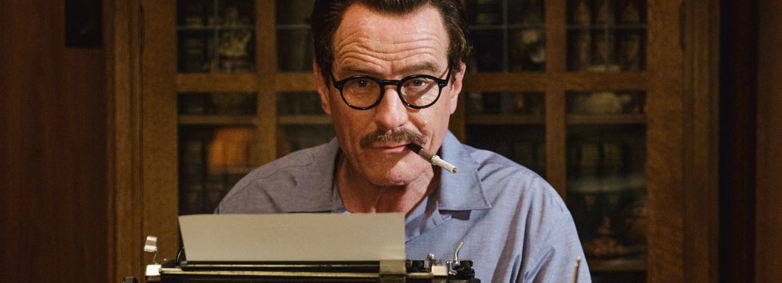
Breaking Bad star Bryan Cranston stars as the irascible scribe who types in the bathtub with a cigarette holder and glass of whiskey in hand.

Trumbo’s a less than loveable eccentric who patronises the masses who watch his movies and fund his comfortable lifestyle.

A honey throated spinner of yarns who invokes the constitution to serve his own ends, Trumbo reminds us of another historic US public figure given a recent cinematic makeover.

There’s a clear parallel between Cranston’s performance and Daniel Day Lewis’ Oscar winning turn as the ill-fated US President in Steven Spielberg’s Lincoln (2013).

The script even includes a similar moment wherein a colleague refuses to listen to any more of Trumbo’s stories, lest he be converted to his cause.

We fail to sympathise for the champagne communist when he suffers the indignity of downsizing from his country manor to a large house with a pool.

Being aggressively covered in fizzy pop isn’t nice and holidays are interrupted. But a brief and uneventful stint in prison aside, nothing too worrying happens to him.

As an illustration of the rarefied social circles Trumbo moves in, a friend can afford to sell the drawing room Van Gogh to pay for their lawyer’s fees.

Meanwhile Trumbo’s career goes from strength to Oscar-winning strength. Under various pseudonyms he works with Hollywood directors and stars of huge stature.

The timeline covers some forty years giving the handsome film a breathless feel despite it’s stately pace.

Part of the problem is a desire to cram in many era-famous faces. As the story lacks drama, this is possibly to compensate for a suspected deficiency of audience interest.

Michael Stuhlbarg as Edward G. Robinson is one of several examples of casting capable peformers as famous cinema actors. They’re not as charismatic or talented and physically aren’t great matches.

David James Elliot essays John Wayne as an unconvincingly magnanimous presence.

At least Dean O’Gorman as Kirk Douglas is given a gift of a line which is guaranteed to bring the house down with laughter.

Helen Mirren is terrific as the waspish society columnist Hedda Hopper. But by making her the villain of the piece, the male dominated hierarchies of cinema and politics are let off the hook for their behaviour.

Hopper suffers a poorly articulated rationale for for the intensity of her attacks on communism and there’s no hint her anti-union publisher is any way pulling her editorial strings for their own ends.

Diane Lane plays Trumbo’s wife Cleo with nothing to do except add glamorous scolding and sympathy.

Elle Fanning as their daughter Nikola fairs little better, being ushered down a civil rights movement cul-de-sac.

John Goodman plays to his strengths as a down market producer offering a broad comic performance which recalls his turn in ben Affleck’s Argo (2012).

Never convicted of any criminal charge, Trumbo presents himself as a fearless defender of the first amendment and the script bequeaths him a suspiciously retro-fitted sermon on the importance of the constitution.

There are great lines in the film but one suspects they’re lifted from the scripts or diaries belonging to one of the many scriptwriters portrayed on screen.

Spotlight

Director: Tom McCarthy (2016)

Stop the press for this Oscar nominated drama of award winning journalism.

Based on real events, a US newspaper team fight to reveal the industrial scale cover up of child abuse perpetrated by the Catholic Church in Boston.

It’s gripping tale which allows for the redemption of an individual, the validation of journalism and the recovery of civic pride.

So exactly the sort of worthy subject matter which allows Hollywood to feel good about itself and self-righteously pat itself on the back for making.

Consequently it’s garnered 6 Oscar nominations including best picture and director ,as well as for individual nods for performers Ruffalo and Rachel McAdams in the supporting acting categories.

It’s set in the early 2000’s in the basement office of the close knit Spotlight newspaper investigations team of The Boston Globe. The real Spotlight Team earned the 2003 Pulitzer Prize for Public Service.

Michael Keaton is weathered and wary as ‘Robby’ Robinson, veteran leader of the four strong department.

Sporting a supportive if volatile chemistry, they’re played by Mark Ruffalo, Rachel McAdams and Brian d’Arcy James.

They face the double threat of the burgeoning new media world and a new editor, played with softly spoken steel by Liev Schreiber.

Marty requests the team investigate complaints made against the church.

Being from out of town Marty is immediately considered someone not to be trusted. A situation compounded by being Jewish in a Catholic dominated city.

It is strongly in part to this insular attitude which allows members of the Catholic clergy to spend years abusing their flock, and for the hierarchy to systematically cover it up.

The powerful and wealthy institution has long put the fear of god into legal profession, justice system, police and even parts of the press.

We follow the team undertaking journalistic procedure of voluminous research, copious coffee consumption, door knocking, meetings with lawyers, prodigious note taking and telephone calls.

As files of evidence go missing from the courthouse, the team realise they can’t trust their colleagues, the police or the courts.

This is all familiar procedural stuff and it’s the high stakes and charisma of the actors which brings it alive.

We are drawn in by the performances, intrigued by their work and disgusted by the subject matter.

Covering a difficult subject in a dignified and sensitive manner, a strong narrative framework provides essential information in a clear manner.

But the film struggles to open out from a series of meetings into something more grand and cinematic.

More than one scene has the team gather around a telephone speaker to receive vital information from a Deep Throat type whistleblower.

As efficient as Spotlight is, it‘s the grim truth which keeps us watching, not the drama.


The Big Short

Director: Adam McKay (2016)

Take cover from an atomic bomb of fraud and stupidity in this knockabout drama based on the catastrophic financial crash of 2008.

Based on Michael Lewis’s account published as The Big Short: Inside the Doomsday Machine (pub. 2010) it’s been nominated for five Oscars including best film, best director and best actor for Christian Bale.

Ryan Gosling plays narrator Jared Vennett, an unrepentant bond salesman at Deutsche Bank.

Vennett meets the one-eyed Aspergers sufferer Michael Burry. Played by Bale in a bad haircut,  he’s a maverick hedge fund manager.

Burry’s discovered Wall Street has been selling mortgages to people with no jobs or income.

So he’s ‘shorting’ the housing market, i.e. betting it will crash and anticipates making billions of dollars by betting millions.

Vennett teams up with Steve Carell‘s permanently angry banker Mark Baum to get rich quick.

Yet no-one seems to have fun with the money they’re making or have any idea what to do with it, or even why they’re doing it.

The script wants us to like these guys, showing us their life traumas to garner sympathy.

They’re fictitious versions of real people and we’re encouraged to see them as heroic outsiders, uncovering the impending crisis.

But they willingly keep schtum and treat it as another investment opportunity.

Then the film’s millionaire movie producer Brad Pitt turns up looking like a retired geography teacher and flexing his social conscience, much like he did in his self-produced project 12 Years A Slave (2014).

Pitt plays another banker who makes a min out of the misery of millions..

Financial flicks Martin Scorsese’s The Wolf Of Wall Street (2014) and J.C. Chandor’s Margin Call (2013) have already covered much the same ground as The Big Short.

This hasn’t the blistering riotousness and moral vigour of the former in which Margot Robbie also appeared, and lacks the sober cynicism of the latter.

It’s all very Scorsese light with an up tempo pace and jokey tone created by pop tunes, freeze frames, frantic editing and characters regularly speaking directly to camera.

Plus it’s full of great performances, very energetic and niftily employs a game of jenga to explain what causes the banking meltdown.

But it’s misjudged in its sympathies and patronisingly employs Margot Robbie and Selena Gomez as themselves to explain the maths.

But The Big Short fails to condemn these hypocritical parasites – the bankers not the actresses – and instead dresses them as heroes.

They should be strung up from lamp posts with the rest of the bankers responsible.


Black Mass

Director: Scott Cooper (2015)

After series of flops including Mortdecai (2015), Transcendence (2014) and The Lone Ranger (2013), Johnny Depp’s career is in desperate need of a hit.

Here he hides his leading man looks under extensive make up, false teeth and a receding wig.

Although he’s great as the ruthless American gangster ‘Whitey’ Bulger, it’s a clunking biopic that’s far less than the sum of it’s parts.

It’s fine looking with a nice contrast between the faded grandeur of the locations and unfortunate 1970’s fashions.

Boston is inherently photogenic and offers a variety of unfamiliar settings.

But strong performances from a great cast are undermined by an unfocused script and uninspired direction.

Whitey feeds information on his mafia rivals to childhood friend turned FBI agent in return for a blind eye to his gangster activities.

Joel Edgerton’s central character is sidelined in order to give more screen-time to Depp.

Neither are sympathetic, despite early attempts to portray Whitey as a loving family man.

Supporting characters such as Jesse Plemons’ are introduced, forgotten about and wheeled back in again.

Benedict Cumberbatch’s role is even more reduced as Whitey’s Senator brother.

There’s an interesting story to be told how the lives of these two brothers took very different directions.

But the film ignores this, preferring to indulge in macho posturing and bloody violence.

The setting, soundtrack, language and violence are very much the milieu of director Martin Scorsese.

However not only does Black Mass feel like Martin Scorsese lite, it feels like poor Martin Scorsese lite.

Black Mass calls to mind the maestro’s weak, albeit Oscar winning The Departed (2006).

What’s more interesting is it’s also Ben Affleck light. Black Mass suffers in comparison with the actor turned director’s Boston set crime thrillers Gone Baby Gone (2007) and The Town (2010).

I say that as a fan of both Affleck’s films.

Depp may have to wait a while longer for his next success.

Steve Jobs

Director: Danny Boyle (2015)

A terrifically talented cast are in perfect sync in this biopic of Steve Jobs, the charismatic and complex founder of the technology giant Apple Inc.

It’s as smooth, sleek and as tightly engineered as one of their computers or iPhones, but has problems with it’s memory and crashes at the worst possible time.

A binary figure who considered his employees to be with him or looking for a new errr, job, the Apple chief died in 2011.

Ashton Kutcher played him in the poorly recieved Jobs (2013) and he is rebooted here in a perfectly calibrated performance from Michael Fassbender.

Far from PC, he’s a bullying, vindictive and paranoid, a control freak with a messiah complex who inspires a noisy devotion in his disciples.

The university dropout was neither an engineer or a designer but was blessed with an intuitive understanding there are vast amounts of money to be earned through brand design and marketing.

Plus trapping his customers into an operating system incompatible with competing systems or products creates slaves of his customers.

This obsession with creating a closed operating system reflects Jobs emotional inner life. The prophet of the future surrounds himself with an  emotional firewall.

In contrast, sociable Apple co-founder Steve Wozniak who wants to create a more flexible, adaptable open system, while urging Jobs to acknowledge the role others have played in the success of the company.

They produced a computer so intuitive to use a five year old could begin to use it without instruction, the five year old being his daughter Lisa, played by Makenzie Moss.

The script is intelligent, sharp and scorchingly funny in its early stages, there’s no romance, sex or violence, except for when Jobs downloads a torrent of abuse on his colleagues, friends and family.

It’s a typically well-researched work by scriptwriter of the Facebook movie The Social Network (2010) Aaron Sorkin. He’s smart enough to wittily flag up the limitations of the structure.

Framed as a three act play, each act focusses on the press launch of a new Apple product: the expensive first Macintosh computer in 1984, the disastrous NeXT in 1988 and the revolutionary classic iMac in 1998.

As Jobs is celebrated, sacked and rises again the drama stalls.

A lack of a martyr makes for a dull finale as the self-mythologising messiah is allowed his moment of destiny defining redemption.

Ridley Scott‘s astonishing Orwellian themed TV advert for Macintosh is seen and discussed.

But it’s never pointed out the Big Brother imagery invoked to attack his rivals products could easily be used to criticise Jobs and Apple itself.

He is creepily aware of the small details of his colleagues’ lives. They form a dysfunctional surrogate family.

Kate Winslet sports a Polish accent and some unfortunate fashions as Joanna, Jobs’ head of marketing and his ‘work wife’. It says something about a corporation when the marketing department represents its compassionate soul.

Jeff Daniels is father figure John Sculley, the ill-fated CEO of Apple against whom Jobs rebels. Seth Rogen plays his ‘bro’ Wozniak.

Few directors possess director Danny Boyle’s consummate command of music to accentuate the visual drama, or have his ability to cajole convincing performances out of young children.

Though Boyle’s attempts to add some visual dynamism through his restless camerawork, he can’t illuminate the dark confines of a dialogue heavy script.

An early girlfriend aside any reference to Jobs’ romantic life is absent. The huge job cuts he instigated on his triumphant return to the company are glossed over.

Coldly calculating in it’s refusal to condemn Jobs for his sins smacks of legal compromise. It’s not possible to libel the dead but one suspects Apple employ extraordinarily expensive lawyers to police it’s brand.

By the end we’re far from convinced of Jobs’ genius, as his only identifiable talent seems to be in rude manipulation, at which he is extraordinary.

A Walk in the Woods

Director: Ken Kwapis (2015)

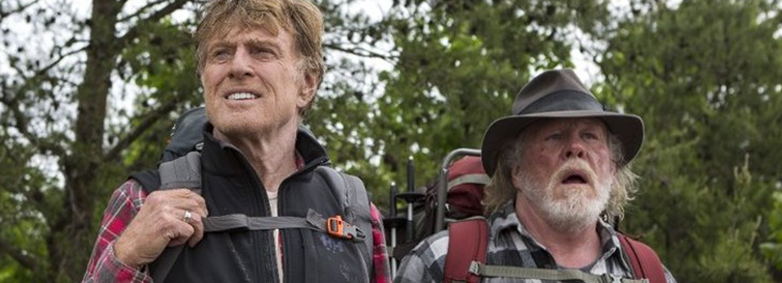
In no danger of ever straining an acting muscle, Robert Redford ambles through this genial adaption of Bill Bryson’s best-selling account of his trek along the Appalachian mountain trail.

After one funeral too many and perturbed by his well-heeled life of ease, successful author Bill decides to take himself out of his comfort zone by hiking over two thousand miles.

Emma Thompson pops up as his wife to warn Bill of the potential hazards and begs him not to go.

Only his raddled, rasping and rambling old friend Nick Nolte is mad enough to go with him. He’s as short of money as he is of breath.

It’s an odd couple comedy, less concerned with the journey travelled but the welcome home. It’s as charming and handsome as it’s lead and equally as empty of interest as his performance.

There’s slapstick buffoonery, unconvincing peril and light grumbling as the decrepit duo are tempted by soft beds, pretty ladies and motorised transport.

The script contains very little of Bill’s scientific curiosity, wonder at the natural world or understated warm wit which made the book such a joy. The lack of it tests our patience.

At 79 years old Redford is still a strikingly good looking man, even if he has borrowed Paul MCartney’s hair colouring.

He is of course still a magnet for the ladies. In true Hollywood style his screen wife is 23 years younger than himself.

It’s inferior to Reese Witherspoon’s one woman trek Wild (2014) which is inferior itself to Mia Wasikowska’s outback odyssey Tracks (2013).

If the bearded and portly former Fleet Street stroller Bryson can score for The Sundance Kid playing him on the big screen, then I’m not settling for anyone less than Keanu Reeves in my future biopic.

Legend

Director: Brian Helgeland (2015)

This barnstorming biopic of cockney crime lords the Krays is a double barrelled blast of brutal and funny entertainment.

The exhausted tale of London’s most infamous gangsters is given a fresh impetus by a pair of magnetic performances by Tom Hardy as twins Reggie and Ronnie.

So well defined are their characters at times I forgot I was watching the same actor.

London is in transition from fifties post war austerity to the swinging sixties. The Krays see an opportunity to expand from their poor East end roots to the moneyed lights of the celebrity-filled West end.

We see their rise through the eyes of Reggie’s wife Frances. Their mother who normally looms large in their legend is a minor figure.

The script rockets through the boys’ rivalries with the Richardson mob, their dealings with the mafia and the murder of Jack ‘the hat’ McVitie.

Reggie is the older of the brothers, a charmer with brains. He’s an ambitiously ruthless businessman who owns clubs, runs protection rackets and wants to break into the casino trade.

Ron is a philosopher fool with fists of iron. His tenuous grasp of reality and impulsive behaviour are disastrous for those nearest to him.

Though unquestionably devoted to each other, the nearest the boys come to affection is beating seven bells out of each other.

Their fall is framed as a tragedy with Greek references peppering conversations.

Reggie is seemingly destined for great things but is thwarted by his love for his brother Ronnie; the most unpredictable of loose cannons.

Frances is a fragile pill-popping poppet who struggles as her husband fails to become the straight businessman he professes he wants to be.

Ozzie actress Emily Browning is fine but forced to deliver a terribly written and utterly unnecessary voice over. It ruins every scene it witters over.

Tara Fitzgerald plays her disapproving mother and antagonises Reggie by wearing black to their wedding.

Prime Minister Harold Wilson is played with pipe-wielding gusto by Kevin McNally. Christopher Eccleston is always two steps behind as Keystone cop Detective Superintendent ‘Nipper’ Read.

There’s great support all round from Colin Morgan, David Thewlis, Paul Anderson, Taron Egerton and Chazz Palminteri. The latter plays Angelo Bruno, the head of the Philadelphia crime family with whom the twins strike a lucrative deal.

The occasionally larky tone may chafe with those who believe it inappropriate in a story where real people are murdered.

However it’s titled Legend for a reason. It makes no attempt to be definitive or exhaustingly accurate. Nor does it offer an apology for not being so.

It presents a glamourised, heightened view of a specific period and is anchored by the emotional truth it offers of the twins’ complex relationship.

Write-director Brian Helgeland won Best Screenplay Oscar for LA Confidential (1997), more recently he wrote Ridley Scott‘s Robin Hood and Paul Greengrass’ Green Zone. (Both 2010.)

Previously he directed Mel Gibson in the thriller Payback (1999) and baseball biopic 42 (2013).

Legend is extremely confident and ambitiously crafted. There is excellent production design by Tom Conroy and gorgeous costume by Caroline Harris.

The dynamic soundtrack and expertly executed camera moves are hugely influenced by Martin Scorsese’s gangster epic Goodfellas (1990).

HIs famous Copacabana tracking shot is transplanted to Frances’s introduction to Reggie’s club. It’s one of several ambitious and expertly executed camera moves.

It’s the work Brit cinematographer Dick Pope was Oscar nominated last year for Mr Tuner and is a regular Mike Leigh collaborator.

Hardy is currently 3 to 1 to be the next James Bond, but on this showing he might just be too good an actor.

Straight Outta Compton

Director: F. Gary Gray (2015)

Busting out of Los Angeles with exhausting attitude, this self-serving musical biopic is an occasionally exhilarating ride of ego and excess.

Straight Outta Compton takes it’s name from the 1988 controversial breakout album of N.W.A., the groundbreaking five strong rap group. It charts their rise and demise.

Central trio of lyricist Ice Cube, producer Dr Dre and rapper Eazy E are played by O’Shea Jackson, Jr., Corey Hawkins and Jason Mitchell. The script isn’t too interested in the other two members, MC Ren and DJ Yella.

With endless macho posturing and ferocious music, they established their reality brand of gangsta rap as a cultural force.

Paul Giamatti plays their shifty, silver-haired manager Jerry Heller whose close relationship with Eazy E threatens the band’s harmony.

Suffering brutal discrimination at hands of the militarised police, their anger and frustration finds a voice in music and reaches a peak with their incendiary and provocative track ‘F** tha Police’.

Sold out concerts bring a heavy police presence and strongly worded letters from the FBI.

There’s barely a female character to speak of though several acres of nubile flesh. And it’s a surprisingly drug light experience.

An indulgence of guns and groupies keep the band occupied, with the former far more highly valued than the latter. One particularly unpleasant post-gig party is disturbingly played for larks.

A parade of unlikeable characters pass through the story which rhymes with a general perception of the music industry. At times even the band are hard to root for.

This is surprising given they produced the movie themselves and Ice Cube is played by his real-life son.

Like many vinyl records, the first side is strong but the second side is weak. Bubbles of soap opera froth up as the story dissolves into contract disputes and ill health.

Even when their millions of dollars have bought huge mansions and flash cars, they’re still breaking the law and getting arrested.

This is where the film loses it’s audience. It wants to suggest regardless of extreme financial and cultural success the band can’t escape the racist behaviour of the state.

And though this may be true, it’s also true for anyone that driving one’s car at extremely high speed through downtown LA will attract the attention of the police, regardless of the officers’ prejudices.

Up until this moment I was mostly on board. But any film which fails to hold the audience sympathies close to it’s own point of view is failing on at least one level.

We’re left with the feeling it’s possible to take the boys outta Compton but not Compton outta the boy.

They wouldn’t seem to want it any other way.

 ★