High-Rise

Diretor: Ben Wheatley (2016)

This towering cinematic achievement offers the audience a dark view of modern life.

British director Ben Wheatley brings to J.G. Ballard’s 1975 blood soaked satirical sci fi novel vividly to life.

With The Kill List (2011) Sightseers (2012) and A Field In England (2013) under his belt, he has the most singular vision of any British director working today.

Aided by his scriptwriter and wife Amy Jump, Wheatley has erected another uniquely English construction of comedy, horror, politics, sex and violence.

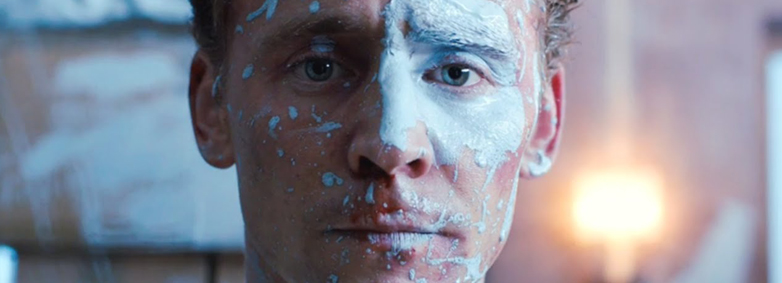
Currently starring in TV’s The Night Manager, Tom Hiddleston is hugely impressive as Dr. Robert Laing.

He’s just moved into a skyscraper and is determined to fit in to the rigid social hierarchy.

Living in the penthouse with his nostalgia obsessed wife and her private menagerie is the pointedly named Anthony Royal.

It’s another intelligent performance from Jeremy Irons. The buildings architect a godlike figure who can’t understand the free will of the chaotic people who populate his creation.

Royal believes he has left one crucial ingredient out of his building, but he hasn’t taken account of the effect of the building on the people who live there.

Laing has a short lived affair with the single mother who lives on the floor above. As the seductive and brittle Charlotte, Sienna Miller relishes the opportunity offered by the role to essay a complex character and delivers a strong and memorable performance.

Luke Evans and Elisabeth Moss as the fertile working class couple on a lower floor are among the strong supporting cast.

As it’s cutting edge 1970’s technology fails, the high-rise deteriorates and Laing starts to suffer a nervous breakdown.

While the penthouse hosts regency themed cocktail parties and swingers accumulate on the shag pile rug, the poor are blamed for their own misfortunes.

There are riots in the supermarket and violent class war descends into animal behaviour.

Styled in the 1970’s the decade the book was written, it’s a concrete, plastic and polythene world dressed in lurid shades of nylon sportswear.

The concept of recycling is in the future, nature is absent or seen as polluting, a hindrance, and a threat. Organic matter is something to be fenced off, bagged up and removed.

A smart script, great design, excellent performances and brilliant use of music combine in powerful critique of social engineering.

Although containing many ideas which are prescient, the power cuts, bodies and bin bags piling up are powerful reminders of headlines of the decade but the historical relevance may need explaining to a younger audience.

But seen from a distance, none of this undermines the soaring strength of the storytelling technique.


London Has Fallen

Director: Babak Najafi (2016)

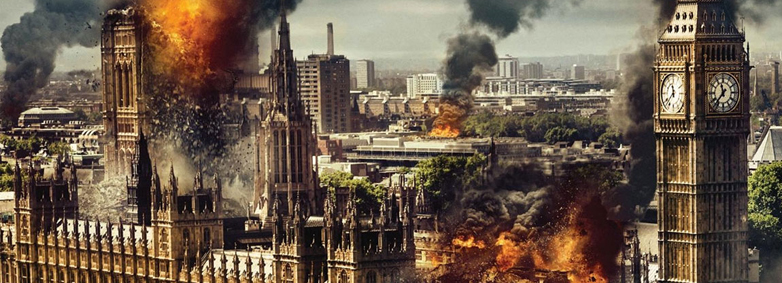
Take cover as this big, dumb action sequel drops into cinema with the subtle grace of a lead balloon.

Gerard Butler is in age denial mode as Secret Service agent Mike Banning, the kick ass star of Olympus Has Fallen (2013). He knows no fear, mercy or decent banter.

It’s a noisy barrage of gun battles and explosions with torture to break the tedium. Cars collide, helicopters crash and the touristy bit of the capital are trashed.

Impressive physical stunts are undermined by some poor CGI, ridiculous dialogue and unintentionally funny moments.

Following the sudden death of British PM, Banning must leave his pregnant wife behind and postpone his resignation plan to accompany the US President to the state funeral in London.

As global leaders gather to pay their last respects and with the streets of London protected by fighter jets, horses, dogs, armed police and snipers, an army of terrorists launch an attack on the steps of St Paul’s cathedral.

With London transport on lockdown and the emergency services incapacitated through terrorist infiltration, it’s up to Banning to drag the President to safety.

Aaron Eckhart sighs, frowns and worries about being tortured on Youtube. This demonstrates his scant faith in Banning’s abilities to save him.

Back in the US, Morgan Freeman’s Vice President chuckles his way through the crisis and talks about his fishing.

Boro girl Charlotte Riley keeps her native accent as an MI6 agent. Her forthright intensity   is in contrast to the joshing efforts of  to shame.

Moments of social realism break out during lulls in the mayhem. The British cabinet is portrayed as posh, smug and stupid and the Italian PM is seen having a tryst with a woman half his age.

No one should expect political discourse from this determinedly violent and witless entertainment which assumes flag waving and drone strikes are the price of a free West.

Banning’s impassioned invocation of a 1,000 year rule is delivered without thought to historical precedent.

The leaden script pays lip service to the qualities of the British, despite London being taken down in a matter of minutes and Banning elbowing aside an SAS squad to do their job for them.

It also makes laughably sure the audience is painfully up to speed with the thin story.

Air raid sirens warn the population to stay at home. You can’t say you haven’t been warned.


Triple 9

Director: John Hillcoat (2016)

This confused crime drama is a loose tissue of tattoos, muscles and machismo.

Despite the violence, very strong language, drug use and nudity, the lack of focus and ambivalent moral stance makes for an un-involving experience.

Too many minor characters slow the pace and the moody lighting fails to illuminate the blunt action scenes.

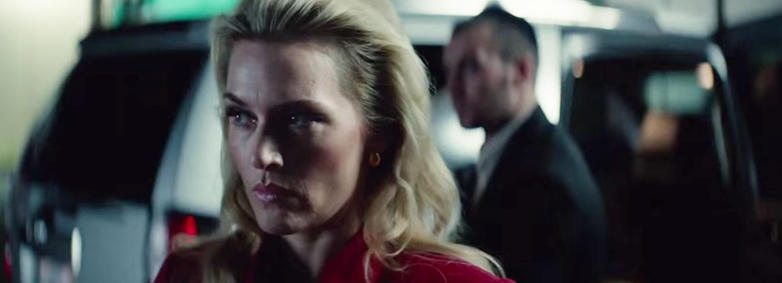
Kate Winslet gives tremendous vamp as a glossy Russian-Israeli mafia mol who blackmails a crew of corrupt cops into one last heist.

The gang leader is Michael who’s played  by Chiwetel Ejiofor, an actor rarely given to compromising his character’s intensity in return for popularity.

Breaking Bad’s Aaron Paul appears as a loose cannon with a drug problem. Again.

Full of epic ambition and clearly influenced by Michael Mann’s far superior Heat (1995), director Hillcoat had a much firmer grip of his material with the taut Australian western The Proposition (2005).


A War

Director: Tobias Lindholm (2016)

Guns, grenades and gavels will shred your nerves in this riveting courtroom drama set in the Afghan war.

An army commander is looking down the barrel of a long prison sentence for killing civilians in the act of saving his men.

A smart script gives meaning to the intense battle scenes and the film is always sympathetic to the soldiers.

We fear for the soldiers, worry for the dirt-poor locals and agonise for the families back home.

Danish duo Tobias Lindholm and Pilou Asbaek team up for the second time as director and star respectively.

They previously collaborated on the gripping A Hijacking (2013) where Asbaek played a ship’s captain held hostage by Somali pirates.

A Hijacking was followed into cinemas by Paul Greengrass’ similar though not superior Captain Philips (2013) which starred Tom Hanks.

As well as directing, Lindholm also writes his own scripts and was responsible for writing the Mads Mikkelson drama The Hunt (2012).

All three scripts feature men under intense pressure stemming from decisions made under stress at work.

Asbaek plays Company Commander Claus Pedersen. He is brave and devoted leader of his team, accompanying them on patrol to restore moral after the loss of one of his men to an IED.

Gallows humour peppers the dialogue and there is an absolute lack of gung ho jingoism.

The tumult of a firefight is created with great sound editing, dust clouds and frantic camerawork.

Having the cast scream at each other in their native Danish adds to the turmoil.

The Taliban are a mostly unseen if ferocious enemy, portrayed by the chaos and death they cause. Their victims are all too easily identifiable.

There are no overt political points being made but the mere presence of Danish nationals patrolling the plains of Afghanistan is a defiantly curious phenomenon.

I spent a lot of time urging them to keep their bloody heads down – while I crouched behind the back of the chair in front.

Being in court is more stressful than the battleground for the heroic Claus. His fight on either front will keep you gripped.

Spectre

Director: Sam Mendes (2015)

From the breathtaking beginning to the doom laden finale, the 24th James Bond adventure is an extraordinary explosive and epic episode of the franchise.

The spy filled cinematic year has included reasonably received riffs on the genre including Kingsman, Spy, Mission Impossible: Rogue Nation and The Man From UNCLE.

Now the daddy of espionage returns to slap down the young pretenders.

Returning in his fourth and possibly final film of an extraordinarily successful tenure, the 47 year old Daniel Craig offers an interpretation of Ian Fleming’s alter-ego at least equal to the very best.

Spectre is fresh and ambitious despite the weight of history and expectation.

So spectacular, sexy and superb in all departments, it sometimes feels less than the sum of its magnificent parts.

Yet British director Sam Mendes is playing a bigger game than merely creating a standalone action thriller.

He’s also made a fabulous final chapter in a four film reinvention of an overly familiar character.

Prior to Craig each Bond movie was a self-contained story connected not by story but by character.

It’s now clear we’ve been watching a long form story which began way back with the Englishman’s debut in the role in Casino Royale (2006).

It’s a bold strategic 9 year move inspired perhaps by the 10 year long Harry Potter series and a forerunner of Marvel‘s creation of a cinematic universe.

This approach won’t harm the home entertainment box-set sales.

The famous gun barrel opening sequence is re-installed and few themes create a shiver of expectation as effectively as Bond’s does.

Following on from Skyfall (2012), a message from beyond the grave sends 007 off-piste and outside the law.

As he follows a trail of clues from Rome, to Austria and Morocco, he once more encounters the deadly Quantum organisation.

It’s a procession vodka martini’s, dangerous women, gorgeous locations, terrific stunts, powerful henchmen and a completely cuckoo villain. Bond’s car is quite beautiful even by his standards.

There’s paranoia, conspiracy, betrayal, torture, sex and death.

And as a riposte to those who suggest Craig’s interpretation lacks humour, it’s also very funny.

A trio of European stars add indispensable talent and glamour.

As the oldest actress to be cast opposite Bond, Monica Bellucci’s widow riffs on a character on in The Italian Job (1969).

Lea Seydoux is an excellent foil and Christoph Waltz mercifully keeps a firm hand on his inclination to camp.

An intelligent script works hard to give ample screen time to Naomie Harris, Ralph Fiennes and Ben Whishaw who return as MI6 stalwarts Moneypenny, M and Q.

They also contribute to the two and a half hour running time and if anything was to be trimmed, it would be this extra muscle.

As cinema owners will be forced to have fewer screenings per day to accommodate Bond’s length, it will be interesting to see if this affects the box office.

This potential shortfall may be compensated for by more expensive IMAX tickets. The opening Mexico sequence certainly warrants the extra cost to the cinema-goer.

It’s dynamically photographed by Dutch-Swedish Hoyte van Hoytema. His work on Interstellar (2014) was one of the few high points of Chris Nolan’s pompous ego trip.

But here the rich wreaths of shadows he wraps around the players are more reminiscent of his glorious work which contributed so much to the success of Tinker Tailor Soldier Spy (2011).

Sam Smith’s theme song sounds thin on the radio but works well in situ over the sensual opening titles.

Mendes encourages his actors to play every scene as if it’s their last. Which for Daniel Craig, may well be the case.

American Ultra

Director: Nima Nourizadeh (2015)

Slackers, spies and sleeper agents get their brains fried in this darkly comic stoner thriller.

Though it takes a while to find a groove, once the story sparks up and the thrills kick in, the entertainment escalates and acheives a riotous velocity.

Sweet-natured slackers Mike and Phoebe share a drug dependancy and matching tattoos. Unfortunately Mike has a tendency to keep making a hash of their romance.

Jesse Eisenberg and Kristen Stewart give the couple a sweetly combustible chemistry.

Unknown to himself, Mike’s a lethal sleeper agent, a guinea pig in the CIA’s Ultra programme designed to turn criminals into expert killing machines.

However the scheme is judged a failure and Topher Grace’s spy boss decides to shut down the programme by terminating the assets.

What the chief lacks in menace he makes up with obnoxious energy.

Connie Britton plays a rival spook who tries to give her one-time charge a fighting chance. She uses a safe word to unlock the training buried deep in Mike’s psyche.

She’s played by Victoria Lasseter on far better form than in the poor Me and Earl and the Dying Girl (2015).

When two agents arrive to kill his buzz and end his life, Mike freaks himself out with the lethal ferocity of his response.

Together with a surprisingly resourceful Phoebe, they face a desperate mission to survive, leaving burnt out buildings and dead bodies in their wake.

The sneaky soundtrack lulls with soft Hawaiian sounds before launching an ear-shattering assault to complement the bloody and bone crunching violence.

A truckful of assassins, drone strikes and a big box of fireworks all fan the flames of the smouldering fun.

Mike’s a stoned version of Jason Bourne and Eisenberg’s performance squeezes the concept for some decent laughs.

Matt Damon was 32 when he first played Robert Ludlum’s all action anti-hero, Eisenberg is 31.

Stewart is full of fierce defiance and equally good, despite being lumbered with the role of  girlfriend in peril. She slyly sports Franka Potente’s red hair from The Bourne Identity (2002).

As fun as Eisenberg is, it’s a shame he and Stewart didn’t swap roles. A hell bent Phoebe would have added to this year’s joyously bumper crop of kick ass cinematic heroines.

With an hawaiian-shirted hero on the run with a girl in a world of drugs, guns and comic books, American Ultra is clearly influenced by True Romance (1993).

Though it similarly includes a cloud of falling feathers it lacks Tony Scott’s visual lyricism and Quentin Tarantino’s dynamite dialogue.

Made on a reasonable budget of $30M, American Ultra is armed with a keen sense of the ridiculous, offers plenty of juiced up action, some laughs and a couple of recognisable faces.

So it’s surprising it hasn’t found more of an audience in the US where it’s only scored for $11M after ten days on release.

If the US poster ads are as terribly unrepresentative of the movie as the UK ones are, then I’d be tempted to place the blame of lack of interest at the publicists.

While it’s not an outstanding movie it is a worthwhile entertainment, hopefully one which will gain traction on other platforms and find the audience it deserves.

★★★☆☆