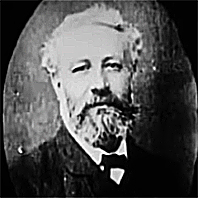
The Mysterious Island (1929)

This epic sci-fi melodrama feature is absolutely terrific fun due in no small part to its gleeful abandoning pretty much all of Jules Verne’s novel on which it’s based.

Discarding fidelity for crazed creative ambition, it hits the creative sweet spot between the high-minded social consciousness and outrageous spectacle of Fritz Lang’s German expressionist classic, Metropolis, and the all-out gung ho whizz bang of Buster Crabbe’s Flash Gordon adventure serial.

An army of mermen pull along a captured and tethered submarine

Verne is often referred to as the ‘Father of science fiction’, and 1875’s The Mysterious Island, is a semi-sequel to his 1871 novel, 20,000 Leagues Under The Sea. It’s notable for featuring Verne’s most celebrated creation, the mercurial billionaire genius inventor and subaquatic explorer, Captain Nemo.

Verne’s novel is set during the US Civil War (1861-1865) sees a group of Union prisoners escape by hot air balloon to the titular Pacific Ocean island, where an elderly and dying Nemo secretly assists their survival and only reveals his presence at the end of the story, and discloses himself to be Dakkar, an Indian Prince deposed by the British Empire.

The novel: absent

There’s an absence of Verne in terms of character or story, but a filmmaker’s love of their source material is never a guarantee of fidelity. Yet the author’s spirit is in every frame of this tremendous movie bursts with Verne’s spirit of adventure, love of exploration, and sublime imagination. Plus it’s wrapped up with a moving and respectful finale.

Plus we have land and underwater battles, a giant squid, an army of humanoid fish people with costumes inspired by Melies, and – I kid you not – a drunken orgy. Verne was a writer who hunted down every opportunity to avoid including women in his stories, and would presumably be aghast at the very thought. Great fun for the rest of us, though.

We’re treated to twice the usual number of submarines and other wondrous technology, plus there’s a volcano, a giant squid and rapacious European powers seeking to overthrow Lionel Barrymore’s Count Andre Dakkar, a generic European aristocrat, rather than the Indian Prince of the novel. The name of Nemo is never mentioned.

However we can sense Verne’s influence extending beyond this film, with Nemo/Dakkar cast as a proto-Dr Who, an irascible older scientist accompanied on his futuristic vessel by two younger and attractive companions to provide across some across-the-class-barricades romance.

You’ll forgive me for occasionally confusing the daughter Sonia here, for the granddaughter Susan in Dr Who. And yes, though the terrific Jacqueline Gadsden’s Susan spends a lot of time waiting to be rescued, is also sexually confident, violently combative, loyal, daring and scientifically trained.

The island itself is not isolated in the Pacific but just offshore the fictional European kingdom of Hetvia, and the story swaps the US Civil War for an attempted European coup. There are no balloonists, dog, castaways or pirates, and no sign of the former slave Neb, or indeed any non-white characters.

Dakkar is a scientist inventor and an egalitarian hero in this version, while the villainous black-caped Baron Falon and his army of henchmen resemble Cossack horsemen, whose invasion of Dakkar’s island home seems designed to invoke the 1917 Russian revolution and the threat of Communism. It also speaks against over-reaching power of European monarchy and in favour of the equality of all ‘men’. That is, it seems designed to play to the political prejudices of its audience in the New World by demonising the Old World.
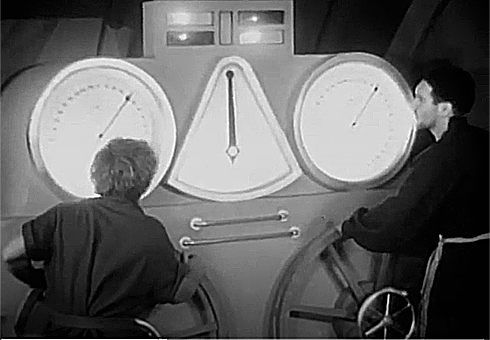
‘I dunno boss, it sounds as if they’re singing. Something about, radio gaga?’

Produced on a grand scale which suggests this was intended as a Hollywood response to Lang’s 1927 masterpiece Metropolis, the filmmakers commit to their barking vision in quite magnificent style. We’re encouraged to gasp in awe at the glorious Art Deco design, extensive use of miniatures, large crowds of extras posing as workmen, futuristic control consoles and prodigious industrial machinery.

Plus they give us giant underwater lizards interacting with live action humans long before Ray Harryhausen did it in the stop-motion classic One Million Years BC. And the giant octopus is wonderful. Various sizes of submarines and parts of submarines are used, with the smaller scale models possessing a lovely Gerry Anderson charm, and clearly inspired the look and feel of 1936’s Flash Gordon. Watching this you realise Gordon‘s rocket ships were really re-tooled flying submarines.

It’s not all a hymn to modernity and the machine age though, with the story drawing on imagery of European legend as a beautiful maiden is used as a Siren to draw an enormous sea beast to its doom.

And we’re given actual hymns, with sweaty chest-baring workmen praising god in song as a prelude to a submarine launch, a surprisingly moving scene in itself despite it being presumably included as a calculated appeal to a US Christian audience.
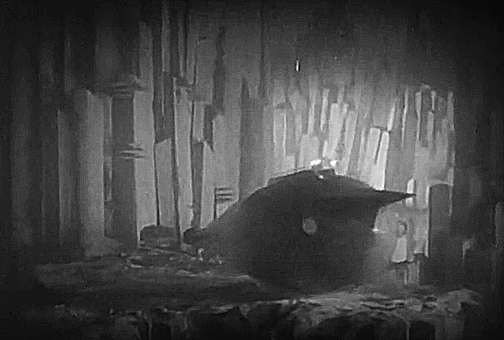
The not-Nautilus is ready for blast-off

Writer and director Lucien Hubbard previously produced 1927’s Oscar winner, Wings, and he fills his 90 minute running time with all manner of great stuff, such as platoons of horse guards, sunken triremes, a duel to the death and a race to repair a sub before the crew asphyxiates.

Hubbard provides us with some very impressive underwater photography where he can, and the rest of the time he uses theatrical tricks, such as making the diving-suited actors mimicking the effect of walking in water, much as later films would have actors mimic the effect of zero gravity.

And the use of sound in this this hybrid production reminds us there was no clear divide between ‘Silent’ films, and Talkies’. Many of Barrymore’s scenes’ using synchronised sound for his dialogue, and inter-title cards used elsewhere.

Plus it’s as noisy as hell. The constant score is accompanied by wonderful and frequent array of industrial noise hisses and clanks, plus hoofbeats, gunfire, animal noises, sung prayers and general alarum.

Despite the name this tremendous entertainment bears almost no relation to the novel, but it captures something of the spirit of Verne, while speaking to the versatility of his ideas and the great flexibility of his greatest creation, Captain Nemo.

I enjoyed this immensely, and if you’re more a submarine than sci-fi fan, there’s still plenty for you to enjoy as well, so dive right in.

Nemo’s Fury is an exciting digital reinvention of Jules Verne’s classic steampunk adventure novel, 20,000 Leagues Under the Sea. 

Download for free to your smartphone or tablet, search your app store for ‘Nemo’s Fury’.

A mobile interactive fiction game employing a bespoke combat system and hundreds of original illustrations, Nemo’s Fury is inspired by the 1980’s role-playing gamebooks such as ‘The Warlock of Firetop Mountain’, of the Fighting Fantasy series which celebrated its fortieth anniversary last year.

Each player joins the legendary Captain Nemo on board his fabulous submarine, the Nautilus, on a wild voyage of adventure, intrigue, loyalty, and betrayal.

There’s mayhem, monsters, maelstroms and murder as Nemo takes you from the South Pacific to the Northern Atlantic via Antartica and the Red Sea. And if they survive long enough, the player will of course fight a giant squid.

Available on your smartphone or tablet, (but not yet your desktop), click on your app store below

Or go to Nemo’s Fury for more info

20,000 Leagues Under The Sea (1916)

Breathtaking in its pioneering use of underwater photography, this silent two-hour feature is a globetrotting epic of action adventure, romance and comedy, and though contains some problematic elements, it’s an early high water mark in Hollywood spectacle, an impressive early entry into the canon of Jules Verne adaptations, and by far the biggest box office success of its year of release.

An adaptation of not one, but two major works of the man often referred to as the ‘Father of science fiction’, 20,000 Leagues combines elements of two of Verne’s novels, namely 1871’s adventure, 20,000 Leagues Under The Sea, and 1875’s semi-sequel, The Mysterious Island, bringing together the twin adventures of Verne’s most celebrated creation, the mercurial billionaire genius inventor and subaquatic explorer, Captain Nemo.

The novel

From this rich material we experience a tale of rape, murder, child abuse, kidnap, and betrayals. Plus there are fistfights, a sea battle, a colonial uprising, a reconciliation of long lost family members, as well as ghosts, devils, and real live sharks.

For those not overly familiar with the source material, 20,000 Leagues is set in 1866, and sees Professor Aronnax and two male companions kidnapped by a middle aged and vigorous Nemo, who takes his captives sailing around the globe in his technologically advanced submarine, The Nautilus. Meanwhile The Mysterious Island is set during the US Civil War (1861-1865) sees a group of Union prisoners escape by hot air balloon to the titular Pacific Ocean island, where an elderly and dying Nemo secretly assists their survival and only reveals his presence at the end of the novel.

The Professor & niece

When it came to adapting this material for his 1916 production, for the sake of cinematic expediency, Verne’s appallingly contradictory timeframe is rightfully given the old heave-ho by Scottish director and screenwriter Stuart Paton, who sensibly also jettisons much of the ballast of Verne’s ponderous scientific explanations, and in true Hollywood fashion introduces female characters to provide romance and intrigue to Verne’s nearly all-male world.

Deep dive into Verne

Paton also introduces female characters such as Aronnax’s adult niece, who replaces the manservant Conseil as one of Aronnax’s companions, and on the Mysterious Island there is a young woman wearing a leopard print dress, who replaces the male castaway of the novel. Although Aronnax’s niece plays little part in the film, the female castaway ‘A Child of Nature’ as she’s billed, is central to the story. And yes, though much of what she does is invented by Paton, there’s no denying it’s an exuberant and captivating performance by actress Jane Gail.

Paton’s script cuts back and forth between the parallel stories of Aronnax on The Nautilus, and the escaped balloonists, eventually bringing the plot-lines together in a terrifically staged finale before ending on a note of poignant dignity which I suspect Verne would approve. This is a great example of how to ruthlessly hack an unwieldy source material into a platform for great cinema.

Child of nature, right

Typical of the era, the Asian characters of Nemo and ‘A Child of Nature’ are played in brownface, a now rightfully discredited technique. Yet A Child of Nature’s inclusion allows for an inter-racial Caucasian-Asian romance between her and a balloonist, which is quite the something in a film released the year after D. W. Griffith’s infamously racist, The Birth of a Nation.

This romance doesn’t occur in Verne, and is possibly inspired by Shakespeare’s The Tempest, which features a crew of shipwrecked men encountering a beautiful girl and her wizard father on a desert island. Nemo is explicably described as a ‘wizard’, and also deals with issues of colonialism and race.

On another note, the romance as portrayed may not be interpreted as such as by a modern audience, there’s no explicit kissing for example. However if we the audience are expected and required to interpret two rape scenes as rape scenes, and not ‘just’ assaults, then we’re similarly beholden to interpret their flirtatious behaviour in scenes as romantic and sexual in intent.

Neb, right

However the film is less kind to the balloonist, Neb, Verne’s sole Black character in these books. Treated with jaw-dropping racism in the novel, The Mysterious Island, this film introduces Neb only to quickly cut him from the film. This happens so alarmingly abruptly I first assumed the copy of the film I was watching was missing a reel.

However Neb’s very noticeably absent from an important scene at the end where the cast are brought together. We can only speculate what happened to poor Neb, and why he ended up so ruthlessly dispatched to the cutting room floor. The treatment of Neb and the casting of Nemo in subsequent adaptations is something I’ll address in another post.

Nemo himself stands alongside Sherlock Holmes as a great example of a literary character whose cultural existence has a life beyond his creator, and who’s longevity in the popular consciousness relies far more on countless and varied media interpretations for fame than for people reading the books. Many more people will be familiar with their names than will have ever read the source material.

Featured in graphic novels, cartoons and now in video games, such the 2015 Japanese mobile game Fate/Grand Order, Nemo’s been portrayed by Russian, Egyptian, Czech, and Puerto Rican actors, as well as by Indian and Pakistani ones. And it’s in The Mysterious Island, not the more famous 20,000 Leagues Under The Sea, that Verne reveals Nemo is an Indian Prince whose wife and child was murdered by the British during the historical Indian Rebellion of 1857, also known as The First War of Independence.

Nemo

It transpires Nemo is really Prince Dakkar, son of the Hindu raja of Bundelkhand, and a descendant of the Muslim Sultan Fateh Ali Khan Tipu of the Kingdom of Mysore. When Verne was writing The British Empire and the Third French Republic were competing for global superiority, and painting the British as the villains would no doubt be a winning strategy for the French writer, and not damage his sales either at home or in the US, a country often celebrated and the source of heroic characters in Verne’s work.

In 1914 when filming of this version of Nemo began production, the world had changed again, with The Great War, as The First World War was then known, was beginning in earnest. And here Nemo’s story is fudged considerably by Paton, who removes some historical context and shifts the blame away from the British.

The map showing India

We learn instead that Nemo’s life in aquatic exile aboard The Nautilus began after he was falsely accused of inciting a rebellion in the unnamed Asian country of his birth, one under colonial rule by an unnamed European. A map on the wall in one scene indicates it is indeed India. However the military uniforms appear more generically European, perhaps French or German than British. It’s possible all Europe colonialism looks the same to Americans. I’m not an expert in military uniform and perhaps the costume department had a surfeit of those costumes readily available.

Nemo’s tragic backstory role in the rebellion is relegated by Verne to a couple of paragraphs, however here it’s portrayed in flashback at the end of the film, with the rebellion allowing for some impressive sets and crowded battle scenes. Rather than being purpose built the sets look suspiciously as if they were borrowed from another production, but they add to the sense of spectacle and allow for a fittingly huge finale.

Williamson bros.

Despite readers of The Mysterious Island being familiar with Nemo’s origin story, interestingly, and presumably for publicity purposes, a title card claims Prince Daakar’s {sic} tragic story has never been told by Verne. The author died in 1905 and so wasn’t available to dispute the claim.

The title cards are fascinating in themselves. The first grandly proclaims this to be ‘The First Submarine Photoplay Ever Filmed’ which is catnip to fans of submarine films such as myself, as well as making this film hugely significant in the realms of special effects and cinematography.

Jules Verne

The second tells us it was directed by Stuart Paton and photographed by Eugene Gaudio, then the third card states the submarine photography was possible by using the inventions of the Williamson brothers, who ‘alone have solved the secret of under-the-ocean photography’ and we’re introduced to the Ernest and George Williamson themselves, who smilingly doff their hats for us. They can be justly proud of their work. And then we’re shown a still photograph of Verne himself, a shame he wasn’t around to see himself honoured so. Imagine if JRR Tolkien had been so honoured by Peter Jackson in his magnificent 2001-2003 Lord of the Rings trilogy.

The shark hunt

There’s a strong commitment to exterior location filming, and the underwater work is phenomenal. An astonishing underwater shark hunting trip is executed with the type of contemporary disregard for health and safety associated with the worst excesses of Cecil B. DeMille, which makes for a very exciting watch.

This undersea footage was shot in the Bahamas where Walt Disney 38 years later shot his 1954 James Mason-starring version of 20,000 Leagues, and for the same reasons, a great deal of natural light and very clear water.

In 1916, underwater cameras weren’t used to shoot the underwater scenes staged in shallow sunlit waters, but the Williamson brothers used a system of watertight tubes and mirrors to allow the camera to shoot reflected images of the scenes as they took place.

The exterior of The Nautilus looks very close to how Verne described it, a very smooth cylindrical hull with a wooden platform on top for the crew to stand on. Whether in or on the water, it’s these scenes that make the film such a joy.

According to IMDB.com, 20,000 Leagues was produced at the unadjusted eye-watering cost of $500,000 by The Universal Film Manufacturing Company, a precursor to todays Universal Pictures. And it took a staggering $8million at the box office, comfortably outgrossing the second biggest hit of the year which could only scrape together $2.18million, thank you and goodnight, D. W. Griffith’s non-apology of an historical epic, Intolerance.

For the pioneering underwater photography which captures Verne’s love of technological innovation, this is madly impressive. When added to it being respectful and faithful to the source while offering spectacle, romance, comedy and action adventure, this sets an extraordinarily high bar that many of the subsequent adaptations of Verne fail to reach.

Nemo’s Fury is an exciting digital reinvention of Jules Verne’s classic steampunk adventure novel, 20,000 Leagues Under the Sea. 

Download for free to your smartphone or tablet, search your app store for ‘Nemo’s Fury’.

A mobile interactive fiction game employing a bespoke combat system and hundreds of original illustrations, Nemo’s Fury is inspired by the 1980’s role-playing gamebooks such as ‘The Warlock of Firetop Mountain’, of the Fighting Fantasy series which celebrated its fortieth anniversary last year.

Each player joins the legendary Captain Nemo on board his fabulous submarine, the Nautilus, on a wild voyage of adventure, intrigue, loyalty, and betrayal.

There’s mayhem, monsters, maelstroms and murder as Nemo takes you from the South Pacific to the Northern Atlantic via Antartica and the Red Sea. And if they survive long enough, the player will of course fight a giant squid.

Available on your smartphone or tablet, (but not yet your desktop), click on your app store below

Or go to Nemo’s Fury for more info
ARTHUR & MERLIN: KNIGHTS OF CAMELOT

Cert 15 Stars 3

There’s a strong northern accent to this admirably earthy take on Arthurian legend, as it’s written and directed by Yorkshireman Giles Alderson, and stars the solid presence of Geordie actor Richard Short as a battle hardened Arthur.

Freeing England by defeating the Romans has taken a toll on Arthur, who’s living in France as a drunk and bearded brawler and must overcome his personal demons in order to unite his unruly Knights of the Round Table to save England again, this time from his illegitimate adult son Mordred, a sneering and arrogant Joel Phillimore.

Stella Stocker’s solemn and steely Queen Guinevere is captive in Camelot. and though we see less than we’d imagine of Richard Brake as Arthur’s mercurial spiritual guru, the wizard Merlin, we’re not shortchanged of Lancelot or Percival, and the Lady in the Lake, and the Sword in the Stone of course appear.

Filmed only in natural light and making good use of locations, this is very much the Game of Thrones version of Arthur, as supernatural elements combine with a dour muddy realism to create a meaty experience.

VALHALLA: LEGEND OF THOR

Cert 12 Stars 3

Knee deep in folklore and medieval mud, this dark fantasy adventure from Denmark puts meat and blood on the bones of Scandinavian myths and is a coming-of-age tale of a young girl caught up in the.

Cecilia Loffredo and Saxo Molthke-Leth play the are brave yet endearingly flawed medieval mortal children Roskva and Tjalfe, who as punishment for a misdeed are required to serve as slaves to Thor, god of thunder, and accompany him on his quest to capture the dreaded giant wolf Fenrir.

This Thor is far removed from Marvel’s hugely popular superhero version, with Roland Moller being a proud, lusty and quarrelsome presence, while Dulfi Al-Jabouri is wryly enigmatic as his vain half-brother god of mischief, Loki.

An animated introduction sketches out the key mythology and warns of impending Ragnarok, the destruction of the world, while the
steady pace is augmented by a storming soundtrack.

Valhalla is based on a comic book and the focus on characters, plotting and power games feels a bit like watching Game of Thrones for kids.

ARTEMIS FOWL

Cert 12 Stars 3

Disney’s latest big budget sci-fi fantasy adventure is a glossy yet muddled adaptation of Eoin Colfer’s 2001 novel, which makes up with some fun action, great design and impressive special effects what it lacks in strong characters or interesting narrative.

Emerald-clad elves and leprechauns add an Irish flavour to this hodgepodge of Harry Potter and junior James Bond, with most of the action taking place in or around a stunning Irish clifftop residence, and the plot concerns the possession of a magic weapon of mass destruction, attempted genocide and missing fathers.

Kenneth Branagh is no slouch to this sort of romp, having previously directed Disney’s live action Cinderella and Marvel’s first Thor movie, and due to the huge amount of voice-over telling us information the brisk running hasn’t time to show us, I suspect Branagh shot a richer, longer and more coherent version than the one we’re presented with.

With eight books in the series this was clearly intended as a franchise starter, but I doubt we’ll see a sequel.

THE WISHMAS TREE

Cert U Stars 3

In a fun departure for Geordie stand up-comic Ross Noble, he lends his voice to this cute and amusing Australian animated eco-friendly adventure based on the children’s book series ‘Tales from Sanctuary City’.

He adopts an avuncular and eccentric persona as Yarra, the keeper of the Wishmas Tree, guardian of the true spirit of Wishmas, and manager of the annual tradition of wish making.

Aussie actress Miranda Tapsell voices the possum Kerry, whose impetuous behaviour sees their secluded paradise homeland threatened by snow, ice and the evil forces of extinction, and so forcing herself and Yarra on a perilous quest to save their land.

The animation is more solid than spectacular but they’ve gone bananas on the cheerful colour palette and the story skips along in a well meaning manner and it should keep your little kids entertained.

Though it feels a little weird watching a festive themed film in June, it’s probably a sign we can expect Christmas decorations in the shops any second now.

THE IRON MASK

Cert 12 Stars 3

East meets West as ageing action stars Arnold Schwarzenegger and Jackie Chan duke it out in this lavish and nonsensical 18th century globetrotting comedy fantasy adventure.

Schwarzenegger gives a thunderous pantomime performance as a guard in the Tower of London, making jokes at the expense of the incarcerated Jackie Chan.

The plot – such as I could follow or that it’s important – involves a man in an iron mask, a captured master wizard and a caged princess, warring wizard tribes and an enormous dragon whose eye lashes provide tea leaves.

Russian actress Anna Churina bring the glamour to the cosmopolitan cast and there’s fun to be had spotting big names Charles Dance and the late Rutger Hauer under their extravagant wigs.

Anything goes in the sake of entertainment as the filmmakers fill every moment with country estates, prisons, secret codes, stowaways, stolen identities, carrier pigeons, flying goblins, floggings, Transylvanian wolves, and mind reading demonic creatures, and what this romp lacks in coherence it over-compensates with personality and vigour.

LIFE OF PI

Stars 5

Treat yourself to the voyage of a lifetime with this breathtaking high seas adventure.

It begins when Rafe Spall’s nameless Writer interviewing Piscine ‘Pi’ Patel, who as an adult is played with knowing charm by Irrfan Khan, and by Suraj Sharma as a teen, who carries the bulk of the film on his young shoulders with desperate, windswept and sunburnt charm.

In flashback we discover Pi was a thoughtful innocent who was forced to become brave and resourceful when sailing from India to Canada. 

A storm cast him adrift in a lifeboat with a hungry Bengal tiger called Richard Parker. He’s the star of the show, a magnificent and menacing bloodthirsty pirate with an all too human desire to survive.

The unlikely companions have to survive storms, sharks, hunger, insanity and each other in order to reach dry land.

Adapted from the best selling book by Yann Martel, this is a film of staggering beauty, great intelligence, and no little humour. Director Ang Lee credits the audience with intelligence, dismissing the need for a huge Hollywood reveal and opts instead to protect the poetic rhythms of the movie.

At times the lifeboat seems to be cruising through the heavens as Pi undergoes a spiritual journey, with wondrous waves of fabulous images crashing across the screen in a tumultuous cascade of colour and energy.

A cinematic experience of the highest order and a towering technical achievement, this fabulous family fantasy is suitable for all but the very young who may find Richard Parker a little too wet and wild.

BREAKING DAWN PART 2

Stars 3

Kristen Stewart and Robert Pattinson return as vampires Bella and Edward for one last bite of the cherry in the final chapter of the Twilight saga which doesn’t hold back on the tooth and claw.

Until now the franchise has been an anaemic exercise that was all teeth and no trousers but this time the gothic horror runs red with passion, anger and blood.

Bella and Edward’s daughter has been wrongly accused of being an immortal child by the Volturi, the royal family of vampires, and so as a threat to them they have decided she must die.

To protect her child, the now rampant Bella must gather help from a motley crew of vampires and werewolves in order to face down the Volturi in a final confrontation.

Stewart is full of furious, motherly anger and rips into her role with gusto, putting Pattinson firmly in her shadow.

Taylor Lautner as Jacob the love-sick werewolf is more petulant than ever and still afraid to put his shirt on, despite the heavy snow on the ground.

Michael Sheen is a great actor and as Aro, the leader of the Volturi, he is a prowling, preening, power hungry vampire who has the best fun delivering the film’s lines.

The film is beautiful to look at, not just for the actors but the stunning Canadian landscape is majestic in its wild, snow-covered glory.

There is again lots of running through forests and jumping from treetops but when the film kicks off in the second half there is some excellent fight choreography and the final confrontation is terrifically and excitingly staged.

I haven’t read the books and I’ve no idea if this is a faithful adaptation or not but I do know this is a handsome and exciting finale to a consistent and successful franchise.

If you’re not a fan of the film series this probably won’t make you change your mind, but if you are then you won’t be disappointed.

SPIDER-MAN: FAR FROM HOME

Cert 12A 129mins Stars 4

You won’t believe what you’re seeing in this comic book action adventure as Spider-man hits the high spots in a deliciously deceptive head-spinning romp.

A direct sequel to blockbuster smash, Avengers: Endgame, this is a mischievous mix of sweet high school romcom, fun teenage spy caper and exciting superhero CGI spectacular.

Peter Parker is in romantic pursuit of classmate MJ, on their school’s European vacation, when his costumed alter-ego Spider-man learns heroes don’t get holidays. 

Grumpy secret agent Nick Fury teams Spider-man with superhero Mysterio, which will be a surprise to long-time Spidey fans as Mysterio is one of the web-swinger’s best known arch-villains.

But re-inventing Mysterio as a dimension-hopping hero with a tragic past makes him a more interesting character while also tying this version of Spider-man into last year’s animated Multi-verse adventure.

Parker identifies Mysterio as the man to replace Iron Man as his mentor, and they set about battling the Elementals, extra-dimensional giants with power over air, earth, wind and fire.

Returning with a winning chemistry as Peter Parker and MJ, Brit actor Tom Holland and pop star Zendaya are the beating heart of the film, with her self-contained charisma making MJ the best superhero squeeze since Margot Kidder’s Lois Lane, in 1978’s Superman.

And they’re reunited with the key young cast members of Spider-man: Homecoming, and Marvel fan favourites such as Samuel L. Jackson, Jon Favreau and Marisa Tomei reprise their roles as the adult guardians.

Indie movie star Jake Gyllenhaal brings his unique brand of loopy intensity to Mysterio, and while he often gives the impression of a man with the weight of the world on his shoulders, it’s a useful quality to have when playing a guy trying to save the planet.

Having Parker unveil various old and new Spider-suits is part of a stream of call-backs to previous films, which will have fans cooing in delight.

Plus a pair of fat-rimmed hi-tech spectacles are a knowing wink to Michael Caine’s 1960’s spy, Harry Palmer, and neatly magnify the script’s central concerns.

While the film wears the frothy air of an espionage caper, the tone disguises some very serious thoughts about fake news and multi-media manipulation, while reminding us Parker was employed in other incarnations as a photojournalist.

From dealing with the fallout of Endgame to deciphering what Marvel has in store for Spider-man, there’s a lot to uncover in this, and one of the best secrets is kept until after the credits, so make sure you stay until the absolute end.