Transformers: Age of Extinction

Director: Michael Bay (2014)

Hardcore fans may enjoy this fourth episode of the fighting robot franchise – but for everyone else it’s a long dull road to cinematic oblivion.

If you strip this film down to its component parts: alien robots, metal dinosaurs, spaceships and good performances by Marky Mark Wahlberg and Stanley Tucci, it should be a lot of fun.

But it’s mangled construction means that no amount of flashy explosions – and there’s an awful lot of them – can jump start the story into life.

Since the Battle of Chicago the surviving autobots (the good transformers) and the decepticons (the baddies) have been hiding from the authorities, particularly sinister CIA boss Harold Attinger (Kelsey Grammer).

He’s teamed up with corrupt millionaire designer Joshua Joyce (Tucci) and they’ve hired mercenary transformer Lockdown (voiced by Mark Ryan) to hunt down the robot cars.

They plan to use the alien technology to build their own indestructible army.

Meanwhile struggling inventor Cade Yeager (Wahlberg) rescues a broken-down truck which turns out to be autobot leader Optimus Prime.

Along with Yeager’s useless daughter Tessa (Nicola Peltz) and her idiot boyfriend Shane (Jack Reynor) they’re soon on the run from Lockdown.

Beneath the special effects sheen there’s a clapped-out engine of mechanical dialogue, shoddy plotting and a repetitive structure of chases and fights.

Devoid of excitement, logic or wit, it lasts a brain melting and bum-numbing two hours and forty five minutes – but seems at least twice as long.

It screams along in second gear at a hundred miles an hour, culminating in another huge battle which includes three dinobots.

As far as autobots go, I’ve watched far more entertaining episodes of The Octonauts.

Mission: Impossible – Rogue Nation

Director: Christopher McQuarrie (2015)

With the face-changing spy team returning to action for the fifth time, latex masks are once again the essential fashion accessory of the blockbuster season.

The evergreen Tom Cruise stars as Ethan Hunt, top agent of the Impossible Missions Force (IMF). It’s an enjoyable but fleetingly thrilling action adventure.

A terror network of former spies called The Syndicate are causing global chaos. Their elusive leader is the husky-voiced Solomon Lane (Sean Harris).

After escaping from a torture cell Hunt is injured and alone in London. But a US government committee has dissolved the IMF and bull-headed CIA boss Alan Hunley (Alec Baldwin) wants Hunt arrested.

Hunt has to round up his usual suspects, err, operatives Benji, William and Luther (Simon Pegg, Jeremy Renner and Ving Rhames) before tracking down Lane.

As they try to locate a data stick containing vital information, we’re offered chases, fights, assassinations, kidnappings, double-crosses and betrayals.

As the action bounces from Washington DC to Vienna and Morocco, there’s a night at the opera, an underwater break-in and a high speed pursuit through the desert.

Fistfights are surprisingly vicious but there’s no swearing or sex. Where British agent James Bond is rewarded with a kiss, Hunt receives a warm hug.

Swedish actress Rebecca Ferguson steals the film as agent Ilsa Faust. She’s an intelligent, tough and glamorous addition to the cast.

Baldwin tiptoes on the chasm of camp while Renner flexes his funny bone more frequently than his muscle.

Pegg and Cruise share a fraternal chemistry; they’re the Dean Martin and Jerry Lewis of international espionage.

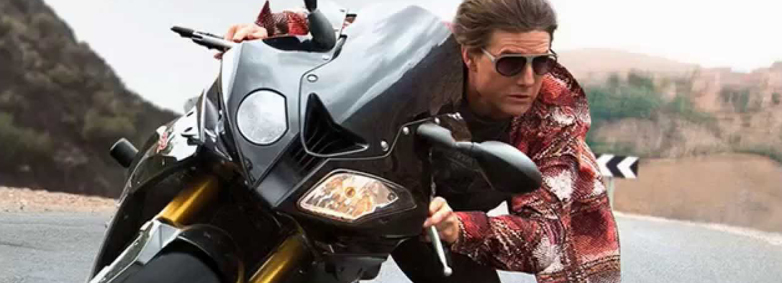
Cruise is prepared to take a beating, smash a car, crash a bike and even hang off a military transport plane during take-off – just for your entertainment.

So it’s a shame he’s put overall control in the hands of workman-like writer/director Christopher McQuarrie.

A longstanding Cruise collaborator, they previously paired up to make the weak Jack Reacher (2012). And McQuarrie has further scripted the Cruise-starring Valkyrie (2008).

He’s also responsible for the scripts of the poor Jack the Giant Slayer (2013) and The Tourist (2010). Yet back in 1995 – the year before Cruise began the MI movie franchise – he won an Oscar for writing The Usual Suspects (1995).

Here his direction is rote not inspired. Action scenes are impressively staged on an epic canvas but fail to generate much tension.

With it’s great theme tune, glossy locations, outrageous stunts and glorious gadgets, the IMF owes a huge debt to 007 James Bond.

With Cruise having played Hunt for nearly twenty years and more times than most actors have played Bond, perhaps it’s time to refresh the MI franchise.

They should give the next mission to Ilsa.

Jurassic World

Director: Colin Trevorrow (2015)

Strap yourself in for a prehistoric thrill-ride of fearsome fun as the theme park dinosaurs return in this bone-snapping action sequel.

Despite being very familiar this is a supremely confident and wildly entertaining monster movie, a determinedly old fashioned, family-friendly adventure with no sex, drugs, booze or rock and roll swearing to scare the parents.

Filmed on a budget conservatively guesstimated at a monstrous $150million, it’s a fast-paced and smartly scripted blend of expert SFX, exciting action and lovely comic moments. It’s everything last year’s Godzilla should have been but wasn’t.

Twenty years on from Jurassic Park (1993) Jurassic World is Jurassic Park IV in all but name. Rather than hiding from or ignoring the original film by rebooting the franchise, it openly and affectionately embraces it’s memory.

Dialogue openly refers to the previous disaster and T shirts and jeeps from the original park are incorporated into the action.

The central mall of the park is named after the avuncular scientist John Hammond (Richard Attenborough) who first extrapolated the dinosaur DNA from amber leading, to the resurrection of the dinosaurs.

It’s set once again on the idyllic tropical island of Nublar, off the coast of Costa Rica. A new Jurassic World theme park has risen from the cold bones of the old one.

It’s bigger, glossier holiday experience with scientists experimenting with genetics to create beasts that are larger, more deadly and more cool. This maintains audience interest and attendance, boosts profits and keeps the shareholders happy.

Uptight corporate chief Claire Dearing (Bryce Dallas Howard) is the park operations manager in charge of the safety of 20,000 customers. They are ferried around on monorails not dissimilar to the youthful utopia of Logan’s Run (1976).

Claire is horrified when avarice and hubris combine to unleash a Frankenstein’s monster to destroy this Babel of vacationing people.

The new star attraction Indominus rex escapes it’s heavily-guarded compound and rampages across the island towards the unsuspecting holidaymakers.

Genetically modified Indominus is driven by carnal desires to eat, hunt and mate. Fashioned in a test tube and reared in isolation, the beast is essentially insane; a reflection of the minds of those who created her.

It represents humanity gone wild, similar to the creature of the Id from Disney’s Forbidden Planet (1956).

Adding to her woes, Claire’s two young nephews Zach and Grey (Nick Robinson, Ty Simpkins) are lost on the island.

So she recruits hunky velociraptor trainer Owen Grady (Chris Pratt) to help her rescue them, defeat the beasts and restore the ordained natural order.

Employed as a dinosaur whisperer with his own pack of semi-trained velociraptors, Grady’s a tequila-loving, board-short sporting dude who lives in a beachside shack and repairs classic motorbikes in his spare time.

Meanwhile head of security Vic Hoskins (Vincent D’Onofrio) sees a financial opportunity in the chaos.

There’s a lot of bone crunching action as various red-shirts are despatched and the customers take a beating from mother nature in the form of  brilliantly rendered dinosaurs.

The work of dinosaur consultant Phil Tippett is brought magnificently to life by the effects powerhouse Industrial Light and Magic. Both worked extensively on the original film.

After his work on time-travel flick Safety Not Guaranteed the director Colin Trevorrow was handpicked by executive producer and director of Jurassic Park I and II, Steven Spielberg.

Barrelling through his story, the young protege has clearly been studying his master’s work. He fills the film with lovely moments using dripping blood and reflective surfaces to provide slow reveals and create tension. Plus he has a nice line in jokey misdirection.

An extensive sound department provide a terrific range of prehistoric roars and wince-inducing snapping and crunching noises.

There are quibbles if you want them. Official walkie-talkies frequently go on the fritz but cell phones work perfectly.

Though broken-family resolution is a common theme in most of Spielberg’s work, women’s careers, childlessness and impending divorce are directly identified here as the reasons for placing the boys in peril.

Based on the film’s trailer, Avengers director Joss Whedon’s offered unsolicited comments of Jurassic World’s presumed hoary sexist stereotypes. But his ‘she’s a stiff, he’s a life force‘ criticism is unfair and ill-judged

Whedon may have more justification being irked at the similarity the tech-savvy character Lowery Cruthers (Jake Johnson) has to space-pilot Wash in his sci-fi adventure Serenity (2005).

B.D. Wong is the only original cast member credited with returning but I believe there’s a one-line cameo from a now very famous face – if appearing only in silhouette.

There’s an unfortunate informal hierarchy among the supporting cast is but I doubt this is the result of any racism in the script/casting – more of an insight into the relative value the producer’s place on the different markets in the global market place.

It’s no reflection on the actor’s involved China and Asia are clearly more important markets than Africa.

While Indian actor Irrfan Khan appears as slick billionaire Simon Masrani and Asian-American B. D. Wong plays brilliant scientist Dr. Henry Wu, French-Senegalese Omar Sy is lumbered with playing Owen’s colleague Barry, an example of a ‘black best friend’ role recently derided by Brit actor David Oyewolo.

For a film set in Central America and filmed in Hawaii, there’s a lack of local faces except for a young, bored and undertrained ride operative.

It’s worth noting the script doesn’t suggest wealth and intelligence is a guarantor of morality.

As the self-confessed alpha male Grady, Pratt reins in the juvenile cocky exuberance from Guardians of the Galaxy (2014) and is all the more engaging for it.

He’s well cast in a role that demands he be smart, funny, charming and rugged; a leading man and action hero. It’s a shame then his character development is non-existent. He’s exactly the same at the beginning as at the end.

However his sparring partner Claire goes through a fundamental change through her experiences.

Beginning in a flawless starched white uniform and ending with a far more organic look, Bryce Dallas Howard (daughter of director Ron) essays her character from perfectly presented management wonk to a gun-toting lioness and defender of her young.

Howard and Pratt share an enjoyable chemistry that is closer to squabbling jungle adventurers Michael Douglas and Kathleen Turner in Raiders Of The Lost Ark (1982) rip-off Romancing The Stone (1984).

Without doubt the second best in the Jurassic Park franchise, Jurassic World is also the third best Indiana Jones movie.

It could easily be read as an extended audition by Pratt for a mooted reboot of Raiders (directed by Spielberg), donning the fedora of Harrison Ford as the whip-cracking professor Indiana Jones.

There’s a subplot where the military want to co-opt the scientific work and use it to replace soldiers and drones with dinosaurs. (A pigeon was awarded the Victoria Cross in WWII so it’s possibly not even the military’s most stupid moment.)

With a direct reference to The War on Terror, heavily armed soldiers are flown in and use an ops room for remote attacks as they try assert their dominance over nature.

Grady’s attempt to thwart the army’s desire to weaponise genetically modified dinosaurs is no different in essence to Indiana Jones racing to prevent Nazi’s using the Ark of the Covenant to win WWII. Both seek to use powers they can’t fathom.

Based on the novel by Michael Crichton, Jurassic Park became the highest grossing film of all time, surpassing Spielberg’s own E.T. the Extra Terrestrial (1982) before being superseded in turn by Titanic (1997).

Two more sequels followed: The Lost World: Jurassic Park (1997) and Jurassic Park III (2001) though only the first sequel was directed by Spielberg.

Unsurprisingly neither were as groundbreaking, well-received or as successful as the first. 

In 1996 Universal Studios opened in Universal Studios Hollywood and now following the recent fad for theme park rides turned movies, Tomorrowland, Pirates of the Caribbean, it’s now evolved into a movie again.

As a summer entertainment this meaty monster movie will be sure to tear chunks out of the box office competition.

Tomorrowland

DIrector: Brad Bird (2015)

Take a smooth roller-coaster ride with George Clooney in this well-oiled but preachy theme park-based adventure.

Inspired by the Disneyland Tomorrowland attraction which opened in 1955, the film wants to inspire us to be creative and free – but only if we follow the Mickey Mouse rules.

Disney have had huge success turning their Pirates of the Caribbean ride into a Johnny Depp starring mega-movie franchise and no doubt secret plans are already afoot for a sequel.

Young Casey Newton (Britt Robertson) sneaks out at night to blow up the bulldozers who are due to tear down Nasa‘s defunct launch pad at Cape Canaveral.

Not only will the closure of the base put her engineer Dad Eddie (Tim McGraw) out of work – but it will also signal the end of humanity’s dreams of a gleaming future among the stars.

Casey finds a small badge decorated with a corporate logo which miraculously transports her to another dimension.

The badge only works when it touches Casey’s skin – with heavy-handed symbolism she has to literally grasp the future.

It transports her to the futuristic city of Tomorrowland where citizens use jet-packs to fly among the soaring silver skyscrapers. It gleams with orderly sunshine and prescribed happiness – and she’s wowed.

Amusingly Casey has to navigate the geography of both world’s simultaneously, allowing for some well-executed physical comedy.

When the battery power of her badge runs out, Casey finds herself back home but determined to return.

Tracking down another badge, Casey is attacked by sharp-suited robot agents with laser-guns and rescued by a mysterious 13 year old called Athena (Raffey Cassidy).

Part bodyguard and part spirit-guide, Athena is named after the Greek goddess of wisdom, courage, and inspiration who’s also the patron saint of cities. She delivers Casey to the home of reclusive and grumpy inventor Frank (Clooney).

He was ejected from Tomorrowland for building a machine which broke the future – but he’s persuaded Casey can fix the machine he created. So the three of them team up to try to save the world.

Brad Bird has a mixed directorial track record; The Incredibles (2004) is brilliant, Ratatouille (2007) is dull and Mission Impossible: Ghost Protocol (2011) is excellent but only in parts.

With it’s love of the space-age, hints of government conspiracy and a young boy with a robot best friend; Tomorrowland is similar to Bird’s wonderful The Iron Giant (1999) – though not as entertaining.

Demonstrating Tomorrowland’s admirable if misguided confidence in itself, the opening scene riffs on The Princess Bride (1987). Also easily recognised as influences are The Wizard of Oz (1939), The Phantom Toll Booth (1970) and The Matrix (1999). The ghost of Pinocchio is never far away.

The wheels of this roller-coaster are greased by glorious design. Referencing the work of modernist architect John Lautner and filmed in the City of Arts and Sciences in Valencia; the sleek buildings and costumes have a retro-futuristic feel.

This contrasts with the gorgeous Jules Verne-inspired steampunk rocket-ships which riff on Disney’s Nautilus from 20,000 Leagues Under the Sea (1954).

Charming performers navigate the decent action scenes with aplomb and employs freeze rays, time bombs and flying robots to dazzle the eye.

But it never reaches the emotional pitch it aims for or delivers the magic and wonder the orchestral score by Michael Giacchino frequently promises.

The plot is powered by an on-brand corporate message rather than drama, excitement or internal logic, and it’s too easily distracted by its own whizzy visuals.

The talented trio of bickering leads do their best to distract you from a message-laden script. In true baby-boomer fashion the film suggests all the the world needs to be a better place is to transmit a positive vibe. Man.

It also demands we choose to feed the wolf of our optimism not the wolf of despair. It’s a small world after all.

The closest there is to a villain is rival inventor David Nix (Hugh Laurie) – but the subdued TV star seems reluctant to project any of the menace, gravitas or camp the role needs and he desperately resorts to comedy swearing.

Even when playing grumpy Clooney is reliably charming. He is generous to his younger co-stars and careful never to overpower their performances. Not that they give him much opportunity to do so.

Robertson gives Casey a feisty energy and is courageous, smart and likeable. However the real star of the film is Cassidy who has a deft comic touch and whose calculated poise is remarkably effective at suggesting wisdom beyond her years.

In order to save the world Frank must reclaim his childhood innocence and imagination by symbolically destroying the source of his unhappiness and negativity.

However this means he also rejects adulthood and those messy adult complications such as love, sex and fear.

The film openly derides the dystopias of Orwell’s 1984, Bradbury’s Fahrenheit 451 and Huxley’s Brave New World and their negative view of the future, while Frank equates politics and bureaucracy with greed.

But Frank’s vision of utopia is an exclusive enclave of beautiful creative thinkers with admission by invitation only. It’s a sterile, sexless land of infantilised adults and scarily squeaky-clean children who could have sprang from The Village Of The Damned (1960) – now where does that remind you of?

If suitable names are already taken, perhaps Frank could call it Hollywoodland.

Mad Max: Fury Road

Director: George Miller (2015)

This barkingly brilliant reboot of the 1979 action classic brings the Road Warrior thundering back into cinemas in a cacophonous cloud of craziness.

Writer/director George Miller returns and though the central character is a former cop called Max (Britain’s Tom Hardy in the role Mel Gibson made famous) there are few connections to the original trilogy.

The Mad Max franchise began with the low budget Mad Max (1979) followed up with the western influenced Mad Max 2: The Road Warrior (1981) before concluding with the weak Beyond Thunderdome (1985) which co-starred Tina Turner.

This is altogether a bigger, badder and more bonkers movie. Clearly there was a meeting where all ideas were left on the table and ended up on the screen.

A reckless pursuit of spectacular entertainment which could have easily ended up as a six lane motorway pile-up. It’s credit to Miller and his team we’re not watching another Dune (1984) or Jupiter Ascending (2015).

They’ve created a frantic metal circus on wheels and populated it with clowns, midgets, acrobats, showgirls and bare-chested warriors. Then they’ve sent it blasting across the desert to the power chords of it’s own onboard guitarist.

An exhilarating chase, it is far closer in epic sweep, energy and colour to Mel Gibson’s Apocalypto (2006) with which it would make a dazzling demented double-bill. Gibson has no connection to this production.

It’s another left turn for Miller who directed Babe (1995) the charming family fantasy about a talking pig. He then went on to win the Academy Award for Best Animated Feature for Happy Feet (2006).

The  script is co-written by artist Brendan McCarthy who first achieved success as an artist on 2000AD‘s Judge Dredd comic strip. Dredd himself was visually influenced in part by the poster for Death Race 2000 (1975) which itself was an influence on the first Mad Max movie.

The dialogue is as sparse and hard as the desert location with location work in Namibia, South Africa and Miller’s native Australia – where the first films were made.

Miller is aided in his pursuit of a no-holds barred cinema experience by cinematographer John Seale, editor Margaret Sixel and production designer Colin Gibson.

Seale’s colour palate is dominated by blues and oranges with controlled explosions of white and green, a moving canvas created with the absolute control of Mondrian. His saturated colour levels add to the intensity of the action.

Sixel’s manic and itchy editing puts us inside the addled mind of Max. Although it generates a ferocious pace it allows time for us to draw breath before the next assault on our senses.

Colin Gibson’s designs are nasty, brutal and far from beautiful – but they are brilliant. 150 wildly different vehicles are fused from different eras and give a new meaning to the expression ‘hybrid motor’.

The greatest of them is Furiosa’s War RIg, a character in itself and one resembling a giant rusting Ninky Nonk. There are also design nods to The Cars That Ate Paris (1974) and The Dark Crystal (1982).

Dutch multi-instrumentalist, producer Junkie XL provide an incredible, raucous, unforgiving soundtrack.

There’s conspicuous CGI to facilitate the 3D experience but the CGI used for the background vistas is convincingly realised.

In the original film, Max is driven to righteous anger by the murder of his family – this time he is insane from the start; a feral, lizard-eating animal. He gradually acquires a new identity and Max’s emerging sanity is reflected through his shifting appearance.

Interested only in his personal survival, Max is haunted by the loss of his daughter in the oil wars that have turned the world into a barren wasteland. It’s a post-apocalyptic future and all resources are in short supply, especially gasoline and water.

Captured by the tribe of War Boys, Max is made a slave of the Citadel and chained to a warrior called Nux (Nicholas Hoult) who is farming Max for his blood.

The Citadel is a water-producing fiefdom owned by Immortan Joe (Hugh Keays-Byrne – he played the psycopathic villain Toecutter in the first film). People are property; cattle for producing milk, blood and babies.

Max escapes and reluctantly teams up with the renegade Imperator Furiosa (Charlize Theron) who’s stolen a War Rig and a tanker full of precious fuel.

Also on board are are Immortan Joe’s five wives. He’s not best pleased at losing his valuable property and unleashes three heavily armed war parties to bring them back.

The wives are angelic beauties who possess economical clothing and extravagant names  – such as The Splendid Angharad (Rosie Huntington-Whiteley).

Whereas the rest of the toothless population are blistered and ravaged by disease, these girls resemble chastity belt-wearing Victoria Secrets models.

Though suspicious of each other Max and Furiosa team up to and what follows is a ridiculously rollicking race from A to B across the desert to the Green Zone of Furiosa’s youth.

There is no romance but through deeds not words the two lost souls begin a healing process in each other. Character is action and there is nothing here but character and action.

Both are the product of a tight script and propelled by demented performances. The actors are uniformly excellently, especially the three leads; Hardy, Theron and Hoult.

Hoult puts his youthful zeal to good use and commits to the madness in a strikingly physical performance and also contributes much to the tender heart of the film.

Theron eschews glamour for cast-iron attitude and she’s as damaged and driven as Max; a feminine hard-nut to rival Ellen Ripley of Aliens (1986).

Although women are treated badly they are portrayed as tough, courageous, resourceful, compassionate and in all ways the equal of men.

In Locke (2013) Hardy did nothing but talk – here he barely talks at all, mostly grunting and occasionally barking out demands.

The mythology is as patched together as the vehicles and just as entertaining. The name Fury Road is an allusion to the Greek furies; goddesses of vengeance – Furiosa is their battle-hardened representative on Earth.

Her cargo of wives represent the classical virtues, identified by Furiosa as hope, life and redemption. The War Boys seek a glorious death to enter their viking Valhalla.

Though madness screams from every character, scene and stunt, it’s optimistic about humanity’s return from the brink of destruction and offers green shoots of hope.

In conception and execution this is a thrill-ride of chaos, an extraordinarily epic and apocalyptic nitrous charge of pure cinema.

You’d be mad to miss it.

Big Game

Director: Jalmari Helander (2015)

A President, terrorists and wild bears are the targets in this goofy action adventure romp which provides a forest full of explosive entertainment.

The son of a famous hunter, 13 year old Oskari (Onni Tommila) is sent into the remote mountains of his native Finland.

Armed only with a sharp knife and a bow and arrow he can barely control, the determined teen must spend a day and night hunting wild bear in a traditional coming of age ceremony. Guns are not allowed.

Meanwhile high above, Air Force One ferries the unnamed US President (Samuel L. Jackson) to a G8 summit in Helsinki. The plane is shot down by terrorist Hazar (Mehmet Kurtulus).

He’s the psychotic son of a Sheik who’s so enjoyably evil he shoots a man in the back with a surface-to-air-missile, and then is rude about the quality of the Chinese made weapons.

Ejected to ground in an escape pod, the barefoot and hapless President is found by a startled Oskari.

However the boy has commendably little respect for the authority of the Oval Office. Even with Hazar in pursuit, Oskari will only take the President to safety after his bear hunt is successfully completed.

Another survivor loose in the wood is the girdle-wearing, pill popping Chief-of-security Morris (Ray Stevenson). He once took a bullet for the President.

Meanwhile back in the Pentagon‘s command bunker, a tank-top wearing, sandwich eating analyst called Herbert (Jim Broadbent) is offering advice to the Vice President (Victor Garber) and General Underwood (Ted Levine).

They’re rapidly falling to pieces quickly at the situation, having definitely picked the wrong day to quit smoking, drinking etc.

Arching an eyebrow alongside the men is the token woman with a speaking role; the CIA Director (Felicity Huffman).

As the script builds betrayal upon betrayal, the most well-intentioned is the most affecting.

Among the the sky-diving, missile attacks and shoot-outs, the special effects aren’t terribly special –  and some of the outdoor locations look suspiciously indoor.

At every possible interlude rousing blasts of orchestral music are accompanied by sweeping helicopter shots of the glorious mountains.

The director coaxes a guileless performance from the young Finnish lead actor and Jackson enjoys himself playing against type as a man definitely not in control of events. Kurtuluş has fun channeling Hans Gruber (Alan Rickman) from Die Hard (1988).

With it’s young hero suffering daddy issues and familiar visual gags and stunts, it’s easy to recognise inspiration drawn from the ’80’s work of Steven Spielberg; specifically E.T. and The Temple Of Doom – but the tone is closer to that of Richard Donner’s The Goonies (1985). (Story and Executive produced by S. Spielberg)

However exciting and fun as it all is, the message one is not a man until you’ve killed something is far from typically Spielberg.

Avengers: Age of Ultron

Director: Joss Whedon (2015)

Bigger, darker, funnier and more explosive than ever; the world’s greatest superhero team return in the most spectacular action movie of the summer.

The Avengers take off on a do or die mission to save the world – but before confronting an army of killer robots, they must put aside their differences and overcome their crippling worst fears.

With ferocious fight scenes, dynamic design and sleekly organic CGI, it’s all underpinned by a busy, witty and coherent script.

The wise-cracking, squabbling team of Captain AmericaIron ManThorThe Hulk, Hawkeye and Black Widow are played with enormously energetic enthusiasm by regulars Chris Evans, Robert Downey Jr., Chris HemsworthMark RuffaloJeremy Renner and Scarlett Johansson.

Following on from Captain America: The Winter Soldier, the Avengers are hunting down Hydra, the terrorist organisation responsible the destruction of law-enforcement spy agency SHIELD.

Meanwhile in his civilian identity as billionaire inventor Tony Stark, Iron Man activates a dormant peace-keeping programme designed to keep the Earth safe form alien invaders.

However the villainous giant robot Ultron (James Spader) takes control and uses it to threaten the extinction of mankind. He is hugely powerful, beautiful, shiny, intelligent and funny – in all ways a threat to Iron Man and his monstrous ego.

Ultron is aided by super-powered twins who want Iron Man dead; Quicksilver and Scarlet Witch. He can move lightning-fast while she uses mystical powers to produce visions of fear to paralyse her enemies.

They’re played by Aaron Taylor-Johnson and Elizabeth Olsen, showcasing their talents on a far better forum than in last year’s terrible Godzilla.

Meanwhile as well as voicing Iron Man’s computer butler JARVIS, Paul Bettany plays a mysterious newcomer called The Vision.

As if this weren’t a surfeit of super-powers, screen-time is also found for a host of supporting characters including SHIELD agents Nick Fury, Maria Hill and Peggy Carter (Samuel L. JacksonCobie Smulders, Hayley Atwell) superheroes War Machine and Falcon (Don Cheadle and Anthony Mackie) and Asgardian warrior Heimdall (Idris Elba).

There’s no appearance by fan’s favourite Tom Hiddlestone as Loki and the absence of Pepper Potts and Jane Foster (Gwyneth Paltrow and Natalie Portman) is mentioned in passing.

Breathless and brilliantly executed action sequences move through Europe, America, Africa and Asia. Though it’s more fierce than Avengers Assemble, the steel-bodied violence is always laced with a tough coating of humour.

The final battle includes an extended composition of astonishing choreography, bearing all the grace and technical excellence we’re used to seeing from British effects house Framestore. They also provide the FX for an amazing freeway chase scene in downtown Seoul.

Visually and thematically Ultron references Moloch, the internet demon from Whedon’s TV series Buffy the Vampire Slayer. The writer also recycles an old Buffy line and puts it in the mouth of Nick Fury.

In his typically intelligent script, Whedon accomplishes the astounding juggling act of tying the large roster of characters to their various plot points, develop them emotionally and maintain their relative positions within the Marvel Cinematic Universe (MCU).

He’s also at impressively at ease including a joke about playwright Eugene O’Neill while bouncing around ideas of sacrifice and duty.

There are also ongoing discussions of evolution, the ethics of eugenics, the accountability of the military and the importance of defending freedoms without sacrificing them.

These are underpinned by visual allusions to the Second World War and references to two British Prime Minsters.

Meanwhile US President’s Teddy Roosevelt‘s maxim about a big stick is invoked and is neatly reflected in some merry horseplay involving Thor’s hammer Molinjor.

More great nuggets of humour are mined from Thor’s mythical self-regard but the focus is moved sideways away from the trio of heroes (Iron Man, Captain America and Thor) who all have their own individual franchise outside of the Avengers.

This allows for the development of the lesser characters of Hulk, Black Widow and Hawkeye.

Despite having starred in two poor films of his own in 2003 and 2008, it was in the Avengers Assemble (2012) where The Hulk became the breakout star, rampaging through the last half hour like, well, an enormous green rage monster.

This time Whedon puts him at the centre of the action from the beginning, squaring off against soldiers, robots and even Iron Man.

More importantly, alter ego scientist Bruce Banner is afforded a full character arc, one influenced by the fairytale of the beauty and the beast.

With his sharp intelligence wrapped up in magnificent brawn and powered by passion, the Hulk is very much the symbol of the Avengers – a super-powered combination offering the best hope Age Of Ultron will be the smash it deserves to be.

The Water Diviner

Director: Russell Crowe (2015)

Oscar-winning actor Russell Crowe makes an ambitious directorial debut in this handsome and exciting period action adventure.

Set in Turkey in the aftermath of the First World War, it’s a sweeping and occasionally sentimental story filled with sacrifice, suffering, grief, duty, mysticism and romance.

Crowe casts himself as Joshua Connor, a farmer and the titular water diviner. We first encounter him and his loyal dog in the digging in the red dusty earth for water. Crowe the director cheekily demonstrates his confidence by riffing on Daniel Day-Lewis in 2007’s There Will Be Blood.

After the tragic death of his wife he swears on her grave he will return with the bodies of their three sons. Four years earlier they were all lost in the battle of Gallipoli on the Turkish peninsular. The money-grabbing church offers no solace to Connor, he’s even smacked with a cross at one point.

He travels from the Outback to Istanbul where he struggles against pickpockets, the Turkish resistance, invading Greeks and the belligerent British army bureaucracy.

Connor’s helped along the way by Turkish soldiers Major Hasan and Sergeant Jemal (Yilmaz Erdogan and Cem Yilmaz). He also finds plenty of time to form a gentle bond with a beautiful hotel receptionist.

Turkish culture is treated with respect and in some detail. We see inside the fabulous Blue Mosque and witness several political protests. There are markets, religious ceremonies, brothels, cigarettes and raki. As a cultural exchange Connor teaches the Turks to play cricket.

The Water Diviner is built with the director’s virtues; it’s solid, honest, macho and hard-working, it’s easy on the eye and and offers unexpected moments of charm and humour.

Crowe underplays his own performance but still allows himself a lot of derring-do. There’s plenty of riding, fighting, drinking and even a rooftop escape to keep him busy.

As director he delivers some terrific action moments – especially an excellent sandstorm sequence – and there’s a harrowing depiction of trench warfare. We see the retreat form Gallipoli from the Turkish point of view, proving their soldiers are as brave and foolhardy as the ANZACS.

The film is less steady when Crowe approaches the delicate subject of the opposite sex, demonstrating he’s more comfortable with animals and children than he is with women. Connor even confesses he’s no good at courtship – it could be the director speaking.

There’s a decent stab at providing the character of Ayshe (Olga Kurylenko) with more to do than just being the love interest. She’s intelligent and proud yet realistic about life. As well as beating carpets and fetching wood, she runs the hotel and cares for her invalid father. She faces choices about her future which will affect her son Orhan (Dylan Georgiades).

Kurylenko seems uncertain in her early scenes though she improves as the film progresses – however the candlelit romantic subplot with Connor slows down the story when it should be gathering pace.

Faring far less well as a rounded character is her friend Natalia the prostitute (Isabel Lucas). She’s ever so jolly and lives upstairs in the hotel.

Crowe has thrown himself into the deep-end with this film but it’s no surprise he swims not sinks under the pressure.

Fast & Furious 7

Director: James Wan (2015)

Despite the mid-shoot death of star Paul Walker, the latest high-octane vehicle to roll off the Furious production line demonstrates there’s no end of the road in sight for this glossy franchise juggernaut.

It’s a typical cacophony of tanked up car-nage powered by the winning performances of Walker and a billiard of bald action co-stars; Dwayne Johnson, Vin Diesel and Jason Statham.

Racing from London to Azerbaijan, Abu Dhabi and Los Angeles in a whirl of screaming tyres, knuckle-crunching fist-fights and shoot-outs, it picks up camels, military drones and helicopter gunships along the way.

What the series lacks is an easily identifiable theme for when the action kicks into gear, such as enjoyed by James Bond and the Mission Impossible films.

Following directly from the previous instalment, former British Special Forces Assassin Deckard Shaw (Statham) swears revenge for the injuries sustained by his brother.

Holding Dominic Toretto (Diesel) and his crew of drivers whom responsible, Shaw uses the office computer of Special Agent Luke Hobbs (Johnson) to discover their whereabouts – and then beats him up for good measure.

This allows Johnson to spend the greatest part of the film recuperating in bed. Despite being plastered prominently in the advertising posters, Johnson bookends the film rather than play a major part. His eventual reintroduction towards the end sees him striding about like Schwarzeneggar in Terminator 2.

When Toretto discovers his former comrade Kang has been murdered by Shaw, he sets out to find the assassin before Shaw can find him.

In walks supercool special operative Frank Petty (Kurt Russell) and puts Toretto’s team back together. Regular franchise watchers will recognise them as Brian, Letty, Roman and Tej (Paul Walker, Michelle Rodriguez, Tyrese Gibson and Chris Bridges).

It takes a while to adapt to seeing Russell – who earlier in his career played Snake PlisskenJack Burton and Elvis – as a government suit.

Petty works in an extremely busy yet surprisingly quiet car factory. He offers the team the use of the God’s Eye, a super-powerful computer program that will trace the whereabouts of Shaw.

But there’s a catch; the hacker who created it – Megan Ramsey (Nathalie Emmanuel) – has been kidnapped and Toretto’s team have to rescue her before they can access the God’s Eye.

This results in a brilliant mountainside chase is the movie’s best sequence and seems partly inspired by Michael Caine’s classic car caper The Italian Job (1969).

Another nod to a major a movie occurs in Los Angeles when a line of mannequins is destroyed immediately before a chase down the 2nd Street Tunnel. I doubt many of 2015’s mega-plex fillers will have the confidence to casually throw in a Blade Runner reference.

Fast Furious 7 works because no matter how preposterous the excellently executed action, all the actors play their roles with cast-iron conviction without once mugging or winking to the camera.

However the film does run away with itself. Except for the brief scene where Shaw is cornered in an old factory, the entire middle section set in Abu Dhabi could be jettisoned.

Although it provides for yet more bikini opportunities, a decent high-rise stunt and some cultural damage involving Chinese Terracotta soldiers, the film would be tightened up and considerably improved without it.

Due to Walker’s accidental death, various techniques were used to complete his scenes in a mostly seamless way.

His brothers Cody and Caleb stood in for him in certain shots and the director added footage of the actor from the earlier films. Some digital manipulation was also used to complete certain scenes.

This enable the producers to deliver a coherent movie which doubles as a fitting and touching tribute to the much-missed action star.

Seventh Son

Director: Sergei Bodrov (2015)

A young pig farmer is taught to battle supernatural forces in this ploddingly derivative fantasy adventure.

A bombastic score can’t drown out laughable dialogue while eccentric and uneven performances wrestle with a dull script.

In an unspecified medieval country, seventh son of a seventh son Tom Ward (Ben Barnes) lives a humble life on a remote lakeside farm.

He suffers premonitions which give a glimpse of what the film holds for us but don’t benefit him in any way.

One day a Spook (witch-hunter) called John Gregory (Jeff Bridges) arrives to buy Tom from his family to serve as an apprentice. Before Tom leaves, his Mam (Olivia Williams) gives him a medallion.

In Gregory’s hideaway full of weapons and potions – like a medieval Bat-cave – Tom learns the names of a lot of useful sounding potions and how to throw a knife.

He also nicks a joke from James Coburn in The Magnificent Seven – which turns out to be the best joke in this film.

Tom discovers Gregory is the last in a line of an order of Knights called the Falcons – which makes them sound like a witch-hunting Rugby Club.

Meanwhile the evil shape-changing queen witch Mother Malkin (Julianne Moore) has escaped the pit Gregory had nailed her inside. She wants revenge and to rule the world.

In seven days there’s a one-in-a-hundred-years blood moon whose mystic powers will make Malkin unstoppable. I’m still not sure why.

Tom and Gregory are assisted by the indestructible and much maligned manservant Tusk (John DeSantis). This loyal and hard-working creature is the butt of a cruel running gag about his looks.

The only other humour comes from Bridges habitually boozing. There are only so many jokes you can steal from a classic Western after all.

En route to thwart Malkin they meet the comely Alice (Alicia Vikander) who is accused of being a witch. She looks fetching in leather trousers and makes a pretty pair with Barnes, even if they struggle to establish a rapport.

With a young apprentice called to adventure by a magi to rescue a princess, this is a sorry trudge through the familiar tropes of The Hero with a Thousand Faces.

The bones of the perfunctory plot are fleshed out with impressive CGI and weighty production design. ‘Legends and nightmares are real’ claims Gregory.

But due to the lack of rounded characters or careful crafting of a convincing universe, we never engage with the story.

It can’t be bothered to invent it’s own encompassing mythology. A ghast is called a level six creature as if this was a game of Dungeons and Dragons – but who knows what the other levels are.

There’s no attempt to fill in cultural details such as history, geography or language. Plus a lack of place names and no relationship between locations.

The major conurbation is ‘The Walled City’. It’s two days travel from somewhere but we’re never told where. There’s no coherent sense of distance or time. Everyone simply moves and arrives.

Bridges delivers a wildly eccentric performance, pitching his accent somewhere between Tom Hardy as Bane in the The Dark Knight Rises and Sean Connery in anything – though most likely The Name of the Rose.

Julianne Moore is distracted or possibly bored. When she and Bridges square off I giggled at the memory of their appearance in 1998’s The Big Lebowski – particularly the Gutterballs scene. It’s more fun and inspired than anything here.

Kit Harington wanders through as Gregory’s former apprentice Billy Bradley. He appears in a tavern scene which may or may not be inspired by Val Kilmer in Tombstone.

Assassins and inquisitors rub shoulders in the shabbily thought out mythology. There’s lots of sword fights and incinerations and people shapeshift into bears, leopards and dragons.

At different times Tom is attacked by a giant mole and a possessed suit of armour, but only because current Hollywood lore demands an action scene every ten minutes. Neither episode contribute to plot or character development in any meaningful way.

One four-armed swordsman recalls the work of the great Ray Harryhausen but this shambolic load of warlocks lacks the charm and narrative clarity of his brilliant work.