David Bowie & the movies

From Elvis to Mick Jagger and Madonna, most successful musicians gravitate to the big screen and David Bowie was no exception.

Relaxed on camera, practised at performing to cue and no stranger to adopting a stage persona, Bowie was a natural fit for cinema.

However his greatest contribution to cinema wasn’t his thespian ability or his music, but we’ll get to that in a bit.

Never one to repeat himself creatively, Bowie’s film career as an actor suffered for the same reason his recording career.

An inclination to experiment saw him explore creative opportunities with varying degrees of success.

His charisma, intelligence and otherworldly demeanour lent itself to portraying outlandish characters such as an alien, a vampire, a goblin king or a mad scientist, respectively in The Man Who Fell To Earth (1976) The Hunger (1983) Labyrinth (1986) and The Prestige (2006).

An audience watching these films would find it easy to suspend their disbelief with Bowie in these roles, the persistent suspicion being Bowie may have been one or all of these things in real life.

It’s far more difficult to imagine the onetime Ziggy Stardust as an ordinary person, so less successful were his attempts to essay straight roles such as his second world war P.O.W. in Merry Christmas Mr Lawrence (1983).

Unable to secure leading roles, there was a small role as Pontius Pilate in Martin Scorsese’s The Last Temptation of Christ (1992) while more typical were cameos such as in Twin Peaks: Fire Walk With Me (1992).

There were many TV appearances as himself, including one in the short lived Ian Le Frenais and Dick Clement scripted series, Full Stretch (1993).

Far from the best series from the creators of Whatever happened To The Likely Lads (1973-74) Bowie gamely played himself asleep in the back of a limousine.

Away from acting Bowie contributed the eponymous tracks to Cat People (1982) and Absolute Beginners (1986). Two great songs worthy of better films to accompany them.

The latter is a muddled British musical mostly remembered for launching Patsy Kensit onto an unsuspecting world.

Bowie’s singing and dancing contribution lifts the film in what is far less than the sum of its ambitious parts.

The former is a glossy retread of a 1942 classic horror and though a complete bomb on release, Bowie’s track is so good Quentin Tarantino used it as part of the soundtrack to Inglourious Basterds (2009).

Containing narrative based lyrics and dramatic swells, Bowie’s songs contain a cinematic air.

Plus the singer possessed non of the reluctant fear of, say The Beatles, to allow others to creatively use his music.

As a result Bowie’s tracks have been used in part or in whole in over 450 different movies.

This may not be a record for an individual artist but it feels like one.

Yes this includes concert recordings, documentaries and the like, but it’s still an impressive total.

The royalties accrued may have been a nice pension for a man who never retired but I feel he was at least equally interested to see how his music would be adapted and used.

Movie-makers have rewarded Bowie’s faith with a genre hopping mix of films.

From sci-fi such as Guardians Of The Galaxy (2014) to football drama The Damned United (2009) musicals Moulin Rouge! (2001) thrillers American Psycho (2000) and romcoms Pretty Woman (1990) all have benefitted from Bowie’s music accompaniment.

However it’s certain Bowie considered his greatest contribution to cinema to be his most unique and personal, his son.

Duncan Jones’ debut directorial effort was the tremendous sci-fi thriller Moon (2009). This was followed up by the tricksy time-bending action adventure Source Code (2011). Next up is the much anticipated mega budget big screen adaption of online game Warcraft (2016).

From performing to soundtracks and bequeathing cinema an exciting new directing talent, its an extensive legacy for a man who was primarily a rockstar.

David Bowie. 1947-2016
Creed

Director: Ryan Coogler (2016)

The long running boxing saga of Rocky Balboa is given fresh legs and a face lift in this knockout sixth sequel to Sylvester Stallone’s Rocky (1976).

It bursts out of its corner to challenge the box office clout of Star Wars: The Force Awakens (2015), itself the sixth sequel to Star Wars (1977).

Both new films utilise fresh talent while returning the familiar fan base-pleasing elements, enabling the franchises to maintain their core audience while attracting a younger demographic.

Of Star Wars: The Force Awakens (2015) and Creed (2016) it’s the latter which rejects the opportunity to wallow in nostalgia and sets out to make a name for itself, much like its titular character.

Coming to terms with one’s legacy is the dominant theme of Creed.

Although many plot points will seem very familiar to fans of the original Rocky, director Coogler is determined to give the franchise a new perspective while always respecting the spirit of the series.

Plus his talent, energy and superb eye allows him to carry off some moves of breathtaking technical accomplishment, especially considering it’s only his second feature after Fruitvale Station (2013) and he’s not even 30 years old.

Coogler has been astutely teamed up with the veteran cinematographer Maryse Alberti. Her CV boasts of working alongside Martin Scorsese, Todd Haynes, Michael Apted, Alex Gibney and recently M. Night Shyamalan for The Visit (2015).

Following the work of directors John G. Avildsen and Sylvester Stallone, Coogler references old characters, re-uses locations and gives new impetus and meaning to memorable scenes.

For long standing supporters of the franchise, the first whisper of Bill Conti’s outstanding theme tune will have your neck hair on end.

Composer Ludwig Goransson uses it intelligently and sparingly and incorporates it alongside more contemporary tracks.

They  share a similar approach to the casting, replacing the old white characters on centre stage with a young black talent, with the emphasis on talent.

The excellent John Boyega was pushed to the fore in Star Wars: The Force Awakens, in Creed it is the charismatic Michael B. Jordan as Adonis Johnson.

Black characters were supporting roles in the early films and unequivocally the bad guys. First Carl Weathers’ Apollo Creed, then Mr T’s James ‘Clubber’ Lang existed to be beaten down and metaphorically emasculated.

In Creed not only is Adonis the central character but he is absolutely the sympathetic and rampant beating heart of the story.

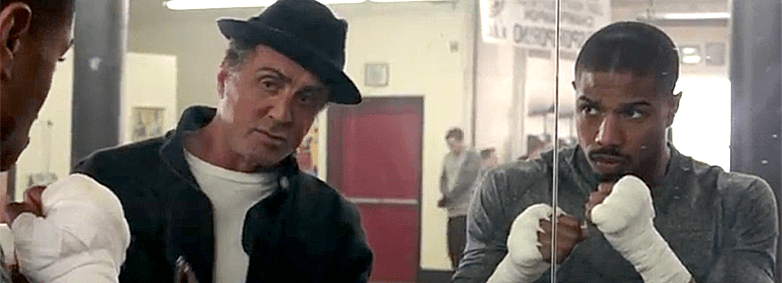
Stallone offers a poignant gravitas as Rocky, the former champ who’s still taking life on the chin.

Never more comfortable than in the Italian Stallion’s pork pie hat, the actor wisely refrains from donning his old gloves.

Rocky’s persuaded to train Adonis, the illegitimate son of one time adversary turned friend now deceased, Apollo Creed.

Creed’s death in the boxing ring weighs heavily in different ways on both characters.

Boxing offers Adonis the opportunity to come to terms with his father’s absence during his life, to honour his legacy while breaking free of his shadow.

Rocky has no desire to see another colleague and friend die from boxing injuries.

Living downstairs in Adonis’ Philadelphia apartment block is Tessa Thompson’s aspiring musician Bianca.

The fluid chemistry between the young actors serve as much as any aspect of the film to invigorate it.

Putting the focus on the pair allows for an introduction to a new generation of movie goers for whom the Rocky franchise may possess scant cultural cachet.

Events allow Adonis a title bout against the world champion Ricky Conlan.

Presumably real life boxer turned actor Tony Bellew was given his shot at the big time to add verity to the boxing scenes.

However he’s a less cinematic pugilist than Jordan and lacks the on-screen menace of the opponents in previous films.

Conlan is well short of Dolph Lundgren’s Ivan Drago from Rocky IV (1985) to name but one.

With artifice working more effectively for cinema than reality, this suggests it’s better to employ actors who can pretend to box than have boxers who aspire to act.

Despite this, the urgent and bloody bouts are pure Hollywood fiction in the best Rocky tradition and the story lands some brisk emotional punches.

The big fight takes place at Goodison Park, home of Everton FC. It’s the best drama seen there all season.

Room

Director: Lenny Abrahamson (2016)

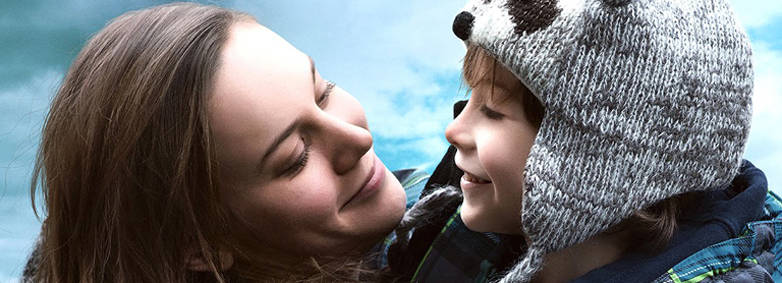
Disturbingly dark and horribly tense, this modern day fable is all the more gripping for the love at the heart of its story.

It’s told through the eyes of five year old Jack via Jacob Tremblay’s astonishing emotionally truthful performance.

He’s grown up in a decaying and cramped single room, entertained with tales of imaginary worlds told by his only companion, his mother Joy.

She’s played by the staggering excellent Brie Larson and the pair share a wonderfully warm chemistry.

Larson has been deservedly BAFTA nominated for leading actress and named as one of their Rising Stars of 2016. An Oscar nom should also be forthcoming.

At night Jack must hide in the cupboard to sleep because a bogeyman called thrusts himself into their world.

We hear of him and hear his voice long before we see him and Sean Bridgers is brilliantly and pathetically creepy as the predatory Old Nick.

Joan Allen and William H. Macy provide strong support as Joy’s parents Nancy and Robert.

As adults we can guess at the truths hidden from Jack and our fears for him and Joy make for a thoroughly unsettling watch.

A great deal of this could have oozed from the mind of Terry Gilliam in his disturbing Tideland (2006) phase.

After confronting Old Nick it is Jack’s turn to keep Joy from the grasp of the room’s demons.

Their mutual love is the thin thread of hope to which they cling to survive

The extraordinary central performances are supported by smart direction, scriptwriting and cinematography.

Emma Donaghue’s screenplay from her novel (pub. 2010) has been nominated by BAFTA for best adapted screenplay. Apart from this category and Larson’s acting nod, the film has sadly been overlooked for British honours.

Room was lensed by Danny Cohen, one of Britain’s most illustrious and hard working cinematographers.

Along with Roger Deakins, Cohen seems destined never to win an Academy Award for his work.

He was nominated for Tom Hooper’s The King’s Speech (2010) and worked again with the director Tom Hooper on the The Danish Girl (2016). Other recent work includes X+Y (2015) and London Road (2015).

Cohen has frequently collaborated with Shane Meadows on the This Is England TV series and his ability to capture grimy realities is fully exploited in Room.

There’s always room at the top for films this good.


A War

Director: Tobias Lindholm (2016)

Guns, grenades and gavels will shred your nerves in this riveting courtroom drama set in the Afghan war.

An army commander is looking down the barrel of a long prison sentence for killing civilians in the act of saving his men.

A smart script gives meaning to the intense battle scenes and the film is always sympathetic to the soldiers.

We fear for the soldiers, worry for the dirt-poor locals and agonise for the families back home.

Danish duo Tobias Lindholm and Pilou Asbaek team up for the second time as director and star respectively.

They previously collaborated on the gripping A Hijacking (2013) where Asbaek played a ship’s captain held hostage by Somali pirates.

A Hijacking was followed into cinemas by Paul Greengrass’ similar though not superior Captain Philips (2013) which starred Tom Hanks.

As well as directing, Lindholm also writes his own scripts and was responsible for writing the Mads Mikkelson drama The Hunt (2012).

All three scripts feature men under intense pressure stemming from decisions made under stress at work.

Asbaek plays Company Commander Claus Pedersen. He is brave and devoted leader of his team, accompanying them on patrol to restore moral after the loss of one of his men to an IED.

Gallows humour peppers the dialogue and there is an absolute lack of gung ho jingoism.

The tumult of a firefight is created with great sound editing, dust clouds and frantic camerawork.

Having the cast scream at each other in their native Danish adds to the turmoil.

The Taliban are a mostly unseen if ferocious enemy, portrayed by the chaos and death they cause. Their victims are all too easily identifiable.

There are no overt political points being made but the mere presence of Danish nationals patrolling the plains of Afghanistan is a defiantly curious phenomenon.

I spent a lot of time urging them to keep their bloody heads down – while I crouched behind the back of the chair in front.

Being in court is more stressful than the battleground for the heroic Claus. His fight on either front will keep you gripped.

Bolshoi Babylon

Director: Nick Read, Mark Franchetti (2016)

This intriguing documentary allows us to peek behind the stage curtain of the world renowned Bolshoi, the ballet company described as as a mirror of Russian society.

The Bolshoi is the focal point of Russian high culture and Prime Minister Dimitry Medveved boasts of it as a secret weapon selling Russia to the world.

Overlooked by the Kremlin just down the road, it’s been the place for Russian leaders from Stalin onwards to entertain visiting dignitaries such as Cuba’s Fidel Castro, the USA’s Ronald Reagan and Britain’s Margaret Thatcher.

Her predecessor as Prime Minister Winston Churchill described Russia as ‘a riddle wrapped in a mystery inside an enigma‘ with the key being Russia’s national interest.

It’s the first time anyone has been granted uncensored access to the theatre and directors Nick Read and Mark Franchetti take full advantage.

Peering about the dark nooks and crannies of the grand old building, they uncover the egos and rivalries of performers and executives.

They capture spectacular shows and candid catty comments of dancers waiting in the wings.

The performers delight in demonstrating the great grace, strength and finesse of their olympian bodies.

And we’re close enough to see the sweat and strain beneath the heavy stage make up and beautiful costumes.

The institution is rampant with accusations of corruption and incestuous staff relations.

The Bolshoi was rocked when former lead dancer turned artistic director and establishment baiting Sergei Filin was blinded in an acid attack.

His rival dancer Pavel Dmitrichenko is arrested with unseemly haste and packed off to six years hard labour on a penal colony. I’m guessing Siberia.

The Kremlin take advantage and send in new broom director Vladimir Urin to sweep away Filin’s regime.

His ruthless top down management structure is powerless to prevent patronage from the powerful political elite on whom it is dependent for state funding.

As various interviewees talk at length while trying to give little away, the material is carefully organised to present an uncompromising picture and hint at one even darker.

 Nothing seems to have changed too too much in modern Russia.

The Danish Girl

Director: Tom Hooper (2016)

Oscar winner Eddie Redmayne aims for more Academy gold as a transgender artist in this period drama.

As in The Theory Of Everything (2015) where he played scientist Stephen Hawking, the British actor gives a committed performance as Einar Wegener.

However he is outshone by Swedish co-star Alicia Vikander as his on-screen wife Gerda who offers strong marital support.

She acts with her eyes and he with his mouth. Some of his alarming lip quivering reminds us of his space camp turn in the terrible Jupiter Ascending (2015).

Gorgeous costumes, polished interiors and fresh exterior locations give Copenhagen of 1926 a living, picturesque appeal.

But it’s suffocatingly sincere and suffers from banal dialogue and a lack of conflict.

Plus director Tom Hooper inflicts on us the same close ups and curious framing which marred his films The King’s Speech (2011) and Les Miserable (2013).

Gerda producers portraits and wears the trousers while Einar paints landscapes and discovers he enjoys wearing frocks.

As he discovers himself more comfortable in women’s clothes than men’s, Einar adopts the alter ego of ‘Lili’.

Gradually she becomes his dominant personality and seeks to make a permanent transformation to womanhood.

Redmayne is a pretty boy in real life but no great beauty as a woman, especially when stood between to his gorgeous on-screen wife and her ballerina best mate Oola, played by Amber Heard.

Lili’s selfish behaviour fails to garner much sympathy and nor does she meet much resistant to her life choices. Society is indifferent to Lili’s plight. So was I.


The Hateful Eight

Director: Quentin Tarantino (2016)

Quentin Tarantino’s new western is a slow burning fistful of cinematic dynamite which explodes all over the screen.

In a set up surprisingly reminiscent of Agatha Christie, eight hateful desperadoes are brought together one night by a Wyoming blizzard.

The discovery of loose connections leads to the opportunity to settle old scores and much bloodshed.

It’s a major work from an important director and a minor masterpiece of the genre.

Building on the strengths of Django Unchained (2013), Tarantino’s burgeoning maturity after a mid career slump of Kill Bill 2 (2004) and Death Proof (2007) suggests the mouthwatering prospect his best work is yet to come.

The Hateful Eight (2016) is proclaimed as Tarantino’s 8th film. With one eye on his legacy the 52 year old director recently speculated he would only make 10 movies, adding he felt he would never dominate the Academy Awards with multiple wins for a single film.

His current upward trajectory suggests his tenth and possibly final film could easily sweep the Oscars board.

In any circumstances I very much doubt Tarantino will go quietly into the cinematic night of his own accord.

With two consecutive westerns under his gun belt, Tarantino seems to have found his meter in the genre, itself the great American art form.

His previous best work was Jackie Brown (1997) based on the novel Rum Punch (pub. 1992) by Elmore Leonard.

The inestimable crime writer produced a raft of novels, many of which ended up on screen. Notable examples are Hombre (1967) Get Shorty (1995) and Out of Sight (1998).

However he began his career as a prodigious writer of pulp westerns. Three-Ten To Yuma (pub. 1953) was filmed in 1957 as 3:10 To Yuma starring Glenn Ford and Van Heflin, and filmed again in 2007 with Christian Bale and Russell Crowe.

Should Tarantino feel the need for inspiration he could do worse than tackle another of Leonard’s many works.

Until then we have The Hateful Eight which as rich in character and performance as any movie Tarantino has made thus far.

The former enfant terrible of Indie cinema takes a more mature and traditional approach.

He throws out the pop cultural references in favour of discussions on justice and the morality of the civil war.

Also out are the eclectic rock soundtrack and in comes a score by the maestro of spaghetti westerns, Ennio Morricone.

As good as it is, it’s no disservice to suggest it’s not the greatest work from the composer of the score for The Good, The Bad and the Ugly, among many others.

And it’s worth the entrance fee to be able to savour it on a cinema sound system.

A majestic opening shot features a vast snow-filled plain with a stagecoach driving past a frozen crucifix.

This elegant, eloquent statement of intent gives an icy indication of the grand guignol the passengers are heading towards.

This is cinematographer Robert Richardson’s 5th Tarantino movie after Django Unchained (2013), Inglourious Basterds (2009) Kill Bill 2 (2004) and Kill Bill (2003).

His ridiculously impressive CV includes 6 Scorsese films, 9 by Oliver Stone and works by Robert Redford, Barry Levinson and Robert Reiner.

Plus he’s one of only two living persons to win 3 Oscars for his craft. There’s another 5 nominations in there as well.

Colorado stands in for Wyoming and camera movement is kept to practical minimum while capturing the magnificent icy vistas.

Once inside in the relative warmth, Richardson’s camera glides about the confined space to skilfully illuminate the dialogue.

Even with 2 screenplay winning Oscars from 3 nominations, his sharp wordcraft is among the best Tarantino has written, it’s no wonder actors return to work for him time and again.

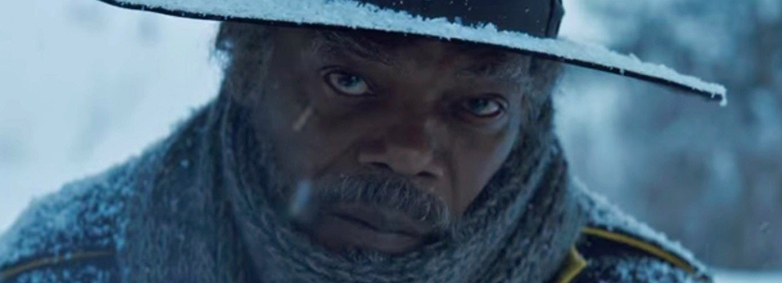
Heading what is now practically of troupe of Tarantino regulars, Samuel L. Jackson plays Major Warren, a former Union soldier turned bounty hunter.

Our first encounter him reprises the entrance of John Wayne in John Ford’s Stagecoach (1939).

Other visual influences are Sam Peckinpah’s The Wild Bunch (1969) and Robert Altman’s McCabe And Mrs Miller (1971).

With his frozen bounty in tow Warren hitches a ride on a private stage hired Kurt Russell’s bounty hunter, known as The Hangman.

It’s always great to see Russell in anything  and seeing him in wrapped up in a blizzard raises pleasant memories of John Carpenter’s sci-fi chiller The Thing (1982).

The Hangman is transporting outlaw Daisy Domergue to the town of Red Rock to be hung. Jennifer Jason Leigh brings a fierce humour to her demented portrayal.

Her heavily bruised eye resembles the stylised look of Alex from Kubrick’s A Clockwork Orange (1971), and suggests some impending ultra violence.

Vying with Leigh as the most valuable player in the uniformly excellent cast is Walton Goggins. He plays a racist former confederate soldier called Chris Mannix.

Other returning Tarantino regulars include Michael Madsen, Zoe Bell and Tim Roth channelling Terry-Thomas.

Caught up in a blinding snowstorm the travellers reluctantly take refuge together in an isolated holding post where other guests are warming themselves.

This fraught atmosphere demonstrates Tarantino’s ability to and it frequently wrong foots us in our expectations of where the story is going.

All the characters have nicknames referring to their status, The Prisoner, The Sheriff and so on.

When doubt is shed on their self-declared personal narratives, this remove from their professed identities adds layers to the slowly building snow drifts of lies, fear and mistrust.

As we’ve come to expect from Tarantino, there is a non-linear narrative. This gives a greater opportunity for character development than a more straightforward approach to structure would allow.

There’s a crude and confrontational tale Major Warren tells Bruce Dern’s aged General and some may feel this scene is evidence the director hasn’t yet shaken off his juvenile sense of humour.

However it serves a narrative purpose and there’s a sense Tarantino can’t resist baiting his film with poisoned morsels for unwary detractors.

Domergue suffers repeated physical abuse. It’s not the violence itself which worries, that can be justified by the milieu and far worse treatment is meted out to women in the westerns of Leone and Eastwood.

What’s problematic about this violence is its use as a literal punchline. The abuse of a captive woman, the only female character of note, is intentionally used to draw laughs from the audience.

The defence could reasonably claim more and greater violence is trespassed against other characters and done in an equally intentionally comic and more grisly manner.

Plus her tolerance for pain and patience for revenge tells us a great deal about her character.

Production of The Hateful Eight ran parallel to the Leonardo DiCaprio vehicle The Revenant (2016).

Although superficially similar in their brutal nature and western setting, the two frozen features are very different beasts except in the extremes of their ambition.

With The Hateful Eight distributor Harvey Weinstein stealing a commercial march by opening in the UK a week earlier, it’s doubtful a mass UK audience could stomach two similar seeming films in quick succession.

With this in mind I expect The Hateful Eight to win at the box office but The Revenant to win bigger at the Oscars.


The Revenant

Director: Alejandro G. Inarritu (2016)

Gripping, grisly and grizzly, this epic revenge western is the first must see film of 2016.

Leonardo DiCaprio goes hunting for the best actor Oscar in this thrilling and icily apocalyptic adventure.

Despite his best efforts, notably his portrayal of a ravenous financier in The Wolf of Wall Street (2014), the Academy award has so far eluded him.

But on this form as fur trapper and explorer Hugh Glass, there’s every chance he’ll bag it.

While on an expedition in the uncharted Northern frontier, Glass is brutally mauled by a bear.

I could barely endure the ferocious scene as the angry beast tears away at Glass with it’s hot breath steaming the camera lens.

He just about survives only to see his son murdered and find himself abandoned.

Driven by his pain and suffering Glass begins a 200 mile odyssey across the wild, wild west, intent on killing the man who betrayed him.

On the lonesome trail Glass endures being washed away, buried alive, burned and stabbed.

There’s visceral violence and dialogue as sparse and unforgiving as the environment.

For those who aren’t convinced by DiCaprio’s acting ability, they should see how much he conveys here while speaking very little.

Meanwhile as an old native American leads a war party in search of his missing daughter, a party of French hunters are wreaking destruction across the landscape and complicating Glass’ progress.

A huddle of orphaned children, murdered sons, forgotten wives and rich fathers are offered as a limited backstory for various characters, tying them together in a litany of loss.

With long stretches of screen time dialogue free, character is conveyed though action. The principals are aware of the conflicts in the damnable choices they face.

A trio of British actors offer brilliant support to DiCaprio.

With Mad Max: Fury Road (2015), Legend (2015) and Locke (2014) Tom Hardy is enjoying a great run of projects.

He plays the pipe smoking trapper Fitzgerald, a vicious pragmatist rather than evil incarnate.

Even more blessed with an uncanny knack of choosing great projects is the likeable, versatile and always interesting Domhnall Gleeson.

He comes of age as Captain Henry, the leader of the hunting expedition who is out of his depth.

Will Poulter is Jim Bridger, the youngest of the troop and arguably the closest it carries to a conscience.

Editor Stephen Mirrione previously worked on Birdman (2015) and won an Oscar for Steven Soderbergh’s Traffic (2000).

His signature long edits create an intensive immediacy and putting us uncomfortably in the centre of the action.

Cinematography Emmanuel Lubezki won consecutive Oscars for Gravity (2014) and Birdman (2015) and may well earn a third here.

Director Inarritu won best film, director and screenplay Oscars for Birdman (2015) and it would it not be undeserved if he repeated the trick in 2016, though in the adapted screenplay not original screenplay category as in Birdman (2015).

As in Birdman (2015) Lubezki’s ceaselessly circling camera work puts us in the middle of the action whether on horseback, on boats or underwater.

We witness an avalanche, rape, castration, shoot outs, knife fights, a hanging, a massacre and the aftermath of several more.

The landscape is alive with moose, wolves, horses, fish, buffalo and ants, demonstrating how ill geared humanity is to surviving in this fierce winter wonderland.

Set in Wyoming the production went snow chasing through Canada, the United States and Argentina to achieve the frostbitten extremes of the American frontier.

Grounded in fire, rock and ice, the elemental force of the film is captured in blues,whites and greys, with explosive moments of orange punctuating the palette.

Visual reference points are Robert Altman’s McCabe And Mrs Miller (1971) and Werner Herzog’s Aguirre: Wrath of God (1972).

Thematically the story draws on Ridley Scott’s Gladiator (2000) and John Ford’s The Searchers (1956). It is based on Michael Punke’s 2002 novel of the same name inspired by the exploits of the real Hugh Glass.

Ideas of commerce and colonisation swirl around the contemporary issues of the ownership of natural resources, the conflict between races and the role of the military in a civil society.

The Revenant means ‘the returned’ and refers to a person who comes back from the dead.

It sounds like a combination of ‘revenge’ and ‘covenant’, god’s code of behaviour issued to Moses in the Old Testament.

These two ideas compete within Glass for supremacy as he battles towards his prey.

Glimpses of Glass’ late wife through fragments of memories remind us of his spirituality even as he symbolically swathes himself in bearskin.

Eating its flesh shows his growing connection with the environment but also suggests a departure from the rational to an animal state.

In fables there is always a limit to how long one can adopt the shape of another creature before losing one’s humanity for ever.

Glass’ quest for revenge becomes a battle for his soul from which he may never recover.

A chilling final frame questions the audience as to how they would behave in Glass’ circumstances. It’s an electrifying end to a remarkably realised endeavour.

@ChrisHunneysett