The Man From U.N.C.L.E.

Director: Guy Ritchie (2015)

This big budget update of a much loved 1960’s spy series is sumptuous, smooth and stylish.

Although the loose vibe and fabulous locations are seductive, sadly the script and the chemistry aren’t.

4 series of the U.N.C.L.E. TV series ran from 1964 to 1968, plus there was the TV movie The Return of the Man from U.N.C.L.E. (1983).

Robert Vaughn starred as the American Napoleon Solo and British actor David McCallum as the Russian Illya Kuryakin.

Beyond the concept, period setting and character names not much remains of the show.

There’s not a radio pen in sight, no opening of Channel D, nor a hint of T.H.R.U.S.H. The U.N.C.L.E. (United Network Command for Law and Enforcement) organisation of the title receives a very belated introduction.

Director Guy Ritchie suffered a career slump with the inglorious mis-steps of Swept Away (2002) and Revolver (2005).

He painstakingly rebuilt his reputation as a safe pair of blockbuster hands with the excellent Sherlock Holmes franchise: Sherlock Holmes (2009) and Sherlock Holmes: Game of Shadows (2011).

Here he’s content to reject his customary zip and go against the grain of contemporary action movies. He is wilfully dismissive, almost contemptuous of his own plot.

Instead of constant wham bam action scenes he focuses on character and builds a mood of glamorous, languid indulgence which is rich in period detail.

It’s an admirable if potentially career-harming move by the writer/director/producer.

Having given Ritchie a name cast and a $75million budget, one can only imagine the horror of the studio’s executives on their first screening.

Certainly Ritchie can argue he included all the elements they wanted; cars, guns, girls, stunts, jokes – but the way he has editor James Herbert put it all together must have them tearing their hair out.

Even the sexually available and semi-naked hotel receptionist seems a studio imposition.

Elsewhere however there is a worrying confluence of violence and foreplay and a fair amount of dull macho posturing for which Ritchie can’t escape responsibility.

In 1963 the US and the USSR are threatening each other with nuclear annihilation.

Rogue nazi sympathiser Victoria Vinciguerra (Elizabeth Debicki) has stolen a computer disc. She’s a deliciously tall and cool glass of cyanide.

The disc contains data on how to super-enrich uranium to make nuclear bombs far more powerful than in existence, threatening the uneasy balance of the super-hot cold war. Whomever has the disc controls the world.

Top man at the CIA and art expert Napoleon Solo (Henry Cavill) is unwillingly teamed up with ferocious KGB agent Illya Kuryakin (Armie Hammer).

Both receive orders to recover the disc at any cost.

But the two leads are hamstrung by dull, innuendo-laden banter and a desire to project a faultless accent.

While the British Cavill plays an American, the American Hammer plays a Russian.

Hammer has less dialogue and is more able to cope but Cavill’s lumbered with laborious exposition. His careful enunciation slows scenes to a crawl.

Doing his best work when not required to speak, Cavill’s – and the film’s – best moment comes when Solo takes time to appreciate the finer aspects of life as the action goes on behind him.

It’s possible he would have been a brilliant silent movie star back in the day.

With his chiselled features and broad frame he’s the most classically movie star-looking movie star since James Garner. He steps through the film with the stately and exquisitely tailored grace of the ageing Cary Grant in To Catch A Thief (1955).

The two spies recruit an East German motor mechanic Gaby Teller (Swedish Alicia Vikander). Her rocket scientist father is held by Victoria and the boys intend to use Gabby’s connections to infiltrate Victoria’s outfit.

Sporting a chic collection of outfits but metaphorically trouser-wearing, Gabby refuses to yield superiority to the boys in any department.

A grey-haired Hugh Grant shuffles on for a couple of scenes to deliver a masterclass in light comedy.

With a storming pop operatic soundtrack throughout, Ritchie saves his visual dynamism for the finale when the screen erupts into a frenzy of split screens, fast cuts and twisted camerawork.

With beautiful production design by Oliver Scholl captured with glossy delight by cinematographer John Mathieson, it makes for a very easy on the eye experience. Berlin in 1963 is expertly rendered.

Ritchie should be applauded for making a film with a strong identity and has the courage to stand or fall on it’s own terms.

But for all it’s speedboats, helicopters and a terrifically synchronised car chase, it’s a pity it’s not more full throttle.

Edge of Tomorrow

Director: Doug Liman (2014)

This blistering sci-fi spectacular sees Tom Cruise destined to fight the same battle over and over again.

Exciting and intriguing, it flares up with a charismatic cast, ferocious action, dynamite design and maze-like plot.

An alien species called Mimics have conquered mainland Europe and are ready to strike at London. They’re whirling dervishes of tentacles and teeth.

On the eve of a major retaliatory attack, Major William Cage (Cruise) is accused of deserting, dumped on the frontline and then caught in an alien ambush.

The brilliantly staged battle is filmed in a palette of blues and greys which channel the authenticity of Spielberg’s Saving Private Ryan (1998) – any other colour generally means something or someone’s on fire. (Cinematography Dion Beebe).

Aided by the rhythm of the editing (James Herbert, Laura Jennings), humour pierces the action like shrapnel.

Cage is killed in action but is shocked when he awakes fully intact back on the parade ground, the day before the attack.

Stuck in a time-loop he has to continually fight and die, learning each day how to survive a little bit longer.

Unlike the similarly structured classic Groundhog Day (1993), there’s no moral solution to the problem.

When Cage meets the famously tough and beautifully buff sergeant Vrataski (an excelllent Emily Blunt), he discovers she has had a similar experience.

Vrataski has learnt the aliens are responsible for the time-loop and that by destroying their hive mind, humans can win the war.

The lack of romantic chemistry between Cruise and Blunt works in the films favour as they form an effective team.

Bill Paxton is hugely entertaining as the swaggering Sergeant Farrell. He relishes every on-screen moment and turns them to his scenery chewing, comic advantage.

Cruise brings his usual intensity but makes Cage likeable by gamely being the punchline of many jokes.

Which is just one of many great reasons to watch this movie again. And again.

The Amazing Spider-Man 2

Director: Marc Webb (2014)

A swinging good time is guaranteed in this superhero sequel which comes fully charged with a shocking finale.

During the many amped–up action sequences, the swooping, dipping camera captures the dynamic thrills of the original comic artwork.

They crackle with humour which Brit actor Andrew Garfield supplies through his upbeat charm and gift for physical comedy.

He reminds us how much exuberant giddy fun can be had as a web-spinning, crime–fighting superhero.

Especially when he’s up against an enjoyably preposterous super-villain called Electro (Jamie Foxx).

Garfield has less fun as alter ego Peter Parker and spends a lot time out of costume mooning over his sassy girlfriend Gwen Stacy (Emma Stone).

However the real-life couple share a hugely likeable and engaging on–screen chemistry.

Parker’s dramatic declarations of love bode ill for the future of their relationship, especially as Gwen surprises him by applying to study at Oxford University here in Blighty.

Spider–Man’s friendly neighbourhood persona mask hides Parker’s emotional pain caused by being abandoned by his parent as a boy.

While he’s making a discovery that leads to the truth about their death, a lonely electrical engineer Max Dillon (Foxx) develops an obsession with Spider-Man.

Meanwhile the new head of Oscorp Harry Osborn (a pale and interesting Dane DeHaan) is suffering from a genetic disease and believes Spider–Man’s blood will save him from an early death.

An ignorance of health and safety regulations and a giant vat of electric eels leads to  a workplace accident – transforming Dillon into the glowing blue-skinned Electro.

After an electrifying confrontation in Times Square, Electro is locked up and blames Spider–Man. Osborn frees him and together they join forces to track down Spidey.

Brit guitarist Johnny Marr contributes to the high voltage soundtrack – appropriately he was once in band called Electronic.

Transformers: Age of Extinction

Director: Michael Bay (2014)

Hardcore fans may enjoy this fourth episode of the fighting robot franchise – but for everyone else it’s a long dull road to cinematic oblivion.

If you strip this film down to its component parts: alien robots, metal dinosaurs, spaceships and good performances by Marky Mark Wahlberg and Stanley Tucci, it should be a lot of fun.

But it’s mangled construction means that no amount of flashy explosions – and there’s an awful lot of them – can jump start the story into life.

Since the Battle of Chicago the surviving autobots (the good transformers) and the decepticons (the baddies) have been hiding from the authorities, particularly sinister CIA boss Harold Attinger (Kelsey Grammer).

He’s teamed up with corrupt millionaire designer Joshua Joyce (Tucci) and they’ve hired mercenary transformer Lockdown (voiced by Mark Ryan) to hunt down the robot cars.

They plan to use the alien technology to build their own indestructible army.

Meanwhile struggling inventor Cade Yeager (Wahlberg) rescues a broken-down truck which turns out to be autobot leader Optimus Prime.

Along with Yeager’s useless daughter Tessa (Nicola Peltz) and her idiot boyfriend Shane (Jack Reynor) they’re soon on the run from Lockdown.

Beneath the special effects sheen there’s a clapped-out engine of mechanical dialogue, shoddy plotting and a repetitive structure of chases and fights.

Devoid of excitement, logic or wit, it lasts a brain melting and bum-numbing two hours and forty five minutes – but seems at least twice as long.

It screams along in second gear at a hundred miles an hour, culminating in another huge battle which includes three dinobots.

As far as autobots go, I’ve watched far more entertaining episodes of The Octonauts.

Star Trek Into Darkness

Director: JJ Abrams (2013)

This spectacular looking but disappointing sequel to 2009’s brilliant franchise reboot is a bumpy retread of the best Star Trek film, The Wrath of Khan (1982).

It’s shamefacedly self-referential, surprisingly violent and riddled with plot-holes.

The cosmic cast returns with Chris Pine as Kirk, Zachary Quinto as Spock, Zoe Saldana as Uhura, Karl Urban as ‘Bones’ McCoy and Simon Pegg as Scotty.

After breaking Starfleet protocols on an alien planet, Kirk is recalled to Earth where former agent Harrison (Benedict Cumberbatch) is conducting a terror campaign.

Harrison escapes to Qo’noS, the Klingon home world, and Kirk hunts him down only for the Enterprise to be stranded, powerless on the edge of the Neutral Zone.

Photon torpedoes, phaser fights, space battles and armour-suited Klingons zip past in a blur of CGI.

As Kirk and Spock’s bickering bromance continues, Cumberbatch’s purring villain brings much needed intelligence and depth.

Director JJ Abrams has difficulty juggling his large cast and some are wheeled on and off at warp speed to pay lip service to the character.

Alice Eve is particularly ill-served as a scientist required to get her kit off to defuse bombs.

Plus the irritating Pegg has far too much screen-time, his comic delivery is laboured and light on humour.

As it’s played at a breakneck speed throughout, it demonstrates Abrams has little time for, or possibly understanding of, dramatic relief.

Abrams is happy to fly at lightspeed past the emotional hub of the film in order to pursue a far less interesting – and over extended – fist fight.

Abrams may wish to be considered the new Spielberg but this appropriately, is more worthy of a latter-day George Lucas.

World War Z

Director: Marc Foster (2013)

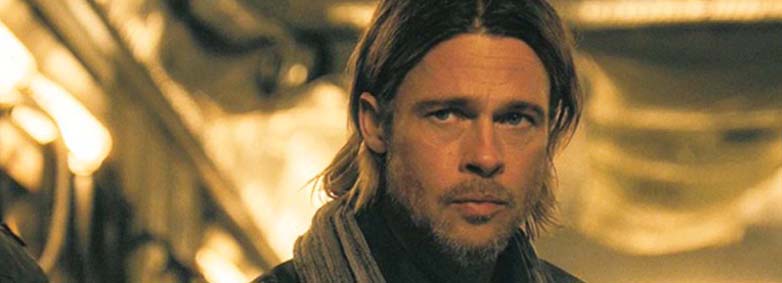
Max Brooks’ brilliant zombie apocalypse novel has been crunched into an action movie template, given a tremendous blockbuster gloss and lit with Brad Pitt’s star wattage.

There is little humour and not much sentimentality but the performances full of conviction and provide an anchor for the action.

It keeps the real world sense of the book while shedding its multi-storied narrative.

Pitt remains a charismatic screen presence but beyond generic action man qualities, no great acting range is required of him.

He plays Gerry Lane, a UN investigator on a mission to save what’s left of the human race after a sudden, devastating zombie attack.

No one knows where or how the zombie pandemic originated but the globe’s cities are abandoned after the lightning fast and murderous onslaught of the undead.

Leaving his wife Karin (Mireille Enos) and daughters Connie (Sterling Jerins) and Rachel (Abigail Hargrove) in the supposed safety of a US aircraft carrier, Lane flies around the world looking for a cure for what is assumed to be a virus.

Moving swiftly from the US to South Korea, Israel and Wales, the blockbuster’s action sequences keep tumbling over one another like the many frenzied zombies at the walls of Jerusalem. That is one of the many thrilling sequences that are tense, violent and guaranteed to make you jump.

With much twitching, convulsing and moaning, the teeth-knocking monsters operate at two speeds: in the absence of prey they are in a moaning and shuffling semi-hibernation. When they attack they become a scary, swirling, swarm of flesh-hungry predators.

Some smart dialogue is scattered among the skin-crawling sound effects. This helps generate tension by hijacking your imagination to do the film’s dirty work for it.

Among the helicopters, transport planes and aircraft carriers, it unusually features soldiers who can shoot straight. Plus it presents sidekicks to provide fresh meat so we’re never sure who will survive.

Driven with a frantic energy and technical prowess, World War Z is is a exciting action adventure.

Though it’s preposterous by nature, the conviction of the players keep the spectacle grounded.

The plot holes widen alarmingly as the film struggles to conclude and though it struggles to maintain its ferocious pace, Z still keeps you interested until its surprisingly low-key ending.

Precinct Seven Five

Director: Tiller Russell (2015)

This funny, violent and arresting tale about corrupt cops in New York is the Goodfellas of police documentaries.

It follows the rise and fall of disgraced former cop Michael Dowd.

He talks, dresses and looks like one the wiseguys in director Martin Scorsese’s mob masterpiece. He even looks like Tony Darrow the actor who played Sonny Bunz, the owner of the ill-fated Bamboo Lounge. The actor was later charged with extortion.

In the early 1980’s, the 75th precinct was the most dangerous in the city, suffering 1000’s of shootings and 100’s of homicides a year. It’s described as ‘the land of f***’ by the officers’ who have to patrol it.

In extensive interviews Dowd admits to extortion, drug dealing, drug use, theft and estimates he has committed thousands of crimes as an officer.

There were bundles of cash and barrels of drugs alongside the kidnappings and murders.

Dowd claims he was taught to bend the rules in the Academy before he even graduated to the streets.

It was there he was taught the code of Omerta (silence) and a sense of brotherhood  – which Dowd exploited to make breaking the law easier.

Poor levels of police pay and the daily grind contribute to corruption. As the criminals are so much more wealthy, crime is seen to pay.

A handsome and charismatic Domenican drug dealer called Diaz cheerfully provides a criminal insight. Dowd admits to providing a police escort for him.

With it’s use of freeze frames, fast cuts and rock soundtrack, there is a similar energy to Scorsese’s finest work.

Among the talking heads, court footage, crime scene reconstructions and some terrific contemporary footage, maps detail exactly where crimes were taking place, anchoring Dowd’s storytelling in reality.

Dowd never believed he would be caught, but ruefully acknowledges his attitude may have been a consequence of the copious amount of cocaine he was consuming.

The Diary of a Teenage Girl

Director: Marielle Heller (2015)

This sincere and uncompromising drama examines the slow burn of a teenage girl’s sexual awakening – from her point of view.

Set in the 1970’s, it’s a taboo-breaking tale of growth and betrayal, a far cry from the ditzy social escapades of Bridget Jones.

Based on the graphic novel The Diary of a Teenage Girl: An Account in Words and Pictures by author and artist Phoebe Gloeckner, it’s described by the makers as sharp, funny, provocative and non-judgemental.

Perhaps not so much the funny, it does have an intelligent script, contemplative pacing, strong performances and, unlike the protagonist, possesses a strong sense of identity.

Fifteen year old Minnie (Brit actress Bel Powley) lives with her sister and single mum Charlotte (Kristen Wiig).

She has began an affair with her mum’s thirty five year old boyfriend, Monroe (Alexander Skarsgard). Minnie’s best friend Kimmie (Madeleine Waters) points out the obvious truth of the situation.

From the beginning Minnie documents her experiences onto cassette tapes via a (knowingly phallic) microphone – with predictable consequences.

Casual hook-ups, lesbianism, threesomes, prostitution, acid trips and coke binges follow.

Minnie is awkward, lonely, bright and talented. Her illustrations burst off the page and move around the frame, illustrating her moods and thoughts.

She writes for career advice to her heroine, the underground cartoonist Aline Kominsky.

Monroe to our eyes is a predatory paedophile, exploiting his relationship with Charlotte for access to Minnie. But importantly it’s not how Minnie sees him.

Equally, Minnie doesn’t see herself as a victim or a survivor of abuse, but as a person seeking independence, her own identity and a place in the world.

We have sympathy for Minnie and her younger sister Gretel (Abby Wait) but most adults are remote, repellent or pathetic.

Your young teenage daughter will probably love this film for it’s honest portrayal. You may be grateful she’s not allowed to watch it.

Man With A Movie Camera

Director: Dziga Vertov (1929)

No-one with an interest in the history of cinema should pass on the chance of seeing this ground-breaking documentary.

It’s astonishing, dynamic, sexy, exhilarating, humorous and vital.

This hymn to the machine age has been lovingly restored and guided by the director’s own extensive notes, gifted a thrilling new orchestration.

Filmed in Odessa, Moscow and Kiev in the 1920’s, an extraordinary range of techniques are used or invented to capture every day life.

These include but are not limited to: double exposure, fast motion, slow motion, freeze frames, jump cuts, split screens, Dutch angles and extreme close-ups.

Christopher Nolan is not the first director to turn a city onto itself.

As we follow the man with the camera we experience the danger and fun of filmmaking. He clings to side of trains and climbs vertiginous chimney-stacks.

Watching him, watching them, we see the population endure births, deaths, divorce and weddings. We witness them enjoy sport and strive at work.

Industry, technology and machinery dominate the landscape; there are ships, trams, cars, chimneys, cranes, mines, telephones and elevators.

As the film deconstructs the mechanics of filmmaking, the camera begins to experience itself and becomes animate.

Eventually it combines with it’s human operator, evolving into cybernetic organism which fixes it’s gaze on the viewer.

Man With A Movie Camera was voted number 1 in Sight & Sound’s Poll of the Greatest Documentaries of All Time (2014) and number 8 in the Greatest Films of All Time (2012).

As Vertov says ‘I am the camera eye, I am the mechanical eye. I am the machine which shows you the world as only I can see it

It is hellish, transcendent and extraordinarily prescient.

Mission: Impossible – Rogue Nation

Director: Christopher McQuarrie (2015)

With the face-changing spy team returning to action for the fifth time, latex masks are once again the essential fashion accessory of the blockbuster season.

The evergreen Tom Cruise stars as Ethan Hunt, top agent of the Impossible Missions Force (IMF). It’s an enjoyable but fleetingly thrilling action adventure.

A terror network of former spies called The Syndicate are causing global chaos. Their elusive leader is the husky-voiced Solomon Lane (Sean Harris).

After escaping from a torture cell Hunt is injured and alone in London. But a US government committee has dissolved the IMF and bull-headed CIA boss Alan Hunley (Alec Baldwin) wants Hunt arrested.

Hunt has to round up his usual suspects, err, operatives Benji, William and Luther (Simon Pegg, Jeremy Renner and Ving Rhames) before tracking down Lane.

As they try to locate a data stick containing vital information, we’re offered chases, fights, assassinations, kidnappings, double-crosses and betrayals.

As the action bounces from Washington DC to Vienna and Morocco, there’s a night at the opera, an underwater break-in and a high speed pursuit through the desert.

Fistfights are surprisingly vicious but there’s no swearing or sex. Where British agent James Bond is rewarded with a kiss, Hunt receives a warm hug.

Swedish actress Rebecca Ferguson steals the film as agent Ilsa Faust. She’s an intelligent, tough and glamorous addition to the cast.

Baldwin tiptoes on the chasm of camp while Renner flexes his funny bone more frequently than his muscle.

Pegg and Cruise share a fraternal chemistry; they’re the Dean Martin and Jerry Lewis of international espionage.

Cruise is prepared to take a beating, smash a car, crash a bike and even hang off a military transport plane during take-off – just for your entertainment.

So it’s a shame he’s put overall control in the hands of workman-like writer/director Christopher McQuarrie.

A longstanding Cruise collaborator, they previously paired up to make the weak Jack Reacher (2012). And McQuarrie has further scripted the Cruise-starring Valkyrie (2008).

He’s also responsible for the scripts of the poor Jack the Giant Slayer (2013) and The Tourist (2010). Yet back in 1995 – the year before Cruise began the MI movie franchise – he won an Oscar for writing The Usual Suspects (1995).

Here his direction is rote not inspired. Action scenes are impressively staged on an epic canvas but fail to generate much tension.

With it’s great theme tune, glossy locations, outrageous stunts and glorious gadgets, the IMF owes a huge debt to 007 James Bond.

With Cruise having played Hunt for nearly twenty years and more times than most actors have played Bond, perhaps it’s time to refresh the MI franchise.

They should give the next mission to Ilsa.