
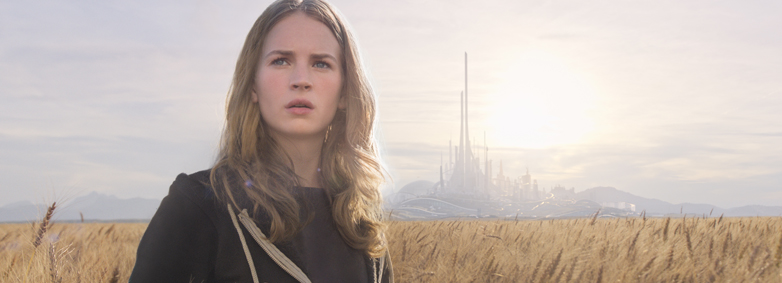
DIrector: Brad Bird (2015)
Take a smooth roller-coaster ride with George Clooney in this well-oiled but preachy theme park-based adventure.
Inspired by the Disneyland Tomorrowland attraction which opened in 1955, the film wants to inspire us to be creative and free – but only if we follow the Mickey Mouse rules.
Disney have had huge success turning their Pirates of the Caribbean ride into a Johnny Depp starring mega-movie franchise and no doubt secret plans are already afoot for a sequel.
Young Casey Newton (Britt Robertson) sneaks out at night to blow up the bulldozers who are due to tear down Nasa‘s defunct launch pad at Cape Canaveral.
Not only will the closure of the base put her engineer Dad Eddie (Tim McGraw) out of work – but it will also signal the end of humanity’s dreams of a gleaming future among the stars.
Casey finds a small badge decorated with a corporate logo which miraculously transports her to another dimension.
The badge only works when it touches Casey’s skin – with heavy-handed symbolism she has to literally grasp the future.
It transports her to the futuristic city of Tomorrowland where citizens use jet-packs to fly among the soaring silver skyscrapers. It gleams with orderly sunshine and prescribed happiness – and she’s wowed.
Amusingly Casey has to navigate the geography of both world’s simultaneously, allowing for some well-executed physical comedy.
When the battery power of her badge runs out, Casey finds herself back home but determined to return.
Tracking down another badge, Casey is attacked by sharp-suited robot agents with laser-guns and rescued by a mysterious 13 year old called Athena (Raffey Cassidy).
Part bodyguard and part spirit-guide, Athena is named after the Greek goddess of wisdom, courage, and inspiration who’s also the patron saint of cities. She delivers Casey to the home of reclusive and grumpy inventor Frank (Clooney).
He was ejected from Tomorrowland for building a machine which broke the future – but he’s persuaded Casey can fix the machine he created. So the three of them team up to try to save the world.
Brad Bird has a mixed directorial track record; The Incredibles (2004) is brilliant, Ratatouille (2007) is dull and Mission Impossible: Ghost Protocol (2011) is excellent but only in parts.
With it’s love of the space-age, hints of government conspiracy and a young boy with a robot best friend; Tomorrowland is similar to Bird’s wonderful The Iron Giant (1999) – though not as entertaining.
Demonstrating Tomorrowland’s admirable if misguided confidence in itself, the opening scene riffs on The Princess Bride (1987). Also easily recognised as influences are The Wizard of Oz (1939), The Phantom Toll Booth (1970) and The Matrix (1999). The ghost of Pinocchio is never far away.
The wheels of this roller-coaster are greased by glorious design. Referencing the work of modernist architect John Lautner and filmed in the City of Arts and Sciences in Valencia; the sleek buildings and costumes have a retro-futuristic feel.
This contrasts with the gorgeous Jules Verne-inspired steampunk rocket-ships which riff on Disney’s Nautilus from 20,000 Leagues Under the Sea (1954).
Charming performers navigate the decent action scenes with aplomb and employs freeze rays, time bombs and flying robots to dazzle the eye.
But it never reaches the emotional pitch it aims for or delivers the magic and wonder the orchestral score by Michael Giacchino frequently promises.
The plot is powered by an on-brand corporate message rather than drama, excitement or internal logic, and it’s too easily distracted by its own whizzy visuals.
The talented trio of bickering leads do their best to distract you from a message-laden script. In true baby-boomer fashion the film suggests all the the world needs to be a better place is to transmit a positive vibe. Man.
It also demands we choose to feed the wolf of our optimism not the wolf of despair. It’s a small world after all.
The closest there is to a villain is rival inventor David Nix (Hugh Laurie) – but the subdued TV star seems reluctant to project any of the menace, gravitas or camp the role needs and he desperately resorts to comedy swearing.
Even when playing grumpy Clooney is reliably charming. He is generous to his younger co-stars and careful never to overpower their performances. Not that they give him much opportunity to do so.
Robertson gives Casey a feisty energy and is courageous, smart and likeable. However the real star of the film is Cassidy who has a deft comic touch and whose calculated poise is remarkably effective at suggesting wisdom beyond her years.
In order to save the world Frank must reclaim his childhood innocence and imagination by symbolically destroying the source of his unhappiness and negativity.
However this means he also rejects adulthood and those messy adult complications such as love, sex and fear.
The film openly derides the dystopias of Orwell’s 1984, Bradbury’s Fahrenheit 451 and Huxley’s Brave New World and their negative view of the future, while Frank equates politics and bureaucracy with greed.
But Frank’s vision of utopia is an exclusive enclave of beautiful creative thinkers with admission by invitation only. It’s a sterile, sexless land of infantilised adults and scarily squeaky-clean children who could have sprang from The Village Of The Damned (1960) – now where does that remind you of?
If suitable names are already taken, perhaps Frank could call it Hollywoodland.
★★★☆☆
 chrishunneysett.uk