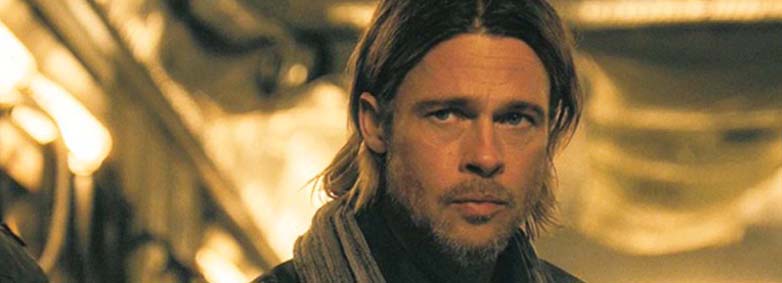
World War Z

Director: Marc Foster (2013)

Max Brooks’ brilliant zombie apocalypse novel has been crunched into an action movie template, given a tremendous blockbuster gloss and lit with Brad Pitt’s star wattage.

There is little humour and not much sentimentality but the performances full of conviction and provide an anchor for the action.

It keeps the real world sense of the book while shedding its multi-storied narrative.

Pitt remains a charismatic screen presence but beyond generic action man qualities, no great acting range is required of him.

He plays Gerry Lane, a UN investigator on a mission to save what’s left of the human race after a sudden, devastating zombie attack.

No one knows where or how the zombie pandemic originated but the globe’s cities are abandoned after the lightning fast and murderous onslaught of the undead.

Leaving his wife Karin (Mireille Enos) and daughters Connie (Sterling Jerins) and Rachel (Abigail Hargrove) in the supposed safety of a US aircraft carrier, Lane flies around the world looking for a cure for what is assumed to be a virus.

Moving swiftly from the US to South Korea, Israel and Wales, the blockbuster’s action sequences keep tumbling over one another like the many frenzied zombies at the walls of Jerusalem. That is one of the many thrilling sequences that are tense, violent and guaranteed to make you jump.

With much twitching, convulsing and moaning, the teeth-knocking monsters operate at two speeds: in the absence of prey they are in a moaning and shuffling semi-hibernation. When they attack they become a scary, swirling, swarm of flesh-hungry predators.

Some smart dialogue is scattered among the skin-crawling sound effects. This helps generate tension by hijacking your imagination to do the film’s dirty work for it.

Among the helicopters, transport planes and aircraft carriers, it unusually features soldiers who can shoot straight. Plus it presents sidekicks to provide fresh meat so we’re never sure who will survive.

Driven with a frantic energy and technical prowess, World War Z is is a exciting action adventure.

Though it’s preposterous by nature, the conviction of the players keep the spectacle grounded.

The plot holes widen alarmingly as the film struggles to conclude and though it struggles to maintain its ferocious pace, Z still keeps you interested until its surprisingly low-key ending.

Precinct Seven Five

Director: Tiller Russell (2015)

This funny, violent and arresting tale about corrupt cops in New York is the Goodfellas of police documentaries.

It follows the rise and fall of disgraced former cop Michael Dowd.

He talks, dresses and looks like one the wiseguys in director Martin Scorsese’s mob masterpiece. He even looks like Tony Darrow the actor who played Sonny Bunz, the owner of the ill-fated Bamboo Lounge. The actor was later charged with extortion.

In the early 1980’s, the 75th precinct was the most dangerous in the city, suffering 1000’s of shootings and 100’s of homicides a year. It’s described as ‘the land of f***’ by the officers’ who have to patrol it.

In extensive interviews Dowd admits to extortion, drug dealing, drug use, theft and estimates he has committed thousands of crimes as an officer.

There were bundles of cash and barrels of drugs alongside the kidnappings and murders.

Dowd claims he was taught to bend the rules in the Academy before he even graduated to the streets.

It was there he was taught the code of Omerta (silence) and a sense of brotherhood  – which Dowd exploited to make breaking the law easier.

Poor levels of police pay and the daily grind contribute to corruption. As the criminals are so much more wealthy, crime is seen to pay.

A handsome and charismatic Domenican drug dealer called Diaz cheerfully provides a criminal insight. Dowd admits to providing a police escort for him.

With it’s use of freeze frames, fast cuts and rock soundtrack, there is a similar energy to Scorsese’s finest work.

Among the talking heads, court footage, crime scene reconstructions and some terrific contemporary footage, maps detail exactly where crimes were taking place, anchoring Dowd’s storytelling in reality.

Dowd never believed he would be caught, but ruefully acknowledges his attitude may have been a consequence of the copious amount of cocaine he was consuming.

The Diary of a Teenage Girl

Director: Marielle Heller (2015)

This sincere and uncompromising drama examines the slow burn of a teenage girl’s sexual awakening – from her point of view.

Set in the 1970’s, it’s a taboo-breaking tale of growth and betrayal, a far cry from the ditzy social escapades of Bridget Jones.

Based on the graphic novel The Diary of a Teenage Girl: An Account in Words and Pictures by author and artist Phoebe Gloeckner, it’s described by the makers as sharp, funny, provocative and non-judgemental.

Perhaps not so much the funny, it does have an intelligent script, contemplative pacing, strong performances and, unlike the protagonist, possesses a strong sense of identity.

Fifteen year old Minnie (Brit actress Bel Powley) lives with her sister and single mum Charlotte (Kristen Wiig).

She has began an affair with her mum’s thirty five year old boyfriend, Monroe (Alexander Skarsgard). Minnie’s best friend Kimmie (Madeleine Waters) points out the obvious truth of the situation.

From the beginning Minnie documents her experiences onto cassette tapes via a (knowingly phallic) microphone – with predictable consequences.

Casual hook-ups, lesbianism, threesomes, prostitution, acid trips and coke binges follow.

Minnie is awkward, lonely, bright and talented. Her illustrations burst off the page and move around the frame, illustrating her moods and thoughts.

She writes for career advice to her heroine, the underground cartoonist Aline Kominsky.

Monroe to our eyes is a predatory paedophile, exploiting his relationship with Charlotte for access to Minnie. But importantly it’s not how Minnie sees him.

Equally, Minnie doesn’t see herself as a victim or a survivor of abuse, but as a person seeking independence, her own identity and a place in the world.

We have sympathy for Minnie and her younger sister Gretel (Abby Wait) but most adults are remote, repellent or pathetic.

Your young teenage daughter will probably love this film for it’s honest portrayal. You may be grateful she’s not allowed to watch it.

Man With A Movie Camera

Director: Dziga Vertov (1929)

No-one with an interest in the history of cinema should pass on the chance of seeing this ground-breaking documentary.

It’s astonishing, dynamic, sexy, exhilarating, humorous and vital.

This hymn to the machine age has been lovingly restored and guided by the director’s own extensive notes, gifted a thrilling new orchestration.

Filmed in Odessa, Moscow and Kiev in the 1920’s, an extraordinary range of techniques are used or invented to capture every day life.

These include but are not limited to: double exposure, fast motion, slow motion, freeze frames, jump cuts, split screens, Dutch angles and extreme close-ups.

Christopher Nolan is not the first director to turn a city onto itself.

As we follow the man with the camera we experience the danger and fun of filmmaking. He clings to side of trains and climbs vertiginous chimney-stacks.

Watching him, watching them, we see the population endure births, deaths, divorce and weddings. We witness them enjoy sport and strive at work.

Industry, technology and machinery dominate the landscape; there are ships, trams, cars, chimneys, cranes, mines, telephones and elevators.

As the film deconstructs the mechanics of filmmaking, the camera begins to experience itself and becomes animate.

Eventually it combines with it’s human operator, evolving into cybernetic organism which fixes it’s gaze on the viewer.

Man With A Movie Camera was voted number 1 in Sight & Sound’s Poll of the Greatest Documentaries of All Time (2014) and number 8 in the Greatest Films of All Time (2012).

As Vertov says ‘I am the camera eye, I am the mechanical eye. I am the machine which shows you the world as only I can see it

It is hellish, transcendent and extraordinarily prescient.

Mission: Impossible – Rogue Nation

Director: Christopher McQuarrie (2015)

With the face-changing spy team returning to action for the fifth time, latex masks are once again the essential fashion accessory of the blockbuster season.

The evergreen Tom Cruise stars as Ethan Hunt, top agent of the Impossible Missions Force (IMF). It’s an enjoyable but fleetingly thrilling action adventure.

A terror network of former spies called The Syndicate are causing global chaos. Their elusive leader is the husky-voiced Solomon Lane (Sean Harris).

After escaping from a torture cell Hunt is injured and alone in London. But a US government committee has dissolved the IMF and bull-headed CIA boss Alan Hunley (Alec Baldwin) wants Hunt arrested.

Hunt has to round up his usual suspects, err, operatives Benji, William and Luther (Simon Pegg, Jeremy Renner and Ving Rhames) before tracking down Lane.

As they try to locate a data stick containing vital information, we’re offered chases, fights, assassinations, kidnappings, double-crosses and betrayals.

As the action bounces from Washington DC to Vienna and Morocco, there’s a night at the opera, an underwater break-in and a high speed pursuit through the desert.

Fistfights are surprisingly vicious but there’s no swearing or sex. Where British agent James Bond is rewarded with a kiss, Hunt receives a warm hug.

Swedish actress Rebecca Ferguson steals the film as agent Ilsa Faust. She’s an intelligent, tough and glamorous addition to the cast.

Baldwin tiptoes on the chasm of camp while Renner flexes his funny bone more frequently than his muscle.

Pegg and Cruise share a fraternal chemistry; they’re the Dean Martin and Jerry Lewis of international espionage.

Cruise is prepared to take a beating, smash a car, crash a bike and even hang off a military transport plane during take-off – just for your entertainment.

So it’s a shame he’s put overall control in the hands of workman-like writer/director Christopher McQuarrie.

A longstanding Cruise collaborator, they previously paired up to make the weak Jack Reacher (2012). And McQuarrie has further scripted the Cruise-starring Valkyrie (2008).

He’s also responsible for the scripts of the poor Jack the Giant Slayer (2013) and The Tourist (2010). Yet back in 1995 – the year before Cruise began the MI movie franchise – he won an Oscar for writing The Usual Suspects (1995).

Here his direction is rote not inspired. Action scenes are impressively staged on an epic canvas but fail to generate much tension.

With it’s great theme tune, glossy locations, outrageous stunts and glorious gadgets, the IMF owes a huge debt to 007 James Bond.

With Cruise having played Hunt for nearly twenty years and more times than most actors have played Bond, perhaps it’s time to refresh the MI franchise.

They should give the next mission to Ilsa.

Ruth and Alex

Director: Richard Loncraine (2015)

Take a gentle stroll through this pedestrian and predictable drama about OAP’s moving house.

After forty years of affectionate squabbling, Ruth and Alex (Diane Keaton, Morgan Freeman) have put their beloved fifth story apartment on the market.

She’s an optimist, he’s a pessimist, neither actor is required to stretch their considerable talents.

Such tension as there is centres on whether they should stay put or up sticks. Ideally upstate to a more age friendly residence – with less steps.

Dinners, BBQ’s and house viewings drift by in a honey-hued haze of charm and nostalgia without consequence or friction.

Freeman struggles with his hearing aid and spends a lot of screen time staring into middle distance, lost in memories of happy times past.

He offers wry reflections on the devils of the modern world: technology and rude service.

There’s a bizarre subplot about a manhunt for a terrorist and much fussing over an over-indulged pet dog whom undergoes a CAT scan.

It gently mocks various wacky and obnoxious New York stereotypes but the humour struggles to zip beyond the New York post code.

A great amount of time is spent discussing the state of the property market – which is as thrilling as it sounds.

Claire van der Boom is impressive as young Ruth, Korey Jackson is less so as young Alex.

Cynthia Nixon (Miranda in TV’s Sex and the City) doesn’t even qualify for a name as their estate agent niece.

Ruth and Alex was released as 5 Flights Up on it’s inauspicious US debut.

It’s a light hearted tale offering no surprises. The limited entertainment springs from spending time in the agreeable company of two charmers.

Maggie

Director: Henry Hobson (2015)

As his daughter turns into a zombie, a father faces a terrible dilemma in this bleak gothic horror.

Fresh from the debacle of Terminator Genisys, Arnold Schwarzenegger plays against type in this thoughtful character study.

Sparse on action, low on budget and long on mood, it’s an admirable and interesting departure from Arnie’s usual flavour of explosive adventure.

It’s such a strange stitching together of component parts it could be a new round of TV’s improvisational game show Whose Line Is It Anyway?

Make a film with ‘zombies’ in the style of ‘Terence Malick’ starring ‘Schwarzenegger’. Go!

It’s a barking idea, albeit a welcome one. A provocative and almost perverse retooling of the Schwarzenegger brand.

Arnie plays Wade, tired, heavy footed farmer in a beard and lumberjack shirt. We meet him taking his daughter Maggie (Abigail Breslin) home from hospital.

Maggie is infected with the Necrombulist virus which decays the skin and changes the victim into flesh eating animal.

Wade knows Maggie will never recover from the virus which has devastated the world. Friends in the local services collude against the federal authorities to help them spend some final quality time together.

As Maggie slowly changes Wade ponders how to deal with her inevitable decline.

It’s an apocalyptic world of burning fields, missing person posters, deserted petrol stations and rubbish filled streets. Marshal law and curfews are enforced by an oppressive bureaucracy and a heavy handed military.

As the camera chases Maggie across fields, she’s backlit with the sun creating a halo. There’s an emphasis on close up head shots in shallow focus. The palette is washed out, chilly and grim.

With a doomed father/daughter relationship it has echoes of John Wayne’s The Seachers (1956). Arnie has the rigidly defined acting range of the Duke and a similarly framed and monumental presence.

It’s the flip-side of Life After Beth (2014) which was played for laughs.

Maggie is well constructed, intelligent, ambitious and achieves a scope beyond it’s budget limitations. Kudos to Arnie for using his industry clout to have it made.

But with it’s sombre, reflective tone and focus on parental guilt, broken homes and self-harm, it’ll disappoint anyone who is expecting the Terminator to turn up and save the day.

Inside Out

Director: Pete Docter (2015)

Take an emotional trip through the mind of an ordinary girl in this worthy animation from Pixar.

The studio made the brilliant Toy Story trilogy but their most recent offering Monster’s University (2013) was mediocre at best.

Director Pete Docter was Oscar nominated for Up (2009) but hasn’t achieved the same heights here.

Inside Out is busy, colourful and undeniably ambitious and clever. The animation and design are excellent.

But it’s so well intentioned and keen to educate they forgot to make it particularly funny, engaging or exciting.

Eleven year old Riley (Kaitlyn Dias) has moved with her parents (Diane Lane, Kyle MacLachlan) to San Francisco.

Riley’s emotions are represented by five brightly coloured characters: Joy, Sadness, Fear, Anger and Disgust (Amy Poehler, Phyllis Smith, Bill Hader, Lewis Black, Mindy Kaling) .

They occupy her mind and dictate her moods and behaviour.

None of them are particularly likeable as they scream, shriek and squabble inside Riley’s brain – or the head-quarters as they call it.

Due to a secure and rural childhood, Joy is Riley’s dominant emotion. She’s bossy, hyperactive, manipulative, mendacious and far from endearing as the film imagines.

As Riley struggles with the trauma of a new city, house and school, Joy and Sadness are lost in the nether reaches of her brain.

The mismatched pair begin a perilous journey to HQ through the various areas of Riley’s subconsciousness and must learn to accept each other and learn it’s ok to be sad sometimes.

They encounter some mildly amusing creatures, of whom Bing Bong (Richard Kind) – Riley’s long forgotten imaginary friend – is the most fun.

Among the different environments are Imagination Land and Abstract Thought. There’s a very self-referential and Hollywood parody in the brain’s Dream Factory.

Meanwhile Fear, Anger and Disgust are left in charge – with predictably unhappy results.

There’s a definite sense of a concept tail wagging the dog of the story. Watching this movie is akin to being smacked around the head by a day glo psychology book. Or being given homework and told to have fun.

Plus for a lengthy part of the film Riley is a puppet, dangling at the command of her emotions. Similarly we can see the emotional strings the film uses to manipulate us.

And there are inconsistencies such as mum and dad’s emotions being appropriately gendered but Riley’s are male and female.

The wait for Pixar’s next feature length masterpiece continues.

The pre-feature short is a masterful musical called Lava, an intimate epic about singing volcanoes which overshadows the main event.

The mythical James Bond, 007

BOND AND KING ARTHUR

In the 23rd James Bond thriller,  Skyfall, director Sam Mendes sought to elevate super spy James Bond, from Hollywood action star to a timeless heroic symbol of England.

By employing poetry, imagery and story elements of Arthurian legend, Mendes stretches an umbilical cord through time to connect Britain’s most modern fictitious national hero, Bond, with its most ancient and legendary King, Arthur.

In Le Morte d’Arthur (pub. 1485), Thomas Malory codified the legend of King Arthur from disparate sources and established what we now consider to be the definitive legend.

King Arthur
Richard Harris as Arthur

Arthur is an orphan who wields a weapon only he can command and must fight a traitor, his step-brother Modred, to save his kingdom. Arthur is betrayed by a woman, mortally wounded in action and is hidden away from the world by the lady in the lake. There he will await until his return to once again rescue his land at the hour of his country’s greatest need.

In Skyfall these events and all occur, though not in this order, and are there to establish Bond’s mythical status.

Skyfall
007 goes sky falling

In the pre-title sequence we see Bond shot by fellow agent, Eve, before falling into a river and being pulled under water by a godlike female hand. Being brought low by a woman named Eve is obviously a very Christian idea, reminding us how closely Arthurian legend deliberately echoes the story of Jesus Christ, his betrayal, death and his resurrection.

Bond undergoes a symbolic Christian death at the hands of his followers, but remains in limbo waiting to be reborn. He only returns from the dead , when England is threatened by terrorists led by a former British agent.

De la croix
Grave matters

In Skyfall Bond/Arthur are tasked with defending Britain from Javier Bardem’s Silva/Mordred. All are orphans raised to be warriors.

And just as Arthur and Mordred were related, so we have lots of references to Judi Dench’s M as their metaphorical mother.

De la Croix is revealed to be the maiden name of Bond’s mother. De la Croix translates as ‘Of the cross’ and so ties in with the idea of resurrection. This feeds neatly into the conceit of Bond regenerating every time a new actor assumes the role. It’s also a nod to Ian Fleming’s socialite mother, Evelyn Beatrice St. Croix Rose.

Bond’s Merlin figure of course, is Ben Whishaw’s Q. He provides Bond with a pistol registered to his unique palm print so only he can use it. It’s an updated Excalibur, the sword in the stone.

Bond sails through a dragon’s mouth prior to sleeping with the mistress of his MI6 colleague-turned-enemy. Compare this to how Arthur’s father Uther Pendragon has Merlin invoke the Dragon’s breath to seduce lgrayne, the wife of his former ally, the Duke of CornwalI. John Boorman vividly illustrates this in his excellent telling of the Arthurian legend, in 1981’s Excalibur .

Dragon mouth
Enter the dragon

We hear how following the loss of his parents, the barely  teenage Bond spent three days in a tunnel before emerging an adult. An echo of the vigil an aspiring knight had to endure before being allowed to join the chivalric order.

Poet Laureate Alfred Tennyson wrote a cycle of narrative poems concerning King Arthur called Idylls of the King (pub. 1859). This is the significance of Judi Dench’s M quoting Tennyson, as Bond races to her rescue.

Fiennes
Ralph Fiennes as ‘M’

All we’re missing is a character called Mallory to appear and oops, that just happens to be the real name of Bond’ new boss, ‘M’.

I don’t believe a director as erudite as Mendes would incorporate these details by coincidence. It would be almost impossible to do so by accident.

These details in the subtext of the film echo in the subconsciousness of the viewer. They reinforce the idea of Bond as a saviour of the English.

The conflation of Bond and Arthur places 007 at the centre of British literary, cinematic and Christian cultural tradition, so elevating him from the contemporary to the mythical, and crowning Bond as the once and future king of English heroes, and Hollywood.

@ChrisHunneysett

Nemo’s Fury is an exciting digital reinvention of Jules Verne’s classic steampunk adventure novel, 20,000 Leagues Under the Sea. 

Download for free to your smartphone or tablet, search your app store for ‘Nemo’s Fury’.

A mobile interactive fiction game employing a bespoke combat system and hundreds of original illustrations, Nemo’s Fury is inspired by the 1980’s role-playing gamebooks such as ‘The Warlock of Firetop Mountain’, of the Fighting Fantasy series which celebrated its fortieth anniversary last year.

Each player joins the legendary Captain Nemo on board his fabulous submarine, the Nautilus, on a wild voyage of adventure, intrigue, loyalty, and betrayal.

There’s mayhem, monsters, maelstroms and murder as Nemo takes you from the South Pacific to the Northern Atlantic via Antartica and the Red Sea. And if they survive long enough, the player will of course fight a giant squid.

Available on your smartphone or tablet, (but not yet your desktop), click on your app store below

Or go to Nemo’s Fury for more info

True Story

Director: Rupert Goold (2015)

Identity theft, serial killing and untrustworthy journalism make for a mire of mendacity in this chilly courtroom thriller.

It’s based on the memoir of Mike Finkel (Jonah Hill), a former New York Times journalist who was sacked for fabricating a story.

He receives a phone call asking for an opinion on homicide suspect Christian Longo (James Franco) who has been caught in Mexico using Finkel’s identity.

Longo is charged with murdering his wife and three daughters and faces the death penalty. As grisly details of the deaths emerge, he paints his family as a victim of harsh economic circumstance.

Sensing a book deal and career resurrection, Finkel interviews Longo in prison and a curious relationship develops based on questionable motives.

Longo is evasive about what happened and emphasises his ordinariness. Finkel equates his own lies to be crimes of a similar magnitude to those of the accused.

Spending a lot of time rubbing his eyes in front of a laptop in a lonely hotel room, Finkel is under pressure from the police, his publisher and his girlfriend Jill (Felicity Jones).

Hill, Franco and Jones have each been nominated for an Oscar. Hill in Moneyball (2011) and Wolf of Wall Street (2013). Franco in 127 Hours (2010) and Jones for A Theory Of Everything (2014).

Hill and Franco previously starred together in weak apocalypse comedy This Is The End (2013).

Principal photography on True Story began way back in March 2013 and it was released in the US in April 2015.

With Jones’ Oscar nomination announced in mid-January 2015, it’s tempting to imagine the producers threw in every useable piece of footage they possessed of her to capitalise on her resultant higher profile.

In any case her character Jill spends most of her scenes alone or not interacting with her fellow performers, such as in a courtroom scene where she simply stands and stares.

At other times she plays piano runs in the woods, immerses herself in work and takes baths. It all accentuates her isolation but has no bearing at all on the plot.

Jones and Hill’s characters have little screen time and she has no purpose other than to make Finkel seem a more rounded personality.

Without her – even with her – Finkel is self-absorbed, humourless, arrogant and professionally flawed. We wonder what attracted each to the other and why she stays with him.

It’s not the first film to dramatise a journalist’s attempts to exploit a prisoner for their own ends. Truman Capote’s book In Cold Blood (pub. 1966) provided a basis for Capote (2005) and Infamous (2006).

A mournful soundtrack, muted colours, studied editing and a measured pace allows for a focus on strong performances.

But it’s difficult to place your sympathy on either of the wholly unreliable storytellers.