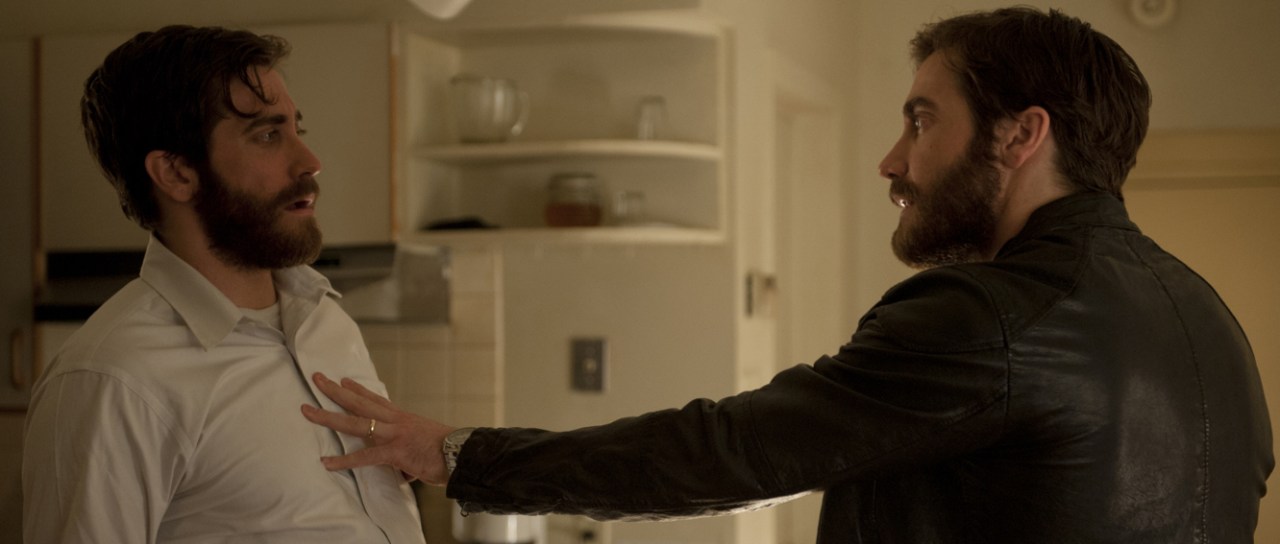
Enemy

dir. Denis Villeneuve

Fantasy, identity and memory are twisted in this dark, expressionist, psychological thriller.

Sly and finely-crafted, it is based on José Saramago’s 2002 novel The Double.

There’s minimal dialogue and a mournful soundtrack while the absence of clocks and times add to the alienating atmosphere and contribute to a memorable finale.

After a chance conversation, history professor Adam Bell (Jake Gyllenhaal) is caught in an opaque web of intrigue, mistrust and betrayal.

Stuck in a failing relationship with the beautiful Mary (Mélanie Laurent) Adam is a listless drone with a life of dull routine, failing to inspire his bored students with his lectures on the political denial of self expression.

Only his mother, Isabella Rossellini is concerned or interested in him, leaving voice mails he doesn’t respond to.

One day a casual exchange with a nameless colleague leads Adam to watching a locally filmed movie ‘Where There’s a Will There’s a way’.

It’s a colourful comedy, disturbing the Enemy’s carefully established austere mood. In the background Adam sees a bellboy, played by an actor who looks uncannily similar to himself.

Intrigued, Adam discovers he’s called Anthony Saint Claire (Gyllenhaal again) and hunts down his other movie appearances.

Anthony is signed to a local agency and when Adam visits their offices he’s mistaken for his doppelganger, exploiting the mistake to pick up a parcel intended for the actor.

Behaving like an excited stalker, Adam instigates a meeting with Anthony which develops into a confrontation.

They’re physically identical but different in attitude, lifestyle and crucially in relationships. Anthony’s pregnant wife Helen (Sarah Gadon) is suspicious of her husband – with very good reason.

With deft deliberation Nicolas Bolduc’s camera follows as character stalks character, capturing scenes in unhealthy yellow register and bold shadows.

Architecture is an oppressive character while cars are cocoons for their faceless, voiceless commuters as they drive around the stark cityscape.

Gyllenhaal’s character is a memorable addition to the cinematic gallery of actors portraying identical characters on screen, joining luminaries such as Leonardo DiCaprio, Jesse Eisenberg, Jeremy Irons, even Elvis has done it

Made in 2013 it’s released now to capitalise on the success of Gyllenhaal’s excellent movie Nightcrawler.

It’s hard to believe the same creative team of Gyllenhaal and Villeneuve who made this were also responsible for 2013’s preposterous  thriller, Prisoners.

★★★★☆

Prisoners

dir. Denis Villeneuve

Hugh Jackman and Terrence Howard are vigilante fathers fighting for justice in this damp, dull and silly thriller.

In this rain-drenched small town that seems to have a deranged individual twitching behind every curtain, there are a seemingly endless number of torture chambers.

Riddled with stupidity, inconsistency, alarming coincidence and a gun-toting granny, it corkscrews a path through plot-holes into a pit of preposterousness.

Survivalist carpenter Keller Dover (Jackman) and his neighbour Franklin Birch (Howard) are relaxing after sharing Thanksgiving dinner with their families.

Jackman pairs a ragged beard with a knitted frown and acts with a fist waving intensity while Howard gawps along with the audience.

As Dover’s wife Maria Bello has little to do but stagger in a pill-popping daze and Viola Davis as Mrs Birch is given less than that.

Their two young daughters fail to return home from playing outside and a desperate search begins for them.

As every cop in the state are brought in to hunt for the girls, Detective Loki (Jake Gyllenhaal) is assigned to lead the investigation and is known for never failing to solve a case.

Gyllenhaal is impressive as the tattooed and slick-haired cop, offering with wry humour the merest specks of light in the gathering gloom.

Keller tracks down the suspected killer himself, beating up the suspectAlex Jones (Paul Dano) and pleading with Franklin to interrogate him.

Brilliant British cinematographer Roger Deakins creates an air of bitter chill that emphasises the bleakness of tone but his talent is squandered on this material.

★★☆☆☆

Gone Girl

Director: David Fincher (2014)

She’s sexy, savage and inscrutable – British actress Rosamund Pike finally gets a role worthy of her talent in the most entertaining thriller of 2014.

Filled with murder, kidnap, rape and revenge, the movie is glossy on the surface and trashy at heart.

But it’s also superbly sharp and twisted, with a fine-tuned sense of humour to balance the darkness.

On his fifth wedding anniversary Nick (Ben Affleck) finds his home spattered with blood and his perfect wife Amy (Pike) missing.

Nick refuses to believe Amy is dead and starts a high-profile campaign to trace her.

Through flashbacks from Amy’s diary, we see the couple fall passionately in love, marry and pursue successful careers.

But the police investigation into her disappearance uncovers Nick’s large credit card debt, incriminating evidence and a mistress.

They also discover her diary, which details Nick’s history of violence and her fears for her safety.

Now the prime murder suspect and facing the death penalty, Nick employs charismatic celebrity lawyer Tanner Bolt (Tyler Perry).

Then the story is turned on its head.

As well as exploring how we create our own identities, the story takes a swipe at trial by TV and has a few choice words to say about marriage as well.

Pike goes full throttle into the curves of her performance and Affleck’s measured performance allows the supporting cast to stand out.

Carrie Coon brings warmth and concern as his twin sister Margo and Kim Dickens as cop Rhonda Boney, steals every scene she’s in.

Cinematographer Jeff Cronenweth (son of cinematographer Jordan) should pick up his third Oscar nomination for his stunning work.

First time scriptwriter Gillian Flynn adapted her own bestseller and the direction by David Fincher is gleefully malicious.

★★★★

Trash

Director: Stephen Daldry (2014)

Fresh fish are good and plastic is bad in this environmental sermon that masquerades as a thriller.

It opens with a teenage boy holding someone at gunpoint, by the time we eventually discover why it’s all turned terribly silly.

Favela-living boys from Brazil Raphael (Rickson Teves)and Gardo (Eduardo Luis) are paid a pittance to scavenge all day on the municipal rubbish dump.

No wonder the US and Europe have sent Father Juilliard (Martin Sheen) and Sister Olivia (Rooney Mara) to bring religion and education.

It’s good they’re doing something as they don’t interfere with the plot in any meaningful way.

Otherwise it’s non-stop street parties and skinny-dipping amid the picturesque poverty of the colourful favela. It even burns down in a  pretty manner.

When Raphael discovers a money-filled wallet, he and Gardo enlist sewer-dwelling Rato (Gabriel Weinstein) to help fence it.

But Rato recognises the key it contains as coming from a train station locker, so off they go to investigate.

However on the payroll of a corrupt  congressman, bad cop Frederico (Selton Mello) is searching for the wallet as it contains something incriminating.

Frederico drinks water from a plastic bottle making him not only brutally corrupt but gasp, a walking environmental disaster as well.

When he indulges in a bit of ultra-violence to classical music he does so on a creative whim – not because it tells us anything anything about his character.

There’s bags of cash, a ledger of crooked accounts, rooftop running, motorbike chases, gunplay and beatings.

There’s aggression but a lack of anger. Sister Olivia who simply shrugs her shoulders at events, even when lured to a prison under false pretences and later arrested.

It’s a shame as Mara is very good acting angry, maybe she’s despondent because the script give her so little to do.

Wretched script-writer Richard Curtis adapted this boy’s own Brazil-based adventure from Andy Mulligan’s book.

There are echoes of Danny Boyle’s Slumdog Millionaire and Millions but it’s nowhere near as coherent, compelling or dynamic.

Editor Elliot Graham tries manfully to inject pace and energy using the cinematic steroids of freeze-frames and flashbacks – but real muscle is lacking.

Failing in its attempt at a feel-good finale, the ending lasts more than long enough to spell out its sanctimonious message.

★★☆☆☆