MacBeth

Director: Justin Kurzel (2015)

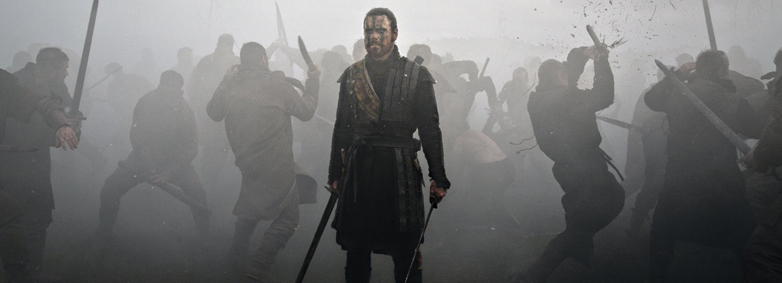
This bold and bleak adaption of Shakespeare‘s Scottish play is violent and visually arresting but curiously unmoving.

A moody, macho and masochistic Michael Fassbender frets for a couple of hours upon the stage.

He drips with menace and blood and there is much sound and fury.

After serving his King by quelling an insurrection, Macbeth encounters three witches who prophesy a royal future.

Encouraged by his wife he murders his way to the throne, and becomes consumed by madness.

A macabre tone is struck from the start with the burial of an infant. Among the battles, murders, ghosts, and witches, the rural feudal society is chillingly and chillily realised.

The relentless rain-lashed realism captures the grim hardships of the era, but there is also beauty is the landscapes, a children’s chorus and the craftsmanship of cloaks and daggers.

Fiona Crombie’s strong production design offers fine detail and heavy weathering, anchoring the actors in the period.

It’s a consistent vision, utilising wild exteriors in what was a gruelling shoot for cast and crew.

Interiors were filmed in the magnificent and contemporaneous Ely Cathedral.

Cinematographer Adam Arkapaw frames some lovely images but fellow Australian, director Kurzel rarely use his camera to fully bring out the drama of the verse.

The pair are stronger on the hoof, creating some terrific moments in battle and in the hunt.

Kurzel’s brother Jed adds to the tone with an unsettling screeching soundtrack.

Three writer’s have acceptably trimmed Shakespeare’s verse. But it’s sadly compromised through frequently flat recital, caught within beards or lost thick fog of a Scots brogue.

There’s also tendency by most of the men to employ a throaty whisper as often as possible, so we have to strain for understanding.

Only Englishman Sean Harris as Macduff and the French actress Marion Cotillard as Lady Macbeth offer engaging readings. Both characters are motivated by grief for lost children.

Elizabeth Debicki has a moment on fire but David Thewlis, Jack Reynor and Paddy Considine seem oddly removed from events around them.

Shakespeare put humour in his tragedies to emphasise his antagonists’ fall and make their doom compelling.

As Fassbender’s Macbeth moves from military machine to murderer to madman, the actor fails to find the humanity.

Devoid of love, humour or a conscience to lose or regain, the tragedy is missing in action.

What remains is a blood-soaked slog through the fog of 10th century war.


McFarland

Director: Niki Caro (2015)

Spanish students face an uphill climb in this aspirational high school sports drama.

It’s set in the world of competitive cross country running. Free from surprises, it’s a leisurely jog along the route to self-improvement.

When PE teacher Jim White is sacked for misconduct, the only job he can get is in the down market California town of McFarland.

It’s an hispanic area and his beautiful blonde family struggle with the language, food and local hoodlums.

Keen to move on, up and out of the school and the neighbourhood, he seizes upon an opportunity for funding for a cross country team as a means of resurrecting his career.

Jim sees potential in the seven pupils he recruits to form a team, but they must run up real and metaphorical mountains in pursuit of success.

Kevin Costner is well cast as the coach, the film capitalises on his decent demeanour, gruff charm and physical presence to good effect.

Sadly the talented Maria Bello hasn’t much to do as Jim’s wife, though she fares better than the youngest daughter who serves no purpose whatsoever.

The film is careful to treat Spanish culture with respect, placing an emphasis on the importance of family, food and hard work.

It’s a struggle to give the individual boys’ screen time or fully develop their characters but they’re an agreeable, engaging group. Carlos Pratts as Thomas Valles is given the closest to a genuine character arc.

Jim’s charges’ have to skip school and training runs to work in the fields. Though the script hints at domestic violence and gang culture, it shies away from showing it.

They race against teams of all-white privileged posh boys. Qualifying for the state championships offers the boys the chance of a university place, away from a future of fruit picking or prison.

As the team show signs of success, Jim faces a fork in the road between loyalty to his team or his career.

A nicely realised postscript saves this film from descending into a simple white saviour flick such as Michelle Pfeiffer’s Dangerous Minds (1995).

McFarland is competently crafted and nicely acted. Though the pace slows in the uphills of sentiment, it has sufficient reserves to provide a satisfying finale.

We Are Your Friends

Director: Max Joseph (2015)

Angst and ambition are mashed up in this uplifting ode to the transcendental powers of dance music.

Zac Efron gives it large, well largeish, as Cole, a real estate developer who dreams of being an international DJ.

When not clubbing Cole spends his time staring into the empty swimming pool of life.

Wes Bentley plays his mentor, a famous forty something club DJ full of alcohol and self-loathing.

He has a beautiful assistant Sophie, brought to doe-eyed life by Emily Ratajkowski.

The model rocketed to fame by appearing naked in Robin Thicke’s Blurred Lines video.

Her dancing here is no worse and she mostly keeps her clothes on.

When Cole begins to fall for Sophie, it threatens his chance at a career-making summer gig.

It’s an unthreatening portrayal of contemporary twentysomething life.

Fans of Simon Pegg’s TV show Spaced may snigger at the manner Cole discovers his dance muse.

There’s a loose Los Angeles vibe and some trippy SFX showing the effects of drugs and music on the body.

The music is played on laptops and the script seems written by a robot.

★★★☆☆

The Diary of a Teenage Girl

Director: Marielle Heller (2015)

This sincere and uncompromising drama examines the slow burn of a teenage girl’s sexual awakening – from her point of view.

Set in the 1970’s, it’s a taboo-breaking tale of growth and betrayal, a far cry from the ditzy social escapades of Bridget Jones.

Based on the graphic novel The Diary of a Teenage Girl: An Account in Words and Pictures by author and artist Phoebe Gloeckner, it’s described by the makers as sharp, funny, provocative and non-judgemental.

Perhaps not so much the funny, it does have an intelligent script, contemplative pacing, strong performances and, unlike the protagonist, possesses a strong sense of identity.

Fifteen year old Minnie (Brit actress Bel Powley) lives with her sister and single mum Charlotte (Kristen Wiig).

She has began an affair with her mum’s thirty five year old boyfriend, Monroe (Alexander Skarsgard). Minnie’s best friend Kimmie (Madeleine Waters) points out the obvious truth of the situation.

From the beginning Minnie documents her experiences onto cassette tapes via a (knowingly phallic) microphone – with predictable consequences.

Casual hook-ups, lesbianism, threesomes, prostitution, acid trips and coke binges follow.

Minnie is awkward, lonely, bright and talented. Her illustrations burst off the page and move around the frame, illustrating her moods and thoughts.

She writes for career advice to her heroine, the underground cartoonist Aline Kominsky.

Monroe to our eyes is a predatory paedophile, exploiting his relationship with Charlotte for access to Minnie. But importantly it’s not how Minnie sees him.

Equally, Minnie doesn’t see herself as a victim or a survivor of abuse, but as a person seeking independence, her own identity and a place in the world.

We have sympathy for Minnie and her younger sister Gretel (Abby Wait) but most adults are remote, repellent or pathetic.

Your young teenage daughter will probably love this film for it’s honest portrayal. You may be grateful she’s not allowed to watch it.

Ruth and Alex

Director: Richard Loncraine (2015)

Take a gentle stroll through this pedestrian and predictable drama about OAP’s moving house.

After forty years of affectionate squabbling, Ruth and Alex (Diane Keaton, Morgan Freeman) have put their beloved fifth story apartment on the market.

She’s an optimist, he’s a pessimist, neither actor is required to stretch their considerable talents.

Such tension as there is centres on whether they should stay put or up sticks. Ideally upstate to a more age friendly residence – with less steps.

Dinners, BBQ’s and house viewings drift by in a honey-hued haze of charm and nostalgia without consequence or friction.

Freeman struggles with his hearing aid and spends a lot of screen time staring into middle distance, lost in memories of happy times past.

He offers wry reflections on the devils of the modern world: technology and rude service.

There’s a bizarre subplot about a manhunt for a terrorist and much fussing over an over-indulged pet dog whom undergoes a CAT scan.

It gently mocks various wacky and obnoxious New York stereotypes but the humour struggles to zip beyond the New York post code.

A great amount of time is spent discussing the state of the property market – which is as thrilling as it sounds.

Claire van der Boom is impressive as young Ruth, Korey Jackson is less so as young Alex.

Cynthia Nixon (Miranda in TV’s Sex and the City) doesn’t even qualify for a name as their estate agent niece.

Ruth and Alex was released as 5 Flights Up on it’s inauspicious US debut.

It’s a light hearted tale offering no surprises. The limited entertainment springs from spending time in the agreeable company of two charmers.

True Story

Director: Rupert Goold (2015)

Identity theft, serial killing and untrustworthy journalism make for a mire of mendacity in this chilly courtroom thriller.

It’s based on the memoir of Mike Finkel (Jonah Hill), a former New York Times journalist who was sacked for fabricating a story.

He receives a phone call asking for an opinion on homicide suspect Christian Longo (James Franco) who has been caught in Mexico using Finkel’s identity.

Longo is charged with murdering his wife and three daughters and faces the death penalty. As grisly details of the deaths emerge, he paints his family as a victim of harsh economic circumstance.

Sensing a book deal and career resurrection, Finkel interviews Longo in prison and a curious relationship develops based on questionable motives.

Longo is evasive about what happened and emphasises his ordinariness. Finkel equates his own lies to be crimes of a similar magnitude to those of the accused.

Spending a lot of time rubbing his eyes in front of a laptop in a lonely hotel room, Finkel is under pressure from the police, his publisher and his girlfriend Jill (Felicity Jones).

Hill, Franco and Jones have each been nominated for an Oscar. Hill in Moneyball (2011) and Wolf of Wall Street (2013). Franco in 127 Hours (2010) and Jones for A Theory Of Everything (2014).

Hill and Franco previously starred together in weak apocalypse comedy This Is The End (2013).

Principal photography on True Story began way back in March 2013 and it was released in the US in April 2015.

With Jones’ Oscar nomination announced in mid-January 2015, it’s tempting to imagine the producers threw in every useable piece of footage they possessed of her to capitalise on her resultant higher profile.

In any case her character Jill spends most of her scenes alone or not interacting with her fellow performers, such as in a courtroom scene where she simply stands and stares.

At other times she plays piano runs in the woods, immerses herself in work and takes baths. It all accentuates her isolation but has no bearing at all on the plot.

Jones and Hill’s characters have little screen time and she has no purpose other than to make Finkel seem a more rounded personality.

Without her – even with her – Finkel is self-absorbed, humourless, arrogant and professionally flawed. We wonder what attracted each to the other and why she stays with him.

It’s not the first film to dramatise a journalist’s attempts to exploit a prisoner for their own ends. Truman Capote’s book In Cold Blood (pub. 1966) provided a basis for Capote (2005) and Infamous (2006).

A mournful soundtrack, muted colours, studied editing and a measured pace allows for a focus on strong performances.

But it’s difficult to place your sympathy on either of the wholly unreliable storytellers.

13 Minutes

Director: Oliver Hirschbiegel (2015)

Cinema’s fascination with all things Der Fuehrer continues with this compelling true story about a lone assassination attempt on Hitler.

Georg Elser (Christian Friedel) is a liberty loving patriot who wants to prevent a war he believes will destroy Germany.

So on 8th November 1939 in a Munich beer hall he planted explosives timed to explode where Hitler was due to speak. High ranking Nazi’s Himmler, Heydrich and Goebbels were also present.

Due to fog changing his travel plans, Hitler avoids the bomb by thirteen minutes.

Seven people are killed and Elser is arrested. He chooses to sing rather than confess even his date of birth.

Through flashbacks we see Elser’s progress from pacifist musician to violent revolutionary.

He is a skilled musician, dancer, carpenter and clockmaker. Although a communist sympathiser not a party member, his attitudes harden when his friends are prosecuted by the Nazi’s.

The duplicitous way a political message is packaged and sold to a greedy public should act as a warning to a contemporary audience.

Explosions from the nearby quarry are a fanfare of the future, a suggestion of the horrors of war to come.

Although Chief interrogator Nebe (Burghart Klaussner) is quickly convinced Elser acted alone, he receives orders from Hitler to discover who the conspirators were.

The mute secretary typing notes is skilled at judging when to leave the room before the blood begins to flow.

After medieval torture involving straps and heated nails, Elser’s girlfriend Elsa (Katharina Schuttler) is threatened, adding emotional torment to the physical.

There’s beatings, hangings, humiliations, some photography and a fair amount of zither music.

Through a combination of editing (Alexander Dittner) and cinematography (Judith Kaufman) plus some choice screaming and vomiting from Elser, the eye-watering torture is suggested rather than shown.

The production design demonstrates excellent attention to detail for the sophisticated Nazi propaganda and the pre-war period as a whole.

Director Hirschbiegel was Oscar nominated for Downfall (2004), his masterful telling of the last days in Hitler’s bunker. His last film was the appalling biopic of the late Princess of Wales, Diana (2013).

Here he’s created a handsome, intelligent film with tremendous performances but it doesn’t reveal anything new.

Mr Holmes

Director: Bill Condon (2015)

The game is afoot for the last time in this elegiac postscript to the magisterial career of retired detective Sherlock Holmes.

As the Baker Street sleuth, Ian McKellen delivers a beautifully honest performance. It’s full of humour and sadness without ever lurching into sentiment or self-pity.

We see Holmes at two points in his life: first as a semi-invalid retiree who is all too aware of his fast diminishing mental faculties. Secondly as the arrogant Victorian investigator at the height of his fame and intellectual power.

Beginning in 1947, the 93 year old former detective spends his time beekeeping on the Sussex coast

He has returned from a trip to Japan where he was the guest of Matsuda Umezaki (Hiroyuki Sanada) on a mission to secure a herb called Prickly Ash.

Holmes hopes to use it as a remedy to halt the decline of his once brilliant mind, an idea looked upon with scorn by housekeeper Mrs. Munro (Laura Linney).

Together with her 10 year old son Roger (Milo Parker) the three form a surrogate family whose combustible chemistry threatens the uneasy equilibrium of their existence.

We expect and receive great performances from the McKellen and Linney but young Parker is also at times exceptional.

In order to understand his present a frustrated Holmes is trying to remember the details of his last case.

He knows it’s unsatisfactory conclusion lead to his retirement but he can’t fathom why.

Several mysteries run in parallel as through flashback we see the Case of the Grey Glove which occurred 30 years earlier.

Holmes is commissioned by Thomas Kelmot (Patrick Kennedy) to investigate the behaviour of his grief-stricken wife Ann (Hattie Morahan).

With a story involving vials of poison, exotic musical instruments and forged cheques, Holmes is lead to the mysterious music teacher Madame Schirmer, played by a show-stopping Frances de la Tour.

Discussions of the afterlife are filtered through his failing memory, adding to a layering of fictions.

There are frequent references to the gap between the image of Holmes and his reality. He is not the infallible scientist of public and private perception.

He struggles to engage his emotions or accept leaning on his lifelong crutch of logic will not protect him from regret, loneliness, or guilt.

We see Holmes reading Dr Watson’s novelisations of their adventures and in the cinema watching his fictionalised life portrayed by actors. (Nicholas Rowe is credited as ‘Matinee Sherlock’.)

Presenting versions of Holmes draws the sting of familiarity from previous incarnations and makes McKellen’s Holmes all the more real, boosting the emotional power of the gripping final scenes.

Mr Holmes is adapted from Mitch Cullin’s 2005 book ‘A Slight Trick of the Mind‘ with a screenplay by playwright Jeffrey Hatcher.

The dignified score by Carter Burwell strikes a sombre tone from the off is combined with the graceful cinematography by Tobias A. Schliessler.

They create a richly sympathetic and melancholy tone similar to the tone of the excellent The Madness of King George (1994).

From Basil Rathbone to Roger Moore and Robert Downey JnrArthur Conan Doyle‘s enigmatic detective has been portrayed by more than 70 different actors in over 200 films.

He’s also been portrayed on radio, on stage and of course extremely successfully in the slick TV series starring Benedict Cumberbatch.

This intelligent and moving version is produced with admirable care and is always true to the spirit of Conan Doyle‘s brilliant novels.

It doesn’t take Sherlock Holmes to deduce this will be an award-winning movie.

West

Director: Christian Schwochow (2015)

A mother and her young son escape from East Germany to West Berlin in this slow burning Cold War drama.

Though there are brief moments of sex and violence it avoids cheap action thrills and nurtures a furtive and paranoid atmosphere.

With a finely nuanced performance the charismatic lead Jordis Triebel heroically provides a great deal of the dramatic heavy lifting.

It also provides a textbook example of the use of costume in cinematic storytelling.

In 1978 Nelly Senff (Triebel) and son Alexei (Tristan Gobel) cross the border and check into the Marienfelde Refugee Centre.

Similar obstacles exist either side of the Wall to prevent the pursuit of happiness and Nelly finds the West’s bureaucracy as invasive as the East’s.

Though she’s funny, resilient and sharp, as Nelly tries to organise their basic needs such as accommodation and schooling, she finds it difficult to trust anyone.

What’s really holding Nelly back is her memory of Alexei’s much-travelled father. Doubts of how well she knew him are sown in her mind by a smooth American Embassy official John Bird (Jacky Ido).

Nelly’s paranoia increases when she believes she sees her long lost love on the street corner.

The cast are great though many supporting characters are under-explored as Triebel dominates the centre ground, talking a good fight and always suggesting she’s hiding her true thoughts.

Equal to Triebel in the importance to the film is costume designer Kristin Schuster. Her costumes are setting, character, mood and at key moments controls our gaze and sense of geography.

Clothing is seen as an extension of personal identity but is also a tool of the political machine.

As the border guards’ uniforms demonstrate political conformity, a boy’s scarf suggests indoctrination. Strip searches are a powerful means of humiliation and also used to validate one’s suitability to join society.

The many extras are dressed in suitably cheap and crumpled contemporary 1970’s fashion.

When a nondescript jumper is passed from boy to man it becomes a symbol of anointment representing love, loss and loneliness, the past and the future.

Costume also shows character development; the Nelly we see at the beginning of the film is very differently dressed to the Nelly at the end.

When we see Nelly for the last time her clothes reflect her view of the future, domestic role, economic status and political allegiance.

Carefully introduced prior to a crowd scene, the small Alexei wears a contemporary jacket with a yellow band across the shoulders. It’s vital in identifying Alexei from behind so we can follow him through a group of much bigger people.

It’s an a great example of how the less herald departments in movie-making are so important in contributing to the success of a film, especially in a thoughtful and character-lead movie such as West.

London Road

Director: Rufus Norris (2015)

Based on the Suffolk Strangler killings, this bleak and complex musical drama is an admiral adaption of the National Theatre production of the same name.

In late 2006 Steve Wright murdered five Ipswich prostitutes and the film explores the peculiarly and resolutely British response to the crimes.

All the words spoken and sung are taken from recordings of contemporary interviews, with the locals expressing a confusion of thoughts and fears.

Following an arrest the police cordon off part of their street and a house is boarded up. Helicopters, paparazzi and news-teams invade the quiet close.

The residents struggle with the massive intrusion and the way their area is portrayed in the national media. Some people sell up and leave.

There’s sympathy – not particularly in the words – for the working girls who have been killed and for those remaining on the streets.

The greatest condemnation is reserved for the rubberneckers outside court waiting the suspect to arrive.

In the mire of despair a sense of community takes root. Watered with copious cups of tea it flowers into a gardening contest.

Olivia Colman leads the excellent cast and is supported by Kate Fleetwood, Clare Burt and Paul Thornley.

As a taxi driver called Mark actor Tom Hardy is behind the wheel of a car for the third film in a row – following Locke (2014) and Mad Max: Fury Road (2015).

As the biggest name in the cast he is all over the promotional material and is excellent in his very brief role.

Clear directorial vision uses fine performances, stilted choreography and muted colours to create an unsettling, paranoid tone which fills the dramatic gap created by the lack of input from either the victims or the villain.

The tunes are repetitive and insistent. As the worried, angry voices rise in a percussive chorus, the use of short focus wide lens and leering close-ups make for a disturbingly intense experience.

That’s fine, it’s a horrible subject deserving an appropriate, intelligent treatment. But the consistently downbeat atmosphere is wearing and makes for a demanding watch.

Although the finale is painted in primary colours, the tone is far closer to a requiem or a wake than a celebration.