The Birth Of A Nation

Director: Nate Parker (2016) BBFC cert: 15

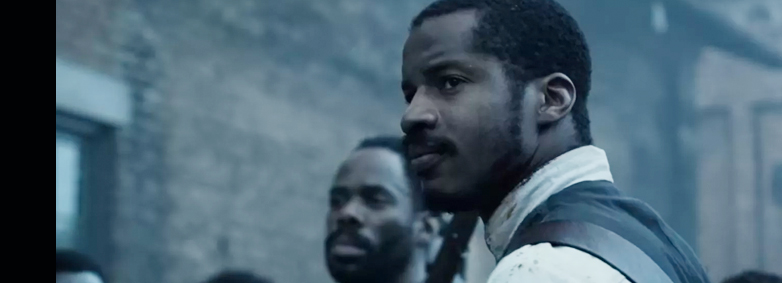
This well staged period drama is based on the little known life of Nat Turner, a messianic Virginian slave who led a short lived rebellion in 1831.

He’s played with impassioned sincerity by Nate Parker, whose considerable ambition exceeds his determined grasp as he produces, writes and stars in his directorial debut.

Parker doesn’t shy away from the brutality of the slaves lives nor the bloody retribution they visit on their owners. But moments of soap opera mix uneasily with melodrama, the finale is undermined by the budget and the story template is familiar from Spartacus (1960) and Braveheart (1995).

Turner rightly points out the bible is employed to justify both sides of the conflict. As such the central struggle within The Birth Of A Nation could be interpreted as a religious war as much as a racial one. However no-one pauses to consider the good book may be part of the problem, not the solution.

The changing economic climate of the period is suggested as an exacerbating factor to the insurgency, but again Parker misses the opportunity to link the issue to contemporary politics.

The heavy handed use of Nina Simone’s Strange Fruit serves to denude the song of power rather than enrich the film as presumably intended. It’s a cheap exploitative move worthy of Zack Snyder, and hopefully one Parker will avoid in future.

An episode from the directors personal life has overshadowed the film which was once considered a contender for best picture at the Oscars. But I doubt it would have gone the distance anyway.

@ChrisHunneysett

CHI-RAQ

Director: Spike Lee (2016) BBFC cert: 15

Anger is the defining emotion of Spike Lee’s films and there’s no denying the blistering power of his latest brash, sexy, and rap-filled essay on the state of the US.

Having produced, directed and co-written this satirical musical, he has updated a classical Greek comedy with an irresistible raucous energy.

As Lysistrata, Teyonah Parris is dynamite in an afro and high heels. Motivated by the shooting of a bystander, she persuades the women on both sides of the Chicago gang divide to withhold sex from their boyfriends as a means of preventing further violence.

Her charismatic criminal boyfriend Chi-Raq is one of the unhappy men. He shares his name with the gang-ridden south side of Chicago, an area more deadly to locals than Iraq to US soldiers.

Samuel L. Jackson has a ball a as zoot suited Greek chorus rapping straight to camera. Jennifer Hudson, Angela Bassett, Wesley Snipes and John Cusack form the backbone of a strong support cast.

@ChrisHunneysett

Sully

Director: (2016) BBFC cert: 12A

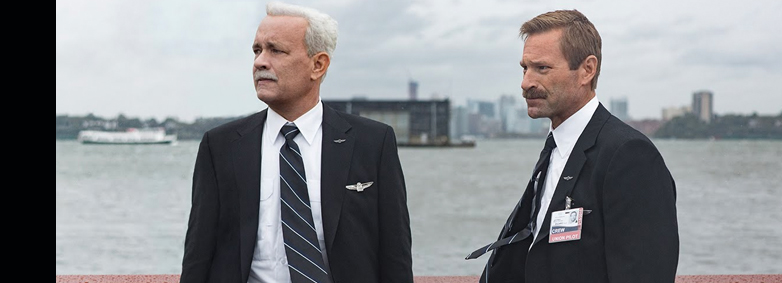
Tom Hanks plays a pilot in a courtroom tailspin in this arresting real life drama. The two time oscar winner is cannily cast as Captain ‘Sully’ Sullenberger who astonishingly landed his passenger jet on New York’s Hudson river.

On January 15th 2009, Sully’s inspired flying saved all 155 souls on board. It’s immediately dubbed the Miracle on the Hudson by a media who can’t get enough of the self effacing former US Navy pilot.

Hank’s innate likability and dependable screen presence acts as a shorthand for everyday decency, honesty and courage. There’s an enjoyable chemistry between Sully and his co-pilot Jeff Skiles. Aaron Eckhart competes in the cockpit to sport the most luxurious moustache.

Following their tremendous piece of aviation skill, the pair are forced to appear on chat shows and are uncomfortable at becoming instant celebrities.

Under Clint Eastwood’s iron directorial grip, the story of heroism is spun into a battle between the individual and a conspiracy of big business and government. The veteran director clearly sides with fly by the seat of your pants intuition against stifling procedure and rules.

The airline’s insurers are unhappy and encourage know-nothing bureaucrats to find a scapegoat. During the investigation into the incident, computer simulations suggest Sully could have flown to a nearby airport to land safely. Facing the loss of their careers, pensions and reputations, the pilots must fight to save themselves.

Airplanes crashing in New York have a recent historical resonance. Rather than shy away from the horror of 9/11, the film embraces it and uses the terrifying imagery of a single crashing plane to express the collective paranoid nightmares of the US.

This is tremendous filmmaking and it’s worth pausing to consider how mass urban destruction was used unthinkingly in Zack Snyder’s Man Of Steel (2013). That film is nearly twice as long but has less than half the brains. Its extended scenes of CGI carnage failed to entertain, never mind pass comment of the nation’s psyche.

It’s at this point Sully resonates with Eastwood’s previous film, American Sniper (2015). The pair are are very much a companion piece for each other. This is a another celebration of the pioneer spirit and can-do blue collar heroism, a tribute to the emergency services, of ordinary Americans guys such as ferrymen and cops doing their jobs with selfless bravery.

Considering we know the outcome of the forced water landing – not a crash – the action is surprisingly tense and is shown from the viewpoints of individuals on board and on shore. The accomplished CGI blends seamlessly with the New York skyline, the plane is a  fragile tin can bobbing on the majestic sweep of the vast Hudson river.

The film flies past in a quick 90 minutes with Eastwood directing with his typical no frills style. But far from flying economy, this is first class storytelling all the way.

@ChrisHunneysett


Paterson

Director: Jim Jarmusch (2016) BBFC cert: 15

Amazon Prime demonstrate their commitment to quality programming by funding this niche market film by a far from box office director. It is also an excellent example of how online streaming services are changing the nature of film production. And for the better.

Although Jarmusch’s brand of philosophy inflected observational drama is far from my cup of tea, his distinct voice would be missed if it could no longer find a platform from which to express itself.

The director followed up his vampire rockstar romance Only Lovers Left Alive (2013) with Gimme Danger (2016), an entertaining documentary of real life rocker Iggy Pop. Now he offers us this meditative tone poem. Its circular construction contains a mirage of faces and snatches of conversation.Twins and waterfalls are employed as motifs. To an eclectic soundtrack of electronic music mixed with rap, soul, blues and country and western, we pass though an urban landscape full of textures, patterns and colour.

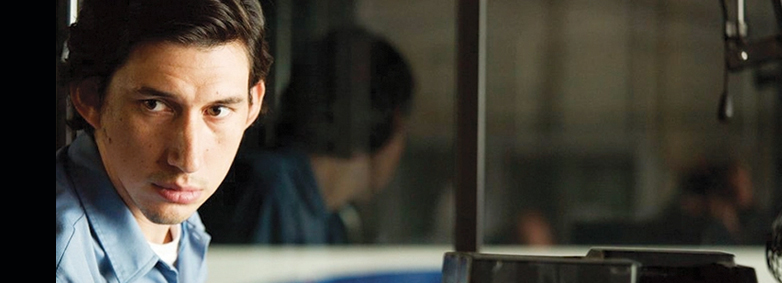
Adam Driver’s unlikely leading man looks find him well cast as the bus driving poet known to everyone simply as Paterson. He lives with his artistically inclined girlfriend in a down at heel New Jersey town, also called Paterson. Time passes but he seems caught in an endless loop. Not that he seems to mind.

He has a tender relationship with the beautiful Laura who is played with a sweet self absorption by Golshifteh Farahani. Indulged in her fancies, she flits between guitar lessons, experimental cooking, interior design and dress making.

As lines of his poetry appear on the screen, we realise as a poet Paterson is best suited to driving a bus. His Sisyphean struggle to straighten his mail box is a metaphor for his life. It’s also a running gag which results in the films biggest chuckle. This is a warm and gentle film but not an overly humorous one.

There is a wall of fame on the bar Paterson frequents, full of pictures of former residents who achieved success and left town. Jarmusch likes his characters too much to make too many demands on them, though there’s a sadness as we suspect we could call back in twenty years and find them still living the same quiet lives.

The film presents creativity as a survivalist response to the mundanity of existence. The rappers, actors and poets Paterson meets are of every age, race and gender, pointing to the universality of the desire to express ones self in a creative manner.

I enjoyed the gentle spirit of Paterson, but others may find the pace of life a little slow.

@ChrisHunneysett


A United Kingdom

Director: Amma Asante (2016) BBFC cert: 12A

The sincerity of this solid historical drama is undermined by the overly flattering portrayal of its subjects, the real life mixed race rulers of Beuchanaland, Seretse and Ruth Khama.

As played by Brit actors David Oyelowo and Rosamund Pike, they are paragons of quiet dignity and determination. Oyelowo is impressively impassioned as the law student turned politician who believes in equality, inclusion and unity. However, with Pike’s accent as well cut as her cheekbones, the supposedly middle class Ruth frequently comes across as far more regal than her royal husband.

As they fight to bring independence to what is today Botswana, the devoted couple face the considerable forces of colonialism, exploitation, prejudice, propaganda and ridiculous ceremonial pomp. Together they battle the Empire, their own citizens, his disapproving family and piratical American mining corporations.

Racially segregated in practice but not in law, the then British protectorate of Bechuanaland was one of the one of worlds poorest countries. It suffered malaria, malnutrition, drought and poverty.

The Khama’s marriage is considered by the Empire to be inflammatory at a time when neighbouring South Africa is instigating apartheid. And stability is South Africa is paramount to the Empire, the UK’s gold supplies are dependent on it.

Styled the black king and white queen by the British press, the Khamas are not prepared to be pawns in the Empire’s game of global politics. Representing the Empire is Jack Davenport‘s wonderfully oily Sir Alistair Canning. Jack Lowden appears as Tony Benn MP. True to form, the self-styled conscience of the parliamentary Labour party spends his time battling his own side.

A companion piece to her period piece Belle (2014), Asante fashions her material with deft confidence and produces an engaging and handsome work. The opening scene is a joy of character and thematic economy. We witness Seretse taking part in a university boxing match. He is shown to be a courageous but naive fighter who is defeated at the hands of treacherous former public school boys.

London is believably stuffy and smog-filled, contrasting well with the bright open and faint optimism of Bechuanaland. There is a smooth dexterity in the handling of scenes which alternate between the intimate and the epic.

However the story struggles against the inertia of reality. The script is stretched having to cover a distance of thousands of miles and a time scale measured in years. Nor does it help having the central duo spend long periods on different continents.

The scant awareness of this story in the west lends the film a fresh appeal. It’s handsomely crafted and well played. It’s an overwhelmingly positive portrayal of an African nation and a celebration of democracy. All of which is welcome. But as a drama I wished it had more grit.

@ChrisHunneysett

Indignation

Director: (2016) BBFC cert: 15

This head bangingly dull melodrama is a poor advert for author Phillip Roth from whose novel it’s adapted. The flat lead performances, self-obsessed characters and clunky direction make for a very testing experience.

As is so often the case in literary adaptions, the presence of a voice over is an early indicator of the ineffective transition from page to screen which follows.

Marcus is a working-class Jewish student who dodges the 1951 Korean war army draft by enrolling in a prestigious Ohio college. Refusing to socialise with his peers he obsesses over the beautiful Olivia, an outwardly confident soul from a wealthy family. Logan Lerman and Sarah Gadon are a handsome couple but can’t find a way to make their characters sympathetic.

The only memorable scene is a lengthy interrogation by the Dean. This is a character whom we’re supposed to reject for his persecution of Marcus, but instead embrace for his patience, charm and humour. It’s an enjoyably human performance by Tracy Letts.

The cyclical script explores how society  applies brutal punishments to those who challenge conformity. After enduring two hours of this wearying philosophising, I was was more than justified in my own indignation.

@ChrisHunneysett


American Pastoral

Director: Ewan McGregor (2016) BBFC cert: 15

The directorial debut of Ewan McGregor is an overwrought and underpowered adaption of Philip Roth’s Pulitzer Prize winning novel. Condensing the heavy weight tome to a thankfully brief running time of under two hours reduces the characters to transparent ciphers of key ideas.

While the dialogue retains its bite and humour, the handsome cinematography is at odds with the bleak allegorical tale about the destruction of social innocence and failure of the American dream.

The Scots actor mistakenly casts himself as the lead, a blonde former high school super star athlete known to everyone as ‘Swede’. He’s a now a pillar of the community but one who is singularly unequipped to cope with the fractures in his seemingly perfect life.

The Swede’s troubles are fermented by and reflect the social upheaval of the turbulent 1960s. Jennifer Connelly plays his beauty queen wife, who pointedly swaps breeding livestock for a a life devoted to real estate development. Dakota Fanning is Merry, their stammering daughter who becomes a political terrorist.

There’s madness, seduction, violence and duplicity, but the biggest betrayal is the jarringly imposed suggestion of redemption.

@ChrisHunneysett


Arrival

Director: Denis Villeneuve (2016) BBFC cert: 12A

Prepare yourself for an epic close encounter in this cerebral sci-fi creature feature. It’s an astonishingly involving, wonderfully acted, technically dazzling and breathtakingly beautiful paean to the pain of existence.

Superb in every department, the intelligent design and gorgeous cinematography are graced by sympathetic editing which reflects the themes of the film. The storytelling of this masterful work constantly wrong foots our expectations to provide this years most profound emotional kick.

I staggered from the screening, aping exactly the stunned expressions of stars Amy Adams and Jeremy Renner after their first contact with alien lifeforms. I was not quite believing of the intensity or meaning of my experience, but I knew it was somehow glorious.

The arrival of an alien fleet on Earth causes global panic and the US government calls a state of emergency. Adams is tremendous as Dr. Louise Banks, a gifted linguist who is recruited by the US military and represents humanity’s best hope. Her mission is to communicate with the extra-terrestrial visitors and ascertain their purpose on our planet. She is aided by Renner’s theoretical physicist, Ian.

The lengthy first view of the monumental alien craft has a gobsmacking power. Humans are pitifully fragile before the enormous alien shell-like ship which gently hovers yards above the ground. This is merely a light jab to soften our senses before the hefty emotional punches Villeneuve lands on us later.

Inside the grey giant egg of a craft, the aliens appear through a shroud of mist,separated from their guests by an invisible wall. The giant squid-like beings have an elephantine hide, and their seven fingered form has echoes of some of the startling imagery in director Villeneuve’s Enemy (2013). They communicate through a sign language composed of inkblots, reminiscent of rorschach tests.

However time is running out as the Chinese and Russians rattle their sabres in the face of the perceived threat. Plus the anxious trigger fingers of the US military are ready with radiation suits, rifles, helicopters and high explosives.

The relatively few action moments are given power by a sharp script which touches upon our understanding of love, language, memory and time. There are elements of the Cold War stand-off and biblical allusions to the tower of Babel and Moses ascending Mount Sinai.

Along with her lead in Tom Ford’s masterful thriller Nocturnal Animals (2016), Adams has two of the plum lead roles of the year, a singular achievement for a forty-something actress in a notoriously youth-orientated Hollywood.

As her scientist sidekick, Renner demonstrates why he’s Hollywoods finest second fiddle. Forest Whitaker and Michael Stuhlbarg offer strong, understated support as a US Colonel and an FBI Agent.

With communication and time key ideas, Arrival appropriately conducts its own dialogue with cinema. Combining the majesty of Stanley Kubrick’s 2001: A Space Odyssey (1968) with the humour and humanity of Spielberg’s Close Encounter Of The Third Kind (1977), Arrival is a far more successful blend of the two masters than Spielberg’s own mesmerisingly flawed A.I. Artificial Intelligence (2001). As well as his own films, Villeneuve includes a call back to the cult sci-fi Cold War thriller War Games (1983). This is the film Christopher Nolan can only dream of making.

The next film by Villeneuve is a sequel to Ridley Scott’s classic Blade Runner (1982), and it’s good to know it’s in the safest possible pair of hands.

But first you absolutely must see this one.

@ChrisHunneysett


The Light Between Oceans

Director: Derek Cianfrance (2016) BBFC cert: 12A

Wade into a sea of grief, madness and death with this mournful melodrama. Solid performances and breathtaking locations bring the best selling book by M. L. Stedman to windswept life.

Michael Fassbender and Alicia Vikander star as Tom and Isabel Sherbourne. He is a black clad and brooding veteran of the First World War’s western front, she is a vivacious local girl in angelic white.

The happiness of Australia’s most photogenic lighthouse keepers hits the rocks due to a repeated failure to have a child.  Demented by grief, Isabel persuades Tom to abandon the ship of common sense when a baby girl is washed ashore. They pass the child off as their own, with the only clue to her identity an expensive silver rattle.

As a period romance this is more gothic tragedy than uplifting celebration of love. Imagine Emily Bronte’s Cathy and Heathcliff escaping Wuthering Heights to spend a day out at the seaside.

There are tales of suicide, ghostly images, wild walks on stormy nights, wailing widows and mourning mothers. There are letters from beyond the grave. In flashback we see the dead, living. Beneath breathy voice overs, the script shovels on unlikely occurrences and coincidences.

The lighthouse island is named after Janus, two headed god who looks to the future and the past. Tom looks one way, Isabel the other. When Isabel shaves off Tom’s moustache, she is defenestrating his stiff upper lip and removing his emotional barrier to the world. Not only does this indicate he prepared to reveal his emotions, but it places him in her power. It is redolent of Samson having his locks shorn and is the harbinger of their doom.

As the drama sinks under the weight of this heavy handed symbolism, eventually the over-wrought storytelling cops out and dissolves into sentimentality. A lack of social smoking undermines the carefully constructed period detail.

Filmed in Tasmania and off the New Zealand coast, the coastline is a character and the crashing waves are a soundtrack. Rachel Weisz offers strong support as Hannah, the daughter of local businessman. It’s always great to see Bryan Brown on screen, even when playing Septimus Potts, as unpleasant a man as his name suggests.

Fassbender and Vikander became a couple while on set and the early scenes have an earthy crackle of electricity. I hope they achieve more happiness than their characters do.

@ChrisHunneysett


I, Daniel Blake

Director: Ken Loach (2016) BBFC cert: 15

If a measure of a films greatness is its ability to generate anger, then this raw slice of social realism is a masterpiece.

This is a rage fuelled articulation of the pain and damage imposed on ordinary people by the machinery of state geared up to disenfranchise them. It’s a bleak and uncompromising condemnation of the deliberate destruction of the social contract between state and citizen by successive UK governments.

The 80 year old Ken Loach delivers a typically powerful piece of political agitation. The veteran director of Cathy Come Home (1966) demonstrates his undiminished rage at injustice inflicted on the most vulnerable.

As Daniel and Katie, the honest performances of Dave Johns and Hayley Squires give humanity and dramatic weight to the story.

Following a major heart attack, 59-year-old joiner Daniel Blake has been signed off sick by his doctor. He is contrarily assessed as able to work, losing his state sickness benefits. This decision making process is outsourced to a private company by the Department for Work and Pensions.

While Daniel attempts to appeal the decision he has no income and is unable to work, but is expected to look for a job in an area of high unemployment.

He meets single mother Katie of two who has relocated to Newcastle from a homeless persons’ hostel in London. He takes a grandfatherly interest in her kids and their positive response to him makes the subsequent slide into distress all the more affecting.

Moments of humour, camaraderie and small acts of kindness make the uncaring cruelty suffered all the more bitter. Debt, hunger, criminality and mental illness are accompanied by a crucifying sense of shame.

All these afflictions are prompted and then maintained by a bureaucracy which actively seeks to avoid helping the deserving poor by an incomprehensible claims system. Jargon, call waiting and internet-only applications are effective barriers to successful claims. Sanctions for non compliance with the rules are routinely threatened.

Loach presents in a style as severe as the policies of austerity meted out by the UK government. There’s an absolute absence of sentimentality and spectacle. The lack of the latter means this will translate easily to television, but without losing any of its righteous anger.

Filming took place on location in Newcastle Upon Tyne. The city offers an array of locations rich in visual texture which are mostly ignored, as a result the city never feels like a character in its own right. The majestic Tyne Bridge is absent, there’s the merest glimpse of glorious Grey Street and scenes are content to play out in anonymous streets, offices and front rooms.

Saving his fury for the dehumanising bureaucratic systems, Loach refuses to demonise anyone. Pimps, madams, police and even the bureaucrats are generally given sympathetic hearings, while outright villainy is absent.

This is probably just as well, the gangsters in Loach’s enjoyable magical realist fable Looking For Eric (2009) were very weakly drawn. In order to create a palpable sense of community, Loach glosses over the chaos of noise, vandalism and random violence which exists at the frayed edges of society.

Fish are a recurring motif and the Christian symbol for hope and peace is a mocking reminder of politicians who make political capital from being openly devout, but whose policies are criminally destructive. This criticism is cross-party and deep rooted.

I’ve never left a cinema burning with anger at the state of the UK. And if you have the slightest sliver of a social conscience, neither will you.

@ChrisHunneysett