Kill The Messenger

Director: Michael Cuesta (2015)

Despite a plot of international significance featuring political corruption, money laundering and drug dealing, this real-life thriller is surprisingly weak and muddled.

It’s a busy dramatisation of the fall from grace of investigative reporter Gary Webb (Jeremy Renner). Uncertain of tone it begins as a courtroom romp, rifles into an astonishing hard news story then dissolves into a dull human interest feature.

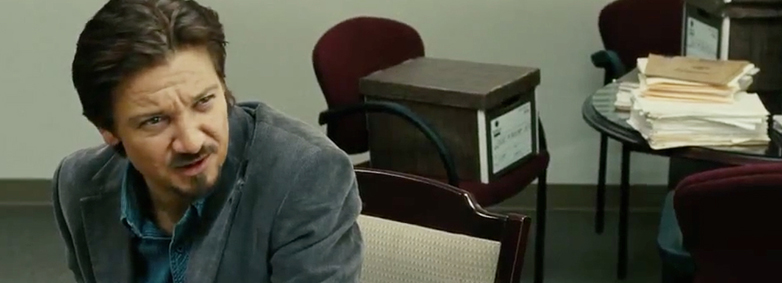
Renner hides behind a goatee bristling with self-righteous rage but his taciturn everyman act lacks charisma. His two Oscar nominations (The Town, The Hurt Locker) seem ever more indebted to strong direction than any tremendous ability.

A scruffy family man with a penchant for British cars, motorbikes and music, Webb works on the small San Jose Mercury newspaper.

In a 1996 newsroom teeming with now unimaginable numbers of staff, Webb is indulged by young editor Anna (Mary Elizabeth Winstead) and avuncular executive editor Jerry (Oliver Platt).

One day the glamorous Nicaraguan Coral (Paz Vega) drops a folder of confidential information into his lap. The first of many characters to pop up before being forgotten, she uses an unwitting Webb to have her boyfriend’s court prosecution collapse.

Following the info in the folder, Webb is soon interviewing incarcerated drug-dealer Rick Ross (Michael K. Williams). He claims the CIA turned a blind eye to Danilo Blandon (Yul Vazquez) importing industrial quantities of cocaine as it served their foreign policy purposes. The enormous sums of cash raised funded the Contra’s attacks on the communist Nicaraguan government.

It’s a doddle for Webb to bribe his way into a Nicaraguan jail to meet fearsome drug baron Norwin Meneses (Andy Garcia). Everybody is happy to tell the journalist exactly what he needs – which means there’s no tension or drama to his story-gathering.

Publishing his story online (a novelty at the time) attracts nationwide attention. Webb is nominated for journalist of the year but quickly competitors line up to challenge the story, mostly by pointing to his conspicuous lack of evidence.

Now painted as a conspiracy theorist, Webb himself becomes the story. He’s convinced the CIA are in cahoots with the Washington Post to discredit him and the pressure affects his relationship with wife Sue (Rosemarie DeWitt) and teenage son Ian (Lucas Hedges).

Blinded by his indignant anger to the realities of the world and consumed by a martyr complex, Webb is demoted to a backwater department but keeps obsessively working the case.

Government insiders Fred Weil and John Cullen (Michael Sheen and Ray Liotta) appear in cameos to confirm Webb’s theories. They could well be figments of his imagination.

As his paranoia increases Webb sees prowlers in the dark and enemies everywhere. When his bike is nicked he stupidly smashes up his own car and harangues passes-by. As Webb’s mental state deteriorates his attire becomes progressively sharper.

Webb suffers a tragic end but the film fails to provide sufficient evidence to support it’s theory as to why.

★☆☆

The Wolf of Wall Street

Director: Martin Scorsese (2014)

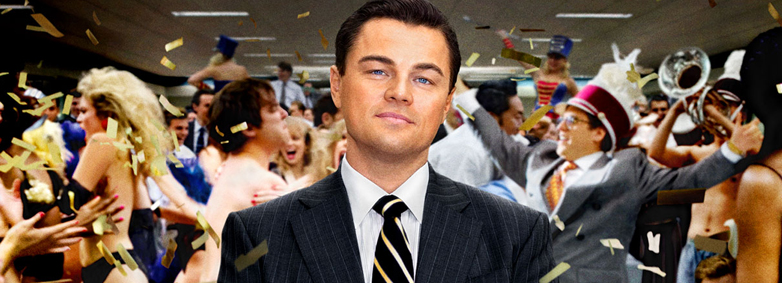
Making money has never seemed so debauched as in this glossy, foul–mouthed and darkly comic biopic.

The fifth collaboration between director Martin Scorsese and Leonardo DiCaprio colourfully captures the outrageous world of crooked Wall Street trader Jordan Belfort.

It’s a blisteringly charismatic turn by DiCaprio as Belfort, a rampant, ravenous and depraved monster whose ego dominates the film.

Margot Robbie plays his underdressed trophy wife Naomi, but to her credit she isn’t overwhelmed by DiCaprio’s gleeful grandstanding.

In typical Scorsese style, dynamic camera-work and a storming soundtrack thrust us through criminal, chemical and domestic abuse while dressed in trashy clothes and driving a fleet of flash cars.

It is Scorsese’s finest film since his mobster masterpiece Goodfellas (1990). It’s similarly structured and high with comedy – at times it’s hilarious.

As Belfort talks directly to camera while walking you through his life, the dialogue even features some of the same key words and phrases to underline how crooked Wall Street is.

A ruthlessly brilliant salesman – imagine Gordon Gekko on Class A drugs – Belfort’s rapid rise is powered by his ability to foster corrupt practises among his employees and his business partner Donnie (Jonah Hill).

He doesn’t bother to explain in detail to the audience how it works but points to his huge spoils to prove hat it does. There are beds full of cash, planes full of prostitutes, showers of drugs, monkeys on rollerskates and dwarf-throwing contests.

Eventually the FBI chase him for his insider trading and his career, house and marriage are at risk.

In his most exhilarating movie since Casino and his best since Goodfellas, Scorsese points out that the wolf can only exist as a result of our greedy gullibility.

It failed to win any of the Oscars it was nominated for; best film, director, male lead, male support for Hill and best adapted screenplay. As DiCaprio couldn’t win a golden statue for this titanic effort – he may as well give up trying.

Rush

Director: Ron Howard (2013)

Roaring into the cinema is this amazing racing tale fuelled by testosterone, booze and occasionally petrol.

It charts James Hunt and Nikki Lauda’s rivalry as they race from Formula 3 to challenging for the F1 world title in 1976.

Both men have similar backgrounds of wealth and privilege – Hunt (Chris Hemsworth) is a champagne-quaffing show-off who sees racing as an extension of his social life. While Lauda (Daniel Brühl) is a yoghurt-eating Austrian who is arrogant, risk-averse and highly focused. He races because it offers huge financial rewards.

Each describes the other as assholes but only Lauda seems sufficiently self-aware to realise the term applies to both men equally.

The film creates great tension by focusing on the friction between the two men which is then released by the starter’s flag. The thrilling races are expertly staged, especially as they show how close stewards and spectators were to these ‘bombs on wheels’.

Among the parties, insults and weddings, Lauda suffers a near fatal crash that leaves him scarred yet defiantly he continues to race to the film’s gripping climax.

In this macho mechanical world the ladies fare badly; being married is seen as being incompatible with success and single women are disposable sex toys.

Sadly Hemsworth’s acting is hamstrung by the demands of maintaining an English accent and is at his best behind the wheel. Brühl is more convincing and the supporting cast are all excellent.

The film offers an great insight into the world of 1970s Formula 1. Smoking is allowed in the pit-lanes, rain is a common enemy and the drivers have to battle mechanical failure, financial disaster, personal demons, media interference and the politics of the racing authorities.

It’s a well-crafted story of competitive courage that’s told with humour and energy.

Wild

Director: Jean-Marc Vallée (2015)

Reese Witherspoon abandons her clean cut perky persona for sex and drugs in this meandering march to personal redemption.

Justifiably Oscar nominated she’s as engaging as ever playing the real-life Cheryl Strayed on whose memoir the story is based.

In order to distance herself from her chaotic past, Cheryl punishes herself by hiking alone over a thousand miles along the picturesque Pacific mountain trail; the barren deserts, snowy mountains and lush forests are all captured with tourist propaganda beauty.

Promiscuity, alcohol and drugs have contributed to a failed marriage, pregnancy and subsequent failed therapy. Despite her mother Bobbi (Laura Dern) being a warm, inspiring and optimistic presence, it’s Bobbi’s story that has compounded Cheryl’s self-destructive behaviour and the trigger for her long walk.

Despite Cheryl’s anger issues we warm to her charm and humour, admiring her dogged determination and perseverance in maintaining a relationship with ex-husband Paul (Thomas Sadoski).

With insufficient preparation she battles grief, guilt and remorse as well as extreme temperatures, rattlesnakes, gun-toting hillbillies, loneliness, lack of food, inelegant toilet facilities and large amounts of unwanted male attention.

Even so the walk itself is fairly uneventful and she receives the frequent help of strangers plus a welcome taste of romance.

With a far from satisfactory script structure from Brit writer Nick Hornby, the reasons for her trek revealed in a series of flashbacks. This means most of the drama has happened before the film has even begun, creating a void where the tension should be.

In heavy-handed fashion inspirational phrases are scrawled across the screen as if we’re not capable of listening to or understanding literature. Worse, there’s no consistent application of the conceit.

It’s an unusual criticism to make – but what this film seems to be lacking most is a train of camels.

☆☆

Grace of Monaco

Director: Olivier Dahan (2014)

How is it possible to have made a terrible film like this out of such a remarkable story – the life of a Hollywood star who married into European royalty?

The tale of Grace Kelly, later Princess Grace of Monaco, has terrific elements – real-life drama, Tinseltown glamour, riches and royalty, fast cars, great locations, intrigue and international conflict.

But this is an insult to our intelligence. It is poorly cast and packed with unsympathetic characters who deliver dreadful dialogue with appalling accents. The script is terrible and the film looks like it has been edited with a hacksaw.

Stunningly beautiful and an Oscar-winner, Grace gives up her film career for a fairytale life in Monaco on the French Riviera. But now she is bored.

You need an actress who can make an audience sympathise with the plight of a beautiful, pampered, wealthy woman. Instead we get ice queen Nicole Kidman.

The self-pitying princess passes time watching videos of her wedding and, preposterously, is portrayed as an international diplomacy mastermind.

Alfred Hitchcock (Roger Ashton-Griffiths) pops by to offer her the title role in the film Marnie – playing a disturbed woman who was molested as a child. Grace, with the backing of her hubby Prince Rainier (Tim Roth), gladly accepts.

Dithering Rainier is trying to preserve his family’s lengthy rule by keeping Monaco as a tax haven for wealthy petrol-heads and gambling addicts.

However he’s driven to chain-smoking by the grasping president Charles de Gaulle (Andre Penvern) who wants to impose taxes on Monaco, exploiting the ‘scandal’ of Grace’s planned return to acting by trying to tax Monaco and threatening to blockade it.

In desperation, Grace takes a shopping trip to Paris and organises a jolly banquet to bring everyone together. Hoorah! And Marnie? In the end the role was taken by Tippi Hedren.

☆☆☆☆

Mr Turner

Director: Mike Leigh (2014)

Brilliant Timothy Spall was surprisingly overlooked by Oscar for his grunting, growling portrayal of superstar artist J.M.W.Turner.

This masterful biopic is a rich canvas covering the last 25 years of the genius’s life until his death aged 76.

Hangdog and whiskered, the man often hailed as Britain’s greatest ever painter is hard on his contemporaries, kind to his patrons and horrible to his servants and children.

With Spall dominant in the foreground, there is a wealth of emotional colour swirling around in the background to ponder.

Never married, Turner has complex relations with the many women in his life. He refuses to acknowledge the children he has with his former lover Sarah Danby (Ruth Sheen) despite her constant appeals.

Meanwhile the artist regularly takes sexual advantage of his devoted housekeeper – and Sarah’s niece – Hannah Danby, played by Dorothy Atkinson.

After the death of his beloved father William (Paul Jesson) Londoner Turner goes to the Kent coast to stay in the Margate lodging house of Mrs Booth (Marion Bailey), a warm, gentle and touching bond develops, accelerating on the death of her husband.

Supremely confident in his creative talent, Turner takes pains to guard his place at the top of the intensely competitive art world.

With his sketchbook for company, he strides across landscapes, walks for miles along the coast and pays prostitutes to show him their bodies for anatomy lessons, we’re left to ponder at what else he may be paying for.

He even has himself tied to a ship’s mast in a storm to study the light. As his work becomes ever more revolutionary he is mocked by satirists, which hastens his decline.

Rich and famous, Turner is still hurt when a young Queen Victoria and her husband Prince Albert – philistines both – are too shallow to appreciate his art.

The gentle ending, the most heartbreaking of 2014, is all the more powerful for lacking sentimentality.

Foxcatcher

Director: Bennett Miller (2015)

In this chilly, complex and exceptionally crafted thriller based on a true story, actors more famous for action and comedy give great dramatic performances.

In mood, tone, subject matter and careful execution it is similar to Miller’s Capote (2005) for which the late Philip Seymour Hoffman won the best actor Oscar.

US gold medal wrestling champ Mark Schultz (Channing Tatum) is being coached for for the Seoul Olympics by older brother Dave (Mark Ruffalo).

Aggressive in the ring, the emotionally stunted Mark lacks social confidence and struggles financially. Dave has acted as father as well as brother but now prioritises his wife Nancy (Sienna Miller) and children.

As in American Sniper, Miller demonstrates she’s capable of excellence given the opportunity, it’s a shame that in both films she isn’t given more to do.

At no point does Dave consider himself to be a contributor to Mark’s issues.

Mark is overwhelmed when patriotic multimillionaire wrestling enthusiast John du Pont (Steve Carell) demands to help the US Olympic cause, flying Mark out to his secluded Foxcatcher estate where he has built a state of the art training facility.

From behind prosthetic nose, paunch and grey hair, Carell offers a mesmerising performance, hinting at a complex internal conflcits, not least his feelings towards his emotionally cold mother Jean (Vanessa Redgrave).

Flexing his financial muscle, du Pont brings on board the entire US wrestling team, names them Foxcatcher after his estate and hires Dave to train them for Olympic glory.

The wrestling scenes are convincing and comprehensible while the muted tone, autumnal colours and nuanced performances create a creeping foreboding.

Desperate for affirmation by his wealthy associates, du Pont parades his pet project around town while tension develops between du Pont and Dave as they compete to exercise an unhealthy degree of control over Mark.

With a shocking violence, the cold blooded and tragic end offers further punishment but no redemption.

★★★★★

The Imitation Game

Director: Morten Tyldum (2014)

Get quizzical with Benedict Cumberbatch in this compelling wartime thriller about real-life code-breakers.

The star of TV’s Sherlock puts in an Oscar worthy performance as Alan Turing; cryptologist, mathematician and inventor of the world’s first computer.

It unlocked the Nazi‘s Enigma code machine and so helped win the second world war – but he was later prosecuted for being gay.

A cleverly constructed narrative switches between between his arrest in 1951, unhappy schooldays and successful war years.

In 1941 he is recruited by MI6 spook  Major General Menzies (a scene-stealing Mark Strong) and placed under the sceptical Commander Denniston (wonderfully caustic Charles Dance).

Although prodigiously brilliant, Turing’s lack of social graces annoys everyone but Joan, the only female team member played by a winning Keira Knightley.

In a laboratory in Bletchely Park they try to decipher German communications before the daily code is changed.

There are over 159 million million possible combinations and every seconds delay means more Allied deaths.

So starts to Turing build his computer, an astonishing room-sized contraption of wires, wheels and whirligigs.

He nicknames it Christopher after a schoolfriend, a perfect name for anything super-intelligent but he’s unable make it work quickly enough.

Denniston wants to close the laboratory down and the paranoid atmosphere is heightened by the possible presence of a spy.

Being a British affair, the terrifically moving moment of eureka happens in the pub.

Despite saving an estimated 14 million lives and shortening the war by two years, his work is classified top secret.

So no-one is aware of his work when he is later tried and punished for indecent behaviour.

This excellent film is an insufficient legacy to a genius and British hero – but it’s a damn fine place to start.

★★★★☆

Unbroken

Director: Angelina Jolie (2014)

Celebrating the human capacity for endurance, this true-life tale of Second World War survival is barely believable – and not for the faint-hearted.

It’s based on the book by Lauren Hillenbrand which covers the life of USA Olympian and airman Louis ‘Louie’ Zamperini.

Director Angelina Jolie demonstrates she’s far from the minimally talented spoiled brat that recently leaked Sony emails would insist, crafting a handsome and traditional movie with exciting flying sequences and strong acting from watchable performers.

But it does suffer from repetition and so fails to achieve the emotional pitch it strives for.

Born into a poor family young Louie (Brit star Jack O’Connell) learns resilience when he’s bullied for being an immigrant. His older brother Pete (Alex Russell) encourages him to channel his energy on the athletics track to avoid getting into serious trouble.

After representing the US as a distance runner at the 1936 Berlin Olympics, Louie enlists as an airman. While on a rescue mission his plane crashes in the Pacific.

Adrift in a lifeboat with two Mac and Phil (Finn Wittrock and Domhnall Gleeson), they survive sharks, sunburn, sickness and being shot at.

This is the strongest part of the movie as dialogue is kept to a minimum allowing the orchestra and the scenery do the talking, captured with customary finesse by ace British cinematographer Roger Deakins.

Picked up by the Japanese navy the survivors are subjected to interrogation, beatings and solitary confinement before being transferred to a savage POW camp.

It’s ran by the sadistic warden nicknamed ‘The Bird’, played competently by Japanese musician Miyavi in his first acting role. But the fraught relationship between guard and prisoner is forced and unconvincing.

Louie is offered by an easy life in exchange for allowing his celebrity runner status as Japanese propaganda in radio broadcasts but instead is returned and sent to a dockside coal-yard – where The Bird is once again in charge.

An early Oscar front runner Unbroken only picked up nominations for cinematography, sound mixing and sound editing and it will be interesting to see if Jolie can build a second career from her solid efforts here.

★★☆☆

The Theory of Everything

Director: James Marsh

This tasteful, tear-ridden and terribly British biopic of scientist Stephen Hawking is sadly uneven.

Despite some Oscar worthy acting this brief history of his life is too thinly stretched with the latter half not matching the emotional power of the first.

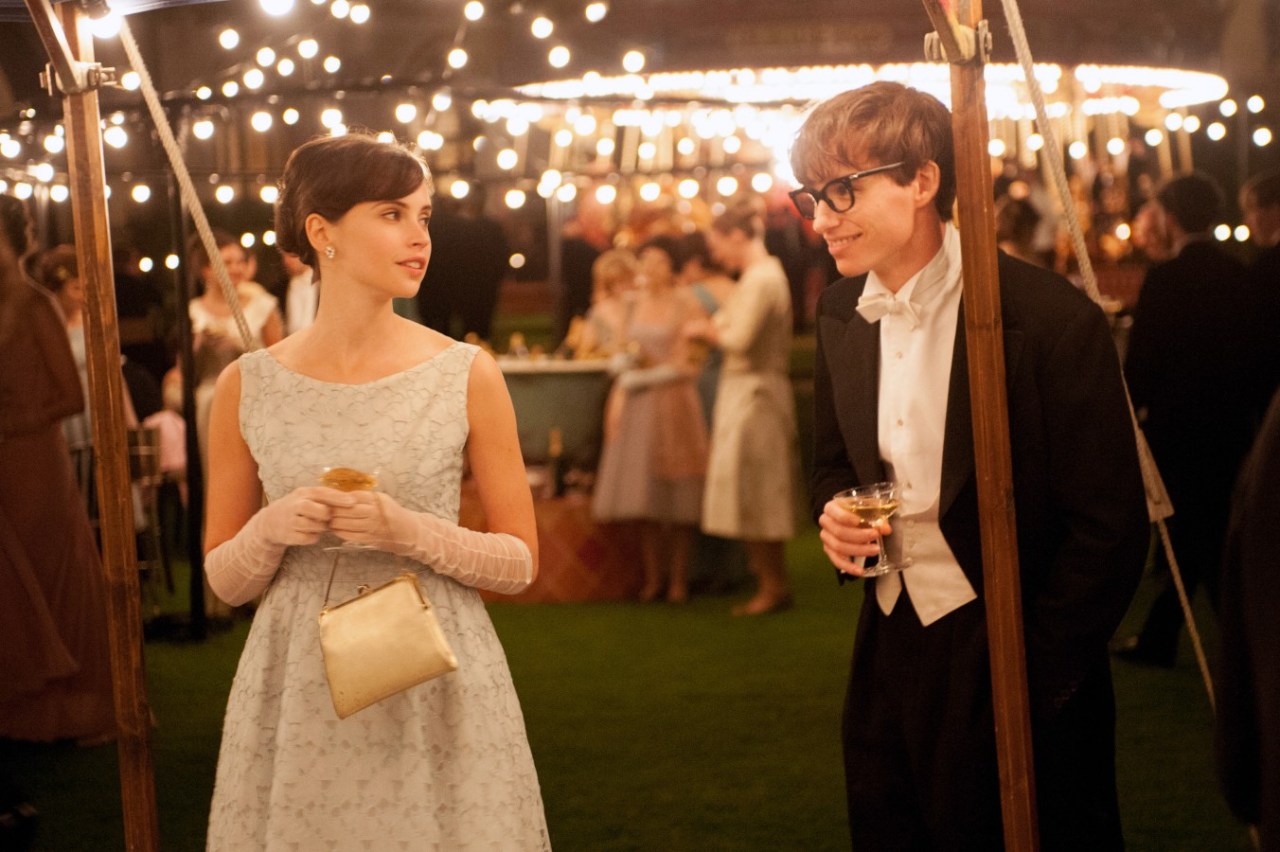
 Prodigiously clever student Hawking (Eddie Redmayne) is at Cambridge University; cycling and studying for his PhD.

He meets the arty, angelic Jane (Felicity Jones) and they enjoy a picture postcard courtship amid the dreaming spires.

It’s an impressively physical performance by Eddie Redmayne and Jones is as excellent as always, great support is offered by David Thewlis as kindly don Dennis and Harry Lloyd as Hawking’s best friend Brian.

His growing clumsiness leads to a collapse and in hospital he is diagnosed with motor neurone disease.

While his mind stays sharp he will lose control of his muscles which will gradually waste away through lack of use.

He is given two years to live.

Moving you to tears with the sort of stiff upper-lip that built the British Empire, Jane refuses Stephen’s requests to leave.

They marry and as walking sticks give way to wheelchairs, his scientific career goes supernova.

Jane is poorly served; transforming abruptly from loving wife to challenged carer, signalling a sea change in their relationship.

However science and the story’s emotional momentum is abandoned for soap opera as the focus moves to marital infidelity and his growing international celebrity.

Meanwhile although we’re left to wonder how years after his terminal diagnosis Hawking is still alive at 72 as the careless script, happy to ponder the scale of the universe, never alludes to that particular mystery.

Nor are we close to knowing whether he’ll ever establish his unified theory of life, the universe and everything.

If only it had ended in physics not platitudes this could have been one of the films of the year.

★★★☆☆