Big Game

Director: Jalmari Helander (2015)

A President, terrorists and wild bears are the targets in this goofy action adventure romp which provides a forest full of explosive entertainment.

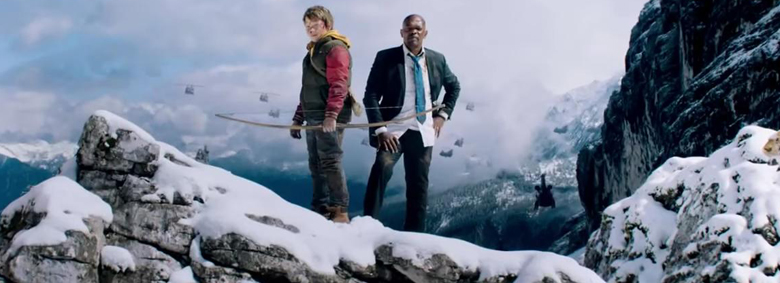
The son of a famous hunter, 13 year old Oskari (Onni Tommila) is sent into the remote mountains of his native Finland.

Armed only with a sharp knife and a bow and arrow he can barely control, the determined teen must spend a day and night hunting wild bear in a traditional coming of age ceremony. Guns are not allowed.

Meanwhile high above, Air Force One ferries the unnamed US President (Samuel L. Jackson) to a G8 summit in Helsinki. The plane is shot down by terrorist Hazar (Mehmet Kurtulus).

He’s the psychotic son of a Sheik who’s so enjoyably evil he shoots a man in the back with a surface-to-air-missile, and then is rude about the quality of the Chinese made weapons.

Ejected to ground in an escape pod, the barefoot and hapless President is found by a startled Oskari.

However the boy has commendably little respect for the authority of the Oval Office. Even with Hazar in pursuit, Oskari will only take the President to safety after his bear hunt is successfully completed.

Another survivor loose in the wood is the girdle-wearing, pill popping Chief-of-security Morris (Ray Stevenson). He once took a bullet for the President.

Meanwhile back in the Pentagon‘s command bunker, a tank-top wearing, sandwich eating analyst called Herbert (Jim Broadbent) is offering advice to the Vice President (Victor Garber) and General Underwood (Ted Levine).

They’re rapidly falling to pieces quickly at the situation, having definitely picked the wrong day to quit smoking, drinking etc.

Arching an eyebrow alongside the men is the token woman with a speaking role; the CIA Director (Felicity Huffman).

As the script builds betrayal upon betrayal, the most well-intentioned is the most affecting.

Among the the sky-diving, missile attacks and shoot-outs, the special effects aren’t terribly special –  and some of the outdoor locations look suspiciously indoor.

At every possible interlude rousing blasts of orchestral music are accompanied by sweeping helicopter shots of the glorious mountains.

The director coaxes a guileless performance from the young Finnish lead actor and Jackson enjoys himself playing against type as a man definitely not in control of events. Kurtuluş has fun channeling Hans Gruber (Alan Rickman) from Die Hard (1988).

With it’s young hero suffering daddy issues and familiar visual gags and stunts, it’s easy to recognise inspiration drawn from the ’80’s work of Steven Spielberg; specifically E.T. and The Temple Of Doom – but the tone is closer to that of Richard Donner’s The Goonies (1985). (Story and Executive produced by S. Spielberg)

However exciting and fun as it all is, the message one is not a man until you’ve killed something is far from typically Spielberg.

Phoenix

Director: Christian Petzold (2015)

Greed, betrayal and revenge are surgically spliced in this intriguing post-war thriller.

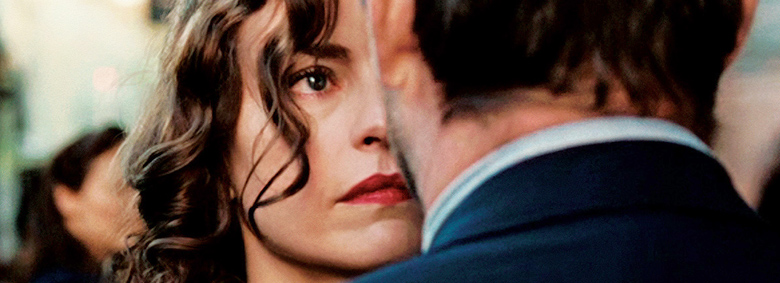
Holocaust survivor Nelly (Nina Hoss) is a former singer rescued from the ‘camps in the East’ and brought to a private asylum to recuperate.

With doctor’s using techniques still in their infancy, Nelly undergoes plastic surgery to rebuild her shattered face.

The motives of her friend and saviour Lene (Nina Kunzendorf) are ambiguous. She is evangelical about escorting Nelly to Palestine and using Nelly’s wealth to help establish a homeland for the Jewish diaspora.

Also her physical intimacy suggests a more emotional, less platonic reason for keeping close to Nelly.

Rejecting Lene’s plans for the future, Nelly haunts the bombed out buildings of Berlin looking for her husband Johnny (Ronald Zehrfeld) – who may have betrayed her to the Nazi’s.

She’s finds ‘Johannes’ working in The Phoenix cabaret club. He doesn’t recognise her but thinks with a make-over and coaching she could pass as his late wife, enabling him to collect her inheritance.

With brisk deliberation the script questions the truth of relationships and raises issues of identity and trust. With Nelly’s memories as fragile as her skin grafts, everyone’s motivation is suspect.

The involving finale gathers close friends together and the casual way they’re introduced to us suggests entire scenes were trimmed in the edit – but not at the expense of the measured tone, subtle performances and claustrophobic, nightmarish atmosphere.

Girlhood

Director: Celine Sciamma (2015)

Teenage tribulations are a trial in this un-involving French drama.

When Marieme (Karidja Toure) fails her final year at school, she rejects the offer of vocational courses.

Instead she embraces the limits of her horizons and joins the local girl gang. The glamorous Lady (Assa Sylla) is the leader of Adiatou and Fily (Lindsay Karamoh, Marietou Toure) and Marieme brings their number up to the seemingly requisite four.

Together they’re loud, aggressive, popular with the opposite sex but content to accept their circumstances.

Even my pidgin French understands the French title ‘Bande de Filles’ doesn’t translate as Girlhood, but ‘gang of girls’ or less literally ‘girl hood(ies), so it’s safe to assume the title was created to catch the coat-tails of residual goodwill from last year’s brilliant coming of age drama Boyhood.

Marieme – re-named Vic, for victory – is soon sporting the obligatory black leather jacket and straightened hair. Then she’s off out smoking, drinking and robbing along with the others. Her character development is traced though her changing haircuts.

Cinematographer Crystel Fournier has nice eye for colour and texture but the plot is weak and the girls are dull. We’re asked to sympathise with them but they’re impressive only in their ordinariness.

Their behaviour may be typical but it’s not pleasant – especially the way work-shy Vic amuses herself by bullying shop girls and organising fights against other gangs.

Eventually she takes the only job she’s prepared to do – working as a drugs mule for the local dealer Abou (Djibril Gueye) but even this potentially interesting development fizzles out.

Girlhood is being lauded for being an unpatronising portrait of black female French teenagers rather than the refined middle class types we’re more frequently presented with.

Unfortunately the story lacks insight; presenting the girls as real people is not the same as showing them in an interesting light.

The girls’ give nicely natural performances but like the gang, the film needs a stronger sense of urgency instead of ambling along without direction and achieving little.